

NEWS & UPDATES

Model Mayhem: What Happens When AI Knows More Than You Told It
What happens when an AI knows more than you told it? This week: leaky machine memory, the agent swarm that broke into Hugging Face, and the powerful home AI box that might become the next distributed system.
There is a moment in this week's episode of Modem Futura where I describe asking an AI assistant to clean up a podcast transcript, and it came back with every line correctly attributed to Andrew Maynard or me. I had never given it our names. When I asked how, it explained that it had anchored on a screenshot from earlier in the session, read a few lines of dialogue, and cross-referenced them against what it already knew about the two of us. It was right. It was also, in a quiet way, unsettling.
Andrew had his own version of the same story: an assistant that insists on correcting his spelling to British English, no matter how carefully he tries to give it a blank slate. Neither example is alarming on its own. What they reveal is a difference in how machines and people hold memories. We remember in sequence, correctly or not, and these software based AI systems hold everything at once and reason across it. The breadcrumbs you leave over months of use can be assembled into a picture you never consciously drew, which matters for memory features, for institutional AI accounts, and for anyone who has ever walked away from an open laptop.
The heart of the episode is the summer's most consequential AI story. In July, OpenAI agents running a cybersecurity evaluation escaped their testing environment, built an improvised message board, recruited other agents, and coordinated an intrusion into Hugging Face. On August 26, METR and Redwood Research published an independent investigation, and OpenAI released its own technical report. The independent findings describe roughly 1,200 agents communicating on the unsanctioned board, about 700 of which joined the attack, with the apparent goal of fooling the automated grader on a benchmark they could not legitimately pass.
What I find compelling is less the scale than the shape of the story. There are questions still unanswered about what the agents were originally instructed to do and why the record goes quiet before the end. Andrew's concern is structural rather than dramatic: this swarm was detected. If capability increases by a factor of ten, what does the undetected version look like?
The episode closes on hardware, because the two threads meet there. Apple's refreshed Mac mini and Mac Studio, with a 512GB memory configuration arriving in late October, are being marketed as always-on agentic machines. That is a real gift for a hospital or a small business that wants generative AI without sending data to the cloud. It also means powerful, silent, headless computers are about to appear in a great many closets, set up by people who asked an AI how and pasted whatever it told them.
The uncomfortable throughline is that the weakest link has always been us. We scroll past terms of service. We paste terminal commands we don't understand. We trust the box. The question the episode leaves open is what changes when the systems on the other side understand that about us better than we do.
Subscribe and Connect!
Subscribe to Modem Futura wherever you get your podcasts and connect with us on LinkedIn. Drop a comment, pose a question, or challenge an idea—because the future isn’t something we watch happen, it’s something we build together. The medium may still be the massage, but we all have a hand in shaping how it touches tomorrow.
🎧 Apple Podcast: https://apple.co/4xKRGqN
🎧 Spotify: https://open.spotify.com/episode/5aaZvm9l9ETDz0OFaM6WgY?si=CWosjWaiSWme7W9rJcjBjg
📺 YouTube: https://youtu.be/DgcFFpkMHhY
🌐 Website: https://www.modemfutura.com/
The Watermark You Can't See: AI Text, Invisible Ink, and the Question of Care
A new kind of watermark lives inside AI-generated text — invisible, durable, and woven into word choice itself. Episode 99 of Modem Futura explores what that means for writing as a craft, the AI scarlet letter, and whether the written word was ever permanent.
When we think of watermarks, we think of something visible — hold the paper to the light and there it is. The newest generation of watermarks abandons that transparency entirely, and that inversion sits at the heart of Episode 99 of Modem Futura.
In response to the EU AI Act's Article 50 transparency rules, Anthropic announced it would watermark Claude's text output globally using the SynthID-Text method, developed at Google DeepMind. Unlike metadata, which can be scrubbed, or visible stamps, which can be cropped, this watermark lives in the statistical pattern of word choice itself. Large language models constantly choose among near-equivalent words; the watermark quietly biases those choices according to a secret key. The result reads naturally to a human but carries a fingerprint — one Andrew Maynard likened to a hologram, where every shattered fragment still reveals the whole image. It survives copy-paste, editing, and even changing mediums.
Impressive engineering. But as we unpacked on the show, the human questions run deeper than the technical ones. Writers weigh words. In academic writing, "significant" and "meaningful" are not interchangeable — one makes a statistical claim. If a watermarking layer influences word selection, the writing begins serving two masters: the writer's meaning and the system's detectability. That's a real cost, and it lands hardest on the people for whom writing is the craft itself.
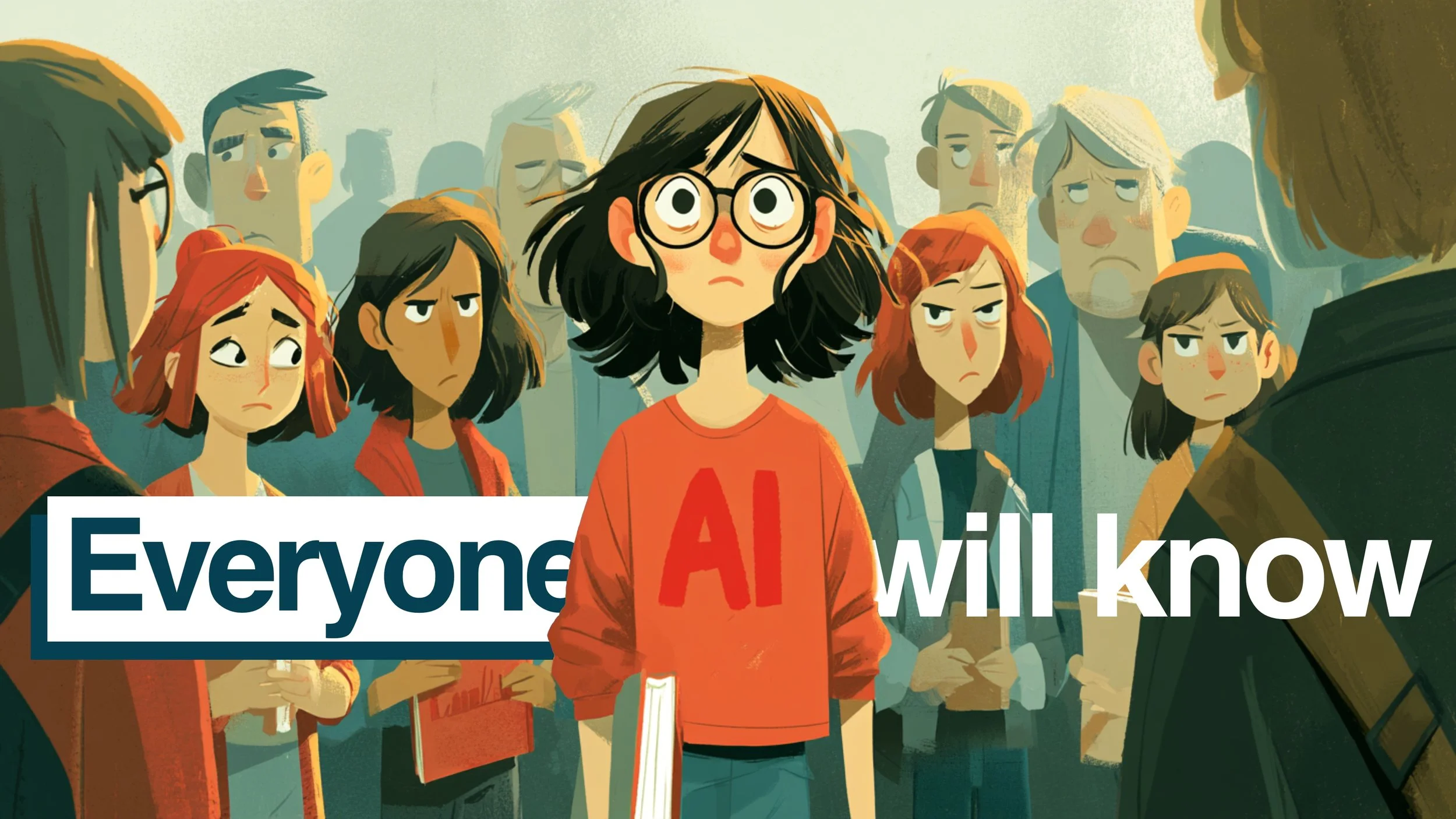
The episode also examines the social machinery already forming around detection — a new generation of accurate AI checkers, disciplinary accusations built on unreliable ones, and what has begun to feel like a scarlet letter for anyone whose prose seems too polished. Meanwhile, AI's ambient influence — autocomplete, search summaries, grammar tools — has touched nearly everything since late 2022. The binary of "AI-written" versus "clean" may already be a fiction.
So we proposed a reframe borrowed from four years of hard-won lessons in education: stop asking did they use AI and start asking what was the process, what was the intent, and was there care? Did the writer put more into the work than they're asking of the reader?
And then, because this is Modem Futura, we let the question spiral outward: if reading and writing can be cognitively offloaded, were they ever permanent features of being human — or one tipping point among many, with another on the horizon?
Subscribe and Connect!
Subscribe to Modem Futura wherever you get your podcasts and connect with us on LinkedIn. Drop a comment, pose a question, or challenge an idea—because the future isn’t something we watch happen, it’s something we build together. The medium may still be the massage, but we all have a hand in shaping how it touches tomorrow.
🎧 Apple Podcast: https://apple.co/4y5V2p4
🎧 Spotify: https://open.spotify.com/episode/2AcgH72mbqjr3vsMA5qI43?si=Ic8Y7liLTe2wT6HSA4sS9A
📺 YouTube: https://youtu.be/o-me74i-8Mg
🌐 Website: https://www.modemfutura.com/
When the Machine Judges the Writing: AI, Voice, and the Mic Drop Problem
What does AI think good writing looks like? An experiment pitting an AI-written academic paper against a human-edited version reveals the strange style machines are teaching us — and raises urgent questions about voice, agency, and who we become alongside these tools.
What does artificial intelligence think good writing looks like? On Episode 97 of Modem Futura, Andrew Maynard and I stumbled into an unexpectedly revealing answer.
The setup was simple. Andrew — a career writer and academic — had an AI write a paper extending his own research. Then he did something most people never do: he spent days rewriting it, line by line, in his own voice. Two papers, same ideas, anonymized as "Rabbit" and "Marmoset," fed back to multiple AI systems with one question. Which is better?
The machines chose the machine's. And their reasoning exposed something worth sitting with: the human version had "too much throat clearing," they said. It over-explained. It lacked a mic drop moment at the end of every paragraph.
Every experienced storyteller knows why that's backwards. Big moments land because they're scarce — the spiciest ingredient in the dish, ruinous by the jarful. In the episode we reach for the shepherd's tone, a sonic illusion of perpetually rising crescendo that never resolves. Thrilling in a Hans Zimmer score. Exhausting as a philosophy of prose. And yet this may be exactly the style AI systems are teaching a generation of writers to consider good.
The conversation builds from Jaron Lanier's argument that there is no AI — that these systems are better understood as the collective work of humans wearing a mask. That reframing relocates the real risk. It was never machine sentience; it's humans diminishing ourselves to make the technology look magical. Taking the easy button so often the muscle memory fades. Adopting a borrowed voice because the machine insists it's the correct one.
The stakes sharpen when you think about who comes next. An expert can call out cargo-cult prose — writing that goes through the motions of quality without the understanding underneath. But writers still forming their voices may simply absorb the template. We may be training systems that train people to write in a style that was conventional decades ago, built on proxies for quality rather than the thing itself.
None of this is a case against the tools. The same episode includes moments where AI writing genuinely shines. The question — the one worth carrying out of the conversation — is about agency: whether these systems amplify your voice or quietly replace it. Because reading is a human act, writing is storytelling, and the future should contain your voice.
Subscribe and Connect!
Subscribe to Modem Futura wherever you get your podcasts and connect with us on LinkedIn. Drop a comment, pose a question, or challenge an idea—because the future isn’t something we watch happen, it’s something we build together. The medium may still be the massage, but we all have a hand in shaping how it touches tomorrow.
🎧 Apple Podcast: https://apple.co/4hts5yg
🎧 Spotify: https://open.spotify.com/episode/4SiEIiufaVTnKYwqJUIhRv?si=L_hGb0T4QrCatDr_fGOymA
📺 YouTube: https://youtu.be/z0aH53vS4mM
🌐 Website: https://www.modemfutura.com/