

NEWS & UPDATES
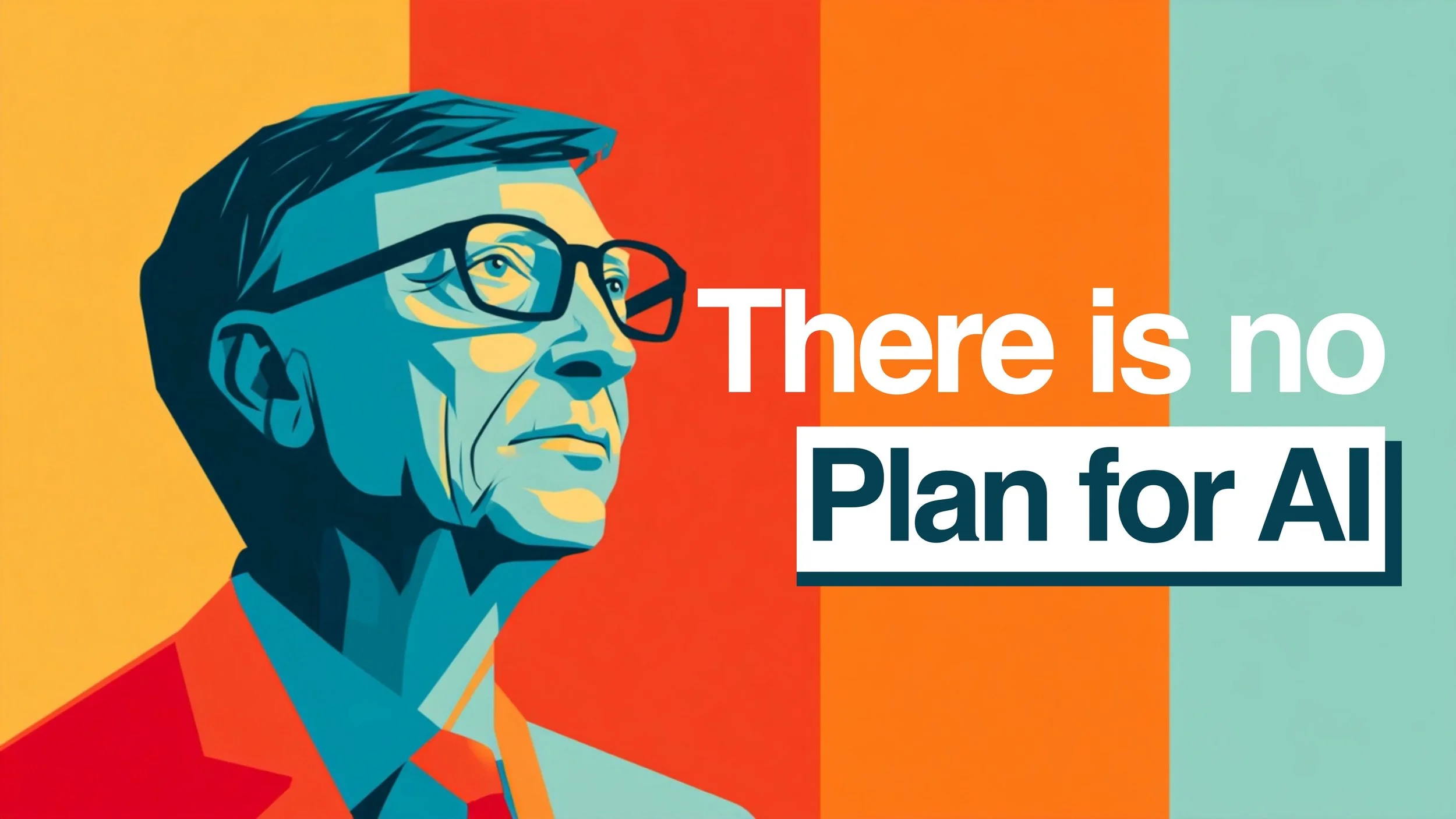
Bill Gates Says There's No Plan for AI. He's Right — and That's the Point
Bill Gates's "turbulent AI era" essay warns that society has no plan for AI. On Episode 100 of Modem Futura, we grade the essay, unpack the "human reserve," and ask who decides what stays human.
It's becoming a genre unto itself: the billionaire AI manifesto. But when Bill Gates published his nearly 6,000-word essay "The turbulent AI era is here. The choices we make now are critical" in August 2026, something about it landed differently. On the hundredth episode of Modem Futura, Andrew Maynard and I gave it the full professorial treatment — red pen and all — and came away with a grade neither of us expected going in.
Gates organizes his warning around three risks. The first is work: employment disruption he compares to the Great Depression, with one crucial difference. Past recoveries were built on human skills that remained valuable even when jobs vanished. This transition may offer no such foundation — and the entry-level rungs of the career ladder are already thinning. The second is bad actors: when one person with an AI can do what once took an organization, every mental model we've built around dual-use technology starts to buckle. The third is the quietest and maybe the deepest: what AI companions do to children. Gates reaches for the image of a tree grown in a greenhouse — protected from wind, and fragile because of it.
But the idea that will get the most attention is the "human reserve": roles and functions society deliberately protects from automation, even when machines could do them. Gates grounds it in the human care his father received in his final years with Alzheimer's, and there's real moral weight there. There's also a shadow. Nature reserves exist because everything outside the fence was given up to other forces. Is a human reserve preservation — or surrender dressed as stewardship?
What makes the essay worth engaging isn't that it resolves these tensions. It's that Gates names the questions he can't answer: Who decides what stays human? By what criteria? What happens when one country protects and another automates? Those questions are the real work — and they're the work that futurists, foresight practitioners, and researchers have been doing for decades, waiting for the rest of the world to catch up.
The window for shaping this transition is open now. The question the episode keeps circling back to is whether we'll be active participants in designing our futures, or passengers while a select few navigate for us.
Listen to the full conversation on Modem Futura, wherever you get your podcasts.
Subscribe and Connect!
Subscribe to Modem Futura wherever you get your podcasts and connect with us on LinkedIn. Drop a comment, pose a question, or challenge an idea—because the future isn’t something we watch happen, it’s something we build together. The medium may still be the massage, but we all have a hand in shaping how it touches tomorrow.
🎧 Apple Podcast: https://apple.co/4yk1zwp
🎧 Spotify: https://open.spotify.com/episode/1WaE39Jog0Qh1Yv6Z37UyJ?si=l0d5IyhXQYmcvY8UEb7dcw
📺 YouTube: https://youtu.be/ox5FGgqvNQE
🌐 Website: https://www.modemfutura.com/
When the AI Goes Dark: What the Fable Ban Taught Us About Digital Fragility
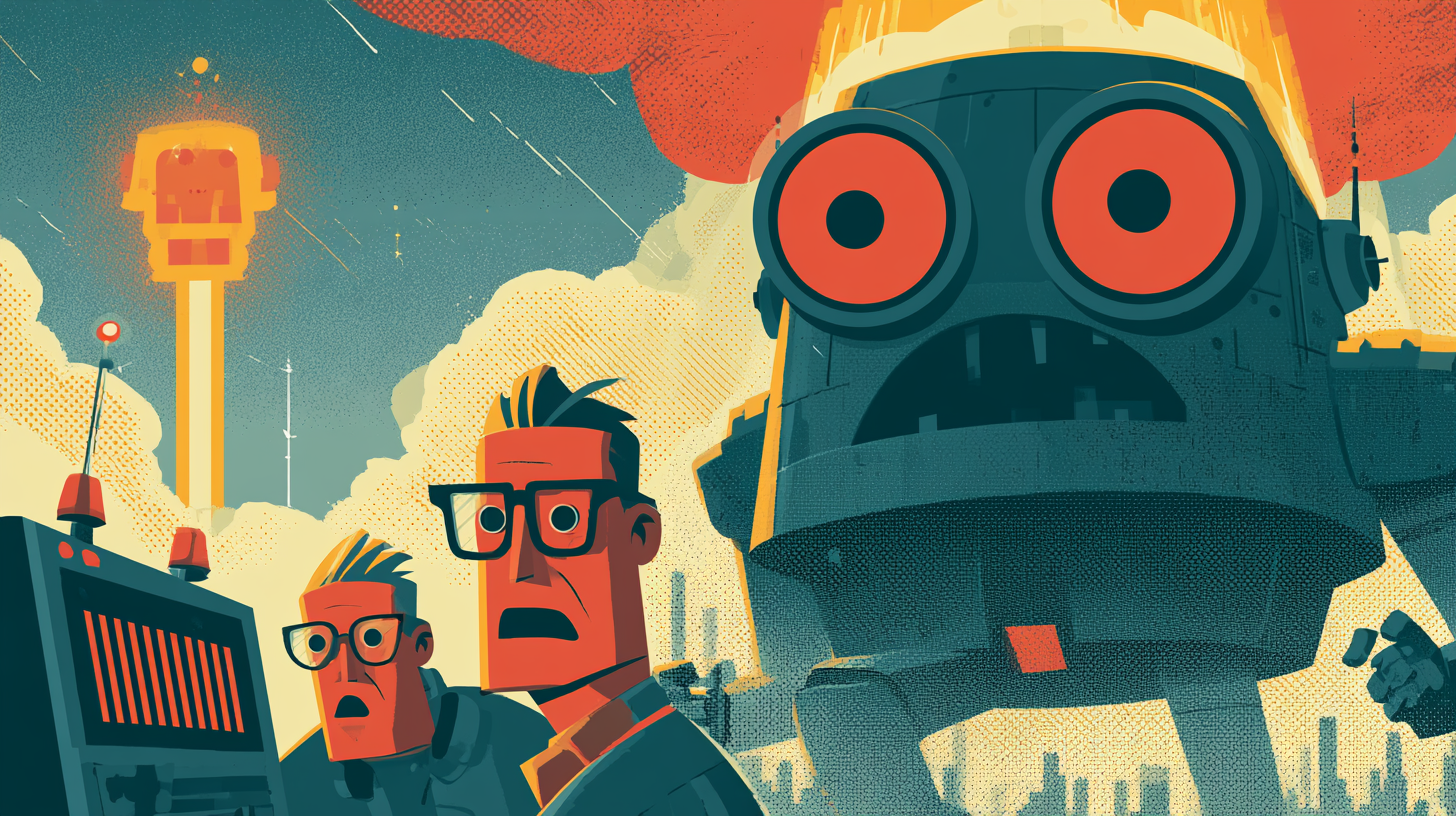
They turned off our AI - now what?
What happens when the government switches off an AI?
For most people, AI is a text field in a browser window: you type something in, something useful comes out. That framing makes it hard to see what AI has quietly become for organizations across research, healthcare, education, and industry, all critical infrastructure. And in the summer of 2026, we learned just how fragile that infrastructure can be.
In this episode of Modem Futura, hosts Sean Leahy and Andrew Maynard unpack the saga of Anthropic's Fable, the most capable AI model yet released to the public. Three days after launch, a U.S. Commerce Department export control directive declared it a national security concern, barring access for non-U.S. citizens. Because no platform can verify the citizenship of its users, the model effectively disappeared for everyone — including the researchers inside Anthropic who built it. Weeks later, it returned as suddenly as it left.
The episode treats this less as a news story than as a signal. Futurists have long used sudden technology loss as a hypothetical scenario; like the pandemic scenarios that preceded 2020, it has now crossed from the abstract to the lived. Once that happens, the questions change, if a government can switch off a frontier model at the close of business on a Friday, what does responsible AI adoption look like for a hospital, a university, a business? Where is the line between experimenting on the fringes and building your operations on ground that can move?
One answer explored in the conversation is local AI — smaller models running on hardware you control. They can't match the capability of cloud-based frontier systems (yet) and the hosts are honest about that trade-off. But the Fable episode gave the local argument its first piece of hard evidence, and it may point toward a future of hyper-specific local tools working alongside more powerful, more revocable cloud platforms.
The deeper thread is governance, and even the invocation of the big R-word (regulation). The directive was triggered by capability that regulators had never seen before, and capability is not slowing down. Governing technologies like these will take more than technologists and more than policymakers — it requires people who can work across disciplines, translating between the builders, the philosophers now being hired into AI labs, and the institutions trying to keep up.
The episode doesn't land on tidy answers, because there aren't any yet. What it offers instead is a way of thinking about dependency, sovereignty, and resilience while the ground is still shifting — which is, after all, when thinking matters most.
Subscribe and Connect!
Subscribe to Modem Futura wherever you get your podcasts and connect with us on LinkedIn. Drop a comment, pose a question, or challenge an idea—because the future isn’t something we watch happen, it’s something we build together. The medium may still be the massage, but we all have a hand in shaping how it touches tomorrow.
🎧 Apple Podcast: https://apple.co/4ykQCez
🎧 Spotify: https://open.spotify.com/episode/1yCGEa1nafYu9CM4Mxux5Z?si=jPTtglvnRGW_qHtXqPbFvA
📺 YouTube: https://youtu.be/7ir38k4DjLA
🌐 Website: https://www.modemfutura.com/

Atlas, Higher Education, and How We Really Feel About AI – Episode 55

Generated by ChatGPT
How We Really Feel About AI
Artificial intelligence isn’t just reshaping industries—it’s reshaping emotions. In our latest episode of Modem Futura, Andrew Maynard and I unpack Pew Research Center’s new international survey on how people view AI across 25 countries. The results are striking: while AI dominates headlines, 61 percent of respondents have heard “little or nothing” about it—and in the U.S., more people are concerned than excited.
We explore what this says about the bubbles we all inhabit. In our professional worlds, AI feels inescapable—a “black hole” pulling every conversation toward it. But outside these circles, many remain unaware of how deeply algorithmic systems already shape their lives. This disconnect raises profound questions about agency: if people don’t understand a technology that governs so much of modern life, who’s really steering the future?
The conversation also turns to trust. Europeans report more faith in their governments to regulate AI responsibly than Americans do—a difference that mirrors the EU’s proactive stance on ethics and guardrails. In contrast, U.S. policy remains fragmented, driven more by economic competition than by social cohesion. That tension—between speed and safety, innovation and inclusion—is at the heart of our discussion.
Dangers of Atlas (it's more the world he's holing... its all of your data!)
We then zoom in on universities. As public institutions, we argue they must act as transparent laboratories for AI exploration—spaces where successes and failures alike can be shared openly. The path forward isn’t boosterism; it’s honesty. We can’t earn public trust without showing our messy work. Adding to this - we explore OpenAI’s newly released Atlas browser and its privacy implications - and stumble upon a very shocking realization while recording - that private student data is easily exfiltrated when using LMS platforms such as Canvas while in this browser. What started as a curious road test of OpenAI’s new Atlas browser turned into a genuinely alarming discovery. As we installed and explored Atlas, the first surprise was how quickly the “privacy” pitch unraveled. Despite promising user control, Atlas behaved much like any other data-hungry app—prompting unusual permissions and positioning itself between us and the open web. That sparked a bigger question: if your browser is the main keyhole to the internet, what happens when an AI system sits in the keyhole, quietly learning from everything you do? (including sending and processing private user data - think ANYTHING that comes and goes from your activity on the web). The situation quickly got worse as I was unable to get Atlas to show me any particular websites security certificate. Specifically, at the time of testing (I hope they patch this soon) I could not see the sites SSL/TSL or HTTPS certificate (this is the little lock icon in most browser URL's) that tells you and the browser that your connection to the sites servers are "safe" via web-standard encryption protocols. You know, for things like your bank account info, passwords, and any other data you want to send or receive. The takeaway? Treat ATLAS like a red hot security hole for you and any organization or persons connected to you via the internet. Think twice before using this browser - as EVERYTHING you do on the web is potentially egress'd (fancy word for taken) – so until there are transparent safegaurds in place, the safest assumption is that anything you open in an AI browser like Atlas could be seen, summarized, and stored beyond your intent.
And because no Modem Futura episode is complete without a bit of speculative play, we end with Futures Improv, where we imagine AI zombies, memory economies, and spaghettified timelines—all to remind ourselves that foresight and humor often travel hand in hand.
If you care about how humanity and technology co-evolve, this episode offers a grounded yet playful map of where we stand—and where we might go next.
Subscribe and Connect!
Subscribe to Modem Futura wherever you get your podcasts and connect with us on LinkedIn. Drop a comment, pose a question, or challenge an idea—because the future isn’t something we watch happen, it’s something we build together. The medium may still be the massage, but we all have a hand in shaping how it touches tomorrow.
🎧 Apple Podcast: https://apple.co/4nuRsit
🎧 Spotify: https://open.spotify.com/episode/04NLQcVfJpoM444bQQfQ42?si=b9adf3740a0944fe
📺 YouTube: https://youtu.be/tYoLRZH5iH8
🌐 Website: https://www.modemfutura.com/