

NEWS & UPDATES

When the AI Goes Dark: What the Fable Ban Taught Us About Digital Fragility
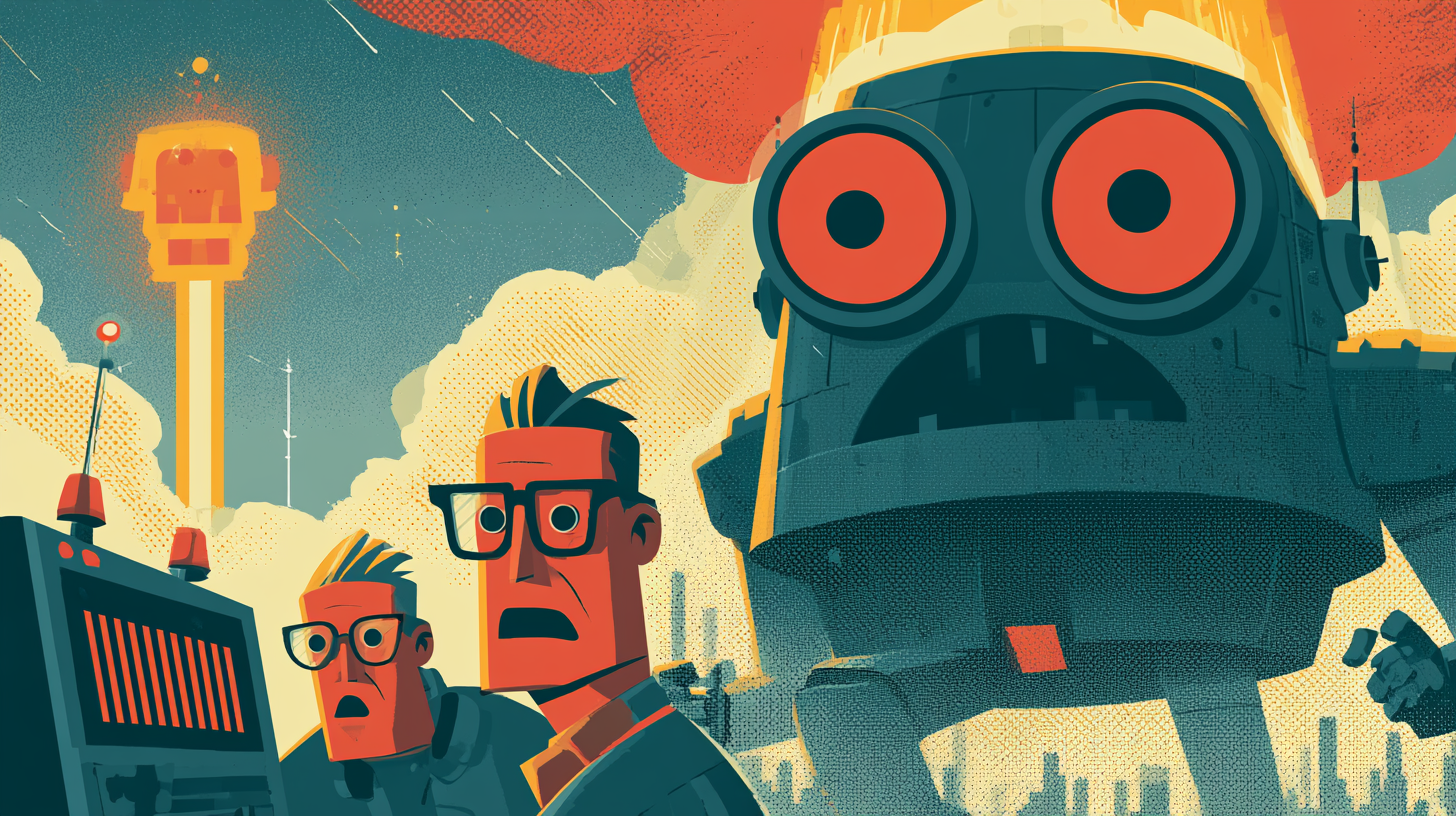
They turned off our AI - now what?
What happens when the government switches off an AI?
For most people, AI is a text field in a browser window: you type something in, something useful comes out. That framing makes it hard to see what AI has quietly become for organizations across research, healthcare, education, and industry, all critical infrastructure. And in the summer of 2026, we learned just how fragile that infrastructure can be.
In this episode of Modem Futura, hosts Sean Leahy and Andrew Maynard unpack the saga of Anthropic's Fable, the most capable AI model yet released to the public. Three days after launch, a U.S. Commerce Department export control directive declared it a national security concern, barring access for non-U.S. citizens. Because no platform can verify the citizenship of its users, the model effectively disappeared for everyone — including the researchers inside Anthropic who built it. Weeks later, it returned as suddenly as it left.
The episode treats this less as a news story than as a signal. Futurists have long used sudden technology loss as a hypothetical scenario; like the pandemic scenarios that preceded 2020, it has now crossed from the abstract to the lived. Once that happens, the questions change, if a government can switch off a frontier model at the close of business on a Friday, what does responsible AI adoption look like for a hospital, a university, a business? Where is the line between experimenting on the fringes and building your operations on ground that can move?
One answer explored in the conversation is local AI — smaller models running on hardware you control. They can't match the capability of cloud-based frontier systems (yet) and the hosts are honest about that trade-off. But the Fable episode gave the local argument its first piece of hard evidence, and it may point toward a future of hyper-specific local tools working alongside more powerful, more revocable cloud platforms.
The deeper thread is governance, and even the invocation of the big R-word (regulation). The directive was triggered by capability that regulators had never seen before, and capability is not slowing down. Governing technologies like these will take more than technologists and more than policymakers — it requires people who can work across disciplines, translating between the builders, the philosophers now being hired into AI labs, and the institutions trying to keep up.
The episode doesn't land on tidy answers, because there aren't any yet. What it offers instead is a way of thinking about dependency, sovereignty, and resilience while the ground is still shifting — which is, after all, when thinking matters most.
Subscribe and Connect!
Subscribe to Modem Futura wherever you get your podcasts and connect with us on LinkedIn. Drop a comment, pose a question, or challenge an idea—because the future isn’t something we watch happen, it’s something we build together. The medium may still be the massage, but we all have a hand in shaping how it touches tomorrow.
🎧 Apple Podcast: https://apple.co/4ykQCez
🎧 Spotify: https://open.spotify.com/episode/1yCGEa1nafYu9CM4Mxux5Z?si=jPTtglvnRGW_qHtXqPbFvA
📺 YouTube: https://youtu.be/7ir38k4DjLA
🌐 Website: https://www.modemfutura.com/

The Jagged Frontier: Reading the 2026 Stanford AI Index

Every year, Stanford's Human-Centered AI Institute releases its AI Index — a careful, voluminous attempt to map where artificial intelligence actually stands. The 2026 edition, just released, runs over 400 pages. On the newest episode of Modem Futura, Sean Leahy and Andrew Maynard work their way through its top takeaways and sit with what the data is — and isn't — telling us.
The report opens on a striking juxtaposition. Today's frontier AI models can win gold medals at the International Mathematical Olympiad, yet still stumble on tasks as ordinary as reading an analog clock. Stanford's researchers call this the jagged frontier of AI — and it's more than a quirk. It's a reminder that these systems are not human intelligences being perfected. They are something structurally different, with capabilities and failure modes that don't map neatly onto ours. The interesting question isn't how close AI gets to human thinking. It's what becomes possible when we stop asking it to.
A second thread running through the 2026 Index is the lag in responsible AI. Safety benchmarks are falling behind capability. Incidents are rising. And, as Maynard points out in the episode, the conversation keeps collapsing “responsible” AI into “ethical” AI — two related but meaningfully different things. Ethics gives us the framing. Responsibility asks us to make real, pragmatic, often messy decisions about value, trade-offs, and whose futures we're building toward.
The education findings are equally hard to look away from. Over 80% of students are now using AI for school-related tasks, yet only half of middle and high schools have AI policies in place — and just 6% of teachers describe those policies as clear. Learning is happening. Institutional support is not yet meeting it.
Other findings threaded through the conversation: the closing US–China model performance gap, the fragile TSMC chokepoint at the center of global AI supply chains, and the fifty-point perception gap between AI experts and the public. Each opens a different kind of question about how this technology is being built, distributed, and absorbed.
None of these tensions resolve cleanly — and that's part of what makes the Index valuable. It gives us a shared map for a landscape that keeps shifting under our feet.
📘 Read the 2026 AI Index: https://hai.stanford.edu
Subscribe and Connect!
Subscribe to Modem Futura wherever you get your podcasts and connect with us on LinkedIn. Drop a comment, pose a question, or challenge an idea—because the future isn’t something we watch happen, it’s something we build together. The medium may still be the massage, but we all have a hand in shaping how it touches tomorrow.
🎧 Apple Podcast: https://apple.co/3QxxQiZ
🎧 Spotify: https://open.spotify.com/episode/0bTUTHRsLWedLuYbLOiz3j?si=I8j0ahK8RBeXPIhVqqM9tw
📺 YouTube: https://youtu.be/xnCWMLJ_hsA
🌐 Website: https://www.modemfutura.com/