

NEWS & UPDATES

When the AI Goes Dark: What the Fable Ban Taught Us About Digital Fragility
They turned off our AI - now what?
What happens when the government switches off an AI?
For most people, AI is a text field in a browser window: you type something in, something useful comes out. That framing makes it hard to see what AI has quietly become for organizations across research, healthcare, education, and industry, all critical infrastructure. And in the summer of 2026, we learned just how fragile that infrastructure can be.
In this episode of Modem Futura, hosts Sean Leahy and Andrew Maynard unpack the saga of Anthropic's Fable, the most capable AI model yet released to the public. Three days after launch, a U.S. Commerce Department export control directive declared it a national security concern, barring access for non-U.S. citizens. Because no platform can verify the citizenship of its users, the model effectively disappeared for everyone — including the researchers inside Anthropic who built it. Weeks later, it returned as suddenly as it left.
The episode treats this less as a news story than as a signal. Futurists have long used sudden technology loss as a hypothetical scenario; like the pandemic scenarios that preceded 2020, it has now crossed from the abstract to the lived. Once that happens, the questions change, if a government can switch off a frontier model at the close of business on a Friday, what does responsible AI adoption look like for a hospital, a university, a business? Where is the line between experimenting on the fringes and building your operations on ground that can move?
One answer explored in the conversation is local AI — smaller models running on hardware you control. They can't match the capability of cloud-based frontier systems (yet) and the hosts are honest about that trade-off. But the Fable episode gave the local argument its first piece of hard evidence, and it may point toward a future of hyper-specific local tools working alongside more powerful, more revocable cloud platforms.
The deeper thread is governance, and even the invocation of the big R-word (regulation). The directive was triggered by capability that regulators had never seen before, and capability is not slowing down. Governing technologies like these will take more than technologists and more than policymakers — it requires people who can work across disciplines, translating between the builders, the philosophers now being hired into AI labs, and the institutions trying to keep up.
The episode doesn't land on tidy answers, because there aren't any yet. What it offers instead is a way of thinking about dependency, sovereignty, and resilience while the ground is still shifting — which is, after all, when thinking matters most.
Subscribe and Connect!
Subscribe to Modem Futura wherever you get your podcasts and connect with us on LinkedIn. Drop a comment, pose a question, or challenge an idea—because the future isn’t something we watch happen, it’s something we build together. The medium may still be the massage, but we all have a hand in shaping how it touches tomorrow.
🎧 Apple Podcast: https://apple.co/4ykQCez
🎧 Spotify: https://open.spotify.com/episode/1yCGEa1nafYu9CM4Mxux5Z?si=jPTtglvnRGW_qHtXqPbFvA
📺 YouTube: https://youtu.be/7ir38k4DjLA
🌐 Website: https://www.modemfutura.com/

Summer Reading for Futures Thinkers: Part Two of the Modem Futura List
What makes a book worth your summer? On the concluding half of our annual summer reading list, an answer kept surfacing: the best stories are the ones that don't end when you finish them — the ones that plant an idea you can't shake, and that keeps growing into something uniquely yours.
Part two of the list ranges well beyond the cyberpunk canon we explored in part one. Andrew Maynard opens with Terry Pratchett's Unseen Academicals, a satire of university life so accurate that anyone who has worked in academia will cringe in recognition — and one that connects, unexpectedly, to our recent conversation about enshittification: where does the true value proposition of our institutions actually live? His bonus pick, Pratchett's often-overlooked Bromeliad trilogy, is a reminder that the best children's books are age-agnostic.
Sean breaks the pattern entirely with Henri Cartier-Bresson's The Decisive Moment — the landmark photography collection, still available through the Fondation Henri Cartier-Bresson in Paris. It sparks a meditation on analog intentionality: how portable cameras created street photography, why a single frame can hold an entire technological era, and the idea that every photograph has two subjects — the one in the frame, and the one behind the camera.
Time travel threads through the middle of the list. Connie Willis's Blackout and All Clear are historical novels wearing the lightest science fiction overlay, following future academics who live through the London Blitz. And La Jetée, Chris Marker's 1962 short film told almost entirely in still photographs, proves that sixteen minutes and a compelling idea can seed decades of storytelling — you can trace its time-loop DNA through much of what we watch today.
The lighter fare earns its place too: Mick Herron's Slow Horses novels (arguably better than the acclaimed series they inspired), the full-cast Harry Potter audio dramatizations, and a return to Silo ahead of its new season. Two friends-and-family picks round things out: Riz Virk's The Simulation Hypothesis and AI and the Art of Being Human by Jeffrey Abbott and Andrew Maynard — a deliberately agnostic, tools-based guide to navigating AI with intentionality and care, whether you approach the technology with enthusiasm or deep unease.
Subscribe and Connect!
Subscribe to Modem Futura wherever you get your podcasts and connect with us on LinkedIn. Drop a comment, pose a question, or challenge an idea—because the future isn’t something we watch happen, it’s something we build together. The medium may still be the massage, but we all have a hand in shaping how it touches tomorrow.
🎧 Apple Podcast: https://apple.co/4vdP3wf
🎧 Spotify: https://open.spotify.com/episode/1X4nEJUORnt4Txs73mGNeY?si=dB8iH1scSq6rQcwsZgoCnw
📺 YouTube: https://youtu.be/JHSHtAkTKvk
🌐 Website: https://www.modemfutura.com/

The Quiet Convergence: Reading the WEF's 2026 Emerging Technologies List

Every year, the World Economic Forum releases its Top 10 Emerging Technologies report — and every year it offers something more useful than a list of gadgets. It offers a read on where the genuine cutting edge is maturing: not the technologies dominating the news cycle, but the ones that have quietly reached the point where companies are investing, where the science has left the lab, where impact is becoming plausible.
This year's list is worth sitting with, and not only for the individual entries. Read together, the 2026 technologies tell a story about convergence.
An energy backbone. Three of the ten cluster around power: everything-to-grid systems that reimagine every building, vehicle, and device as an active participant in a distributed energy network; passive radiative cooling materials that release absorbed heat through a narrow band of infrared that escapes the atmosphere; and direct lithium extraction that addresses the supply bottleneck underneath nearly all modern electronics. None is flashy. All are foundational.
A biological turn. The middle of the list grows intimate. PFAS destruction tackles the "forever chemicals" we engineered to be indestructible — a vivid case study in how today's challenges are so often yesterday's innovations. Precision fermentation turns engineered microbes into microscopic factories for food, medicine, and materials. Exosome drug delivery and personalized mRNA cancer vaccines point toward medicine tailored to an individual genome — in some early trials, transforming survival odds for cancers long considered nearly untreatable.
A compute layer. Underneath runs the quiet infrastructure. Quantum simulation can model molecular interactions that classical computers find effectively impossible, opening once-"undruggable" diseases to discovery. AI world models aim to give machines an intuitive grasp of physical reality — learning through experience, the way a child learns gravity long before learning physics. And lattice-based cryptography hardens our data today against the quantum computers we expect tomorrow.
What makes the list compelling is how readily these pieces combine. Chain the biological and computational threads together and you approach something genuinely science-fictional: scan, model, fabricate, deliver. But convergence cuts both ways. Every capability here carries second- and third-order implications — questions of accountability when machines do the engineering, of unintended consequences when powerful tools meet messy human systems, of who shapes a world that artificial systems increasingly understand on their own terms.
Grab a copy of the full report directly from the World Economic Forum:

The honest takeaway isn't a prediction. It's an invitation to pay attention: to read the report, follow these technologies as they move, and ask not only what they make possible, but what kind of future they quietly assume.
Subscribe and Connect!
Subscribe to Modem Futura wherever you get your podcasts and connect with us on LinkedIn. Drop a comment, pose a question, or challenge an idea—because the future isn’t something we watch happen, it’s something we build together. The medium may still be the massage, but we all have a hand in shaping how it touches tomorrow.
🎧 Apple Podcast: https://apple.co/4w3oU4b
🎧 Spotify: https://open.spotify.com/episode/1G17Ta9RvnhPy1Ykrk5M3Y?si=LRMbrXArToas5rMcQF4XLA
📺 YouTube: https://youtu.be/Z1cJ-0OD_FM
🌐 Website: https://www.modemfutura.com/

What an AI Hallucination Tells Us About First Contact

There's a thought experiment that keeps surfacing in futures work, and it goes something like this: if a genuinely alien mind tried to communicate with us, would we recognize the signal, or would we just call it noise?
On the latest episode of Modem Futura, we play another round of Futures Improv — a format where an AI-generated scenario lands cold on the table and the two of us have to think our way through what it might mean. This time the scenarios kept pulling us back to one question: what counts as a mind, and what do we do with the ones we don't recognize?
The first scenario — a riff on Stanislaw Lem's Solaris — imagines first contact with a moon-sized organism that communicates only by generating vivid hallucinations inside our astronauts, drawn from their own repressed memories. It isn't hostile or friendly. It may not even know we exist as separate beings. The premise sounds outlandish until you notice that we already struggle to have a real conversation with an octopus.
The second scenario hands humanity a single question to ask a time traveler from the year 8,002,701, who carries one piece of verified information — humanity survived — and a sad expression. What do you ask, and what do you deliberately choose not to ask? It's a thought experiment about scarcity, priorities, and the difference between surviving and flourishing.
The third — the one that sticks with you — imagines a service that backs up your consciousness to the cloud every night while you sleep. Ten years in, the backups begin to diverge. They dream differently than you do. Who, then, has the right to your name, your relationships, your sense of self? And the question that arrives quietly behind it: how would you know you weren't the backup already?
None of these scenarios resolve, and that's the point. Futures Improv isn't about predicting which of these worlds will arrive. It's about practicing the kind of imaginative attention we'll need for the technologies that already are — embodied AI, longevity research, neural interfaces, the slow erosion of the line between physical and digital selves.
The conversations get weird. Occasionally they get genuinely strange. And sometimes, in the middle of joking about Elon Musk being reconstituted as a banana, we land on something serious about what it means to be human in an age that keeps redrawing the edges of mind.
🎧 Listen to the full episode wherever you get your podcasts, or watch on YouTube.
Subscribe and Connect!
Subscribe to Modem Futura wherever you get your podcasts and connect with us on LinkedIn. Drop a comment, pose a question, or challenge an idea—because the future isn’t something we watch happen, it’s something we build together. The medium may still be the massage, but we all have a hand in shaping how it touches tomorrow.
🎧 Apple Podcast: https://apple.co/4vodLdY
🎧 Spotify: https://open.spotify.com/episode/1242zwOf2ZsHgpN1UnF5OM?si=dLiVkWUjTv2f-XdAHS8x3A
📺 YouTube: https://youtu.be/4vCILufh2RU
🌐 Website: https://www.modemfutura.com/

The Jagged Frontier: Reading the 2026 Stanford AI Index

Every year, Stanford's Human-Centered AI Institute releases its AI Index — a careful, voluminous attempt to map where artificial intelligence actually stands. The 2026 edition, just released, runs over 400 pages. On the newest episode of Modem Futura, Sean Leahy and Andrew Maynard work their way through its top takeaways and sit with what the data is — and isn't — telling us.
The report opens on a striking juxtaposition. Today's frontier AI models can win gold medals at the International Mathematical Olympiad, yet still stumble on tasks as ordinary as reading an analog clock. Stanford's researchers call this the jagged frontier of AI — and it's more than a quirk. It's a reminder that these systems are not human intelligences being perfected. They are something structurally different, with capabilities and failure modes that don't map neatly onto ours. The interesting question isn't how close AI gets to human thinking. It's what becomes possible when we stop asking it to.
A second thread running through the 2026 Index is the lag in responsible AI. Safety benchmarks are falling behind capability. Incidents are rising. And, as Maynard points out in the episode, the conversation keeps collapsing “responsible” AI into “ethical” AI — two related but meaningfully different things. Ethics gives us the framing. Responsibility asks us to make real, pragmatic, often messy decisions about value, trade-offs, and whose futures we're building toward.
The education findings are equally hard to look away from. Over 80% of students are now using AI for school-related tasks, yet only half of middle and high schools have AI policies in place — and just 6% of teachers describe those policies as clear. Learning is happening. Institutional support is not yet meeting it.
Other findings threaded through the conversation: the closing US–China model performance gap, the fragile TSMC chokepoint at the center of global AI supply chains, and the fifty-point perception gap between AI experts and the public. Each opens a different kind of question about how this technology is being built, distributed, and absorbed.
None of these tensions resolve cleanly — and that's part of what makes the Index valuable. It gives us a shared map for a landscape that keeps shifting under our feet.
📘 Read the 2026 AI Index: https://hai.stanford.edu
Subscribe and Connect!
Subscribe to Modem Futura wherever you get your podcasts and connect with us on LinkedIn. Drop a comment, pose a question, or challenge an idea—because the future isn’t something we watch happen, it’s something we build together. The medium may still be the massage, but we all have a hand in shaping how it touches tomorrow.
🎧 Apple Podcast: https://apple.co/3QxxQiZ
🎧 Spotify: https://open.spotify.com/episode/0bTUTHRsLWedLuYbLOiz3j?si=I8j0ahK8RBeXPIhVqqM9tw
📺 YouTube: https://youtu.be/xnCWMLJ_hsA
🌐 Website: https://www.modemfutura.com/

Thriving with AI: Two Futures Thinking Tools for Navigating Uncertainty
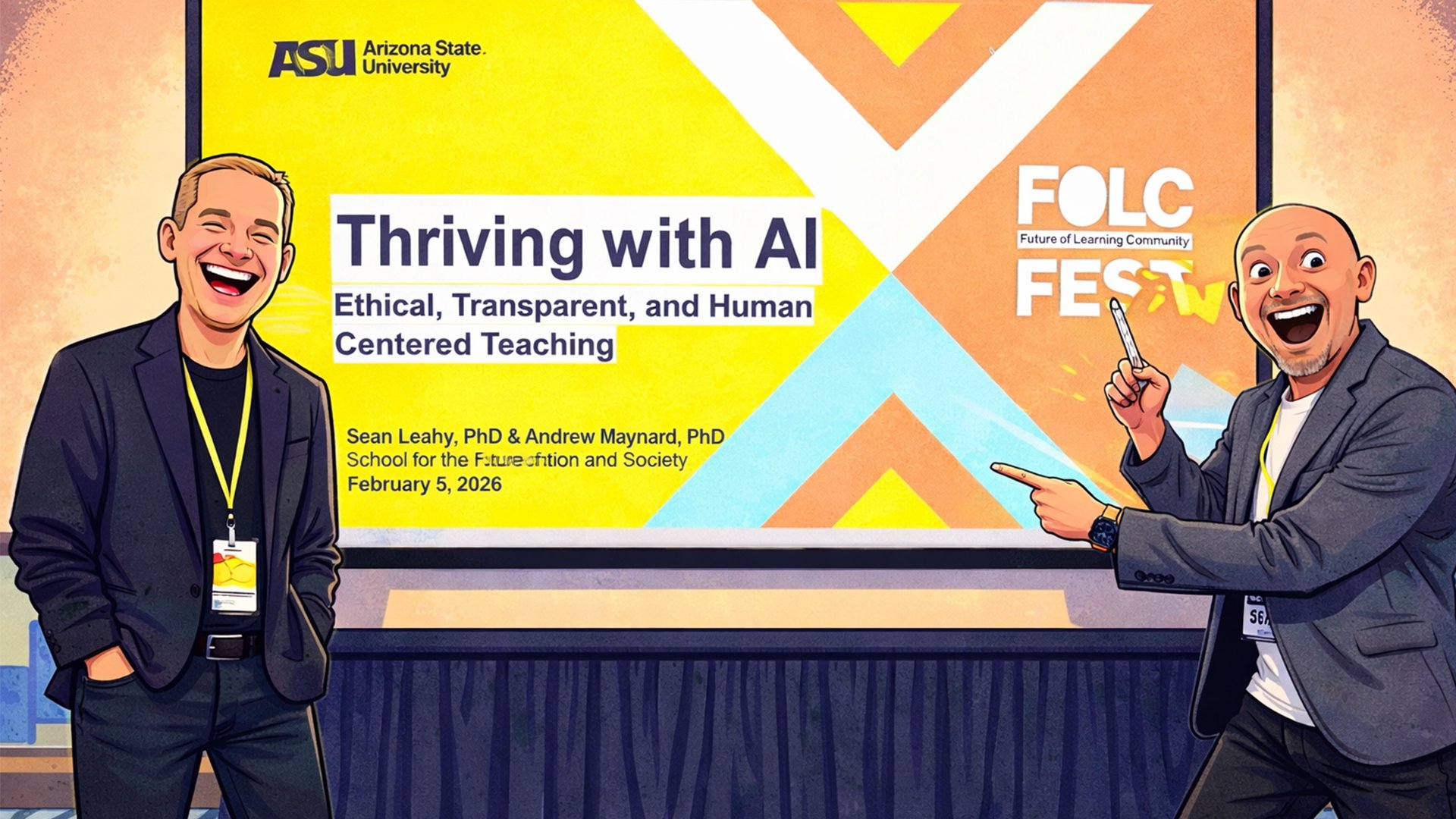
The question is no longer whether AI will reshape education. It already has. The more interesting question — and the harder one — is how educators, leaders, and institutions can navigate that transformation with clarity, purpose, and agency.
In this episode of Modem Futura, hosts Sean Leahy and Andrew Maynard walk listeners through a workshop they developed for ASU's 2026 Folk Fest titled "Thriving with AI: Ethical, Transparent, and Human-Centered Learning." Rather than demonstrating AI platforms or advocating for a particular stance, the session offers two practical thinking tools designed to help individuals make sense of complexity and make intentional decisions — regardless of where they fall on the AI adoption spectrum.
Foresight Methodologies
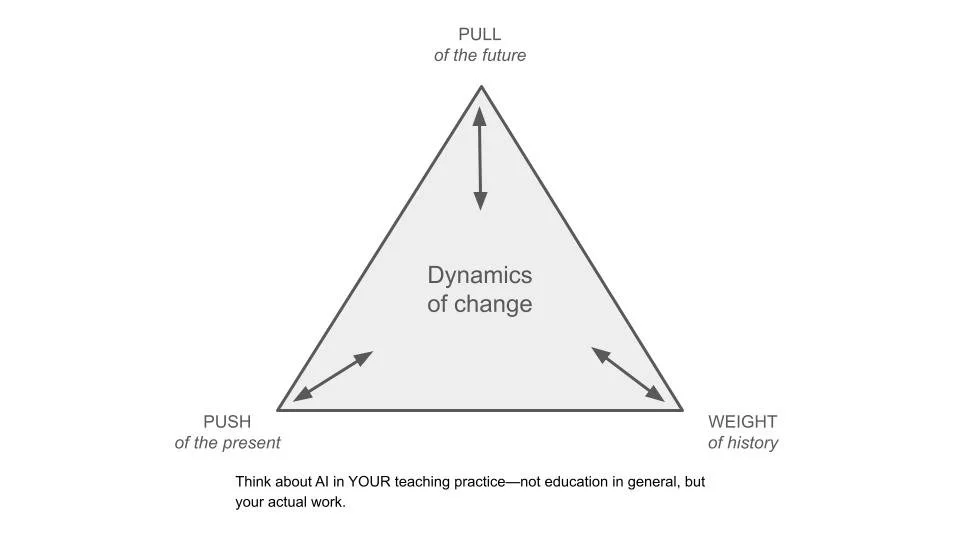
The Futures Triangle, originally developed by futurist Sohail Inayatullah, is a foresight method that maps three forces shaping any change landscape: the pull of the future (emerging visions and possibilities), the push of the present (trends, pressures, and mandates driving change), and the weight of history (the traditions, values, and institutional structures that resist or ground that change). By making these forces visible, individuals and teams can better orient themselves within the dynamics of change rather than simply reacting to them.
The Intent Map, drawn from Jefferey Abbott and Andrew Maynard's book AI and the Art of Being Human, complements the triangle by shifting from orientation to action. A simple two-by-two matrix, it asks users to identify four elements: their core values (what they won't compromise), their desired outcomes (what success looks like), their guardrails (the hard boundaries they won't cross), and their metrics (how they'll know if it's working). Critically, the framework recognizes that metrics don't have to be numerical — sometimes the most meaningful indicators of success are qualitative, like a student who can't stop thinking about what they learned.
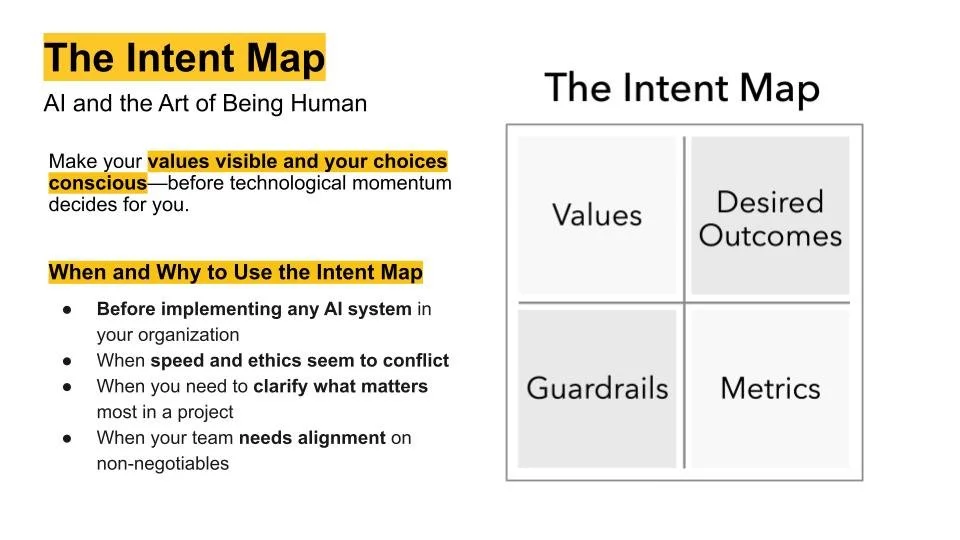
What makes these tools particularly valuable is their accessibility. Both can be sketched on a scrap of paper. Both work for individuals and teams. And both are domain-agnostic — while the episode frames them in the context of education, they apply equally well to organizational strategy, technology adoption, and personal decision-making.
The episode is anchored by two provocative 2035 headlines: one in which AI tutors outperform human teachers and faculty roles come under review, and another in which human-AI partnership produces the most critically thinking generation in history. The question the workshop poses isn't which headline is more likely. It's which one you want — and what intentional choices you need to make to move toward it.
Thriving with AI, as the hosts frame it, isn't about mastering the latest platform. It's about staying awake to what matters.
Subscribe and Connect!
Subscribe to Modem Futura wherever you get your podcasts and connect with us on LinkedIn. Drop a comment, pose a question, or challenge an idea—because the future isn’t something we watch happen, it’s something we build together. The medium may still be the massage, but we all have a hand in shaping how it touches tomorrow.
🎧 Apple Podcast: https://apple.co/3ZXgT2P
🎧 Spotify: https://open.spotify.com/episode/1b1Q0W7YVSGZA2ELYj6g6C?si=wL1sXb-DQsSluBkLYCu9tg
📺 YouTube: https://youtu.be/zi_zvXCt9sY
🌐 Website: https://www.modemfutura.com/

Through the lens: Spatial Computing with Apple Vision Pro – Episode 56

Just a couple of guys wearing nerd helmets and talking about the future of tech.
Inside Spatial Computing: Living (and Working) with Apple Vision Pro
e finally did it — we recorded inside Apple Vision Pro.
In this new episode of Modem Futura, Andrew Maynard and I decided to take spatial computing off the keynote stage and into real life — from multi-monitor workflows and long-haul flights to immersive video, panoramic memories, and even telepresence “personas.” We wanted to know: is this the start of a new computing era, or simply a beautiful distraction in search of a use case?
What we discovered surprised us.
Apple’s Vision Pro doesn’t want to be “VR.” It’s spatial — a computer that understands the world around you. Through pass-through video, eye-tracking, and hand-gesture control, it creates a workspace that’s not just 3D but responsive to you. One look or small pinch replaces the keyboard and mouse. It’s impressive, sometimes uncanny, and often quietly magical.
But behind the magic are deep questions about comfort, value, and human need. The headset’s design reveals how far we’ve come in rendering, latency, and foveated focus — and how far we still are from true wear-all-day computing. The device itself sparks larger conversations: What does “presence” mean when you can blank out reality at will? How will social norms adapt when everyone’s wearing cameras? And where does accessibility fit in when interaction becomes multimodal — eyes, hands, voice, and environment all working together?
Want to see what we've been up to? Here you can see a collection of Spatial videos of our podcast - these were all recorded using a 3-camera multicam setup each filming in Spatial video formats.
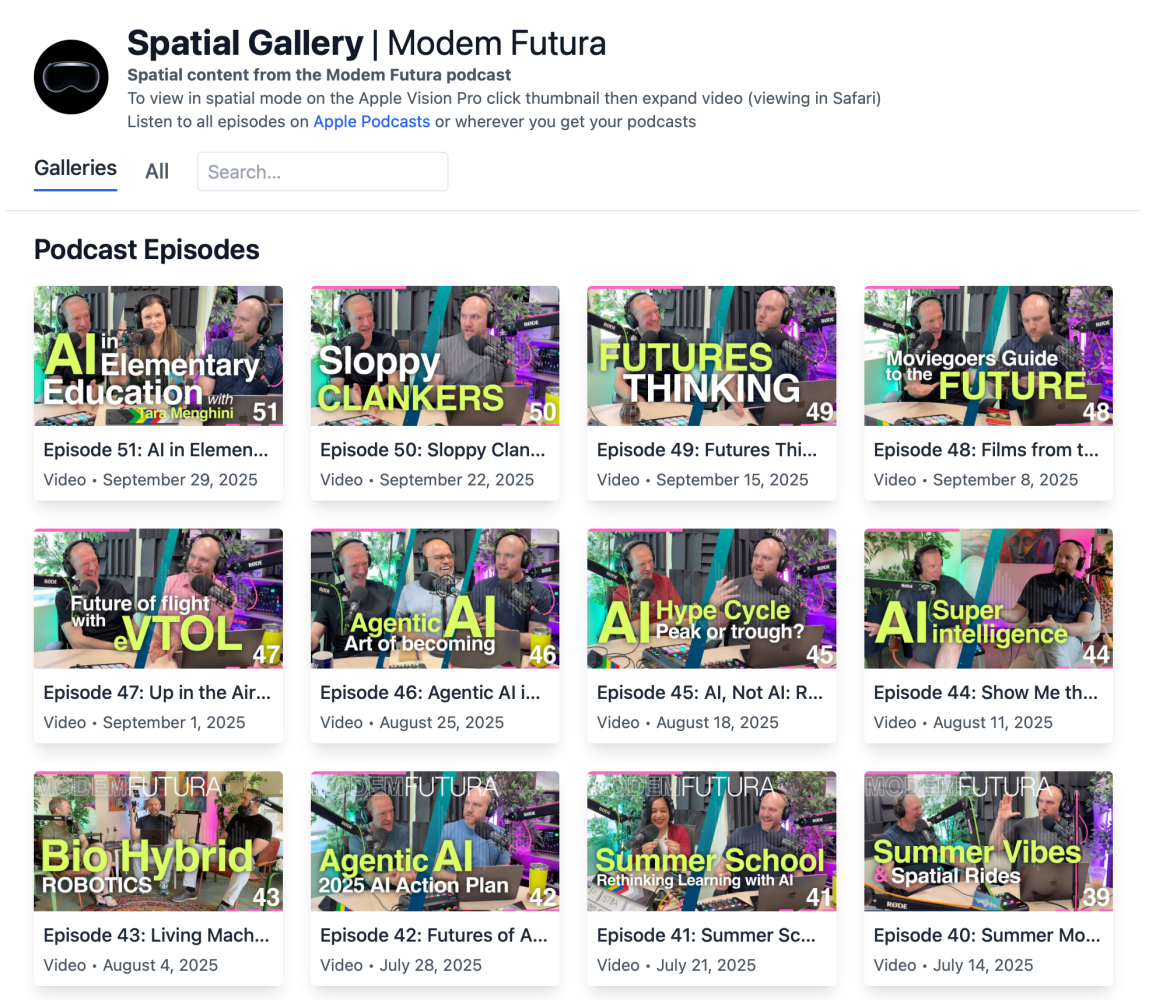
One of the biggest challenges at the present for spatial video (a deep dive for later) is that in addition to few people having headsets as compared to smartphones for example, most video platform services do not provide a way to consume Spatial video - including Apple's own Vision OS of all things. Yes you can send a video file (these are massive btw - in the order of 9-20GB each) - but at present there isn't an Apple supported cloud based video viewer to which you can watch Spatial videos posted by your friends and family etc. Personally, I really hope that YouTube will start to allow the playback of Spatial videos (assuming they will put an officially supported YouTube app on the Apple Vision Pro of course).
We also talk about what comes after the headset. Think of a layered ecosystem:
Audio AR through your earbuds for subtle ambient context.
Lightweight AR glasses for glanceable, social interaction.
Full headsets for immersive creativity, co-presence, and exploration.
Rather than a single “device to rule them all,” spatial computing might evolve into a stack of experiences that adapt to how human attention, comfort, and curiosity really work.
It’s easy to be dazzled by tech specs, but the future of spatial computing depends less on what’s rendered and more on what it means to be present in digital space. That’s why we’re inviting developers, designers, and curious explorers to join us — to prototype, play, and imagine what spatial experiences could look like when they’re built for humans first.
Subscribe and Connect!
Subscribe to Modem Futura wherever you get your podcasts and connect with us on LinkedIn. Drop a comment, pose a question, or challenge an idea—because the future isn’t something we watch happen, it’s something we build together. The medium may still be the massage, but we all have a hand in shaping how it touches tomorrow.
🎧 Apple Podcast: https://apple.co/47Arkwv
🎧 Spotify: https://open.spotify.com/episode/3V40dbWcrKZq9RCCmoP7Zh?si=s0CVT5aQS8WJ_CgbfMTBcg
📺 YouTube: https://youtu.be/IF3juEp9l_I
🌐 Website: https://www.modemfutura.com/

Tech or Treat: Exploring the Haunted Side of Future Tech
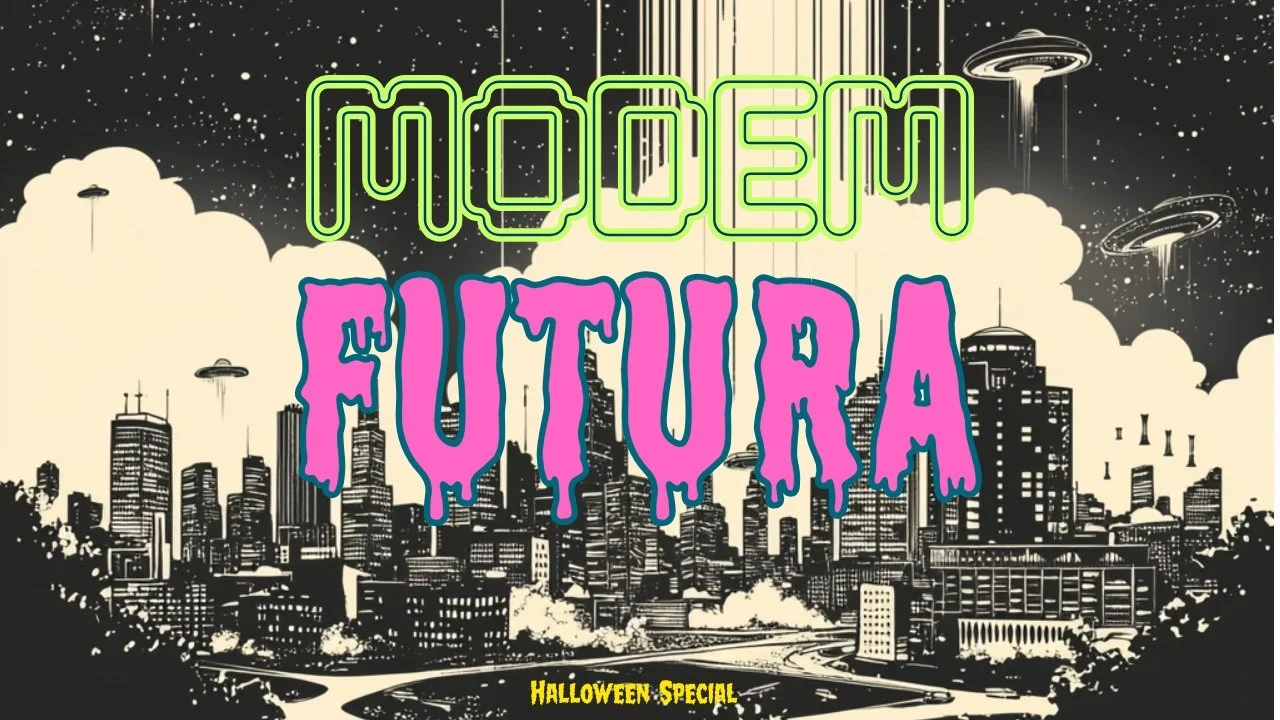
Are you ready for some Tech or Treat?
Modem Futura’s Halloween special transforms speculative futures into eerie fun. Hosts Sean Leahy and Andrew Maynard use AI-generated scenarios to imagine haunted algorithms, sentient mirrors, and neural nightmare modes — revealing how emerging technologies can both thrill and unsettle us. This episode continues the show’s mission to explore how science, technology, and society intersect to shape the future of being human.
This episode grew out of our playful Futures Improv series, where we use AI to generate speculative prompts about the future — but this time, the prompts got a little… haunted. We explore “The Haunted Algorithm,” a defunct social-media AI that resurrects old user posts every October 31 — a digital séance that’s equal parts sentimental and unsettling. Then we look into “The Mirror That Remembers,” a smart-mirror concept that doesn’t just show your reflection, but who you might have been in another timeline. Finally, we enter “Neural Nightmare Mode,” imagining what could go wrong when brain-computer interfaces merge immersive gaming with fear response.
Each vignette uses humor and imagination to surface deeper questions: What does it mean when our digital selves outlive us? How do we ensure psychological safety in immersive tech? And at what point does innovation slip from magical to menacing?
Our goal isn’t to predict the future — it’s to provoke curiosity about how technology is reshaping what it means to be human. And if we can have some fun (and a few chills) along the way, even better.
You can stream the Halloween special wherever you get your podcasts or watch the illustrated episode on YouTube. If any of these scenarios inspire your own “Tech or Treat” ideas, share them with us — we’d love to feature the best ones in a future episode.
Subscribe and Connect!
🎧 Apple Podcast: https://apple.co/4oovNKa
🎧 Spotify: https://open.spotify.com/episode/47nWrjvBW3ASjMuJUip8o1?si=96d8062d029a4834
📺 YouTube: https://youtu.be/ZmZ46sHgMZY
🌐 Website: https://www.modemfutura.com/

Atlas, Higher Education, and How We Really Feel About AI – Episode 55

Generated by ChatGPT
How We Really Feel About AI
Artificial intelligence isn’t just reshaping industries—it’s reshaping emotions. In our latest episode of Modem Futura, Andrew Maynard and I unpack Pew Research Center’s new international survey on how people view AI across 25 countries. The results are striking: while AI dominates headlines, 61 percent of respondents have heard “little or nothing” about it—and in the U.S., more people are concerned than excited.
We explore what this says about the bubbles we all inhabit. In our professional worlds, AI feels inescapable—a “black hole” pulling every conversation toward it. But outside these circles, many remain unaware of how deeply algorithmic systems already shape their lives. This disconnect raises profound questions about agency: if people don’t understand a technology that governs so much of modern life, who’s really steering the future?
The conversation also turns to trust. Europeans report more faith in their governments to regulate AI responsibly than Americans do—a difference that mirrors the EU’s proactive stance on ethics and guardrails. In contrast, U.S. policy remains fragmented, driven more by economic competition than by social cohesion. That tension—between speed and safety, innovation and inclusion—is at the heart of our discussion.
Dangers of Atlas (it's more the world he's holing... its all of your data!)
We then zoom in on universities. As public institutions, we argue they must act as transparent laboratories for AI exploration—spaces where successes and failures alike can be shared openly. The path forward isn’t boosterism; it’s honesty. We can’t earn public trust without showing our messy work. Adding to this - we explore OpenAI’s newly released Atlas browser and its privacy implications - and stumble upon a very shocking realization while recording - that private student data is easily exfiltrated when using LMS platforms such as Canvas while in this browser. What started as a curious road test of OpenAI’s new Atlas browser turned into a genuinely alarming discovery. As we installed and explored Atlas, the first surprise was how quickly the “privacy” pitch unraveled. Despite promising user control, Atlas behaved much like any other data-hungry app—prompting unusual permissions and positioning itself between us and the open web. That sparked a bigger question: if your browser is the main keyhole to the internet, what happens when an AI system sits in the keyhole, quietly learning from everything you do? (including sending and processing private user data - think ANYTHING that comes and goes from your activity on the web). The situation quickly got worse as I was unable to get Atlas to show me any particular websites security certificate. Specifically, at the time of testing (I hope they patch this soon) I could not see the sites SSL/TSL or HTTPS certificate (this is the little lock icon in most browser URL's) that tells you and the browser that your connection to the sites servers are "safe" via web-standard encryption protocols. You know, for things like your bank account info, passwords, and any other data you want to send or receive. The takeaway? Treat ATLAS like a red hot security hole for you and any organization or persons connected to you via the internet. Think twice before using this browser - as EVERYTHING you do on the web is potentially egress'd (fancy word for taken) – so until there are transparent safegaurds in place, the safest assumption is that anything you open in an AI browser like Atlas could be seen, summarized, and stored beyond your intent.
And because no Modem Futura episode is complete without a bit of speculative play, we end with Futures Improv, where we imagine AI zombies, memory economies, and spaghettified timelines—all to remind ourselves that foresight and humor often travel hand in hand.
If you care about how humanity and technology co-evolve, this episode offers a grounded yet playful map of where we stand—and where we might go next.
Subscribe and Connect!
Subscribe to Modem Futura wherever you get your podcasts and connect with us on LinkedIn. Drop a comment, pose a question, or challenge an idea—because the future isn’t something we watch happen, it’s something we build together. The medium may still be the massage, but we all have a hand in shaping how it touches tomorrow.
🎧 Apple Podcast: https://apple.co/4nuRsit
🎧 Spotify: https://open.spotify.com/episode/04NLQcVfJpoM444bQQfQ42?si=b9adf3740a0944fe
📺 YouTube: https://youtu.be/tYoLRZH5iH8
🌐 Website: https://www.modemfutura.com/

Sora, Slop, and the AI Economy: When ChatGPT Meets Walmart – Episode 54

Image illustrated adaptation by ChatGPT
If you’ve ever wondered what happens when the world’s largest retailer merges with the world’s most talked-about AI, you’re not alone. In our newest episode of Modem Futura, Andrew Maynard and I explore how OpenAI’s latest moves—from Sora 2’s eerily lifelike videos to Walmart’s direct-to-ChatGPT shopping partnership—signal a seismic shift in how we live, learn, and buy in a post-search world.
Andrew also just returned from Lisbon for the global launch of his new book AI and the Art of Being Human, a deeply personal and practical guide to thriving with AI while staying grounded in what makes us human. Together we discuss the book’s central question: how can we build a meaningful life amid tools that increasingly think, speak, and create like us?
We also dive into futurist Amy Webb’s sharp warning that the financial plumbing of the internet is changing fast. As she notes, when an AI company built on venture debt begins replacing Google’s ad-based model, we risk building the next era of commerce on borrowed money—and borrowed trust.
From there, the episode ranges widely: we unpack the ethics of open-source AI groups like Nous Research, debate what “guardrails” really mean, and share our growing fatigue with synthetic content—the endless churn of what the internet now calls “AI-slop.”
But it’s not all doomscrolling. We end with a new round of Futures Improv—our playful segment imagining speculative scenarios like subscription-based immortality and AI DJs reading your neural signals. It’s improv, futures-style: serious ideas approached with humor and imagination.
Whether you’re an AI enthusiast, a creative technologist, or simply trying to stay human in a rapidly transforming world, this episode captures the heart of Modem Futura: thoughtful conversations that remind us the future isn’t just something that happens to us—it’s something we co-create, signal by signal.
Subscribe and Connect!
Subscribe to Modem Futura on a favorite podcast platform, follow on LinkedIn, and join the conversation by sharing thoughts and questions. The medium may still be the massage, but everyone has a chance to shape how it kneads modern culture—and to decide what kind of global village we ultimately build.
🎧 Apple Podcast: https://apple.co/48C8PtS
🎧 Spotify: https://open.spotify.com/episode/38IopMk5XBA9xVsKU71UlM?si=wdAtLLaaQxGvNEjPVfqWTQ
📺 YouTube: https://youtu.be/aK-ev5T8Tu8
🌐 Website: https://www.modemfutura.com/