

NEWS & UPDATES

The Syllabus Is Not the Course: AI, Course Design, and the Junk Playground
AI can produce a complete-looking university course in minutes. But the most important part of a course may be the part it can't build. On AI as instructional designer, learning as a journey, and what a 1943 Danish junk playground might teach educators now.
Generative AI can produce a "complete-looking" university course in minutes: learning outcomes, weekly topics, readings, assignments, rubrics. For anyone who designs courses, that is both an extraordinary capability and a quiet trap. In Episode 107 of Modem Futura, Sean Leahy and Andrew Maynard reflect on more than a year of using AI as a private instructional designer, and on why the most important part of a course may be the part these systems are least able to build.
From sounding board to finished product
Used as a thinking partner, AI can be remarkably helpful. It can test whether a sequence holds together, surface readings no single person would find, and catch overlap between weeks. It is also good at turning existing material into worksheets or self-contained interactive pages that work around the limits of a learning management system. The trouble starts when the tools move from responding to finishing. Ask for help thinking through a course and, increasingly, they return a complete one: plausible, polished, and conventional. These systems are very good at reflecting what has worked before and much weaker at imagining what hasn't been tried (which is no surprise, but increasingly frustrating).
Content is abundant; journeys are designed
The distinction the hosts keep returning to is between content and journey. What remains scarce is the intentional design of experience, the sequence of challenges and moments of realization that carries a learner somewhere new. It echoes John Dewey's argument that education should build on learners' natural impulses toward inquiry, communication, construction, and expression rather than fill them with facts. A course that a single AI prompt could reproduce may be telling its designer something.
A junk playground for the AI age
The episode's most generative idea comes from 1943, when a playground designed by Danish landscape architect Carl Theodor Sørensen opened in Emdrup, Copenhagen. Sørensen had noticed that children were more drawn to piles of scrap than to the playgrounds he designed, so he gave them a space full of loose materials and a play leader to support rather than direct them. He later described it as both the ugliest and the best of his works. Andrew is now exploring what a digital junk playground might look like: a curated space where students build with whatever AI tools they choose and learn through the making.
For educators, that points to a different role, less authority over learning and more what Sean calls an elevated co-participant in it. When nobody yet knows the rules for learning alongside AI, play, experimentation, and care may be among the most rigorous approaches available.
Listen to the full conversation on Modem Futura.
Subscribe and Connect!
Subscribe to Modem Futura wherever you get your podcasts and connect with us on LinkedIn. Drop a comment, pose a question, or challenge an idea—because the future isn’t something we watch happen, it’s something we build together. The medium may still be the massage, but we all have a hand in shaping how it touches tomorrow.
🎧 Apple Podcast: https://apple.co/4yZg4X0
🎧 Spotify: https://open.spotify.com/episode/55Z17htCK9S3HKDEGDQd7w?si=D99hOJiUQdOK7jaKn5kHJA
📺 YouTube: https://youtu.be/Ob6PjC4tGVg
🌐 Website: https://www.modemfutura.com/

Asimov's "The Fun They Had" and the Real Cost of AI-Driven Education
The History of our Future
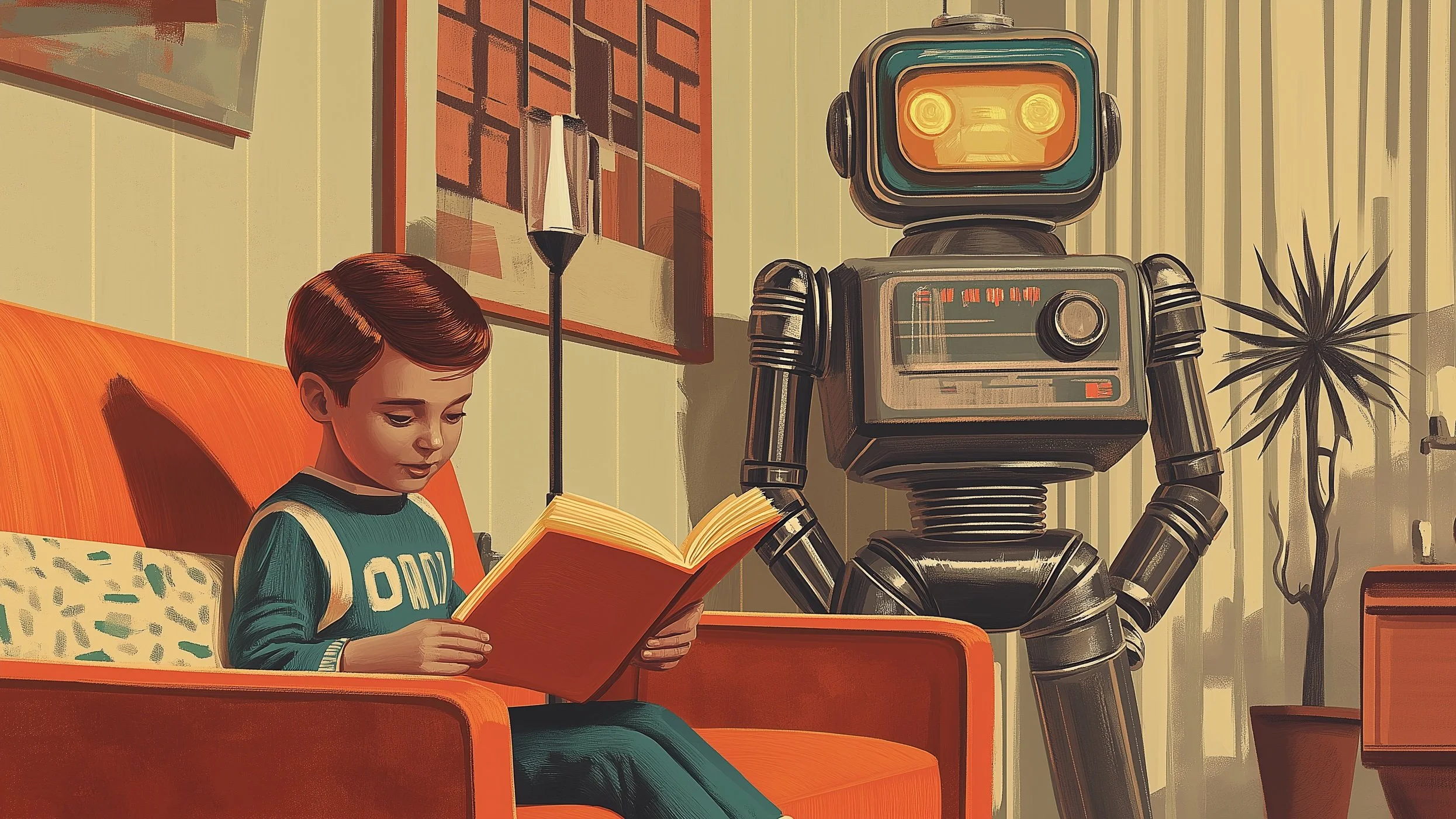
More than seventy years ago, Isaac Asimov imagined a future where children learn in isolation, guided by personalized mechanical tutors, and books are relics of a forgotten age. His 1951 short story, "The Fun They Had," is set in 2155, but its questions feel startlingly current.
In the story, a young girl named Margie discovers a paper book and learns about a time when children went to school together—sat in classrooms, were taught by human teachers, and shared the experience of learning with their peers. Her own education is efficient, personalized, and lonely. Her mechanical teacher can diagnose her struggles and recalibrate its approach, but it cannot inspire her, connect with her, or make her feel like she belongs to something larger than a lesson plan.
“Asimov didn’t predict AI as we know it. But he predicted the question that matters most: in our rush to optimize education, are we designing out the very things that make learning meaningful?
”
This is precisely the tension at the heart of today's conversation about AI in education. The promise of AI-powered tutors is real and, in many cases, genuinely valuable: adaptive pacing, instant feedback, content tailored to individual needs. But when personalization becomes the dominant paradigm—when every learner is on a separate track, in a separate space, at a separate time—the communal dimensions of education begin to disappear.
Natural Human Impulses for Learning (not schooling)
John Dewey argued more than a century ago that learning is driven by four natural impulses: inquiry, communication, construction, and expression. Most of these are inherently social. They depend on friction, dialogue, surprise, and the presence of other people. No amount of algorithmic sophistication can fully replicate the moment a teacher's unexpected enthusiasm shifts a student's entire trajectory, or the experience of working through difficulty alongside peers who share the same struggle.
Asimov's story also raises a subtler question about what endures. The book Margie discovers has survived two centuries. The static words on the page—unchanging, tactile, physical—carry a kind of permanence that digital media cannot easily match. This resonates with the growing cultural appetite for analog experiences: vinyl records, film photography, even old iPods. These are not acts of technological rejection. They are expressions of a deeper need for embodied engagement, deliberate choice, and the kind of friction that gives experience its texture.
Where do we go next?
None of this means AI has no place in education. It does, and increasingly will. But Asimov's story is a quiet reminder that the most important things about learning—curiosity, connection, belonging, the joy of shared discovery—are not problems to be optimized. They are human experiences to be protected.
The question is not whether AI can teach us. It's whether, in building systems that teach us more efficiently, we are designing out the very things that made learning worth having in the first place.
*Episode 71 of Modem Futura explores these themes through Asimov's story and a wider conversation about technology, nostalgia, and what it means to learn as a human being.*
Subscribe and Connect!
Subscribe to Modem Futura wherever you get your podcasts and connect with us on LinkedIn. Drop a comment, pose a question, or challenge an idea—because the future isn’t something we watch happen, it’s something we build together. The medium may still be the massage, but we all have a hand in shaping how it touches tomorrow.
🎧 Apple Podcast: https://apple.co/4s1lDk1
🎧 Spotify: https://open.spotify.com/episode/20I5j2DliUnZAbWDiVw7y8?si=WoEW_Zb2SPiynHYb4d8XHA
📺 YouTube: https://youtu.be/TDQc15Muwto
🌐 Website: https://www.modemfutura.com/