

NEWS & UPDATES

Megatrends 2026 Explained: The 11 Forces Shaping our Futures
Megatrends aren't predictions, and they rarely move in straight lines. But they may be the closest thing to stability the futures world has. A look at the 2026 CIFS Megatrends report and what happens when eleven slow forces collide.
Futures work has an awkward relationship with stability. The field exists because the future is uncertain, and one of its first lessons is that no one can predict what comes next. Yet anyone making decisions about the next decade needs something to stand on. Megatrends are the closest thing the futures world has to solid ground, not because they never move, but because they move slowly and broadly enough to frame almost everything else.
In Episode 106 of Modem Futura, Sean Leahy and Andrew Maynard work through the Copenhagen Institute for Futures Studies' 2026 Megatrends report, its first update in several years.
What makes a trend "mega"?
While the world may feel like it moves at the speed of the news cycle. And headline news focuses our attention on immediate events, megatrends reveal the broader shifts unfolding over years and decades—from demographic change and urbanization to climate pressures and technological transformation. They help us place individual stories in context, connect developments across sectors, and consider what their cumulative effects could mean. While there is no globally accepted definition of the term, its core working definition begs a nod to John Naisbitt and Patricia Aburdene (1990) on establishing the first widely published set in their popular book: Megatrends 2000: Ten New Directions for the 1990’s.
Horizon scanning surfaces weak signals, early hints that something is changing. As signals accumulate, they become trends with measurable momentum. When trends converge into something with global reach, a long track record, and the likelihood of shaping decades to come, they become a megatrend.
The word has been stretched thin along the way. A 2024 review in the journal Futures found that most published megatrend reports never define the term. CIFS takes that problem seriously, naming it conceptual drift and publishing the filters each candidate must pass: clear boundaries, a definite direction, durability beyond short-term shocks, and evidence that isn't cherry-picked. That transparency is what turns a list into a teaching tool. Readers can test the method, argue for a twelfth megatrend, or challenge one of the eleven.
What makes this report especially valuable for anyone new to futures work is its transparency. The word "megatrend" has suffered from what the institute calls conceptual drift, stretched to cover everything from consumer fads to wishful thinking, and a 2024 review in the journal Futures (Naughtin et al. 2024) found that most published megatrend reports never define the term at all.
Eleven forces, and the spaces between them
The 2026 list includes a shifting world order, the inversion of the population pyramid, the green transition, individualised everyday life, health beyond the clinic, the rise of embedded AI, the biotech revolution, the constrained economy, the new face of urbanisation, power through networks, and the concentration of wealth.
The list itself is not the insight. The insight lives in the intersections. A trade disruption becomes a story about fuel, farms, and food prices. An aging workforce becomes a question about migration and brain drain. The rise of individualized life raises one of the report's sharpest uncertainties: when relationships are chosen rather than inherited, does trust grow or erode? And as critical digital infrastructure concentrates in a handful of private networks, sovereignty begins to look less like control of territory and more like control of systems.
Responding to the world as it is
Andrew offers a principle from his years in environmental health: respond to the world as it is, not as you think it should be. Megatrends are a tool for exactly that discipline. They are most useful when they pull institutions, higher education included, out of the habit of imagining their futures in isolation. Combine two or three of them, build scenarios, and work backward from the future worth preferring.
Megatrends won't say what the future holds. They offer a wider frame, and the question worth carrying forward is which collision an organization hasn't yet imagined.
Listen to the full conversation on Modem Futura, and download the free report from CIFS.
Subscribe and Connect!
Subscribe to Modem Futura wherever you get your podcasts and connect with us on LinkedIn. Drop a comment, pose a question, or challenge an idea—because the future isn’t something we watch happen, it’s something we build together. The medium may still be the massage, but we all have a hand in shaping how it touches tomorrow.
🎧 Apple Podcast: https://apple.co/4s4BCz0
🎧 Spotify: https://open.spotify.com/episode/5hZZbXfo4aCdbCC2bO7PAl?si=-BfsC_4RQxu4MaOtjhkotg
📺 YouTube: https://youtu.be/V8h9J9sEjpI
🌐 Website: https://www.modemfutura.com/

Designing Learning Futures: Navigating Toward the Next Normal

On March 17, 2021 I had the pleasure to co-present the closing keynote for the OLC Innovate K-12 Summit with my trusted colleague Ben Scragg. In this presentation we explore the challenges of creating a new “normal” as it relates to educational futures - and explore a set of strategic foresight tools and methodology that can assist leaders in creating an intentional “next normal” for their organization.
Below is the extended abstract from the event website.
Extended Abstract:
We are certainly living through a volatile, complex, uncertain, and ambiguous (VUCA) world at the present moment, and its impacts have been felt perhaps more deeply and tangibly in K12 education than anywhere else - both at global level and within our local schools and communities. Given the rapid disruption and changes brought on by COVID-19, we know that there will be no returning “back to normal.” While schools, educators, students and families have all navigated the past year in different ways and with different degrees of hardship, challenge, and even success - we still look forward to establishing a future sense of normalcy, however the new normal takes shape.
In this session, we want to explore some of the ways in which educators and leaders can begin to design and give shape to this new normal, despite all the uncertainty of now. Given all that educators and communities are facing, it’s worth exploring how we might re-imagine our teaching and learning environments - particularly online and digital learning environments - by addressing and harnessing the plausible outcomes and impacts of our collective uncertainty.
We will invite participants to learn about and experiment with emergent design and strategic foresight tools that can reveal risks and opportunities, helping us prioritize the work needed to build the next normal. The goal of this session is not to predict what will happen in the future, but to stretch the imagination (and ourselves!) to think about what we would like to have happen, using a framework and tools for how it might happen. The maxim “we cannot predict the future, but we can invent it “ is often cited as a call to design and use strategic forecasting tools and methodologies. Join us as we create a studio space to explore a set of tools and reflective prompts that we’re describing as Learning Futures.

An Invited Talk: Futures Thinking & Strategic Foresight
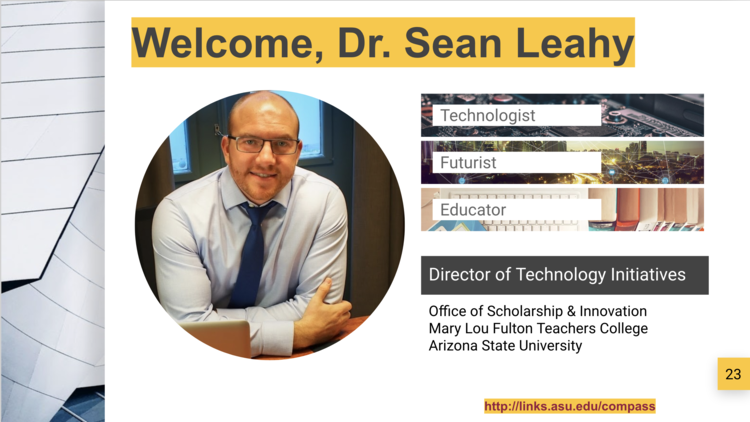
It was a lot of fun to join the panel of invited speakers on July 14, 2020 for the first Learning Futures Leadership Studio, hosted by Mary Lou Fulton Teachers College and Arizona State University.

Learning Futures Leadership Studio Speakers
Learning Futures Leadership Studios
For full program details and information.
“The events of the past few months have demonstrated that we live in a volatile, uncertain, complex and ambiguous world. Whether the global shutdown of schooling due to COVID-19 and the sudden move to remote learning, or the more recent protests against systemic, recurring inequities in our society, it is clear that we as educators need to do a better job.
This summer, Mary Lou Fulton Teachers College hosts Learning Futures Leadership Studio, a series of four online action-oriented studio sessions that are designed to engage teams of education leaders in creating pathways for leading systems in a time of change.
You will be immersed in provocative questions and ideas through interactive studio experiences. With your colleagues and others, you will reflect on these ideas and experiences. And you will develop action steps to pursue in your own context.
This is a BYOC (Bring Your Own Challenges) experience intended to allow you, in a team, to explore new angles and perspectives on the issues that you face today and expect to face in the future.
”
As the first studio to kick off the event, I focused on a topic that is not only contemporary, but one that I feel is critical to the collective needs of our society, Futures Thinking and Strategic Foresight.
Official tagline of my studio:
It is clear today that there will be no return to “normal” or to a pre-COVID-19 world. As a result, leaders must be prepared to forge ahead – with courage and efficacy – in a policy and bureaucratic context where there may or may not be clear guidance or feasible policy mandates. In this context, leaders cannot simply wait for guidance; rather, they must design and lead for the futures of learning.
In this session, we will introduce leaders to practical and creative tools of scenario planning and strategic foresight for leaders to explore new ways to think about strategically planning for uncertainty. Participants will learn how to forecast future trends and develop strategic plans to identify possible, plausible, and preferable futures.
(https://learningfutures.education.asu.edu)
In other words, the main objective of this studio is to demonstrate the need for organizational leaders (especially those in the educational system), to actively engage in futures thinking and strategic foresight. To create an organizational culture that allows for this type of thinking, planning, and strategy. I covered a handful of foresight methodological tools developed and open sourced (via Creative Commons) by the Future Today Institute.
The aim of this talk was to start an ember of futures thinking in educational systems leadership, with the hope that this will be the first of many subsequent explorations into the realm of strategic foresight.

Invited Lecture: Principled Use of Technology in the Fourth Industrial Revolution

On February 22, 2020 I delivered an invited presentation on the “Principled Use of Technology in the Fourth Industrial Revolution” as part of the Principled Innovation: Leadership for today, tomorrow and the future conference held at Arizona State University.

The main objective of this particular talk was to provide a general ‘provocation’ or ‘call to action’ for educational systems leadership to take note of the emerging Fourth Industrial Revolution, and to understand the implications of the potential systems-disrupting innovations and convergence of physical, digital, and biological technologies.
This talk also presented the audience with a cursory exploration of the need for organizational leadership to engage in strategic foresight and futures thinking.
To help illustrate the complexities of future uncertainty I also explored the Black Swan Theory and model used to demonstrate the potential peril or promise from new or converged technological advancements in society.
Overall it was a fun and engaging presentation with a lively group of participants that drove an enriching conversation throughout the session.