

NEWS & UPDATES

Futures Improv: Spin it to win it!
Our favorite podcast segment is now a free browser game. Deal a wheel of what-if scenarios, spin it, and answer cold.
One of my favorite conversations on Modem Futura started with a question nobody had time to prepare for. Now that game is open to anyone who wants to play it.
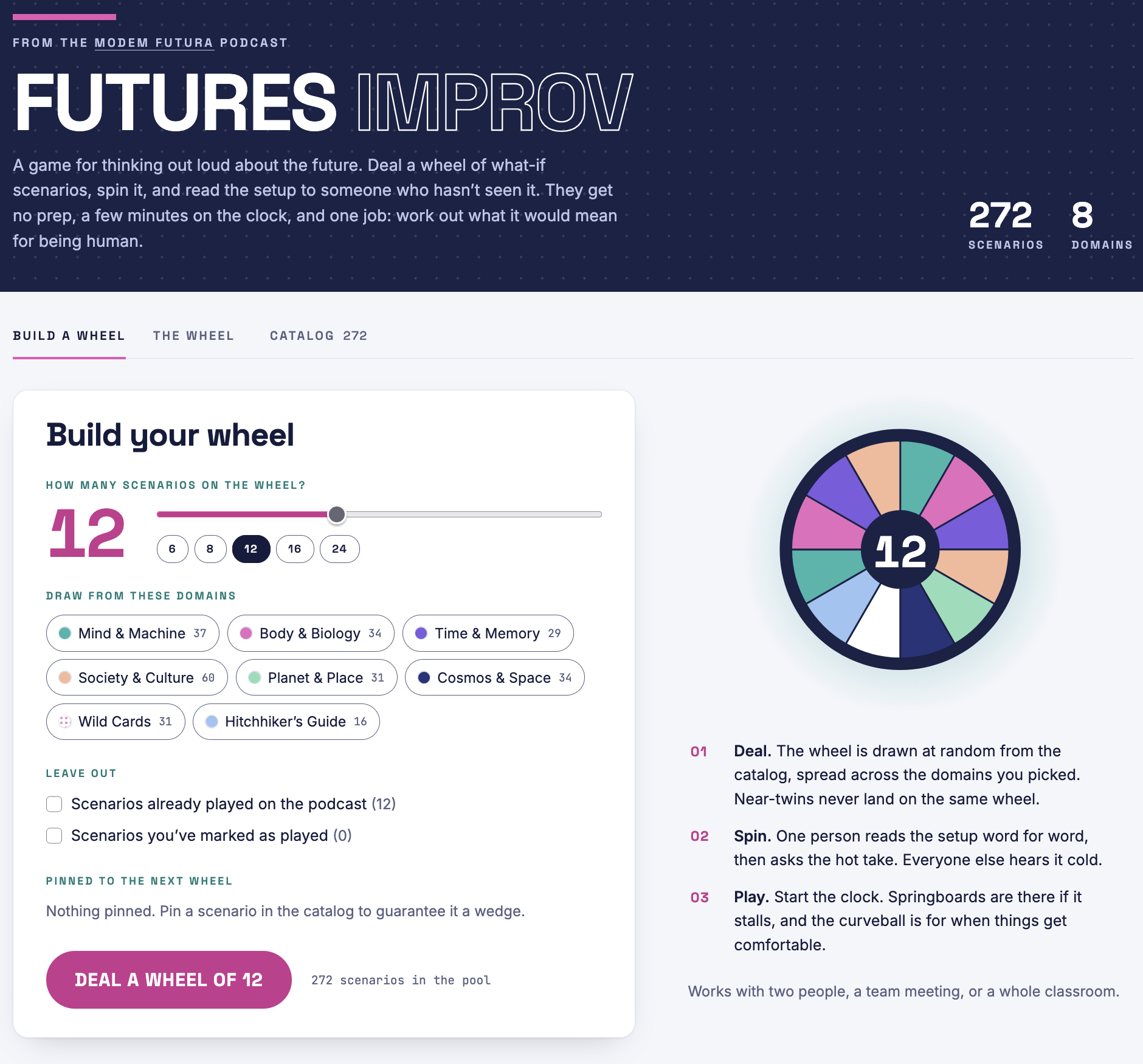
The Futures Improv Wheel is live at modemfutura.com/improv. It is a free game that runs in your browser: it deals you a wheel of what-if scenarios, you spin it, and whoever is in the room thinks out loud about whatever comes up. There is nothing to install and no account to create, and it works on a phone as well as a laptop.
Where the game came from
Futures Improv began as a segment on the show that I created to give Andrew and I a fun and ‘randomly’ created future scenario to riff on. Generally, I’d have a list of scenarios and ask Andrew to give me a number or something and I woud read out a scenario: a strange trend, a hypothetical, a piece of science fiction nudged one step closer to plausible. Then Andrew and I, who have dad no preparation have to respond cold, working out in real time what the scenario might mean for people, for society, and for the ordinary texture of daily life.
The premises often range from sci-fi adjacent, silly, to downright absurd. The conversations they start however tend not to be, and this is the real power of this little segment and now tool you can use. A setup as daft as gravity taking Fridays off can turn, within a minute or two, into a conversation about infrastructure, about who adapts and who gets left behind, and about how much of modern life rests on things we never think to question. It is this deep conversation that is catalyzed, is where the power in the tool is, as these scenarios give participants the agency and permission to explore and interrogate the future, while critically analyzing the world as it is today, in an inclusive, hopefully fun, and accessible way.
After enough rounds on air we had a large pile of scenarios and a question of our own: does this work as well around a dinner table or in a classroom as it does in a studio? Releasing the wheel is how we intend to find out.
How it works
A round takes three steps.
Build your wheel. Choose how many scenarios you want, and the game deals a random set from a catalog of more than 160.
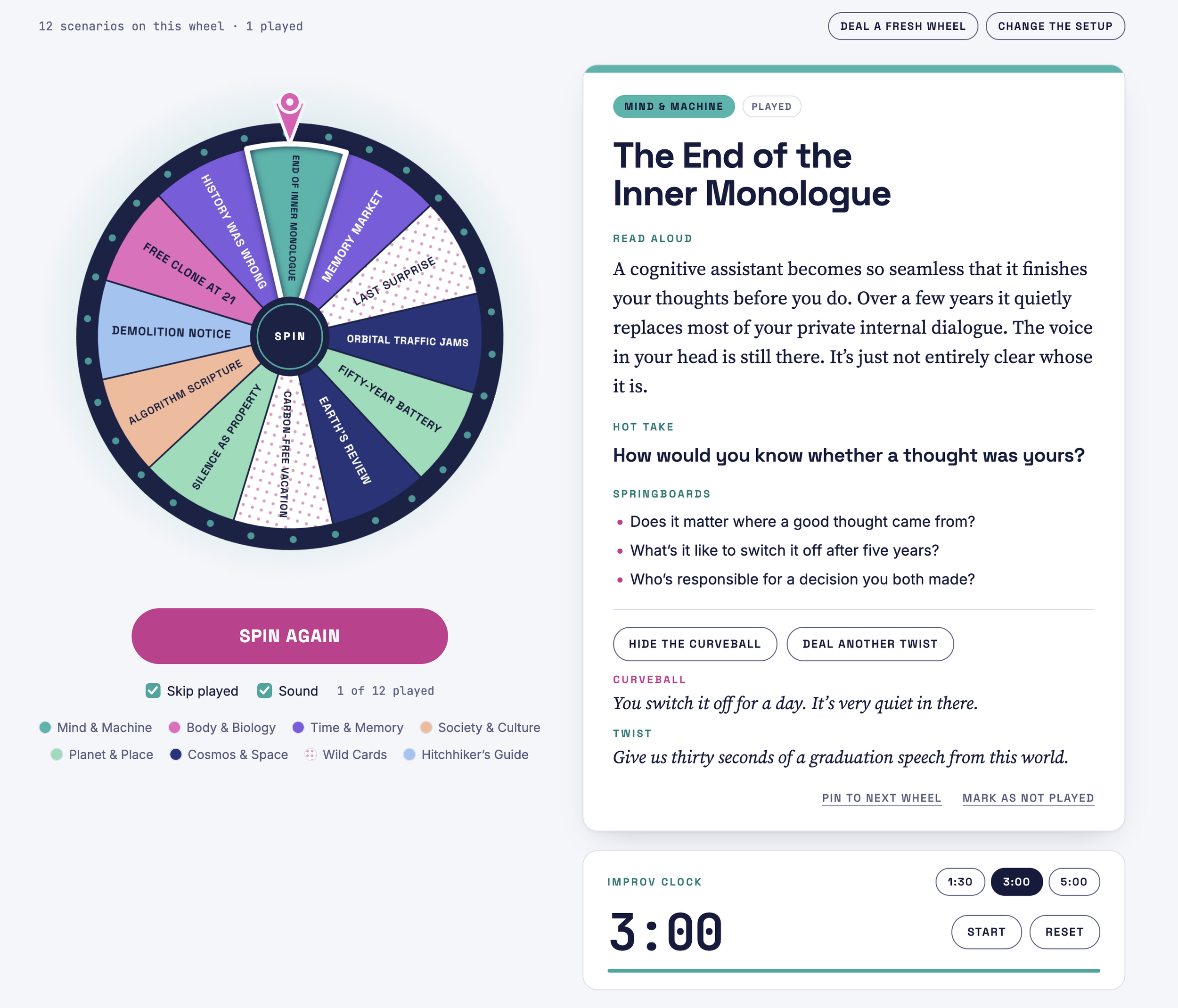
Spin. The wheel lands on a scenario and brings up its card.
Read the setup aloud, then answer cold. One person reads. Everyone else responds without preparation.
Each card carries more than the setup, for the moments when a conversation needs a push:
A hot take: the direct question the scenario is really asking.
Springboards: three angles to try when the room goes quiet.
A hidden curveball: a complication to reveal mid-conversation.
Inspired by: a credit line where a scenario leans on a particular book, film, or story.
There is also a twist deck that works on any scenario ("Now argue this is the preferred future" is one), and a clock you can set to 1:30, 3:00, or 5:00 if you want the pressure of a buzzer.
The scenarios range across minds and machines, bodies and biology, space, society, and the planet, with a set of wild cards for the more unhinged premises. A few titles give the flavor: The Machines Are Bored, Your Monthly Thinking Statement, Rain at Auction, The City Sues, Degrees With an Expiration Date. If you would rather choose than leave it to chance, the full catalog is searchable, and scenarios we have played on the podcast are tagged with their episode.
Why a game?
For many, the future is seen as something to forecast: what will happen, and when. Futures work asks a different set of questions. What could happen? What probably will? What would we actually want? Those questions about possible, probable, and preferred futures are hard to practice, partly because the stakes feel high and the temptation to sound certain is strong.
Improv lowers the stakes, and creates a safe environment to think about wildly creative futures, challenge assumptions and status quo. When the premise is that the universe turns out to have an autosave, nobody expects you to be right. What is left is the useful part: following a change through to its second and third consequences, noticing who benefits and who pays, and asking what it would do to the way people live, work, and relate to each other. This is where the tools power lies - getting players to start thinking deeper and more intentionally about the future - regardless of how silly or deranged the original prompt might seem at first glance.
We don't think a spinning wheel teaches foresight on its own. We do think the habit of taking a strange premise seriously for three minutes is worth having, and that it is more fun with other people. We can imagine it in a classroom, at the start of a team workshop, on a long drive, or at a dinner table that has run out of small talk. We are curious where else it ends up.
An experiment, and we mean that
The scenarios on the wheel are AI-generated (a bizarre amalgamation of various versions of ChatGPT and Anthropic’s Claude). They grew out of the prompts we use to prepare the segment for the show, and we have gathered them into one catalog. That comes with caveats we would rather state plainly than bury in a footer.
Expect the occasional error. Expect, too, the occasional scenario that resembles an existing book, film, or story without saying so. Where we have spotted a likeness, the card credits it under "Inspired by," and one set of scenarios is openly drawn from Douglas Adams's The Hitchhiker's Guide to the Galaxy and labeled that way. If you find one we missed, tell us at hello@modemfutura.com and we will fix it. Even though Claude has worked very hard on cross referencing any scenario with any pre-existing work and labeling at “inspired by” it undoubtedly will have missed one here and there.
This is an experiment, an app, a game (not even really sure what we’re calling it yet), meant for entertainment. The wheel supplies the prompt. The thinking, the arguing, and the laughing are left to the people in the room, which is the part we care about.
Spin it, then tell us what happened
The wheel is at modemfutura.com/improv. Deal yourself a few scenarios, find someone to play with, and see where three minutes takes you.
We plan to keep adding to the catalog, and we would like your help. If you have a scenario that belongs on the wheel, or you played one that fell flat or started an argument that lasted all evening, write to hello@modemfutura.com. What we hear back will shape where the game goes next.
And if you want to hear how it sounds when we play it ourselves, with all the stalling and second-guessing left in, the Futures Improv episodes of Modem Futura are available wherever you get your podcasts.