

NEWS & UPDATES

Summer Reading for Futures Thinkers: Part Two of the Modem Futura List
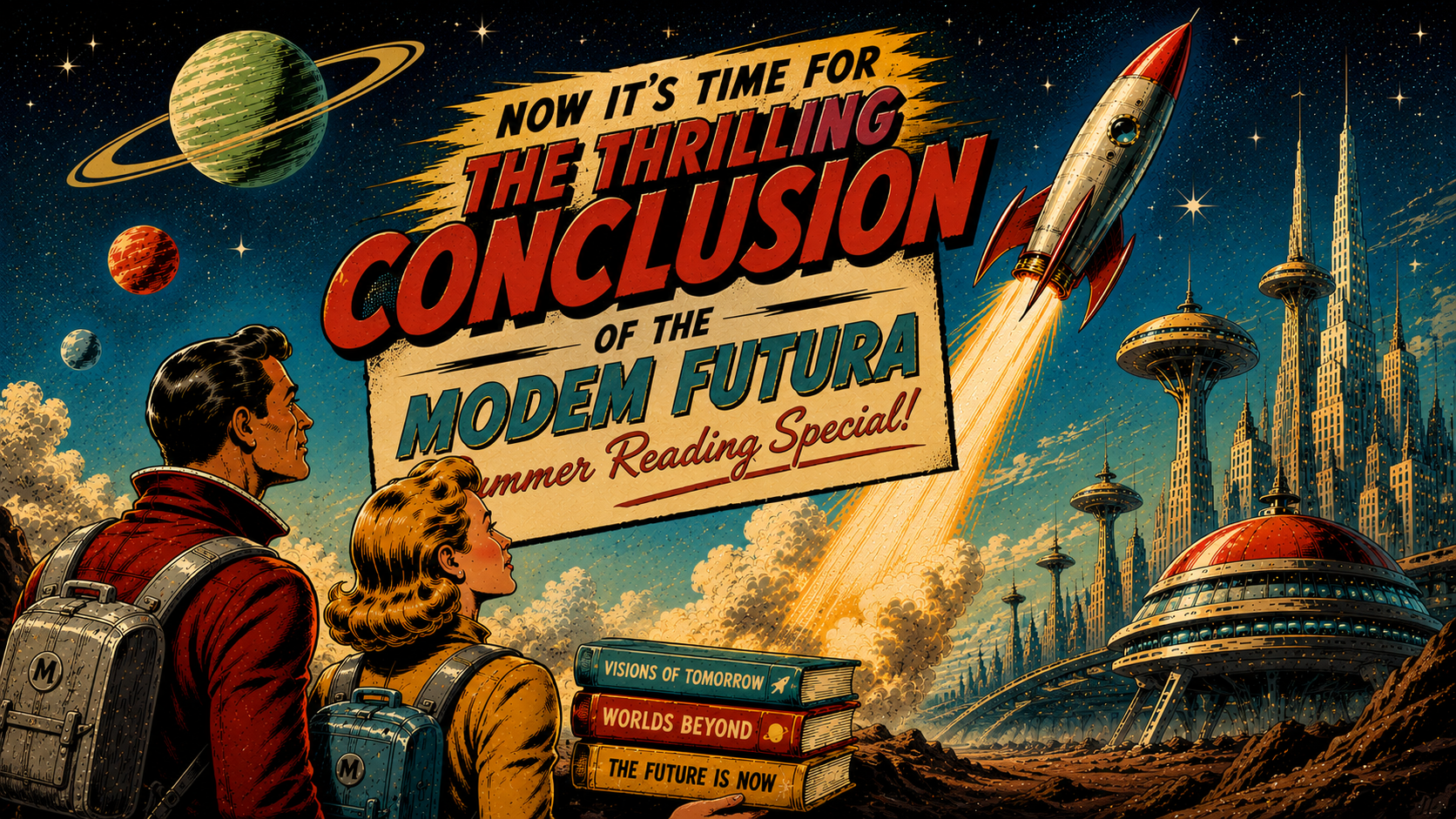
What makes a book worth your summer? On the concluding half of our annual summer reading list, an answer kept surfacing: the best stories are the ones that don't end when you finish them — the ones that plant an idea you can't shake, and that keeps growing into something uniquely yours.
Part two of the list ranges well beyond the cyberpunk canon we explored in part one. Andrew Maynard opens with Terry Pratchett's Unseen Academicals, a satire of university life so accurate that anyone who has worked in academia will cringe in recognition — and one that connects, unexpectedly, to our recent conversation about enshittification: where does the true value proposition of our institutions actually live? His bonus pick, Pratchett's often-overlooked Bromeliad trilogy, is a reminder that the best children's books are age-agnostic.
Sean breaks the pattern entirely with Henri Cartier-Bresson's The Decisive Moment — the landmark photography collection, still available through the Fondation Henri Cartier-Bresson in Paris. It sparks a meditation on analog intentionality: how portable cameras created street photography, why a single frame can hold an entire technological era, and the idea that every photograph has two subjects — the one in the frame, and the one behind the camera.
Time travel threads through the middle of the list. Connie Willis's Blackout and All Clear are historical novels wearing the lightest science fiction overlay, following future academics who live through the London Blitz. And La Jetée, Chris Marker's 1962 short film told almost entirely in still photographs, proves that sixteen minutes and a compelling idea can seed decades of storytelling — you can trace its time-loop DNA through much of what we watch today.
The lighter fare earns its place too: Mick Herron's Slow Horses novels (arguably better than the acclaimed series they inspired), the full-cast Harry Potter audio dramatizations, and a return to Silo ahead of its new season. Two friends-and-family picks round things out: Riz Virk's The Simulation Hypothesis and AI and the Art of Being Human by Jeffrey Abbott and Andrew Maynard — a deliberately agnostic, tools-based guide to navigating AI with intentionality and care, whether you approach the technology with enthusiasm or deep unease.
Subscribe and Connect!
Subscribe to Modem Futura wherever you get your podcasts and connect with us on LinkedIn. Drop a comment, pose a question, or challenge an idea—because the future isn’t something we watch happen, it’s something we build together. The medium may still be the massage, but we all have a hand in shaping how it touches tomorrow.
🎧 Apple Podcast: https://apple.co/4vdP3wf
🎧 Spotify: https://open.spotify.com/episode/1X4nEJUORnt4Txs73mGNeY?si=dB8iH1scSq6rQcwsZgoCnw
📺 YouTube: https://youtu.be/JHSHtAkTKvk
🌐 Website: https://www.modemfutura.com/

Modem Futura Year in Review: What 2025 Taught Us About Being Human
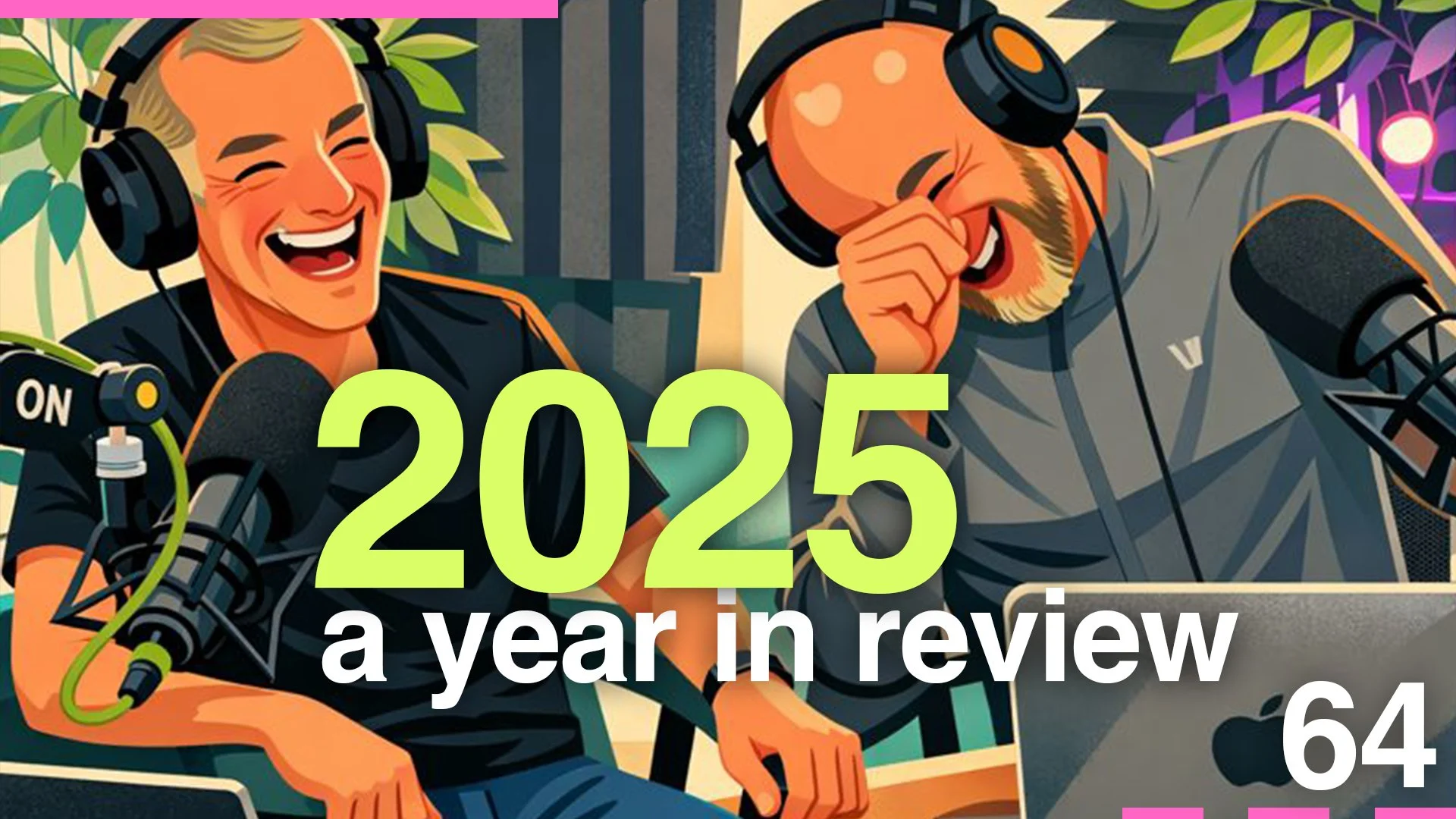
As we step toward 2026, we recorded a “Year in Review” episode of Modem Futura to pause the treadmill, look back, and ask a bigger question: what did this year reveal about the future of being human?
This wasn’t a victory lap. It was a reflection on what resonated, what surprised us, and what it means to build a future-focused show while the future keeps moving.
metrics matter… and they don’t
Yes, growth matters — it helps ideas travel. But podcast analytics are often incomplete and inconsistent, and they rarely capture what impact actually looks like. The most meaningful signals are still human: messages, emails, thoughtful disagreement, and reviews that help someone new discover the show.
“If you want to support the show: subscribing, sharing, and leaving a rating/review are still the most helpful actions.”
The themes that defined our year:
AI, beyond the hype: We kept returning to the same tension — generative tools are everywhere, but “AI” isn’t just a feature set. It’s a cultural force that shapes identity, agency, creativity, and values. We try hard to avoid both the hype machine and the doom loop, and instead stay in the messy middle where the most useful questions live.
Education and learning: We lean into what learning actually is (not just schooling), including John Dewey’s idea that humans are wired for inquiry, communication, construction, and expression. When AI arrives in every document and device, what does it do to those impulses — especially for kids?
Technology in the physical world: From autonomous‑vehicle safety systems that quietly drift out of calibration, to EVs and the persistent “flying car” dream, we explore what happens when shiny promises meet real‑world constraints.
Big questions, no apologies: Yes, we go there — simulation hypotheses, black holes, de‑extinction, space travel, and the edges of what science can (and can’t) explain. These episodes aren’t about “being right.” They’re about expanding the space of possible futures we can imagine.
If there’s one takeaway, it’s this: the future isn’t something that happens to us — it’s something we build together.That’s why we keep showing up each week: to create a shared space for curiosity, skepticism, wonder, and responsible imagination.
If you’ve been listening, thank you. If you’re new here, welcome. And if an episode sparked a thought you can’t shake — share it with a colleague, a student, a friend, or your community. As we step into 2026, we’re excited to keep exploring the possible, probable, and preferable futures — with you.

The Metaverse - A Stack of Reality Layers – Episode 57
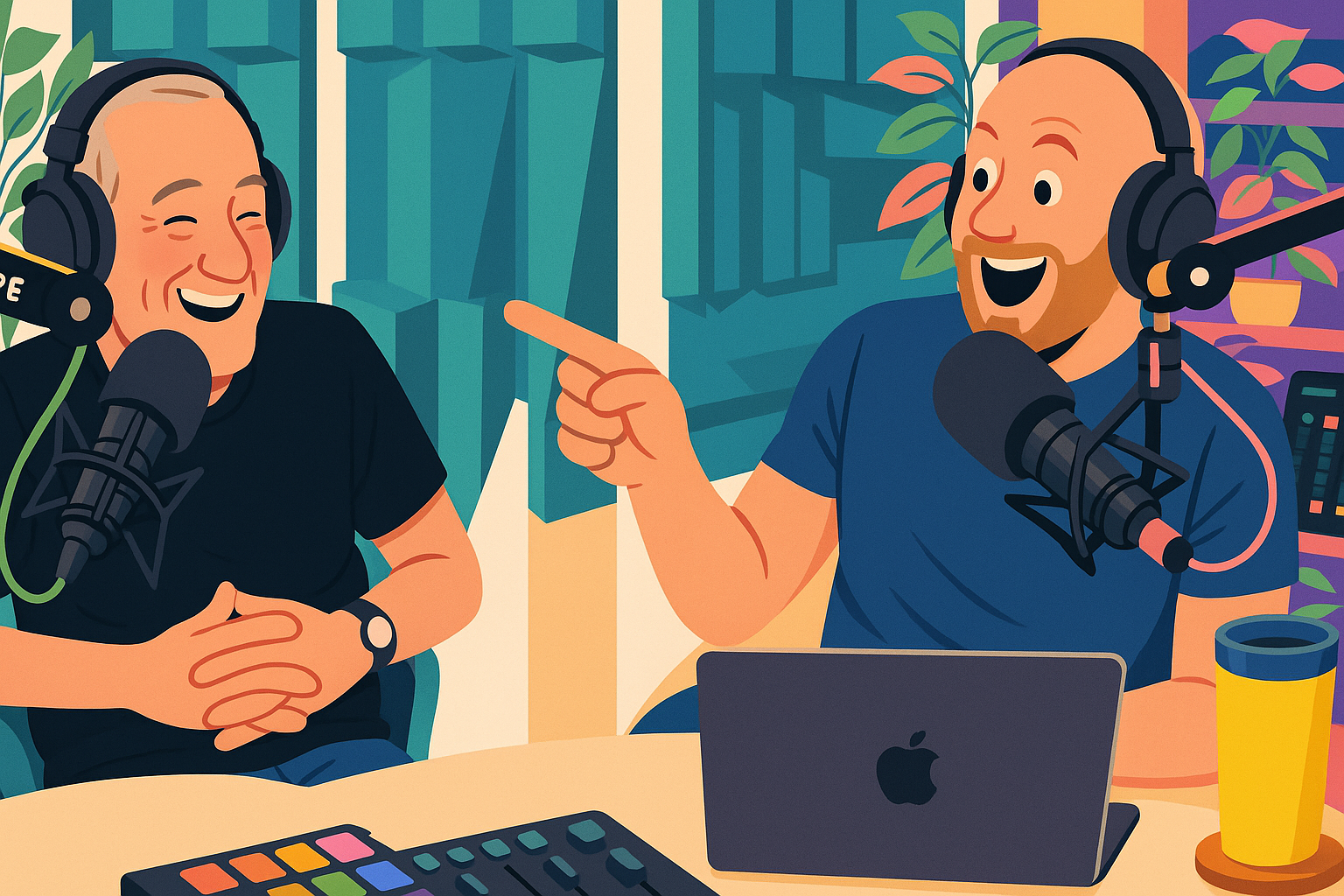
Layers of Reality: Exploring the Metaverse Stack
When the headset comes off, does the world you were just in disappear—or does it linger somewhere between your senses and memory?
n our latest episode of Modem Futura, Andrew Maynard and I explore the metaverse as more than a corporate buzzword or sci-fi dream. We approach it as a continuum of realities — a multi-layered “stack” that spans the physical and digital, each tier more immersive than the last.
From our own immersive sessions with the Apple Vision Pro, we reflect on that strange moment of re-entry—when the headset comes off and the world feels slightly less real. It’s a feeling that raises existential questions about presence, identity, and how AI-generated worlds are shaping the boundaries of human experience.
In this episode, we trace the metaverse’s origins from Neil Stephenson’s Snow Crash to today’s spatial computing revolutions. We ask what happens when digital spaces become persistent and indistinguishable from physical ones—and why futures thinking is essential for guiding that transition responsibly. From procedurally generated AI environments to the idea of “digital sustainability,” we discuss how these technologies will reshape privacy, ethics, and our collective sense of reality.
Ultimately, this conversation is about our tethers to truth. In an age of deeply immersive AI systems and blended realities, how do we find our totem—our anchor that keeps us grounded in what matters most? We believe that intentional design, transparency, and care must guide how we build these new worlds before they begin to build us.
Subscribe and Connect!
Subscribe to Modem Futura wherever you get your podcasts and connect with us on LinkedIn. Drop a comment, pose a question, or challenge an idea—because the future isn’t something we watch happen, it’s something we build together. The medium may still be the massage, but we all have a hand in shaping how it touches tomorrow.
🎧 Apple Podcast: https://apple.co/4p7ZZcr
🎧 Spotify: https://open.spotify.com/episode/2C5LiGRYCdZgr5JijtK7LI?si=0FbAEihfTD6QXX5FN-2nag
📺 YouTube: https://youtu.be/iCAtutBmN5w
🌐 Website: https://www.modemfutura.com/

We Turned One - plus Liquid Media, Work Slop, and the Road Ahead – Episode 53
Year One, Human First: How We’re Building a Relational Future Podcast
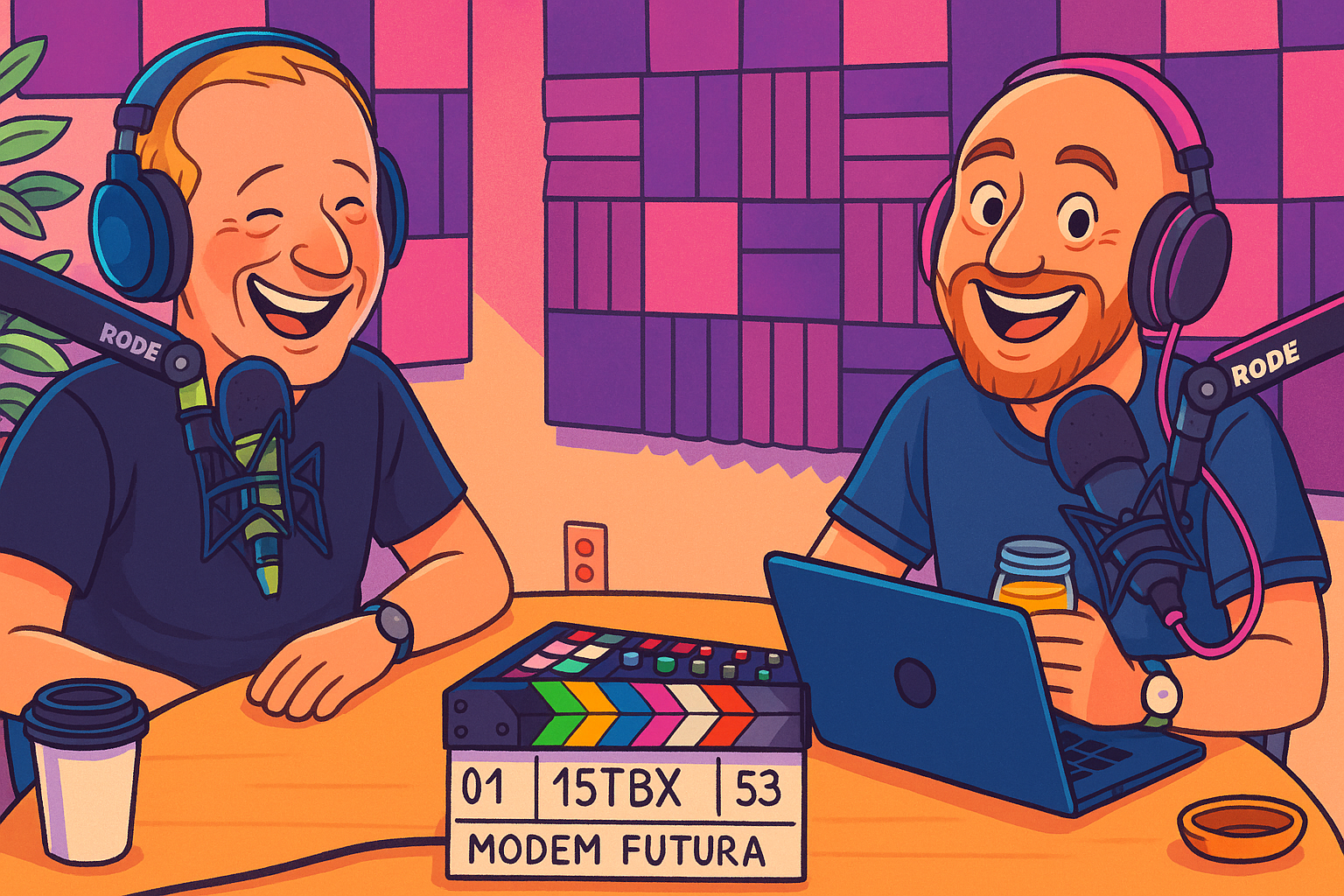
When ChatGPT thinks you run a podcast gameshow - this is how it draws you ;)
Fifty‑two straight weeks, many guests, and countless “aha” moments later, Modem Futura just turned one. Instead of a victory lap, we used this episode to do what we always do: invite you into the studio while we make sense of the future—together.
From day one we set out to be relational rather than transactional. That means no polished lectures and no sugar‑coated takes. It means showing our work, making space for genuine curiosity, and trusting that a community grows when people feel like they’ve pulled up a chair at the table. Over the past year, that approach has taken us everywhere—from AI and AGI to bio‑hybrid robots, simulation hypotheses, autonomous mobility (including a Waymo ride‑along), space futures, and media theory, just to scratch the top of the list. Listeners have told us they’re using episodes to kick off team discussions, and yes, we’re even astronaut approved! (Thanks Cady). That’s rocket fuel!
This anniversary episode isn’t just about reflections we also look ahead. We probe “liquid media”—from tools like NotebookLM to Huxe’s 24/7 AI‑generated radio—and ask where convenience ends and exhaustion begins. We talk about “work slop,” the plausible‑sounding but soulless output AI can slip into workflows, and the hidden cognitive tax leaders pay to verify it. And to keep futures thinking playful, we run a “Futures Improv” lightning round: AI pets smarter than real ones? Brain‑to‑brain headbands at work? Meditation‑mandated robotaxis? Jurassic Park on the Moon? The point isn’t to predict perfectly—it’s to stretch how we think so we can exercise our radical creativity. (Maybe this should become a reoccurring segment? - I’ll need to craft up a quick theme song I think… )
What’s on the calendar for next year? Expect deeper dives into human‑centered AI, experiments with spatial and wearable interfaces (Vision Pro, Meta’s glasses), and conversations that foreground care—for people, institutions, and futures worth having. And as Andrew’s new book AI and the Art of Being Human lands, we’ll keep exploring how technology can amplify, not erode, what makes us…us.
Join us:
Listen to the anniversary episode and subscribe on your favorite app
Comment with one idea we should explore next—or what we should put in the “empty chair” on non‑guest weeks
If the show sparked a conversation where you work, tell us how. We’ll highlight examples in a future episode.
If you believe better futures are built through candid, caring conversation, you’re in the right place.
Subscribe and Connect!
Subscribe to Modem Futura on a favorite podcast platform, follow on LinkedIn, and join the conversation by sharing thoughts and questions. The medium may still be the massage, but everyone has a chance to shape how it kneads modern culture—and to decide what kind of global village we ultimately build.
🎧 Apple Podcast: https://apple.co/48oB1QS
🎧 Spotify: https://open.spotify.com/episode/1H29Q1LnP8oL7LER1gS6wa?si=5j97IKzGSjGJFlZSQMS-hg
📺 YouTube: https://youtu.be/FX0DmYgIe0w
🌐 Website: https://www.modemfutura.com/