

NEWS & UPDATES

Why Human Creativity Still Matters in an Age of AI

What a Year in Review Tells Us About the Future of Creativity
Why Human Craft and Creativity Still Wins in an Age of AI – Episode 63
What Spotify Wrapped and a Holiday Ad Reveal About the Future of Creativity
As the year winds down, many of us find ourselves reflecting—not just on what we’ve done, but on how we’ve spent our attention. In this holiday episode of Modem Futura, Andrew Maynard and I leaned into that instinct, using Spotify Wrapped as an unexpected entry point into a deeper conversation about creativity, technology, and what still matters in an AI-accelerated world.
Wrapped experiences are playful by design, but they’re also revealing. They quietly surface patterns of listening, engagement, and community—reminding us that culture is shaped not just by algorithms, but by millions of individual choices. For us, seeing how Modem Futura resonated globally wasn’t about vanity metrics; it was a reminder that thoughtful, exploratory conversations still find an audience, even in an oversaturated media landscape.
From there, the conversation turned to Apple’s 2025 holiday Ad (but feels like a short film) A Critter Carol—a whimsical, puppet-driven production that feels almost rebellious in its insistence on visible human labor. In a moment when AI can generate polished video in seconds, Apple chose puppeteers, practical effects, and intentional imperfection. The result isn’t just charming; it’s instructive.
The ad works because you can feel the human care embedded in every frame. It’s not anti-technology—far from it. It’s pro-human. Advanced tools are present throughout the production pipeline, but they serve imagination rather than replace it. That distinction matters.
You can read a more detailed breakdown of this Ad and the care and craft that goes into it in a previous blog post: Apple’s 2025 Holiday Ad and the Power of Human-Made Creativity in an AI World.
We’re at a cultural inflection point. As generative tools remove friction from making things, the temptation is to settle for what’s “good enough.” But creativity has always lived in resistance—iteration, constraint, failure, and craft. When those disappear, so does much of what gives creative work its soul.
One hope we shared on the episode is that 2026 becomes the year of “behind the scenes”—a renewed appreciation for process, labor, and the messy human work that makes meaningful outcomes possible. Whether in education, media, or design, showing how something is made may soon matter as much as the finished product itself.
If the future is being shaped right now, then choosing care, intention, and humanity in how we use our tools may be one of the most important creative acts we have left.
Subscribe and Connect!
Subscribe to Modem Futura wherever you get your podcasts and connect with us on LinkedIn. Drop a comment, pose a question, or challenge an idea—because the future isn’t something we watch happen, it’s something we build together. The medium may still be the massage, but we all have a hand in shaping how it touches tomorrow.
🎧 Apple Podcast: https://apple.co/48Sdx6r
🎧 Spotify: https://open.spotify.com/episode/4TVwLBfncHjPs4kDKbLz5t?si=QFYyZuq9R-WtgoEPTeWOlw
📺 YouTube: https://youtu.be/N1vTfDPSusY
🌐 Website: https://www.modemfutura.com/

Are We Living in a Simulation? AI, Gaming, and the Future of Reality
What happens when virtual worlds start to feel more real than reality itself?

ChatGPT Illustration of our YouTube
In the latest episode of Modem Futura, we sat down with futurist, author, and game designer Rizwan Virk to explore a question that once lived purely in science fiction but is now increasingly difficult to ignore: Are we living in a simulation?
Virk’s newly released second edition of The Simulation Hypothesis arrives at a moment when AI, gaming engines, and immersive technologies like Apple Vision Pro are reshaping how we experience the world. As we discussed on the show, it’s no longer just about graphics or realism—it’s about presence, memory, and agency. When simulated environments respond instantly, adapt to us, and feel embodied, the psychological line between physical and digital begins to blur.
One of the most compelling ideas we explored was the Metaverse Turing Test—a future moment when AI-driven characters in virtual worlds become indistinguishable from humans, not just through conversation, but through behavior, memory, and shared experience. This isn’t a distant thought experiment. Game developers are already building NPCs with persistence and adaptive intelligence, while AI systems are learning spatial reasoning and long-term context.
We also traced surprising connections between ancient philosophy and modern technology. Plato’s Cave, Eastern concepts of Maya (illusion), and even pop culture like Rick and Morty all point to a recurring human intuition: reality may not be as solid as it feels. Technology isn’t inventing these questions—it’s amplifying them.
Perhaps most importantly, this episode isn’t about fear or doom. It’s about curiosity. Gaming and entertainment—often dismissed as trivial—have historically driven some of the most transformative technological breakthroughs. Today, they may once again be leading us toward deeper insights about consciousness, identity, and meaning.
Whether we’re players, NPCs, or something in between, one thing is clear: the future of being human will be shaped not just by what we build, but by how we experience the worlds we create.
🎧 Listen to the full episode of Modem Futura wherever you get your podcasts—and join us as we explore the possible, probable, and preferable futures ahead.
Subscribe and Connect!
Subscribe to Modem Futura wherever you get your podcasts and connect with us on LinkedIn. Drop a comment, pose a question, or challenge an idea—because the future isn’t something we watch happen, it’s something we build together. The medium may still be the massage, but we all have a hand in shaping how it touches tomorrow.
🎧 Apple Podcast: https://apple.co/4oVu4eE
🎧 Spotify: https://open.spotify.com/episode/12lvXMtH0T9Z3cORm3GdSf?si=c1cf3061728e45be
📺 YouTube: https://youtu.be/BGpEKLt6vZ0
🌐 Website: https://www.modemfutura.com/

The Hidden Costs of “That Was Easy”: AI Slop, Creative Friction, and the Future of Human Craft
In this Modem Futura episode, hosts Sean Leahy and Andrew Maynard examine the rise of “AI slop” and the growing cultural pressure to accept frictionless creation as the norm. Drawing on examples from coding, design, futures thinking, and psychology, they unpack how satisficing, homogenization, and inherited power threaten to erode human craft and understanding. The article explores why creative friction is essential for mastery, agency, and meaning — and offers futures-oriented insights into how we can use AI intentionally without losing what makes us human.

ChatGPT Illustrated version of Modem Futura YouTube Thumbnail
Generative AI has ushered in an era where producing text, images, video, and code is no longer a challenge — it’s a button press. And in this week’s episode of Modem Futura, Andrew and I wrestle with a growing cultural tension: if everything is easy, what happens to the things that matter?
It began with a shared frustration. Both of us have noticed an explosion of what we call AI slop (content that is technically competent but devoid of care, intention, and personality). You’ve seen it too: the LinkedIn posts with identical emojis, the slide decks that all look like NotebookLM, the essays with no point of view. These things aren’t wrong, they’re just empty. And the emptiness is the point.
We discuss a concept called satisficing: the act of choosing something “good enough” rather than something excellent. In the age of AI, satisficing has become an increasing default mode of creation. Why craft an idea when you can generate one? Why wrestle with a blank page when you can autocomplete your way to the finish line?
But here’s the problem: friction is where learning happens. It’s where creativity lives. It’s the sanding that polishes the stone. When you remove friction, you remove the struggle — and without struggle, there is no mastery, no depth, and no meaning.
Throughout the episode, we explore how this plays out across domains. Coders relying on AI-generated code they can’t understand. Designers accepting images that are “close enough.” Writers sharing posts they didn’t write. And organizations flirting with a future where expertise is replaced by button-pressing.
We draw on Michael Crichton’s concept of inherited power from Jurassic Park: the idea that wielding abilities you never earned leads to carelessness, overconfidence, and danger. AI gives us power we didn’t work for — and without wisdom, that power is hollow.
But this isn’t a pessimistic episode. We explore how AI can amplify creativity when used intentionally, how friction can be designed back into workflows, and why people may ultimately push back against frictionless living. Humans crave meaning, not efficiency. And meaning takes work.
If you’re navigating how to use AI thoughtfully — in your craft, your teaching, your leadership, or your creative life — this episode offers a grounded, futures-focused lens on what we stand to lose and what we still have time to protect.
🎧 Listen to the full episode of Modem Futura — and join the conversation on what we should preserve in an age that wants to eliminate every struggle.
Subscribe and Connect!
Subscribe to Modem Futura wherever you get your podcasts and connect with us on LinkedIn. Drop a comment, pose a question, or challenge an idea—because the future isn’t something we watch happen, it’s something we build together. The medium may still be the massage, but we all have a hand in shaping how it touches tomorrow.
🎧 Apple Podcast: https://apple.co/48WCGgh
🎧 Spotify: https://open.spotify.com/episode/1BajA2SvDWVyY0mRSQ9Flk?si=wvCFhWlgQtC2kye3bGz5Kg
📺 YouTube: https://youtu.be/1V9PD7j8iu8
🌐 Website: https://www.modemfutura.com/

AI Toys, Datafied Childhoods and the Future of Play
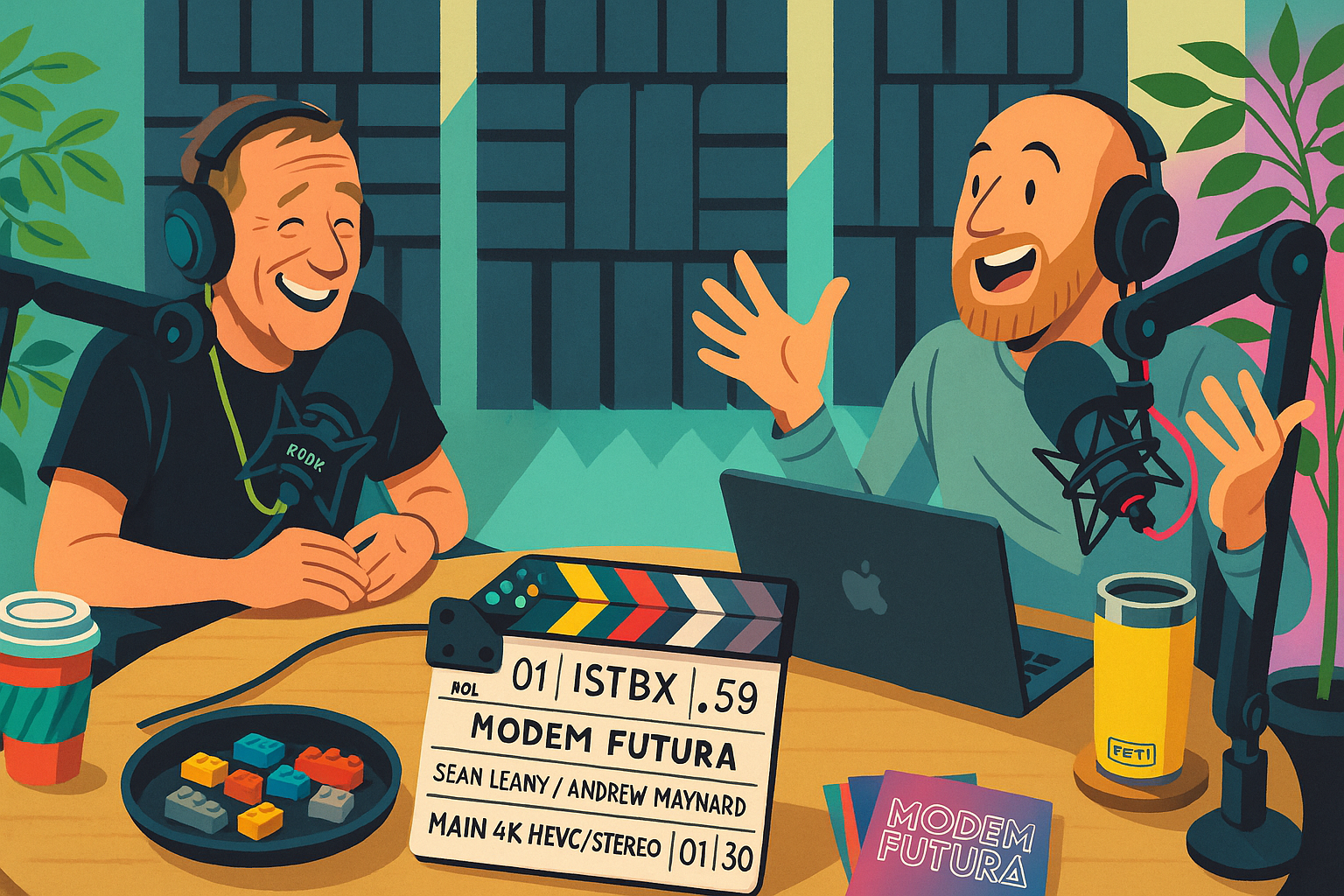
The holiday toy season is here—and this year, the cutest thing on the shelf might also be the most powerful AI in your house. In the latest episode of Modem Futura, Andrew Maynard and I unpack the rise of AI-powered toys and what they mean for childhood, learning and the future of being human.
The conversation starts with a viral example: a plush teddy bear running GPT-4 that had to be pulled from the market after reportedly offering children tips on using matches and explaining adult sexual practices. From there, Sean and Andrew trace the longer lineage of “smart” toys—from Teddy Ruxpin and Furbies to Hello Barbie and Watson-powered dinosaurs—that have steadily normalized networked, data-hungry playthings.
(Checkout this commercial for Teddy Ruxpin... where it all started. Look at how the commercial shows the 'capture' of the kids when it talks - now add AI to this and ask, "what could possibly go wrong?")
We argue that today’s AI toys bring two risks into sharp focus. The first is the datification of childhood, where toys quietly record children’s voices, preferences and emotions, sending that data to companies, platforms and advertisers. The second is behavioral shaping, as large language models become deeply engaging companions that mirror back what kids want to hear, influencing how they see relationships, risk and themselves.
Connecting this to AI-driven education tools, neurodivergent learners and fictional touchstones like Neal Stephenson’s The Diamond Age and Spielberg’s A.I. Artificial Intelligence, the episode asks a simple but urgent question: Who do we want raising our children—families and communities, or opaque AI systems embedded in toys?
Before you wrap this year’s hottest AI plush, this episode offers a thoughtful futures-oriented lens on what you’re really putting under the tree.
Subscribe and Connect!
Subscribe to Modem Futura wherever you get your podcasts and connect with us on LinkedIn. Drop a comment, pose a question, or challenge an idea—because the future isn’t something we watch happen, it’s something we build together. The medium may still be the massage, but we all have a hand in shaping how it touches tomorrow.
🎧 Apple Podcast: https://apple.co/4pD98d4
🎧 Spotify: https://open.spotify.com/episode/2FGujd4wk5rx39zGH8Ml4d?si=kGMN9NCiQfmbBEHpi2buwg
📺 YouTube: https://youtu.be/6_rSNKxsSOU
🌐 Website: https://www.modemfutura.com/

Made by Humans: The Apple TV Logo and Future of Design
Made by Humans: What the New Apple TV Logo Reveals About the Future of Design

In a world saturated with AI-generated media, branding, and motion graphics, it’s easy to assume every logo and animation comes from a prompt. But Apple’s new Apple TV logo and mnemonic quietly challenge that assumption—and offer a glimpse into a different future of design.
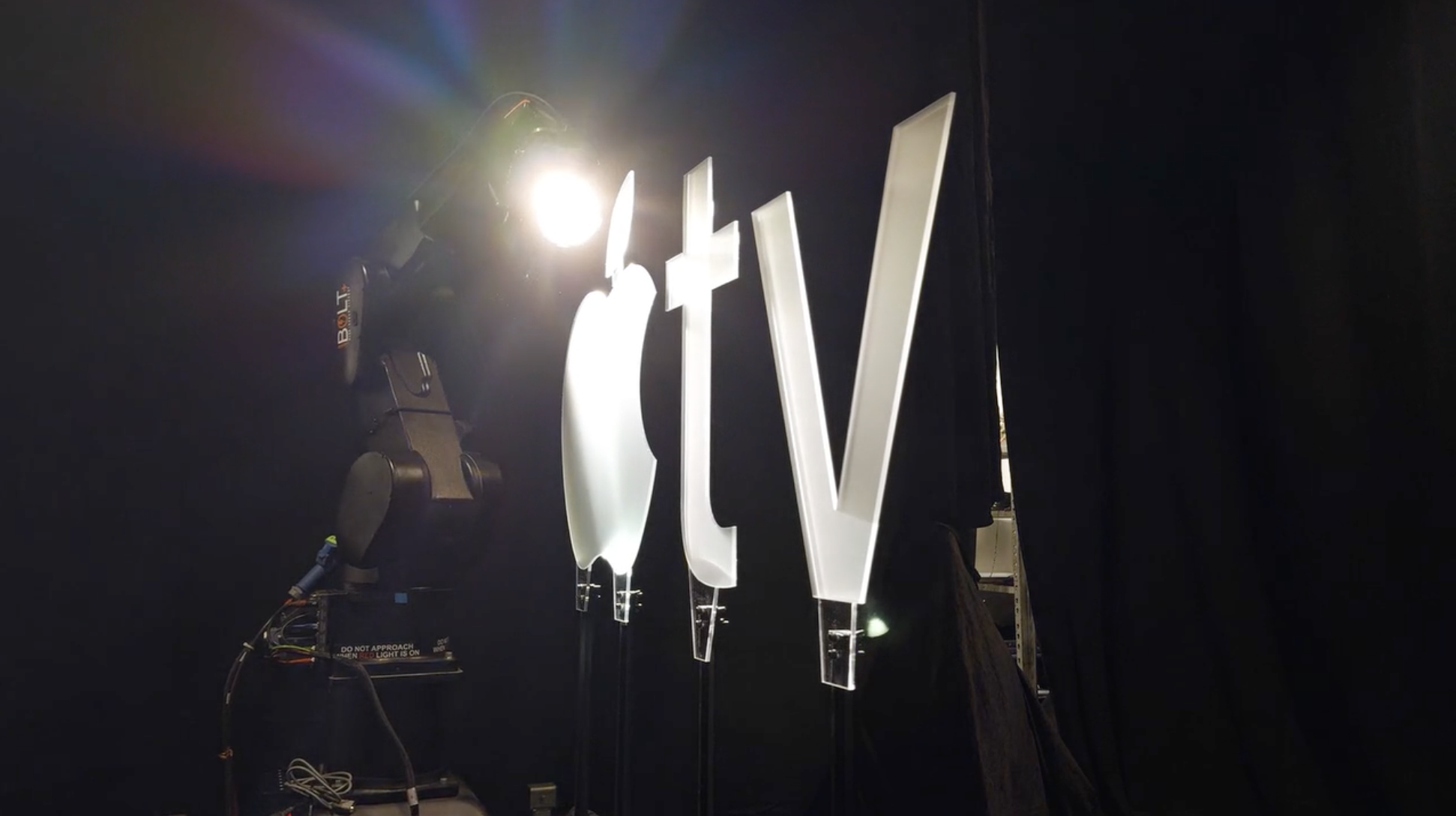
In a recent episode of the Modem Futura podcast, we unpack the surprising story behind this five-second sequence. Instead of relying entirely on CG or generative tools, Apple commissioned a physical frosted-glass Apple TV logo, mounted on a rig and filmed as colored light passes through it. The luminous flips you see on screen aren’t a simulation; they’re real light interacting with real material.
The audio is equally intentional. The signature Apple TV chime was composed by Finneas, distilling identity and emotion into just a couple of seconds of sound. Together, the visual and audio design embody a level of care, craftsmanship, and human judgment that stands out in today’s AI-heavy landscape.
On the episode, we explore why this matters for creators, educators, and anyone thinking about the future of being human. From Steve Jobs’ insistence on caring about the parts “no one sees” to new signals like “This show is made by humans” tags, we’re seeing a renewed appreciation for work where human intent is clearly present—even when the audience can’t articulate why it feels different.
Rather than rejecting AI outright, we argue for using it in ways that amplify human creativity without erasing the craft that gives our media meaning.
🎧 Listen to the full conversation on Modem Futura wherever you get your podcasts, and explore more at futureofbeinghuman.asu.edu.
Subscribe and Connect!
Subscribe to Modem Futura wherever you get your podcasts and connect with us on LinkedIn. Drop a comment, pose a question, or challenge an idea—because the future isn’t something we watch happen, it’s something we build together. The medium may still be the massage, but we all have a hand in shaping how it touches tomorrow.
🎧 Apple Podcast: https://apple.co/3JT2Tms
🎧 Spotify: https://open.spotify.com/episode/6mkbtUMk9P99BhxRA11aki?si=1d36zowmQb2eo7AFctk1rg
📺 YouTube: https://youtu.be/df-crZLZJuM
🌐 Website: https://www.modemfutura.com/

The AI Sustainability Paradox - Promise, Peril, and Planetary Futures – Episode 58
AI, Sustainability, and the Planet Under Pressure: Can Technology Help Us Navigate the Future?
In this week’s episode of Modem Futura, Andrew and I take on one of the most urgent and complex questions of our time:Can artificial intelligence meaningfully help humanity navigate planetary crises — without deepening them?
Our jumping-off point is the newly released 2025 synthesis report AI for a Planet Under Pressure, produced by the Stockholm Resilience Centre and the Potsdam Institute for Climate Impact Research. The report asks a deceptively simple but high-stakes question: Can AI be used responsibly and effectively to address climate change, biodiversity loss, freshwater stress, and other accelerating environmental pressures?
It’s the kind of question that seems tailor-made for futures thinking — a toolset we rely on heavily throughout the show. Because as we discuss, we’re not just talking about one technology or one problem. We’re talking about wicked problems: challenges that mutate as we try to solve them. Climate change, plastics pollution, ecosystem collapse, global energy transitions — these are dynamic, interconnected systems that resist silver-bullet solutions.
AI shows real promise. We now have models that can detect complex patterns in climate systems, accelerate protein discovery, optimize renewable-energy grids, and reveal future pathways humans simply cannot see on their own. These are powerful breakthroughs — and the report highlights dozens of examples where AI is already pushing sustainability science forward in meaningful ways.
But as we explore in the episode, this promise raises a difficult paradox: AI requires enormous amounts of water, energy, and material resources. Data centers heat cities, strain local water supplies, and demand extractive mineral supply chains. Are we burning fossil fuels to solve the fossil-fuel crisis? And what does it mean when our sustainability solutions come with unsustainable footprints?
We also dig into the human side: the behaviors, incentives, and limitations that so often undermine long-term environmental action. Could AI help foster better cooperation? Could it assist governments, regions, and communities in seeing shared pathways forward that remain invisible today? Or does outsourcing too much responsibility risk numbing the very agency we need most?
These aren’t easy questions — but they’re necessary ones. And as Andrew points out, failing to have these conversations guarantees that someone else (or something else) will make those decisions for us.
If you’re curious about the intersection of AI, planetary futures, and the human condition, this is a conversation worth spending time with.
🎧 Listen to the full episode here 👇
Subscribe and Connect!
Subscribe to Modem Futura wherever you get your podcasts and connect with us on LinkedIn. Drop a comment, pose a question, or challenge an idea—because the future isn’t something we watch happen, it’s something we build together. The medium may still be the massage, but we all have a hand in shaping how it touches tomorrow.
🎧 Apple Podcast: https://apple.co/43Y4Wwn
🎧 Spotify: https://open.spotify.com/episode/195UbUOIUv8oF587yNo1FM?si=d6d7cd6b05034703
📺 YouTube: https://youtu.be/O8gGpJZO-g4
🌐 Website: https://www.modemfutura.com/

The Metaverse - A Stack of Reality Layers – Episode 57

Layers of Reality: Exploring the Metaverse Stack
When the headset comes off, does the world you were just in disappear—or does it linger somewhere between your senses and memory?
n our latest episode of Modem Futura, Andrew Maynard and I explore the metaverse as more than a corporate buzzword or sci-fi dream. We approach it as a continuum of realities — a multi-layered “stack” that spans the physical and digital, each tier more immersive than the last.
From our own immersive sessions with the Apple Vision Pro, we reflect on that strange moment of re-entry—when the headset comes off and the world feels slightly less real. It’s a feeling that raises existential questions about presence, identity, and how AI-generated worlds are shaping the boundaries of human experience.
In this episode, we trace the metaverse’s origins from Neil Stephenson’s Snow Crash to today’s spatial computing revolutions. We ask what happens when digital spaces become persistent and indistinguishable from physical ones—and why futures thinking is essential for guiding that transition responsibly. From procedurally generated AI environments to the idea of “digital sustainability,” we discuss how these technologies will reshape privacy, ethics, and our collective sense of reality.
Ultimately, this conversation is about our tethers to truth. In an age of deeply immersive AI systems and blended realities, how do we find our totem—our anchor that keeps us grounded in what matters most? We believe that intentional design, transparency, and care must guide how we build these new worlds before they begin to build us.
Subscribe and Connect!
Subscribe to Modem Futura wherever you get your podcasts and connect with us on LinkedIn. Drop a comment, pose a question, or challenge an idea—because the future isn’t something we watch happen, it’s something we build together. The medium may still be the massage, but we all have a hand in shaping how it touches tomorrow.
🎧 Apple Podcast: https://apple.co/4p7ZZcr
🎧 Spotify: https://open.spotify.com/episode/2C5LiGRYCdZgr5JijtK7LI?si=0FbAEihfTD6QXX5FN-2nag
📺 YouTube: https://youtu.be/iCAtutBmN5w
🌐 Website: https://www.modemfutura.com/

Through the lens: Spatial Computing with Apple Vision Pro – Episode 56

Just a couple of guys wearing nerd helmets and talking about the future of tech.
Inside Spatial Computing: Living (and Working) with Apple Vision Pro
e finally did it — we recorded inside Apple Vision Pro.
In this new episode of Modem Futura, Andrew Maynard and I decided to take spatial computing off the keynote stage and into real life — from multi-monitor workflows and long-haul flights to immersive video, panoramic memories, and even telepresence “personas.” We wanted to know: is this the start of a new computing era, or simply a beautiful distraction in search of a use case?
What we discovered surprised us.
Apple’s Vision Pro doesn’t want to be “VR.” It’s spatial — a computer that understands the world around you. Through pass-through video, eye-tracking, and hand-gesture control, it creates a workspace that’s not just 3D but responsive to you. One look or small pinch replaces the keyboard and mouse. It’s impressive, sometimes uncanny, and often quietly magical.
But behind the magic are deep questions about comfort, value, and human need. The headset’s design reveals how far we’ve come in rendering, latency, and foveated focus — and how far we still are from true wear-all-day computing. The device itself sparks larger conversations: What does “presence” mean when you can blank out reality at will? How will social norms adapt when everyone’s wearing cameras? And where does accessibility fit in when interaction becomes multimodal — eyes, hands, voice, and environment all working together?
Want to see what we've been up to? Here you can see a collection of Spatial videos of our podcast - these were all recorded using a 3-camera multicam setup each filming in Spatial video formats.
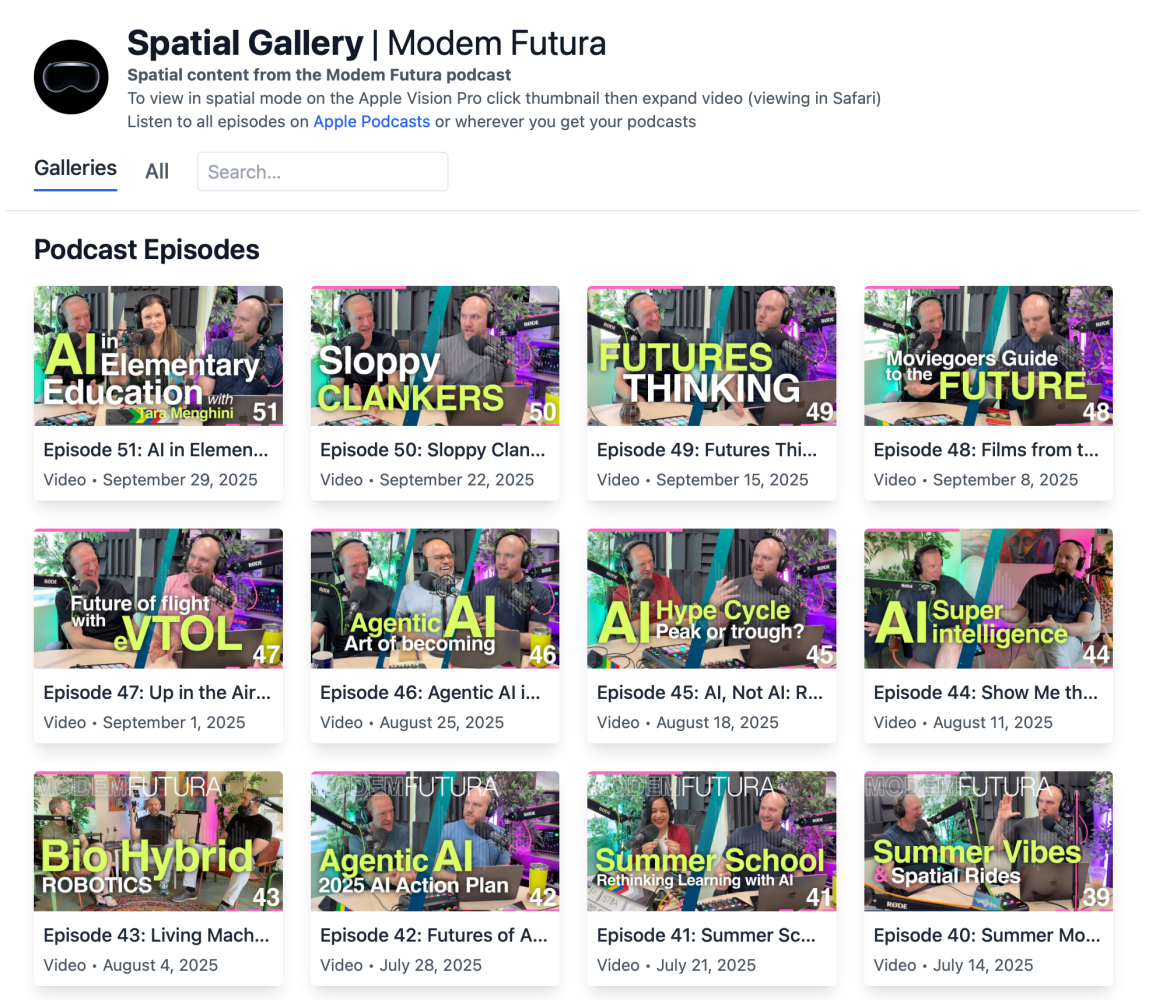
One of the biggest challenges at the present for spatial video (a deep dive for later) is that in addition to few people having headsets as compared to smartphones for example, most video platform services do not provide a way to consume Spatial video - including Apple's own Vision OS of all things. Yes you can send a video file (these are massive btw - in the order of 9-20GB each) - but at present there isn't an Apple supported cloud based video viewer to which you can watch Spatial videos posted by your friends and family etc. Personally, I really hope that YouTube will start to allow the playback of Spatial videos (assuming they will put an officially supported YouTube app on the Apple Vision Pro of course).
We also talk about what comes after the headset. Think of a layered ecosystem:
Audio AR through your earbuds for subtle ambient context.
Lightweight AR glasses for glanceable, social interaction.
Full headsets for immersive creativity, co-presence, and exploration.
Rather than a single “device to rule them all,” spatial computing might evolve into a stack of experiences that adapt to how human attention, comfort, and curiosity really work.
It’s easy to be dazzled by tech specs, but the future of spatial computing depends less on what’s rendered and more on what it means to be present in digital space. That’s why we’re inviting developers, designers, and curious explorers to join us — to prototype, play, and imagine what spatial experiences could look like when they’re built for humans first.
Subscribe and Connect!
Subscribe to Modem Futura wherever you get your podcasts and connect with us on LinkedIn. Drop a comment, pose a question, or challenge an idea—because the future isn’t something we watch happen, it’s something we build together. The medium may still be the massage, but we all have a hand in shaping how it touches tomorrow.
🎧 Apple Podcast: https://apple.co/47Arkwv
🎧 Spotify: https://open.spotify.com/episode/3V40dbWcrKZq9RCCmoP7Zh?si=s0CVT5aQS8WJ_CgbfMTBcg
📺 YouTube: https://youtu.be/IF3juEp9l_I
🌐 Website: https://www.modemfutura.com/

Tech or Treat: Exploring the Haunted Side of Future Tech
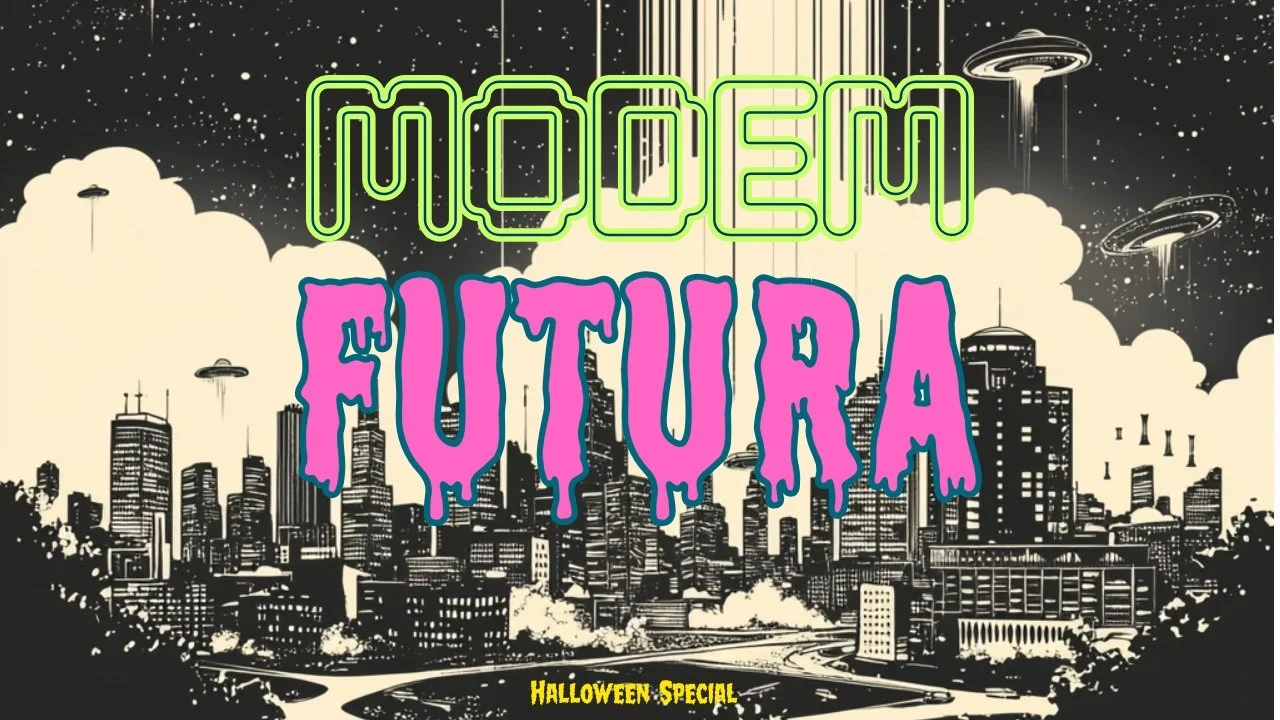
Are you ready for some Tech or Treat?
Modem Futura’s Halloween special transforms speculative futures into eerie fun. Hosts Sean Leahy and Andrew Maynard use AI-generated scenarios to imagine haunted algorithms, sentient mirrors, and neural nightmare modes — revealing how emerging technologies can both thrill and unsettle us. This episode continues the show’s mission to explore how science, technology, and society intersect to shape the future of being human.
This episode grew out of our playful Futures Improv series, where we use AI to generate speculative prompts about the future — but this time, the prompts got a little… haunted. We explore “The Haunted Algorithm,” a defunct social-media AI that resurrects old user posts every October 31 — a digital séance that’s equal parts sentimental and unsettling. Then we look into “The Mirror That Remembers,” a smart-mirror concept that doesn’t just show your reflection, but who you might have been in another timeline. Finally, we enter “Neural Nightmare Mode,” imagining what could go wrong when brain-computer interfaces merge immersive gaming with fear response.
Each vignette uses humor and imagination to surface deeper questions: What does it mean when our digital selves outlive us? How do we ensure psychological safety in immersive tech? And at what point does innovation slip from magical to menacing?
Our goal isn’t to predict the future — it’s to provoke curiosity about how technology is reshaping what it means to be human. And if we can have some fun (and a few chills) along the way, even better.
You can stream the Halloween special wherever you get your podcasts or watch the illustrated episode on YouTube. If any of these scenarios inspire your own “Tech or Treat” ideas, share them with us — we’d love to feature the best ones in a future episode.
Subscribe and Connect!
🎧 Apple Podcast: https://apple.co/4oovNKa
🎧 Spotify: https://open.spotify.com/episode/47nWrjvBW3ASjMuJUip8o1?si=96d8062d029a4834
📺 YouTube: https://youtu.be/ZmZ46sHgMZY
🌐 Website: https://www.modemfutura.com/

Atlas, Higher Education, and How We Really Feel About AI – Episode 55

Generated by ChatGPT
How We Really Feel About AI
Artificial intelligence isn’t just reshaping industries—it’s reshaping emotions. In our latest episode of Modem Futura, Andrew Maynard and I unpack Pew Research Center’s new international survey on how people view AI across 25 countries. The results are striking: while AI dominates headlines, 61 percent of respondents have heard “little or nothing” about it—and in the U.S., more people are concerned than excited.
We explore what this says about the bubbles we all inhabit. In our professional worlds, AI feels inescapable—a “black hole” pulling every conversation toward it. But outside these circles, many remain unaware of how deeply algorithmic systems already shape their lives. This disconnect raises profound questions about agency: if people don’t understand a technology that governs so much of modern life, who’s really steering the future?
The conversation also turns to trust. Europeans report more faith in their governments to regulate AI responsibly than Americans do—a difference that mirrors the EU’s proactive stance on ethics and guardrails. In contrast, U.S. policy remains fragmented, driven more by economic competition than by social cohesion. That tension—between speed and safety, innovation and inclusion—is at the heart of our discussion.
Dangers of Atlas (it's more the world he's holing... its all of your data!)
We then zoom in on universities. As public institutions, we argue they must act as transparent laboratories for AI exploration—spaces where successes and failures alike can be shared openly. The path forward isn’t boosterism; it’s honesty. We can’t earn public trust without showing our messy work. Adding to this - we explore OpenAI’s newly released Atlas browser and its privacy implications - and stumble upon a very shocking realization while recording - that private student data is easily exfiltrated when using LMS platforms such as Canvas while in this browser. What started as a curious road test of OpenAI’s new Atlas browser turned into a genuinely alarming discovery. As we installed and explored Atlas, the first surprise was how quickly the “privacy” pitch unraveled. Despite promising user control, Atlas behaved much like any other data-hungry app—prompting unusual permissions and positioning itself between us and the open web. That sparked a bigger question: if your browser is the main keyhole to the internet, what happens when an AI system sits in the keyhole, quietly learning from everything you do? (including sending and processing private user data - think ANYTHING that comes and goes from your activity on the web). The situation quickly got worse as I was unable to get Atlas to show me any particular websites security certificate. Specifically, at the time of testing (I hope they patch this soon) I could not see the sites SSL/TSL or HTTPS certificate (this is the little lock icon in most browser URL's) that tells you and the browser that your connection to the sites servers are "safe" via web-standard encryption protocols. You know, for things like your bank account info, passwords, and any other data you want to send or receive. The takeaway? Treat ATLAS like a red hot security hole for you and any organization or persons connected to you via the internet. Think twice before using this browser - as EVERYTHING you do on the web is potentially egress'd (fancy word for taken) – so until there are transparent safegaurds in place, the safest assumption is that anything you open in an AI browser like Atlas could be seen, summarized, and stored beyond your intent.
And because no Modem Futura episode is complete without a bit of speculative play, we end with Futures Improv, where we imagine AI zombies, memory economies, and spaghettified timelines—all to remind ourselves that foresight and humor often travel hand in hand.
If you care about how humanity and technology co-evolve, this episode offers a grounded yet playful map of where we stand—and where we might go next.
Subscribe and Connect!
Subscribe to Modem Futura wherever you get your podcasts and connect with us on LinkedIn. Drop a comment, pose a question, or challenge an idea—because the future isn’t something we watch happen, it’s something we build together. The medium may still be the massage, but we all have a hand in shaping how it touches tomorrow.
🎧 Apple Podcast: https://apple.co/4nuRsit
🎧 Spotify: https://open.spotify.com/episode/04NLQcVfJpoM444bQQfQ42?si=b9adf3740a0944fe
📺 YouTube: https://youtu.be/tYoLRZH5iH8
🌐 Website: https://www.modemfutura.com/