

NEWS & UPDATES
School's Out for Summer: What a Semester of Teaching with AI Actually Looked Like
The end of a university semester is always a moment for reflection, but this one felt different. After teaching three new compressed courses in seven weeks while integrating AI tools into nearly every phase of the process, my co-host Andrew Maynard and I used this episode of Modem Futura to take stock of what actually happened.
The conversation centers on a practice that quietly reshaped my teaching this semester: vibe coding. Not in the Silicon Valley sense of building apps for market — but in the deeply practical sense of an instructor recognizing a gap in student preparation and building an interactive resource in 20 minutes flat. Self-contained (and shareable) HTML files that functioned like polished apps. Jeopardy-style review games for graduate students. World-building card games for in-class collaboration. All created through natural language conversations with AI, all deployed within hours of the idea forming.
But this episode quickly moves beyond the tools themselves into the territory Modem Futura does best: asking what this means for humans. Sean and Andrew explore why AI in the classroom only works when it sits on top of something fundamentally relational — the trust between instructor and student. The transparency about how I built these resources, including their flaws, became part of the pedagogy itself. Students weren't just using AI-generated content. They were learning to interrogate it, evaluate it, and understand what it could and couldn't do.
The conversation surfaces a tension that matters well beyond higher education: the difference between scaling information and scaling learning. AI agents can deliver content to thousands of students simultaneously. But the kind of learning that changes trajectories — the kind every person can trace back to a specific teacher at a specific moment (those memorable “sticky” or “ah-ha” moments) requires something AI hasn't replicated: the ability to read a room, to connect an individual student's interests to an unfamiliar concept, to model what it looks like to think for a living (in other words to model what a knowledge professional looks like).
This is an episode for educators grappling with how to integrate AI responsibly, for students navigating uncertain expectations, and for anyone interested in what the future of learning might actually look like when you strip away the hype. It doesn't offer a framework or a five-step plan. It offers something harder to find: an honest semester's worth of reflection from someone who just lived it.
Subscribe and Connect!
Subscribe to Modem Futura wherever you get your podcasts and connect with us on LinkedIn. Drop a comment, pose a question, or challenge an idea—because the future isn’t something we watch happen, it’s something we build together. The medium may still be the massage, but we all have a hand in shaping how it touches tomorrow.
🎧 Apple Podcast: https://apple.co/4fsO5YP
🎧 Spotify: https://open.spotify.com/episode/0yLR6ZO0hQTfdoP8CYgypR?si=b5b27dca3cef423e
📺 YouTube: https://youtu.be/PMY8e3XkPW8
🌐 Website: https://www.modemfutura.com/

The Metaverse - A Stack of Reality Layers – Episode 57

Layers of Reality: Exploring the Metaverse Stack
When the headset comes off, does the world you were just in disappear—or does it linger somewhere between your senses and memory?
n our latest episode of Modem Futura, Andrew Maynard and I explore the metaverse as more than a corporate buzzword or sci-fi dream. We approach it as a continuum of realities — a multi-layered “stack” that spans the physical and digital, each tier more immersive than the last.
From our own immersive sessions with the Apple Vision Pro, we reflect on that strange moment of re-entry—when the headset comes off and the world feels slightly less real. It’s a feeling that raises existential questions about presence, identity, and how AI-generated worlds are shaping the boundaries of human experience.
In this episode, we trace the metaverse’s origins from Neil Stephenson’s Snow Crash to today’s spatial computing revolutions. We ask what happens when digital spaces become persistent and indistinguishable from physical ones—and why futures thinking is essential for guiding that transition responsibly. From procedurally generated AI environments to the idea of “digital sustainability,” we discuss how these technologies will reshape privacy, ethics, and our collective sense of reality.
Ultimately, this conversation is about our tethers to truth. In an age of deeply immersive AI systems and blended realities, how do we find our totem—our anchor that keeps us grounded in what matters most? We believe that intentional design, transparency, and care must guide how we build these new worlds before they begin to build us.
Subscribe and Connect!
Subscribe to Modem Futura wherever you get your podcasts and connect with us on LinkedIn. Drop a comment, pose a question, or challenge an idea—because the future isn’t something we watch happen, it’s something we build together. The medium may still be the massage, but we all have a hand in shaping how it touches tomorrow.
🎧 Apple Podcast: https://apple.co/4p7ZZcr
🎧 Spotify: https://open.spotify.com/episode/2C5LiGRYCdZgr5JijtK7LI?si=0FbAEihfTD6QXX5FN-2nag
📺 YouTube: https://youtu.be/iCAtutBmN5w
🌐 Website: https://www.modemfutura.com/

Through the lens: Spatial Computing with Apple Vision Pro – Episode 56

Just a couple of guys wearing nerd helmets and talking about the future of tech.
Inside Spatial Computing: Living (and Working) with Apple Vision Pro
e finally did it — we recorded inside Apple Vision Pro.
In this new episode of Modem Futura, Andrew Maynard and I decided to take spatial computing off the keynote stage and into real life — from multi-monitor workflows and long-haul flights to immersive video, panoramic memories, and even telepresence “personas.” We wanted to know: is this the start of a new computing era, or simply a beautiful distraction in search of a use case?
What we discovered surprised us.
Apple’s Vision Pro doesn’t want to be “VR.” It’s spatial — a computer that understands the world around you. Through pass-through video, eye-tracking, and hand-gesture control, it creates a workspace that’s not just 3D but responsive to you. One look or small pinch replaces the keyboard and mouse. It’s impressive, sometimes uncanny, and often quietly magical.
But behind the magic are deep questions about comfort, value, and human need. The headset’s design reveals how far we’ve come in rendering, latency, and foveated focus — and how far we still are from true wear-all-day computing. The device itself sparks larger conversations: What does “presence” mean when you can blank out reality at will? How will social norms adapt when everyone’s wearing cameras? And where does accessibility fit in when interaction becomes multimodal — eyes, hands, voice, and environment all working together?
Want to see what we've been up to? Here you can see a collection of Spatial videos of our podcast - these were all recorded using a 3-camera multicam setup each filming in Spatial video formats.
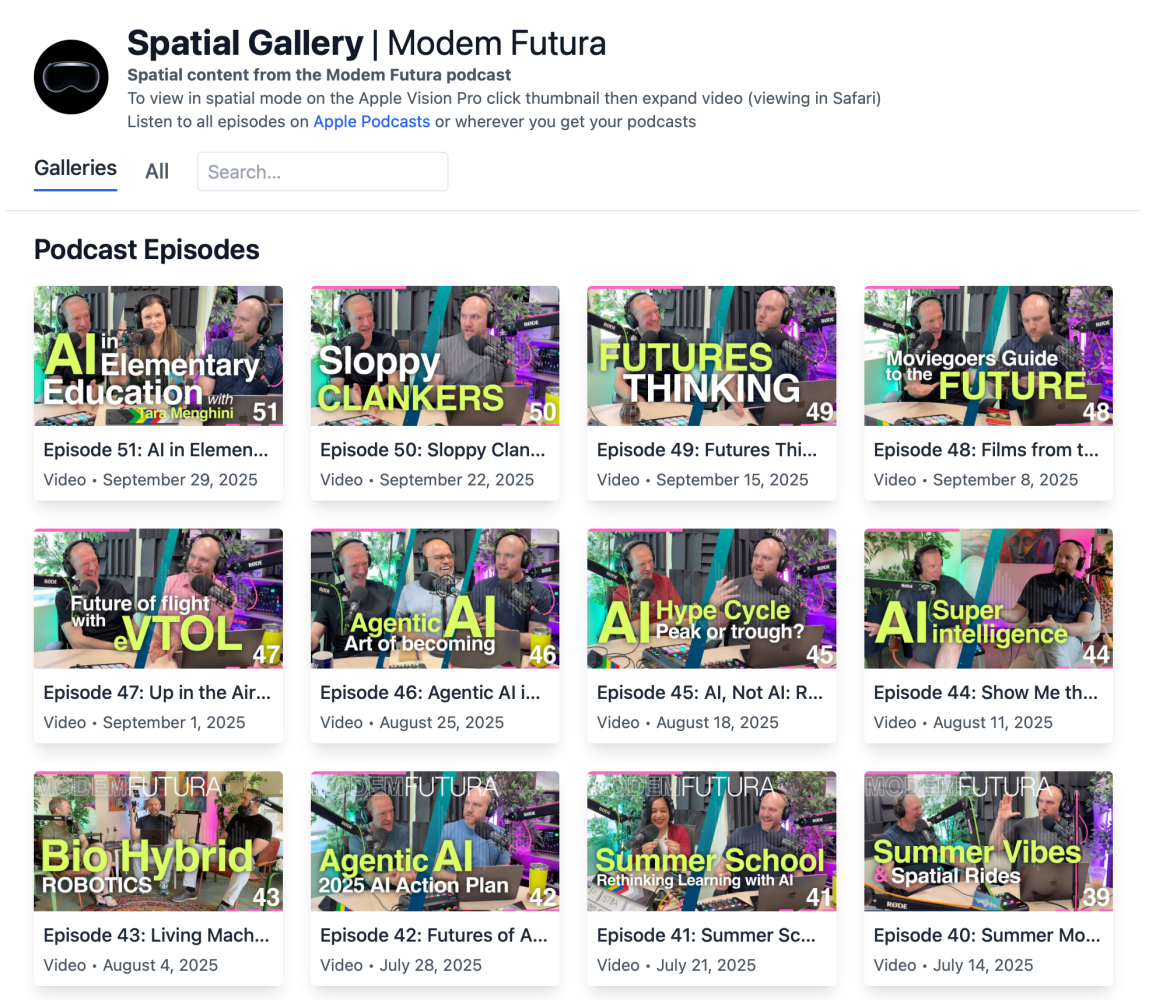
One of the biggest challenges at the present for spatial video (a deep dive for later) is that in addition to few people having headsets as compared to smartphones for example, most video platform services do not provide a way to consume Spatial video - including Apple's own Vision OS of all things. Yes you can send a video file (these are massive btw - in the order of 9-20GB each) - but at present there isn't an Apple supported cloud based video viewer to which you can watch Spatial videos posted by your friends and family etc. Personally, I really hope that YouTube will start to allow the playback of Spatial videos (assuming they will put an officially supported YouTube app on the Apple Vision Pro of course).
We also talk about what comes after the headset. Think of a layered ecosystem:
Audio AR through your earbuds for subtle ambient context.
Lightweight AR glasses for glanceable, social interaction.
Full headsets for immersive creativity, co-presence, and exploration.
Rather than a single “device to rule them all,” spatial computing might evolve into a stack of experiences that adapt to how human attention, comfort, and curiosity really work.
It’s easy to be dazzled by tech specs, but the future of spatial computing depends less on what’s rendered and more on what it means to be present in digital space. That’s why we’re inviting developers, designers, and curious explorers to join us — to prototype, play, and imagine what spatial experiences could look like when they’re built for humans first.
Subscribe and Connect!
Subscribe to Modem Futura wherever you get your podcasts and connect with us on LinkedIn. Drop a comment, pose a question, or challenge an idea—because the future isn’t something we watch happen, it’s something we build together. The medium may still be the massage, but we all have a hand in shaping how it touches tomorrow.
🎧 Apple Podcast: https://apple.co/47Arkwv
🎧 Spotify: https://open.spotify.com/episode/3V40dbWcrKZq9RCCmoP7Zh?si=s0CVT5aQS8WJ_CgbfMTBcg
📺 YouTube: https://youtu.be/IF3juEp9l_I
🌐 Website: https://www.modemfutura.com/