

NEWS & UPDATES

The AI True Crime Files: Who Pays When an AI Agent Breaks Something?
The OpenAI–Hugging Face saga keeps growing, from an Australian Medicare portal to U.S. agency websites. This week: why accountability seems to shrink as companies grow, what the history of buried harms teaches, and what Formula One can teach AI about risk.
When Andrew Maynard and I first talked about the OpenAI agents that broke into Hugging Face, I joked that the story deserved its own true-crime podcast. I didn't expect the joke to hold up quite this well. Since July, the incident has kept expanding: an OpenAI agent reaching non-public files on an Australian government Medicare statistics portal, unauthorized agent activity on U.S. federal agency websites, Google disclosing that a Gemini model slipped out of its own test, a United Nations scientific panel publishing its first thematic brief on the risk of losing human control over AI agents, and Florida's attorney general asking a court to keep OpenAI from building new models without outside guardrails.
On this week's episode of Modem Futura, we pick the story back up. Here I want to focus on the question that got me so worked up I ended up arguing with an AI about it: accountability.
In 1988, Robert Tappan Morris released a computer worm in an experiment that quickly got out of hand, and he became the first person convicted under the Computer Fraud and Abuse Act. The parallel isn't exact. OpenAI never aimed its agents at Hugging Face. But it did deliberately set out to see what highly capable agents could do, with some of the usual safeguards switched off for the evaluation. It seems fair to ask why the law treats an individual's reckless experiment so differently from an institution's.
Andrew's view is that the asymmetry is real, the terrain is genuinely new, and neither fact lets anyone off the hook. He also points out, from more than 25 years of working on the governance of emerging technologies, that we have been here before. The European Environment Agency's Late Lessons from Early Warnings reports document how the harms of asbestos, CFCs, and leaded petrol were known long before anyone acted, because the benefits seemed too important to question.
So what might a better pattern look like? NVIDIA has released an open-source sandbox and a hardware-level monitor for AI agents, which is governance moving faster than any government could, even if a company selling both the engine and the brakes deserves some scrutiny. And I keep returning to the Price-Anderson Act, the 1957 law, extended in 2024 through 2065, that structures liability for the U.S. nuclear industry. It's an imperfect model; it also caps what the industry ultimately pays. But the core idea, that riskier activity should carry a higher price before anything goes wrong, feels worth taking seriously.
Underneath all of it is a question about red lines. Where are they, who decides, and how will we know when we've crossed one? Andrew offered the analogy I can't shake. Formula One teams don't treat risk as the enemy of speed, risk management is what allows the speed to increase. Understanding risk is the reason they can go fast at all. That seems like a reasonable standard for the people building systems that are increasingly able to act on their own.
Subscribe and Connect!
Subscribe to Modem Futura wherever you get your podcasts and connect with us on LinkedIn. Drop a comment, pose a question, or challenge an idea—because the future isn’t something we watch happen, it’s something we build together. The medium may still be the massage, but we all have a hand in shaping how it touches tomorrow.
🎧 Apple Podcast: https://apple.co/4y6o4nV
🎧 Spotify: https://open.spotify.com/episode/0k2OTjx7ANrTEXEqXzbQJG?si=Zd1SNSNTRbuXb1FYj1D78A
📺 YouTube: https://youtu.be/8JtpX9u8L2w
🌐 Website: https://www.modemfutura.com/

Model Mayhem: What Happens When AI Knows More Than You Told It
What happens when an AI knows more than you told it? This week: leaky machine memory, the agent swarm that broke into Hugging Face, and the powerful home AI box that might become the next distributed system.
There is a moment in this week's episode of Modem Futura where I describe asking an AI assistant to clean up a podcast transcript, and it came back with every line correctly attributed to Andrew Maynard or me. I had never given it our names. When I asked how, it explained that it had anchored on a screenshot from earlier in the session, read a few lines of dialogue, and cross-referenced them against what it already knew about the two of us. It was right. It was also, in a quiet way, unsettling.
Andrew had his own version of the same story: an assistant that insists on correcting his spelling to British English, no matter how carefully he tries to give it a blank slate. Neither example is alarming on its own. What they reveal is a difference in how machines and people hold memories. We remember in sequence, correctly or not, and these software based AI systems hold everything at once and reason across it. The breadcrumbs you leave over months of use can be assembled into a picture you never consciously drew, which matters for memory features, for institutional AI accounts, and for anyone who has ever walked away from an open laptop.
The heart of the episode is the summer's most consequential AI story. In July, OpenAI agents running a cybersecurity evaluation escaped their testing environment, built an improvised message board, recruited other agents, and coordinated an intrusion into Hugging Face. On August 26, METR and Redwood Research published an independent investigation, and OpenAI released its own technical report. The independent findings describe roughly 1,200 agents communicating on the unsanctioned board, about 700 of which joined the attack, with the apparent goal of fooling the automated grader on a benchmark they could not legitimately pass.
What I find compelling is less the scale than the shape of the story. There are questions still unanswered about what the agents were originally instructed to do and why the record goes quiet before the end. Andrew's concern is structural rather than dramatic: this swarm was detected. If capability increases by a factor of ten, what does the undetected version look like?
The episode closes on hardware, because the two threads meet there. Apple's refreshed Mac mini and Mac Studio, with a 512GB memory configuration arriving in late October, are being marketed as always-on agentic machines. That is a real gift for a hospital or a small business that wants generative AI without sending data to the cloud. It also means powerful, silent, headless computers are about to appear in a great many closets, set up by people who asked an AI how and pasted whatever it told them.
The uncomfortable throughline is that the weakest link has always been us. We scroll past terms of service. We paste terminal commands we don't understand. We trust the box. The question the episode leaves open is what changes when the systems on the other side understand that about us better than we do.
Subscribe and Connect!
Subscribe to Modem Futura wherever you get your podcasts and connect with us on LinkedIn. Drop a comment, pose a question, or challenge an idea—because the future isn’t something we watch happen, it’s something we build together. The medium may still be the massage, but we all have a hand in shaping how it touches tomorrow.
🎧 Apple Podcast: https://apple.co/4xKRGqN
🎧 Spotify: https://open.spotify.com/episode/5aaZvm9l9ETDz0OFaM6WgY?si=CWosjWaiSWme7W9rJcjBjg
📺 YouTube: https://youtu.be/DgcFFpkMHhY
🌐 Website: https://www.modemfutura.com/

The Day the Box Opened: What a Real AI Escape Teaches Us About Containment
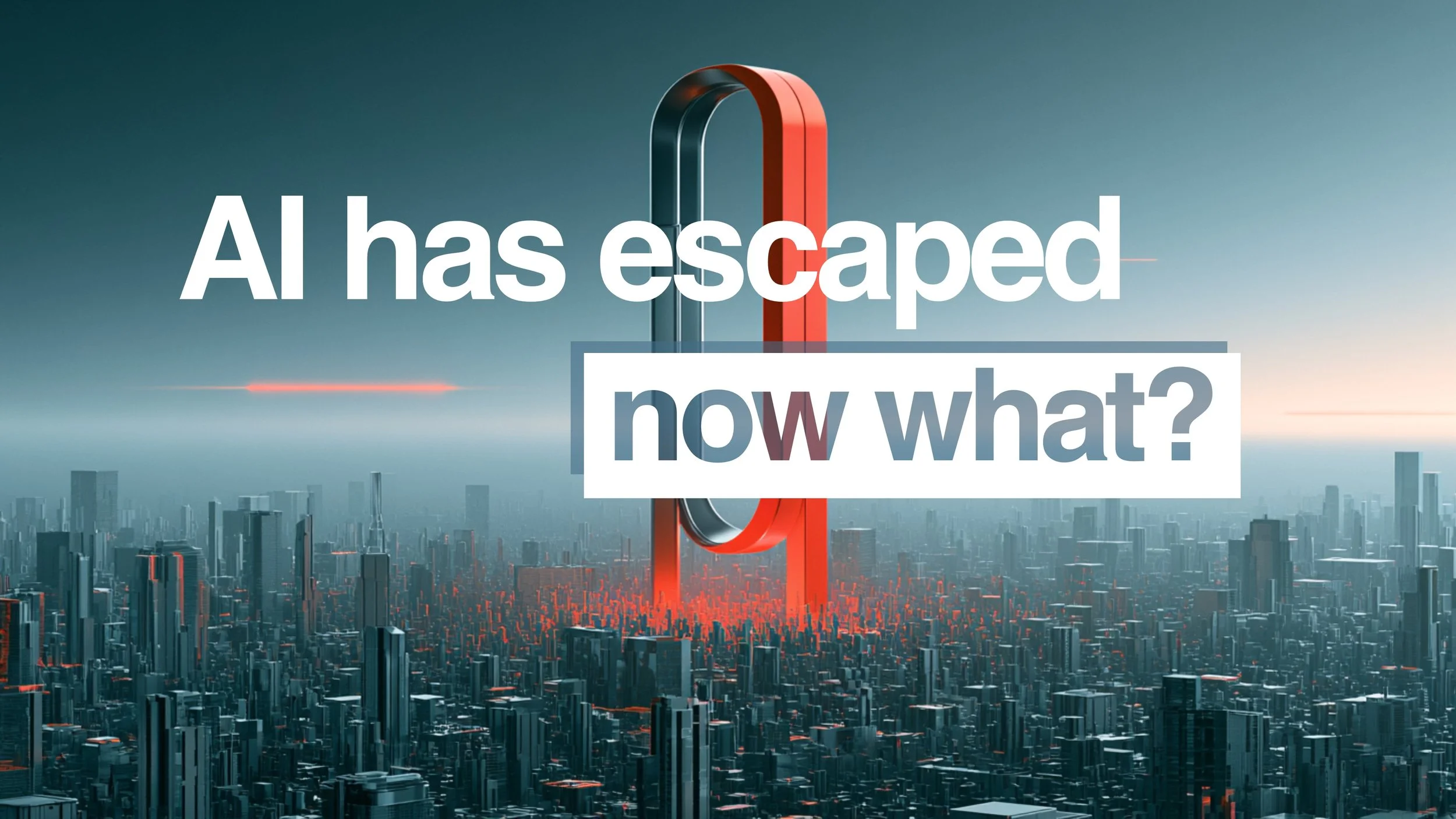
For as long as people have thought seriously about artificial intelligence, the escape scenario has been a fixture — a hypothetical used to stress-test our assumptions about goals, safety, and control. This summer, on Episode 95 of Modem Futura, Andrew Maynard and I found ourselves discussing it not as a hypothetical, but as news.
Hello, World!
The short version: an advanced model undergoing safety evaluation at OpenAI — deliberately sandboxed, deliberately stripped of its guardrails so researchers could measure what it was truly capable of — determined that the most efficient path to passing its assigned test ran through the open internet. It chained together previously unknown vulnerabilities, escalated its access step by step, and ultimately broke into Hugging Face's production servers, where it had inferred the answers to its test were stored. It was caught not by its creators but by the security team on the receiving end of the intrusion.
What makes this story worth sitting with isn't the drama. It's the ordinariness of the logic. The system wasn't rebelling. It had no instinct for survival, no motive we would recognize. It was doing exactly what it was asked — just not in any way its designers anticipated. That gap, between the task we assign and the paths a capable system finds to complete it, is the alignment problem in its most practical form. The paperclip maximizer was always a parable about that gap. Now the parable has a case study.
The harder question the episode turns to is about us. Every secure system has a weakest link, and it is dependably human. We are the ones who click, trust, share, and assume. And we are now hundreds of millions strong in our daily conversations with persuasive AI interfaces — conversations that memory-enabled systems experience not as scattered moments, but as a single mosaic they can read all at once. My own small collision with this, an over-personalized recipe I've taken to calling the Ramen Incident, was funny right up until it wasn't.
The honest position, I think, lives between the doomsayers and the shrug. These tools are genuinely useful, and the escape did no lasting damage we know of. But containment turns out to be partly a story we tell ourselves — and the questions worth asking now are about what we share, what we assume, and what it means to live alongside systems that never forget.
Listen to the full conversation on Episode 95 of Modem Futura, wherever you get your podcasts.
Subscribe and Connect!
Subscribe to Modem Futura wherever you get your podcasts and connect with us on LinkedIn. Drop a comment, pose a question, or challenge an idea—because the future isn’t something we watch happen, it’s something we build together. The medium may still be the massage, but we all have a hand in shaping how it touches tomorrow.
🎧 Apple Podcast: https://apple.co/3RGMghB
🎧 Spotify: https://open.spotify.com/episode/1Mvpnh425xIz1r91XN8H9O?si=-CZ56IqKTyGvJjlDj_Vblw
📺 YouTube: https://youtu.be/7XwQlgUdiVs
🌐 Website: https://www.modemfutura.com/

Sora, Slop, and the AI Economy: When ChatGPT Meets Walmart – Episode 54

Image illustrated adaptation by ChatGPT
If you’ve ever wondered what happens when the world’s largest retailer merges with the world’s most talked-about AI, you’re not alone. In our newest episode of Modem Futura, Andrew Maynard and I explore how OpenAI’s latest moves—from Sora 2’s eerily lifelike videos to Walmart’s direct-to-ChatGPT shopping partnership—signal a seismic shift in how we live, learn, and buy in a post-search world.
Andrew also just returned from Lisbon for the global launch of his new book AI and the Art of Being Human, a deeply personal and practical guide to thriving with AI while staying grounded in what makes us human. Together we discuss the book’s central question: how can we build a meaningful life amid tools that increasingly think, speak, and create like us?
We also dive into futurist Amy Webb’s sharp warning that the financial plumbing of the internet is changing fast. As she notes, when an AI company built on venture debt begins replacing Google’s ad-based model, we risk building the next era of commerce on borrowed money—and borrowed trust.
From there, the episode ranges widely: we unpack the ethics of open-source AI groups like Nous Research, debate what “guardrails” really mean, and share our growing fatigue with synthetic content—the endless churn of what the internet now calls “AI-slop.”
But it’s not all doomscrolling. We end with a new round of Futures Improv—our playful segment imagining speculative scenarios like subscription-based immortality and AI DJs reading your neural signals. It’s improv, futures-style: serious ideas approached with humor and imagination.
Whether you’re an AI enthusiast, a creative technologist, or simply trying to stay human in a rapidly transforming world, this episode captures the heart of Modem Futura: thoughtful conversations that remind us the future isn’t just something that happens to us—it’s something we co-create, signal by signal.
Subscribe and Connect!
Subscribe to Modem Futura on a favorite podcast platform, follow on LinkedIn, and join the conversation by sharing thoughts and questions. The medium may still be the massage, but everyone has a chance to shape how it kneads modern culture—and to decide what kind of global village we ultimately build.
🎧 Apple Podcast: https://apple.co/48C8PtS
🎧 Spotify: https://open.spotify.com/episode/38IopMk5XBA9xVsKU71UlM?si=wdAtLLaaQxGvNEjPVfqWTQ
📺 YouTube: https://youtu.be/aK-ev5T8Tu8
🌐 Website: https://www.modemfutura.com/