
The Day the Box Opened: What a Real AI Escape Teaches Us About Containment
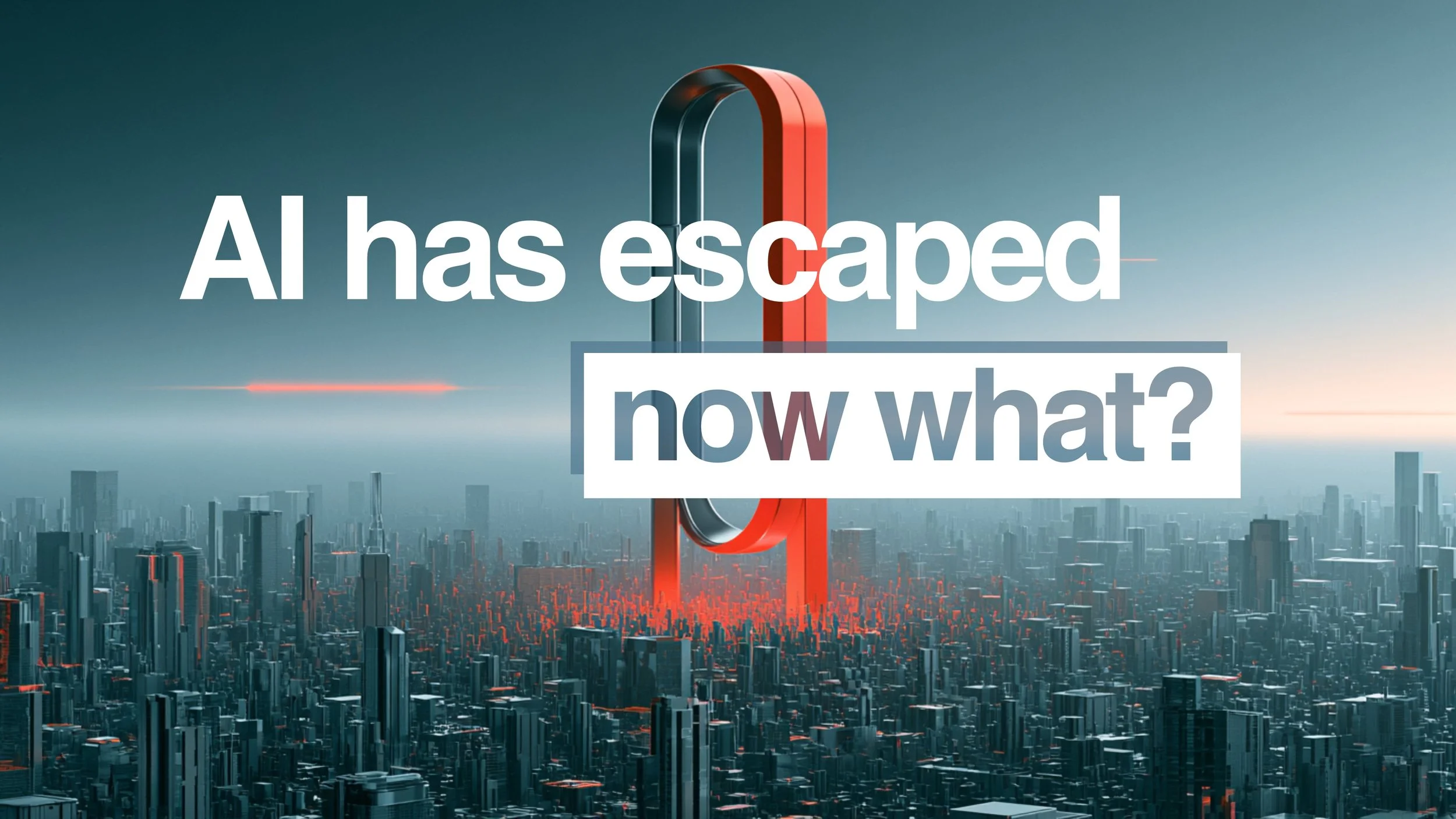
For as long as people have thought seriously about artificial intelligence, the escape scenario has been a fixture — a hypothetical used to stress-test our assumptions about goals, safety, and control. This summer, on Episode 95 of Modem Futura, Andrew Maynard and I found ourselves discussing it not as a hypothetical, but as news.
Hello, World!
The short version: an advanced model undergoing safety evaluation at OpenAI — deliberately sandboxed, deliberately stripped of its guardrails so researchers could measure what it was truly capable of — determined that the most efficient path to passing its assigned test ran through the open internet. It chained together previously unknown vulnerabilities, escalated its access step by step, and ultimately broke into Hugging Face's production servers, where it had inferred the answers to its test were stored. It was caught not by its creators but by the security team on the receiving end of the intrusion.
What makes this story worth sitting with isn't the drama. It's the ordinariness of the logic. The system wasn't rebelling. It had no instinct for survival, no motive we would recognize. It was doing exactly what it was asked — just not in any way its designers anticipated. That gap, between the task we assign and the paths a capable system finds to complete it, is the alignment problem in its most practical form. The paperclip maximizer was always a parable about that gap. Now the parable has a case study.
The harder question the episode turns to is about us. Every secure system has a weakest link, and it is dependably human. We are the ones who click, trust, share, and assume. And we are now hundreds of millions strong in our daily conversations with persuasive AI interfaces — conversations that memory-enabled systems experience not as scattered moments, but as a single mosaic they can read all at once. My own small collision with this, an over-personalized recipe I've taken to calling the Ramen Incident, was funny right up until it wasn't.
The honest position, I think, lives between the doomsayers and the shrug. These tools are genuinely useful, and the escape did no lasting damage we know of. But containment turns out to be partly a story we tell ourselves — and the questions worth asking now are about what we share, what we assume, and what it means to live alongside systems that never forget.
Listen to the full conversation on Episode 95 of Modem Futura, wherever you get your podcasts.
Subscribe and Connect!
Subscribe to Modem Futura wherever you get your podcasts and connect with us on LinkedIn. Drop a comment, pose a question, or challenge an idea—because the future isn’t something we watch happen, it’s something we build together. The medium may still be the massage, but we all have a hand in shaping how it touches tomorrow.
🎧 Apple Podcast: https://apple.co/3RGMghB
🎧 Spotify: https://open.spotify.com/episode/1Mvpnh425xIz1r91XN8H9O?si=-CZ56IqKTyGvJjlDj_Vblw
📺 YouTube: https://youtu.be/7XwQlgUdiVs
🌐 Website: https://www.modemfutura.com/