

NEWS & UPDATES

The Futures Cone: A Framework for Exploring What Could Be
How one deceptively simple tool can transform the way you think about uncertainty, possibility, and the choices that shape tomorrow.
There's a habit most of us share when it comes to thinking about the future: we treat it as a destination. A singular, somewhat “predictable” place that today's trends are quietly marching toward. It's a useful shorthand — but as a mental model, it's quietly limiting.
The Futures Cone, a foundational tool in the field of futures studies, offers a different way of seeing. Rather than imagining the future as a point, it asks you to imagine it as a cone — wide open, expanding outward from the present moment, filled with layers of possibility that range from the likely to the genuinely unthinkable.
How the Cone Works
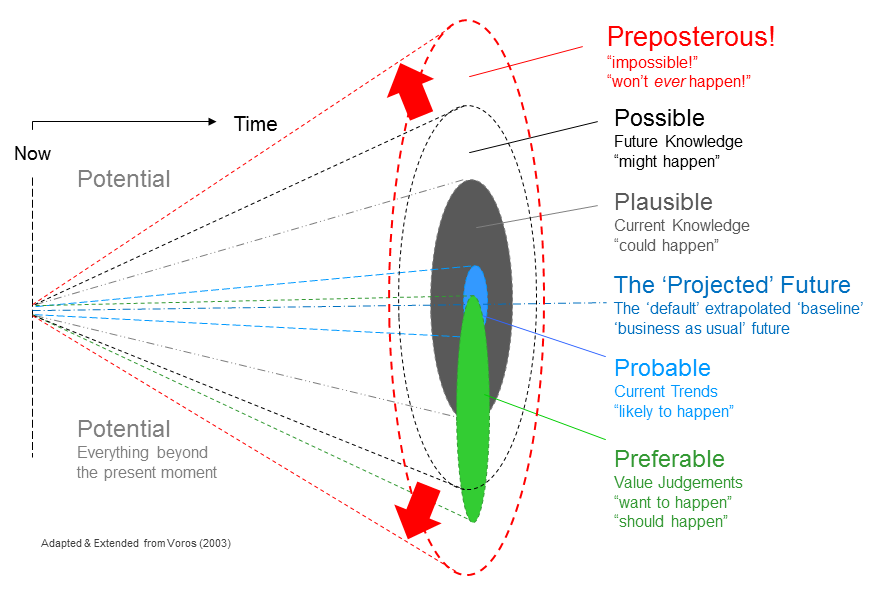
The narrowest point is now. As the cone extends outward through time, it widens to reveal different regions of possible futures, each defined by how much disruption or change would be required to bring them about:
Projected futures — the baseline; what happens if nothing changes
Probable futures — where current trends are pointing
Plausible futures — what could happen given known forces and trajectories
Possible futures — speculative, requiring future knowledge we don't yet have
Preposterous futures — the outer edge; scenarios that challenge our deepest assumptions about what is physically or socially feasible
Threaded through all of these is the Preferable future — not a separate ring, but a cross-section that asks: given everything in this cone, what do we actually want? Where do our values point?
The Dator-Clarke Line
One of the most provocative ideas associated with the cone is what's referred to as the Dator-Clarke Line — drawn from futurist James Dator's claim that any genuinely useful idea about the future should, at first glance, appear ridiculous. Paired with Arthur C. Clarke's observation that the only way to find the limits of the possible is to push into the impossible, it suggests that the most valuable futures work happens precisely in the uncomfortable space at the edge of the cone.
The practical implication is significant: if every idea your team generates sounds reasonable, you probably haven't stretched far enough. The preposterous isn't a failure of imagination — it's a boundary worth exploring.
Why This Tool Matters Now
In a period defined by technological acceleration, geopolitical uncertainty, and rapid social change, the instinct to "project forward" can feel reassuring — but it's also where strategic blind spots form. The Futures Cone doesn't resolve that uncertainty. Instead, it gives individuals, teams, and organizations a shared language for navigating it: a structured way to ask not just "what will happen?" but "what could happen, what might we prefer, and what are we willing to do about it?"
This is the subject of Episode 74 of Modem Futura, in which we walk through the cone layer by layer — and then demonstrate it live with a thought experiment that starts with frogs and ends somewhere near the moons of Jupiter.
Subscribe and Connect!
Subscribe to Modem Futura wherever you get your podcasts and connect with us on LinkedIn. Drop a comment, pose a question, or challenge an idea—because the future isn’t something we watch happen, it’s something we build together. The medium may still be the massage, but we all have a hand in shaping how it touches tomorrow.
🎧 Apple Podcast: https://apple.co/4bz1tIC
🎧 Spotify: https://open.spotify.com/episode/20Hz36eLfZ90M6EifUrRuu?si=swNkzHWZSLCelVSKsAyj7A
📺 YouTube: https://youtu.be/wc_e3dsY-vw
🌐 Website: https://www.modemfutura.com/
The Future From a Kid's Perspective: What a 10-Year-Old Thinks About AI, Jobs, and Meaningful Work
We spend a lot of time talking about young people when we discuss the future of technology. We debate how AI will affect their education, reshape their careers, and transform the world they'll inherit. But we rarely stop to ask them what they think.
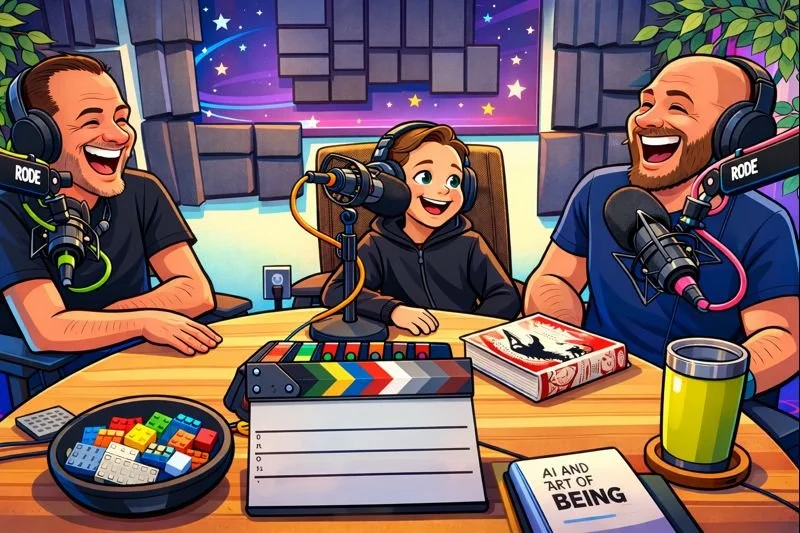
In this special episode of Modem Futura, we did exactly that. Freddie Leahy—co-host Sean's almost-10-year-old son—joined us for an unscripted conversation about artificial intelligence, meaningful work, and the questions that don't have easy answers.
Already Thinking About Job Displacement
When asked what he thinks about when he imagines the future, Freddie's first response wasn't about flying cars or space travel. It was about jobs.
"I kind of more think about the AI part of the future," he said. "And I'm just wondering what jobs will be overran by AI."
He's almost ten. And he's already calculating whether his dream career—paleontology—will exist by the time he's ready to pursue it.
This isn't abstract concern. Freddie has a specific vision: he wants to be like Alan Grant from Jurassic Park, out in the field, hands in the dirt, discovering fossils himself. When we suggested that AI might help him find more dinosaur bones faster, he didn't immediately embrace the idea. His worry isn't about efficiency—it's about being separated from the work itself.
"I would be doing it not for the money," he explained, "just because of the experience."
The Limits of AI Creativity
Freddie has firsthand experience with generative AI. He and I have spent time creating AI-generated images—D&D characters, fantasy creatures, book covers. But he's noticed something that many adults are also discovering: the gap between imagination and output.
"Every time you create an AI image," he said, "you never feel like it's quite right. So you just keep making these, and then you have to choose one, but in the end it never feels like the perfect cover you wanted."
When asked why, his answer was simple: "AI isn't our heads."
This observation—from a fourth-grader—gets at something fundamental about the current state of generative tools. They can produce impressive outputs, but they can't access the specific vision in your mind. The friction between prompt and result isn't just a technical limitation; it's a gap between human intention and machine interpretation.
When it comes to his own writing—Freddie is working on stories—he's clear that he doesn't want AI assistance. The temptation exists, especially when facing a blank page. But he recognizes something important: "It's the point about using your own creativity."
Suspicious of AI Companions
One of the most revealing exchanges came when we explored the idea of AI friendship. What if Freddie could have an AI companion who shared all his interests—someone who wanted to talk about dinosaurs as much as he does?
His response was immediate skepticism.
"That would be weird," he said, "because nobody likes what I like."
The very thing that might make an AI friend appealing—perfect alignment with his interests—is exactly what made it feel inauthentic. Part of what makes his interests meaningful is that they're his, distinct from the people around him. An AI that mirrored them perfectly would feel hollow.
When pressed further about whether he'd want an AI as a secret companion—a sort of digital spirit animal—Freddie remained uncertain. "Who knows what it could do," he noted. "It could hack everything."
There's healthy skepticism there, but also something deeper: a sense that friendship involves more than shared interests. It involves trust, vulnerability, and the unpredictability of another mind.
"I Refuse": Mind Uploading at Nine
During our Futures Improv segment, we posed a classic transhumanist scenario: What if you could upload your consciousness to a computer and live forever digitally, while your biological body remained behind?
Freddie's answer required no deliberation:
"I refuse. I will not upload my brain into a digital computer."
His reasoning was practical but profound. At nine years old, why would he abandon a body that works? The theoretical benefits of digital immortality don't outweigh the immediate reality of physical experience.
This perspective offers a useful counterweight to futures discourse that sometimes treats technological transcendence as obviously desirable. From Freddie's vantage point, the question isn't whether we can escape biological limitations, but whether we'd want to—and what we might lose in the process.
Questions Without Right Answers
Perhaps the most important takeaway from this conversation came near the end, when Freddie observed something about the nature of our questions.
"Because of all these questions," he said, "there is no wrong or right answer."
That's exactly right. The value of futures thinking isn't in predicting what will happen or determining the "correct" response to emerging technologies. It's in learning to sit with uncertainty, explore tensions, and develop our capacity for navigating complexity.
At almost ten years old, Freddie already understands this. He's not looking for definitive answers about AI and jobs and creativity. He's learning to ask better questions—and to recognize that asking them is more important than resolving them.
What the Future Thinks About Itself
We often frame conversations about technology and youth as adults preparing children for a world we're creating. But this episode suggests something different: young people are already thinking about these issues, often with more nuance than we might expect.
Freddie isn't anti-technology. He plays VR games, makes AI art, and follows developments in the field. But he's also holding onto something—a sense that some experiences are valuable precisely because we do them ourselves, that the struggle of creation is part of its meaning, and that efficiency isn't the only measure of a good life.
These aren't lessons we taught him. They're insights he's developing on his own, as he navigates a world where these technologies are simply part of the landscape.
Maybe the best thing we can do isn't to tell young people what the future will look like. Maybe it's to listen to what they already think about it—and learn from their perspective.
I don't know what the future holds for his generation. But if this conversation is any indication, they're thinking about it more carefully than we might expect.
Subscribe and Connect!
Subscribe to Modem Futura wherever you get your podcasts and connect with us on LinkedIn. Drop a comment, pose a question, or challenge an idea—because the future isn’t something we watch happen, it’s something we build together. The medium may still be the massage, but we all have a hand in shaping how it touches tomorrow.
🎧 Apple Podcast: https://apple.co/4khmVES
🎧 Spotify: https://open.spotify.com/episode/5nKjpEVZcaUDisdZpGGaMZ?si=YgWp_O84T1yVlBSloedV1w
📺 YouTube: https://youtu.be/mfumkJZav-M
🌐 Website: https://www.modemfutura.com/