
The Futures Cone: A Framework for Exploring What Could Be
How one deceptively simple tool can transform the way you think about uncertainty, possibility, and the choices that shape tomorrow.
There's a habit most of us share when it comes to thinking about the future: we treat it as a destination. A singular, somewhat “predictable” place that today's trends are quietly marching toward. It's a useful shorthand — but as a mental model, it's quietly limiting.
The Futures Cone, a foundational tool in the field of futures studies, offers a different way of seeing. Rather than imagining the future as a point, it asks you to imagine it as a cone — wide open, expanding outward from the present moment, filled with layers of possibility that range from the likely to the genuinely unthinkable.
How the Cone Works
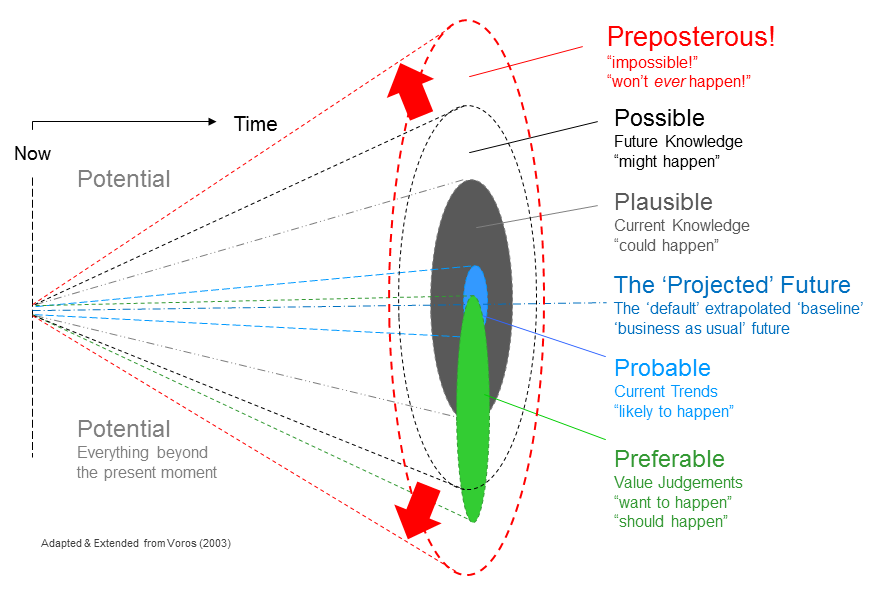
The narrowest point is now. As the cone extends outward through time, it widens to reveal different regions of possible futures, each defined by how much disruption or change would be required to bring them about:
Projected futures — the baseline; what happens if nothing changes
Probable futures — where current trends are pointing
Plausible futures — what could happen given known forces and trajectories
Possible futures — speculative, requiring future knowledge we don't yet have
Preposterous futures — the outer edge; scenarios that challenge our deepest assumptions about what is physically or socially feasible
Threaded through all of these is the Preferable future — not a separate ring, but a cross-section that asks: given everything in this cone, what do we actually want? Where do our values point?
The Dator-Clarke Line
One of the most provocative ideas associated with the cone is what's referred to as the Dator-Clarke Line — drawn from futurist James Dator's claim that any genuinely useful idea about the future should, at first glance, appear ridiculous. Paired with Arthur C. Clarke's observation that the only way to find the limits of the possible is to push into the impossible, it suggests that the most valuable futures work happens precisely in the uncomfortable space at the edge of the cone.
The practical implication is significant: if every idea your team generates sounds reasonable, you probably haven't stretched far enough. The preposterous isn't a failure of imagination — it's a boundary worth exploring.
Why This Tool Matters Now
In a period defined by technological acceleration, geopolitical uncertainty, and rapid social change, the instinct to "project forward" can feel reassuring — but it's also where strategic blind spots form. The Futures Cone doesn't resolve that uncertainty. Instead, it gives individuals, teams, and organizations a shared language for navigating it: a structured way to ask not just "what will happen?" but "what could happen, what might we prefer, and what are we willing to do about it?"
This is the subject of Episode 74 of Modem Futura, in which we walk through the cone layer by layer — and then demonstrate it live with a thought experiment that starts with frogs and ends somewhere near the moons of Jupiter.
Subscribe and Connect!
Subscribe to Modem Futura wherever you get your podcasts and connect with us on LinkedIn. Drop a comment, pose a question, or challenge an idea—because the future isn’t something we watch happen, it’s something we build together. The medium may still be the massage, but we all have a hand in shaping how it touches tomorrow.
🎧 Apple Podcast: https://apple.co/4bz1tIC
🎧 Spotify: https://open.spotify.com/episode/20Hz36eLfZ90M6EifUrRuu?si=swNkzHWZSLCelVSKsAyj7A
📺 YouTube: https://youtu.be/wc_e3dsY-vw
🌐 Website: https://www.modemfutura.com/