

NEWS & UPDATES

Ice to Water - Exploring Biotechnology through Virtual Reality

It was an honor to present this paper, Ice to water: Exploring biotechnology through virtual reality at the 35th EdMedia + Innovate Learning Conference (by AACE) in Vienna Austria this week. A special thank you to my co-authors for their hard work and contributions to the paper (Ahbi and Mustafa!).
Ice to water: Exploring biotechnology through virtual reality
(Sean Leahy, Mustafa Demir, & Abhishek Singharoy)
Paper Abstract
The BioSense Network has developed a new generation of a virtual computational microscope using virtual reality (VR) to bring the wonders of the microscopic world of biotechnology to a mainstream audience. Funded by the U.S. Department of Defense National Defense Education Program (DOD NDEP), the BioSense Network aims to build sustainable biotechnology programs for middle and high schools by redefining the approach to biotechnology learning in the K-12 environment enabling learners to experience the behavior and interactions of molecules in a simulated first-hand experience in virtual reality.

Revolutionizing Higher Ed with AI: Insights from the ShapingEDU Mini Summit

Utilizing AI Tools
Empowering educators to create more impactful, personalized learner opportunities
“Artificial Intelligence has the potential to create more impactful, individualized learning journeys that maximize learning experiences at every step, and streamline educator’s workload. With the wildly fast-paced introduction of new AI tools, we’re forced to process a new array of challenges and opportunities almost daily.”
What an incredible event - so many wonderful panelists and discussions around the potential impact of AI and Higher Education. I am very grateful for having the opportunity to co-host this with the amazing Stephanie Pierotti. I’m already looking forward to future conversations…
Agenda
9:15amPT | Early Bird Coffee + Trivia
9:30amPT | Welcome! Why We're Here (Stephanie Pierotti, ASU ShapingEDU Director + Dr. Sean Leahy, ASU Director of Creative and Emerging Technology)
9:50amPT | What's Now: A Brief History Of Artificial Intelligence
10:00amPT | What's Next: One Year + Five Year Outlook (Hosts + Dr. Punya Mishra, Associate Dean of ASU Mary Lou Fulton Teachers College + Eric Wang, Vice President, Artificial Intelligence at Turnitin)
10:30amPT | Fireside Chat: AI x The Humanities (Phaedra Boinodiris, IBM Consulting's global leader for Trustworthy AI and co-founder of Future World Alliance + Dr. Julie Keane, Chief Learning Officer at Participate)
10:50amPT | Mini-Workshop: AI x Serious Play (Dr. Ruben Puentedura)
11:10amPT | AI x The Loneliness Epidemic - Student Insights (Sigrid Benitez, ASU Graduate Student, Counseling)
11:20amPT | Fireside Chat: AI x Visual Design (Stephen Hart, Principal Customer Success Manager - Education at Adobe)
11:45amPT | Fireside Chat: AI x Educational Technology (Ryan Gialames, Edtech Product & Design Leader at Robots & Pencils)
12:05pmPT | Fireside Chat: AI x The Future Of Work (Tim Sanders, Vice President of Client Strategy at Upwork)
12:25pmPT | AI x The Future of Learning Environments (Shawn Augenstein, Principal CX Consultant - Digital Velocity Solutions at CDW + Christopher Marcolis, Head of Analytics & Data Governance, Data and AI at CDW)
12:50pmPT | AI x The Future of Education (Michael J. Jabbour, Chief Innovation Officer at Microsoft Education)
1:10pmPT | Stephanie & Sean's Favorite AI Tools + Next Steps > ShapingEDU Global Cafe (online community)

Generative AI Webinar Conversation Series
Hosting a Webinar Conversation Series
I was honored to be asked to host a series of conversational webinars with fellow AI experts at Arizona State University this spring. This webinar series provided an opportunity for faculty, staff, and students to engage in contemporary and emergent discussions around the use of generative AI in higher education. You can access the full webinar series along with other generative AI resources for ASU from the PO’s official website: Office of the University Provost: Generative AI
Background For Conversation series
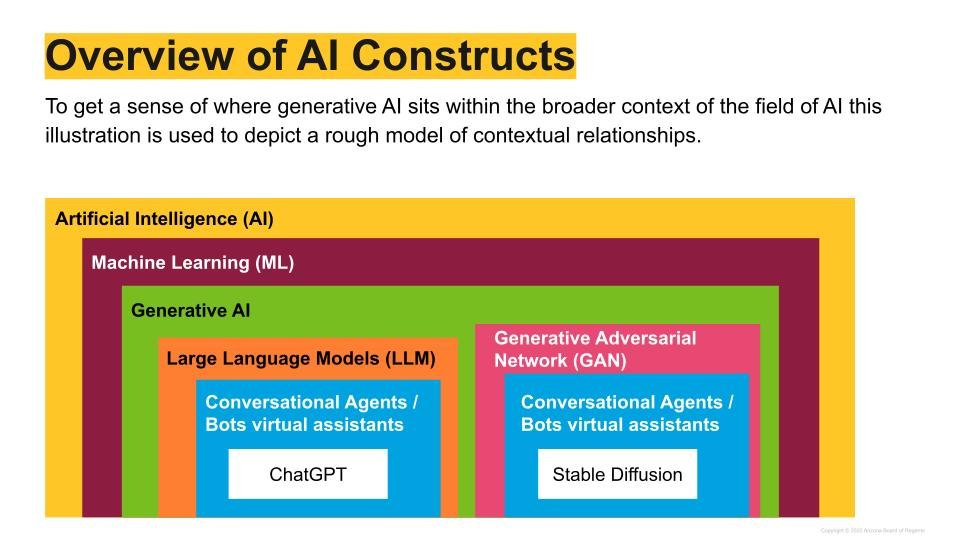
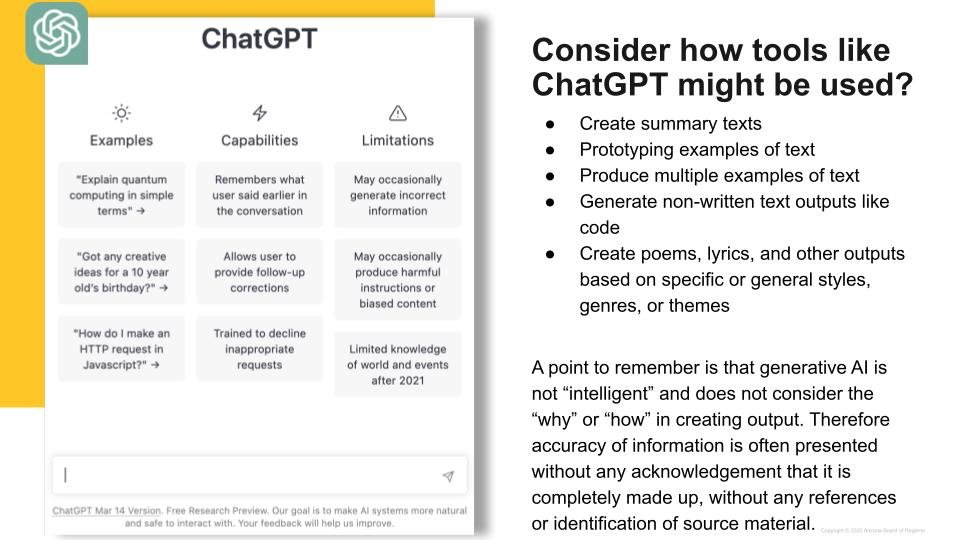
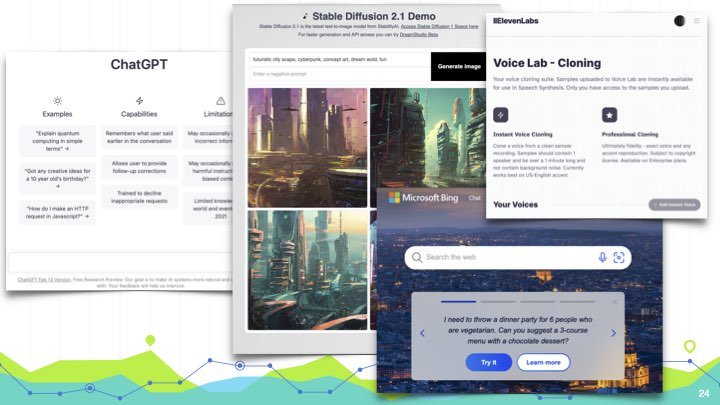
Generative artificial intelligence (AI) has been a burning topic of conversation far and wide since late 2022 - and the discussions among the higher education community is just one sector (out of many) that are trying to grapple with this seemingly sudden wide-spread emergent technology. While Generative AI tools have been available for a while, the sudden appearance of user-friendly interfaces popularized by OpenAI’s ChatGPT and Stability.ai’s Stable Diffusion, Midjourney, etc. have ushered in a new era of access to these large machine learning tools that were previously only accessible to those with more advanced AI / ML knowledge than the general public.
What is Generative AI?
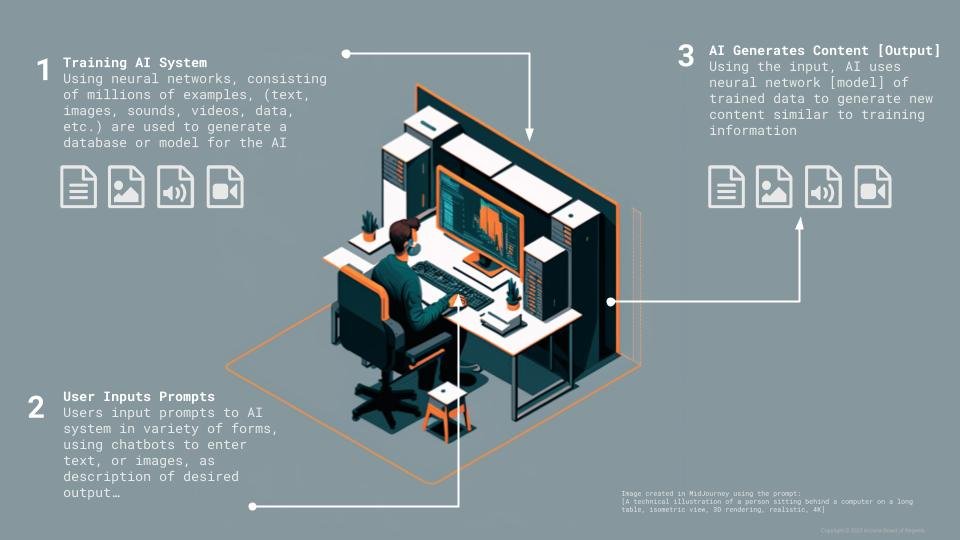
Generative AI is a type of artificial intelligence that uses machine learning algorithms to create new content based on user input, without being explicitly programmed. Generative AI systems are trained using large datasets, and analyze patterns, rules and statistical structures to generate new content. There are different types of generative AI applications and models, each using different machine learning models, neural networks and approaches to generating content. Examples of generative AI include ChatGPT, DALL-E and StableDiffusion. DALL-E and StableDiffusion are text-to-image generators that use a type of neural network called generative adversarial network (GAN) to create new images based on input parameters. ChatGPT builds a transformer-based language model from a generative pre-trained transformer (GPT) to process sequential data and generate sequenced responses.

Unlocking Creativity with a Generative AI Workshop

Generative AI Workshop
An exploration of emergent artificial intelligence tools, Spring semester 2023.
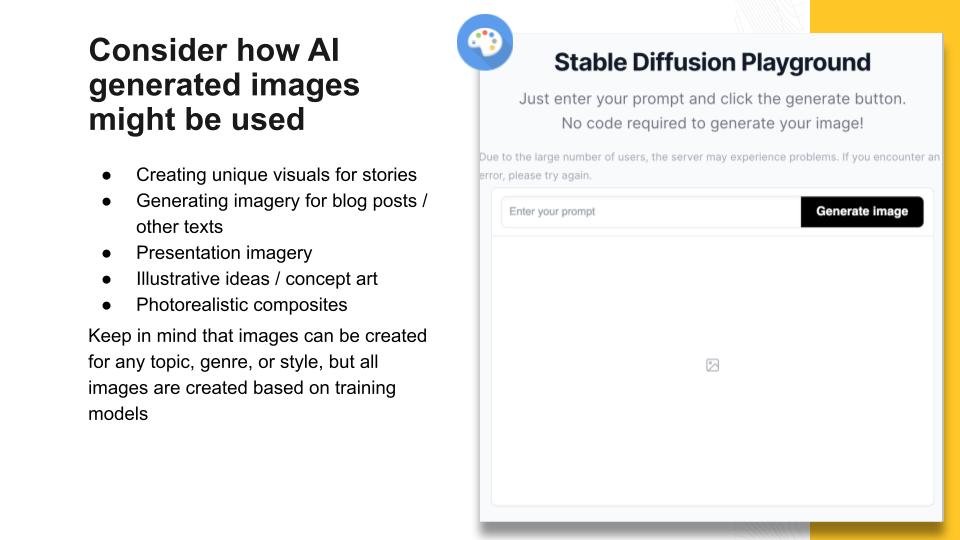
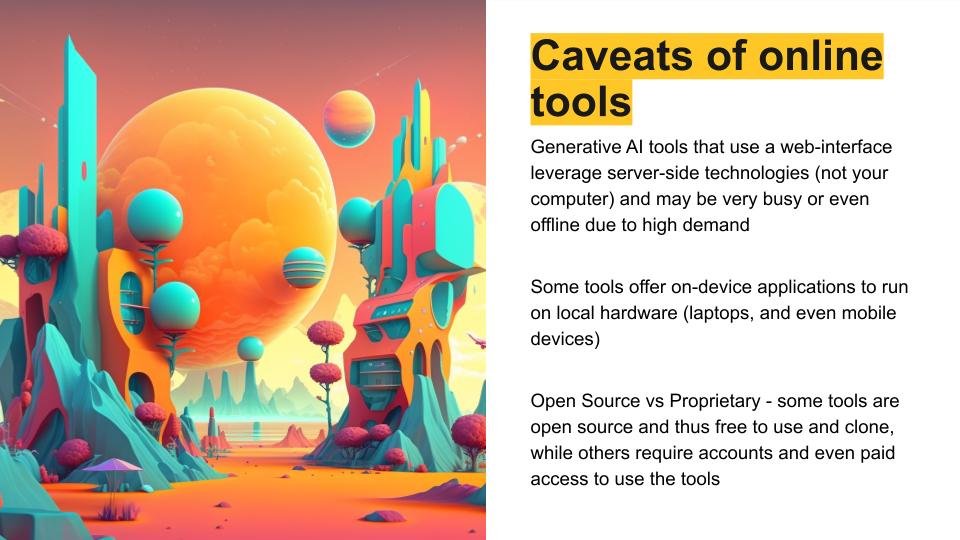
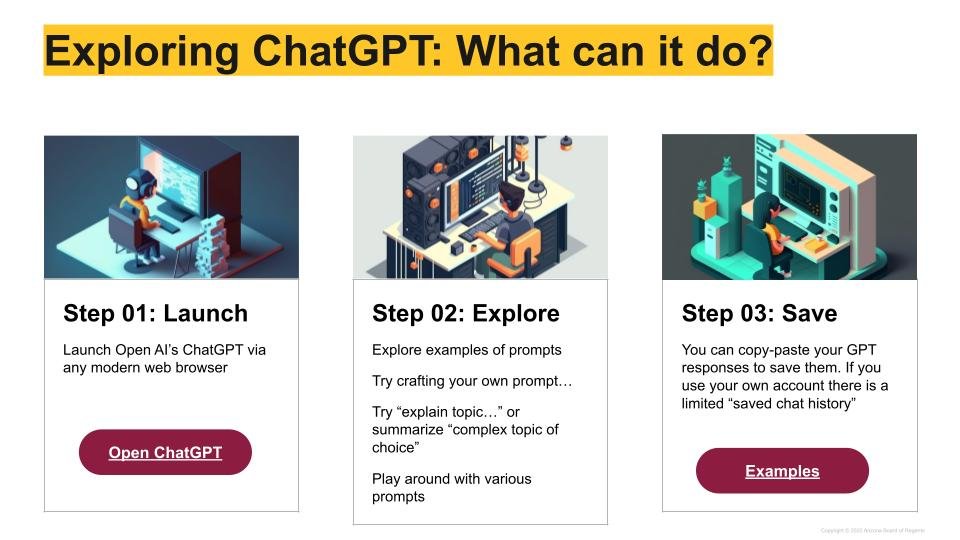
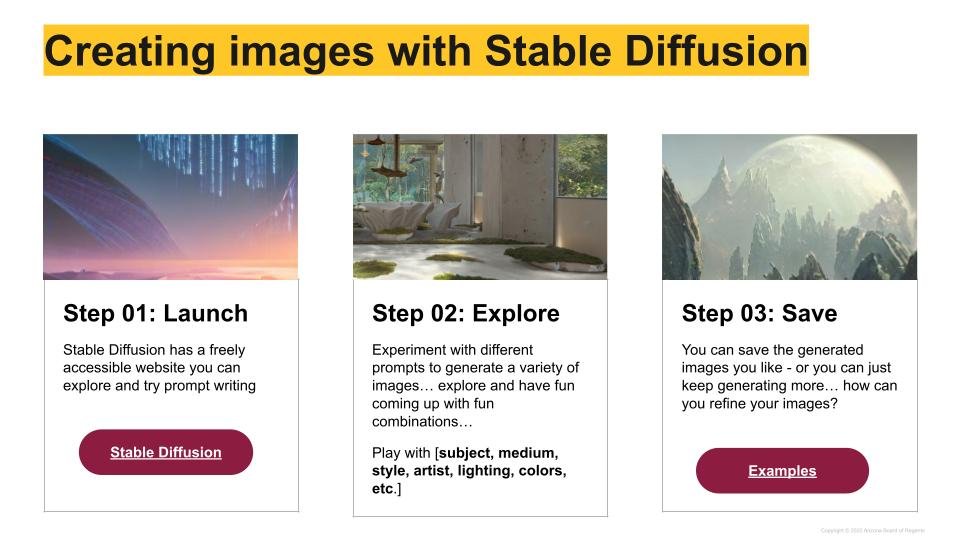
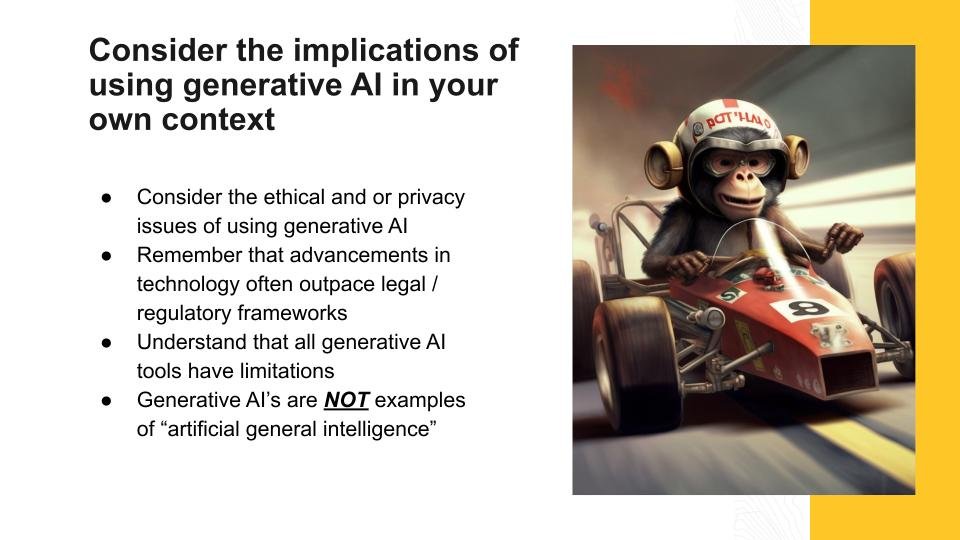
Spring semester 2023 - the one topic that seems inescapable is artificial intelligence (AI) or more specifically the “Cambrian explosion” of generative AI platforms such as ChatGPT, StableDiffusion, Elevenlabs, and MidJourney just to name a few. This increasing awareness and need for exploring and understanding generative AI led to the development of this short introductory workshop offered in the Spring 2023. One of the core tenants of the experience is taking a hands-on approach through a Learn-it, Try-it, and Apply-it model with a short section of reflection.
Goals and Learning Outcomes
As educators work to familiarize themselves with these new and emergent tools this workshop was designed to foster a positive discourse to encourage a constructive dialogue and atmosphere regarding the integration of Generative AI in educational practices, academic research, and creative endeavors.
Learning Outcomes
High level understanding of fundamental technology behind popular generative AI applications
Discuss experiences and observations of affordances and constraints of generative AI tools
Evaluate potential impact on educational context, and identify areas of need for deeper understanding
Background on the Purpose and Need
As the field of Artificial Intelligence (AI) continues to evolve and grow, there has been an increasing interest in the use of Generative AI in various industries (or perhaps another way to think about this - are there any industries at the moment that is NOT looking into the disruptive potential of generative AI?). In the field of higher education, Generative AI has the potential to revolutionize the way students learn and interact with the world around them. By enabling machines to generate new and unique content, educators can create personalized learning experiences that cater to each student's individual needs. However, with this exciting potential comes a need to understand how this technology actually works, and to evaluate the affordances and constraints it has in each contextual setting. Hosting a workshop for higher education faculty on Generative AI is crucial for ensuring that educators have the skills and knowledge necessary to incorporate this technology into their teaching practices effectively.
TPACK and the Cambrian explosion of AI

Cambrian Explosion of AI
Unlocking New Possibilities for Education with Neural Network-Based Models
The 2023 SITE conference provided a great opportunity to launch a short paper into publication that had been bubbling up since late 2022. Generative AI - a topic that is never far from the top of news feeds at the moment. Specifically, this paper was intended to approach the conversation in way that aims to cool the wild speculation around the hyperbole of Generative AI in education - and remind ourselves that with all new and emergent technology innovations and disruptions comes an ecological change… and while this change may have lots of affordances and constraints that need to be examined, explored, and deeply considered… we have existing technological, pedagogical, content knowledge frameworks that can help us navigate this new era of Generative AI in education.
TPACK and the Cambrian explosion of AI
Sean Leahy, Punya Mishra
Abstract
The Cambrian explosion of artificial intelligence (AI) powered tools has raised important questions about their use in education. The TPACK framework address the knowledge and skills that educators need to effectively integrate such emergent technologies into their current and future learning environments. As technologies continue to rapidly evolve, TPACK must likewise adapt to new eco-technological changes. The recent emergence of freely available AI tools such as OpenAI’s ChatGPT have the potential to revolutionize education. In this brief paper we examine the use of AI powered tools using neural network-based models in education and how the TPACK framework can be applied to consider the implications of these technologies on teaching and learning. We also explore the opportunities for educators to create new, authentic, and deeper learning experiences in their learning environments using AI tools, while also considering the potential risks and challenges.
Futures Futures Futures - ShapingEDU GCSS23

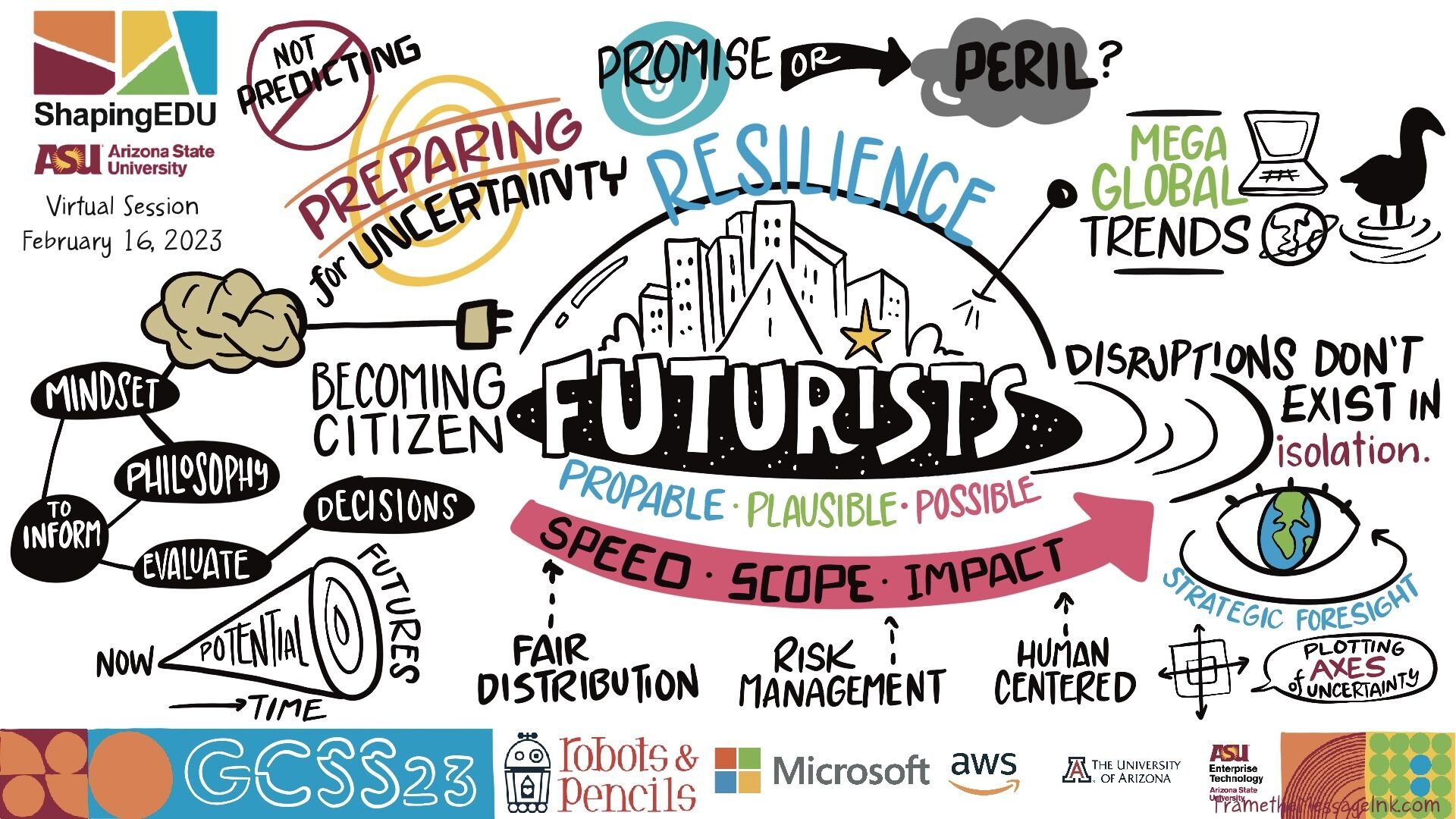
In February I was invited to present a handful of lectures and workshops to the ShapingEDU community at the ShapingEDU Global Community Solutioneering Summit 2023. The event was split over several days, starting with a virtual component where I presented a short lecture on Becoming A Citizen Futurist.
“
What could we accomplish together that we couldn’t accomplish alone?
For this event, we chose the theme of Education As Jazz. The Smithsonian Institute eloquently summarized the importance of jazz: “Often acclaimed as America’s greatest art form, jazz has become accepted as a living expression of the nation’s history and culture, still youthful, difficult to define and impossible to contain, a music of beauty, sensitivity, and brilliance that has produced (and been produced by) an extraordinary progression of talented artists.””
February 16 - Virtual Component
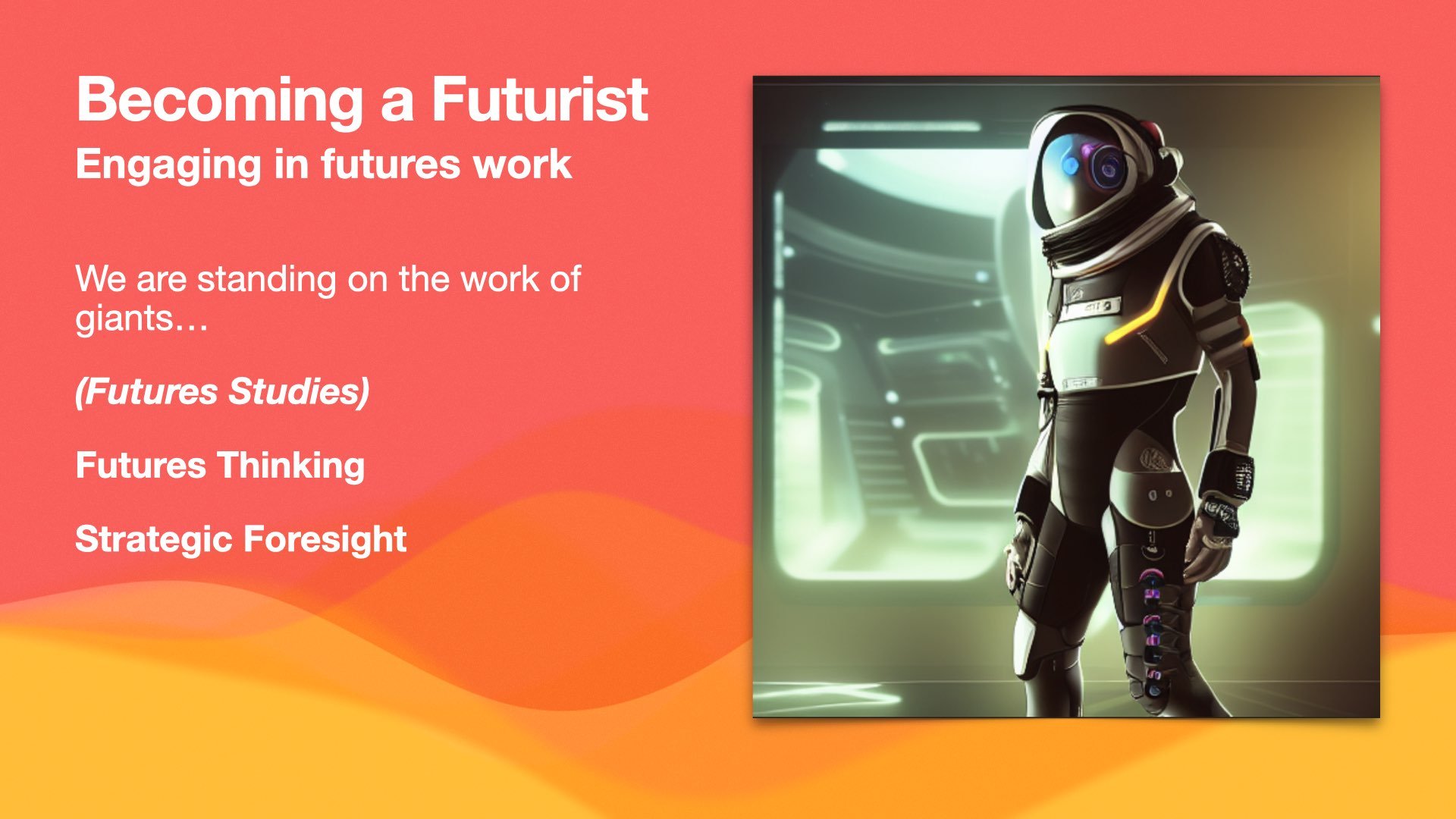
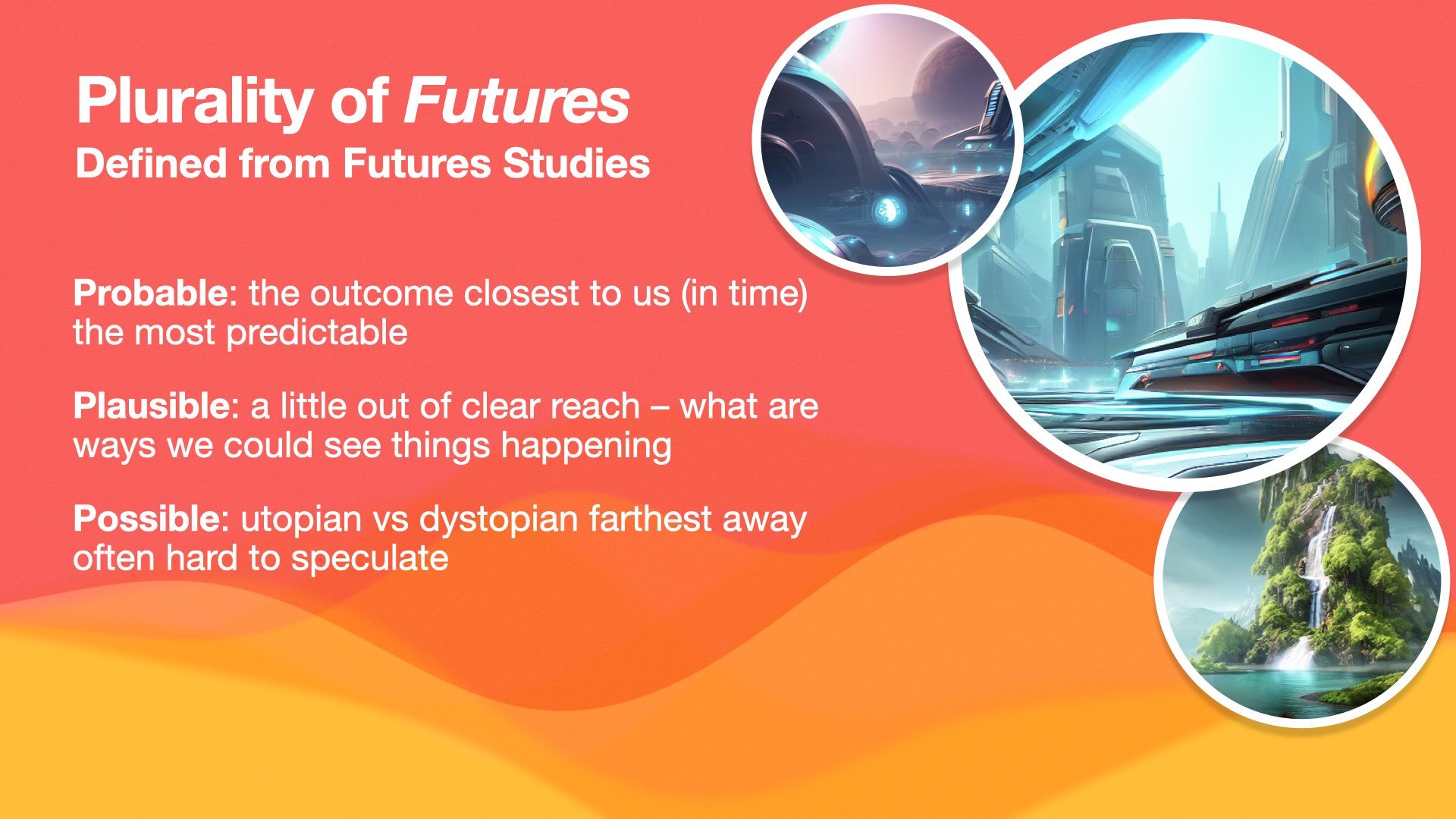
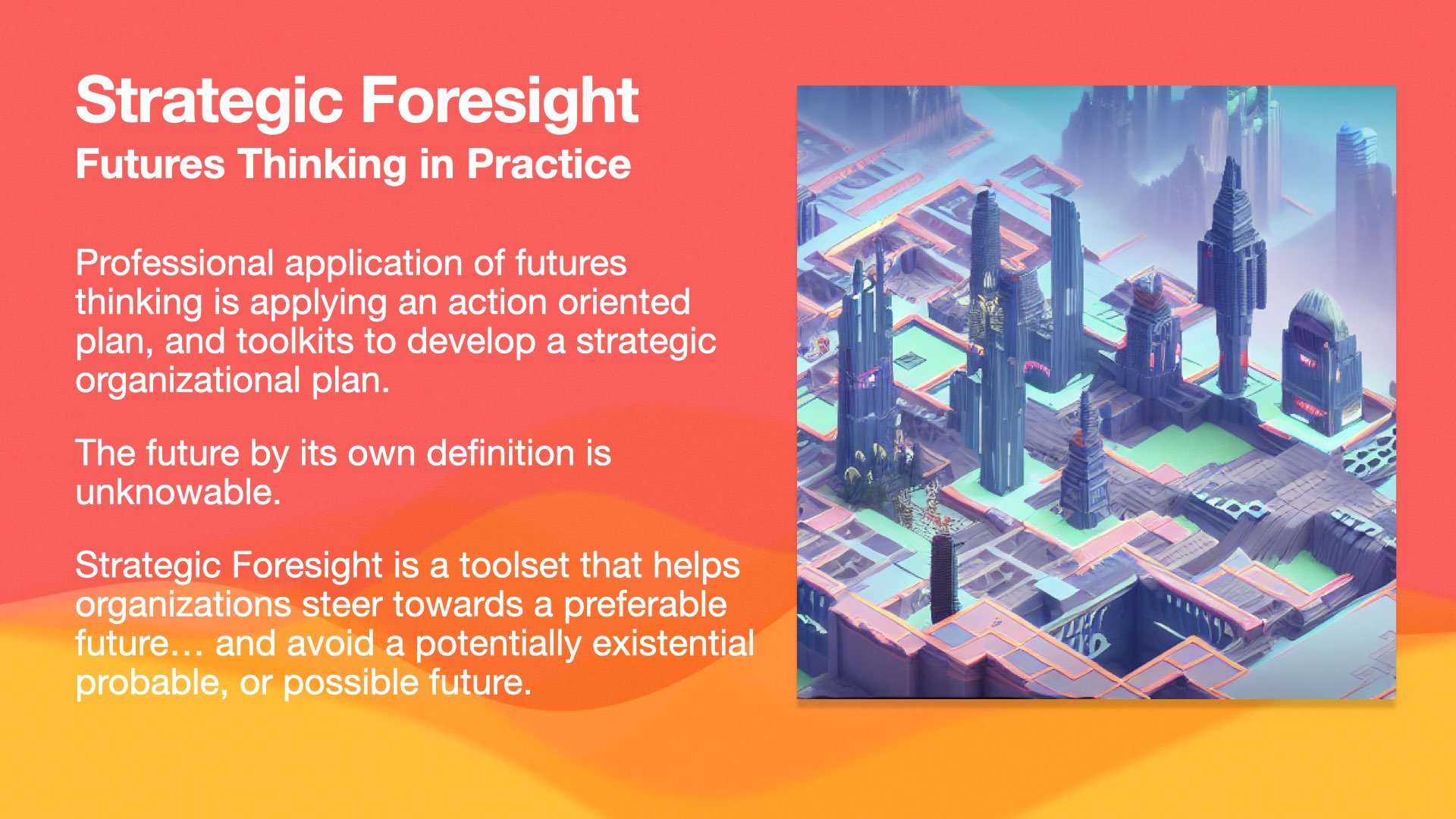
Lecture on Becoming A Citizen Futurist: Preparing for Uncertainty (a few select slides shared below)
February 23 - In Person Conference Event
Lecture on Educating for Sustainable Futures: Scanning the Futures Horizon (select images from presentation)
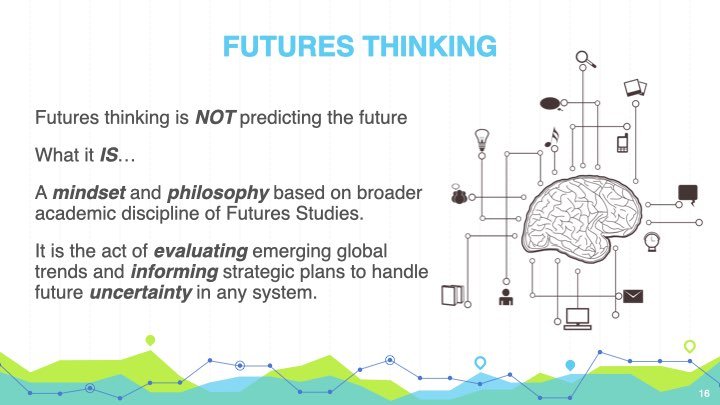
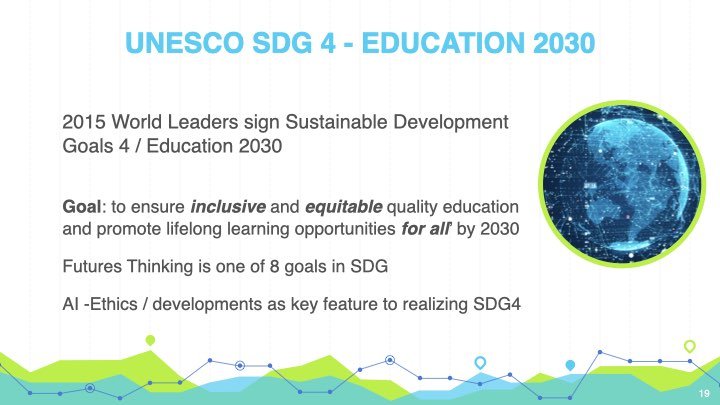
February 24 - In Person Workshop
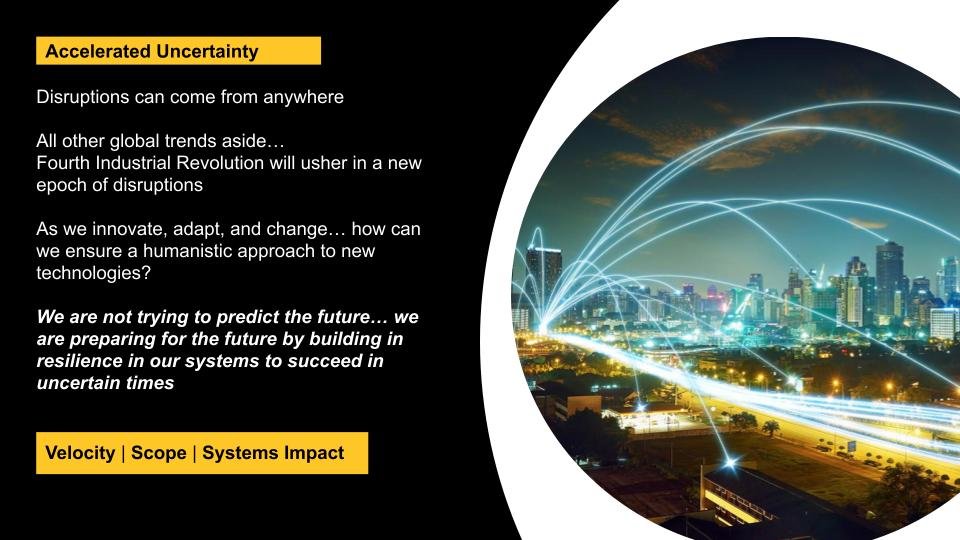
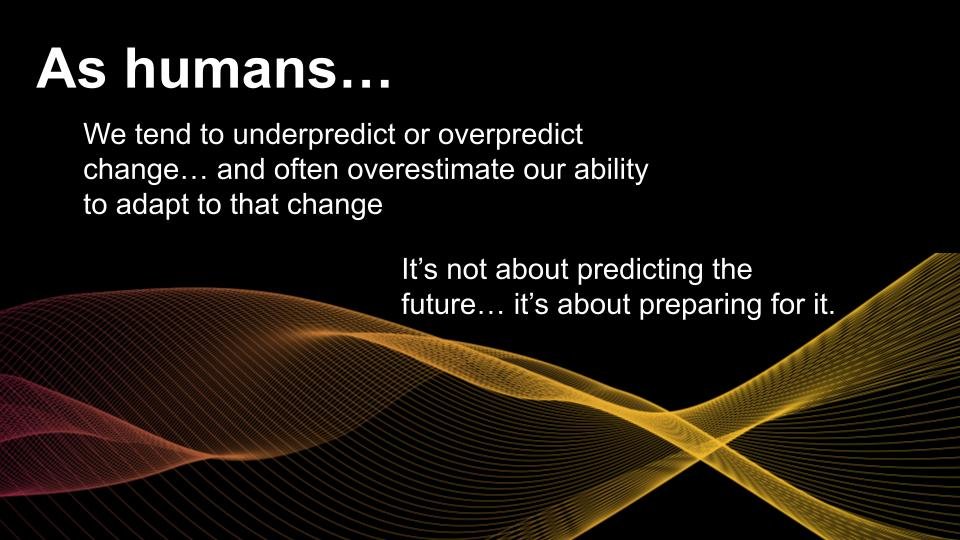
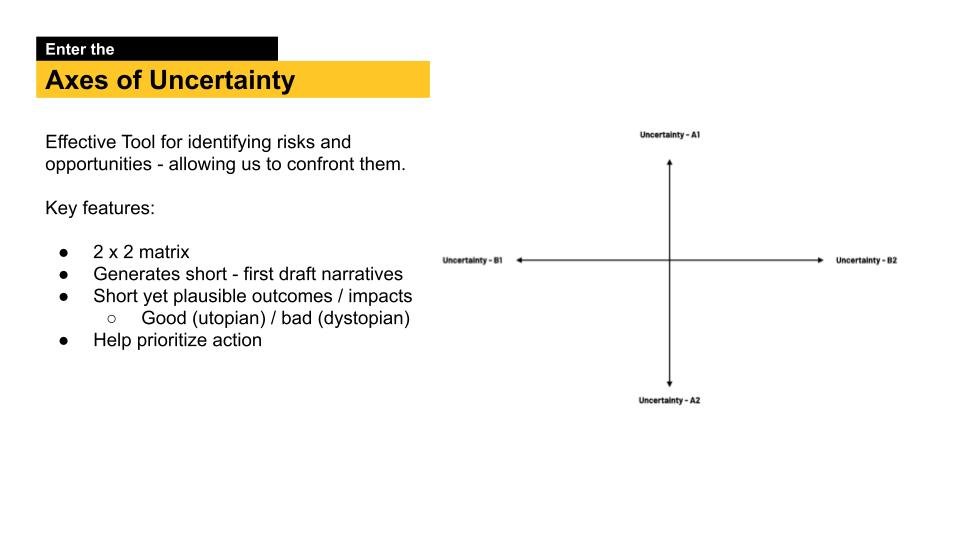
Workshop on Strategic Foresight (Becoming a Citizen Futurist). This workshop focused on using the Axes of Uncertainty as an introductory foresight tool. This session was also followed up by an extended Q&A session of “Ask a futurist” where I fielded a wide range of questions from the conference participants. (A few select slides shared below)


Educating for Sustainable Futures
In this bonus episode of the Learning Futures Podcast Dr. Sean Leahy talks about the importance of educating for sustainable futures, discussing the opportunities and challenges. Dr. Leahy explores the urgency created by the Fourth Industrial Revolution, and the need to prepare for the uncertainty by engaging in futures thinking and other futures methodologies.
Futures Thinking: Exploring the adjacent possible (new book chapter)
“There has never been a time of greater promise, or greater peril ”
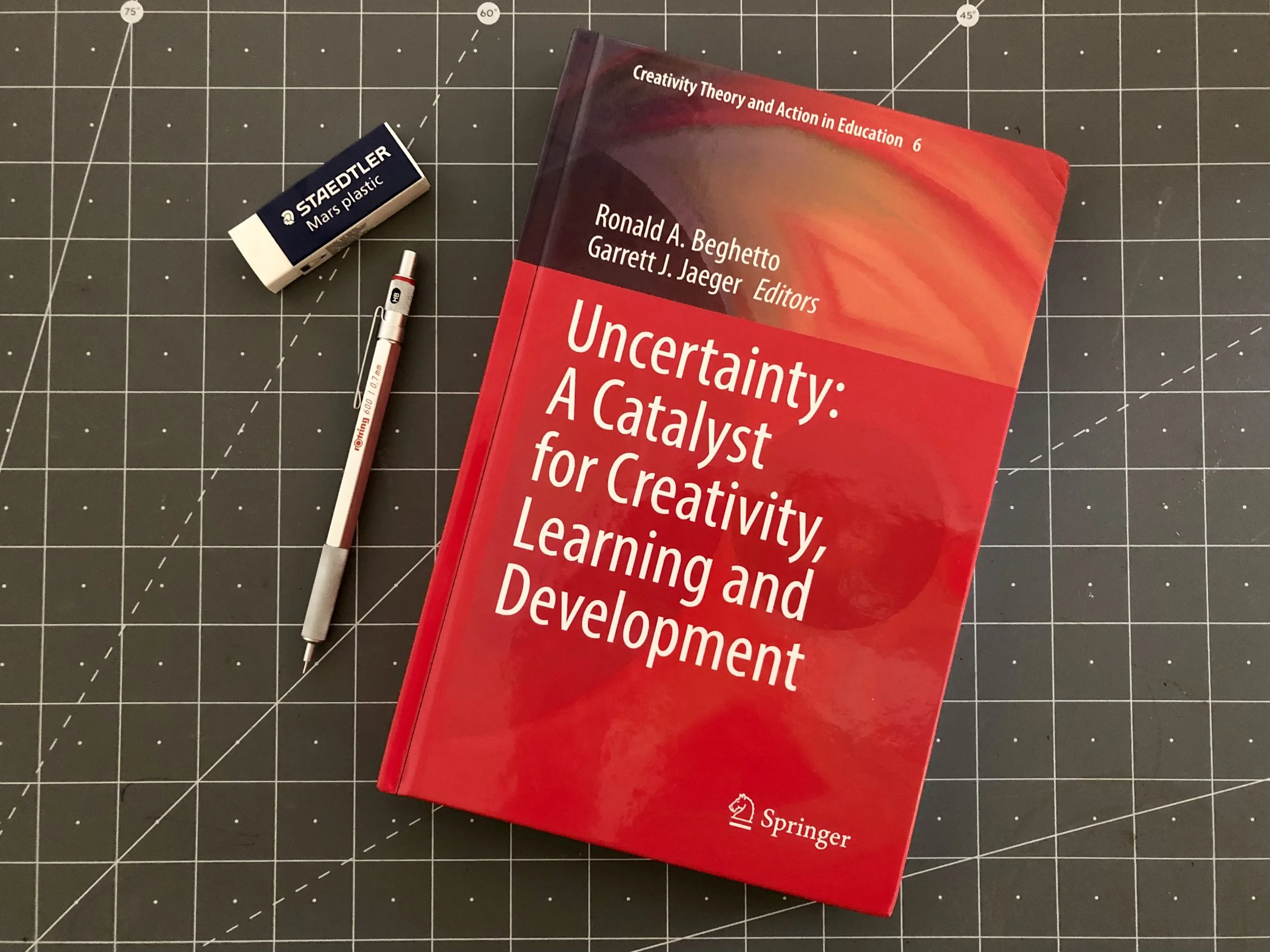
How can the educational system shift to a proactive–participant model in exploring the adjacent possible ushered in through the inherent uncertainty of the Fourth Industrial Revolution? How can we look to historical patterns of disruption to gain insights into the challenges of preparing for future uncertainties? How can all of this lend itself to a more sustainable futures? Find out in the ‘exciting’ new book chapter referenced below that was published in Uncertainty: A Catalyst for Creativity, Learning and Development (edited by Beghetto and Jaeger)
We (Punya Mishra, Ben Scragg, and I) invite you to read along through our recently published book chapter and join the conversation around this growing field of inquiry in educational futures and futures thinking.
[APA Citation]
Leahy, S.M., Scragg, B., Mishra, P. (2022). Creatively Confronting the Adjacent Possible: Educational Leadership and the Fourth Industrial Revolution. In: Beghetto, R.A., Jaeger, G.J. (eds) Uncertainty: A Catalyst for Creativity, Learning and Development . Creativity Theory and Action in Education, vol 6. Springer, Cham. https://doi.org/10.1007/978-3-030-98729-9_17
Abstract
In this chapter we explore the unknown possibilities that lie in the shadows of disruptions and innovations known as the adjacent possible. We frame the challenges educational leaders face when trying to prepare for an increasingly volatile, uncertain, complex, and ambiguous world that is propelled into the Fourth Industrial Revolution imbued with rapidly changing and unevenly distributed technological proliferation. Throughout our chapter, we offer strategic mindsets in design and futures thinking to combat the growing challenges of preparing educational systems that are rife with existing deep and complexly interwoven wicked problems for uncertainty. We propose that looking to the past, we can discover insights into meta-patterns and the ways we failed to predict the futures that emerged from previous discoveries and innovations. Using this frame, we discuss the potential of combining the interconnected mindsets of futures thinking and design, not to predict the future, but to prepare our educational systems for the uncertainty of the future.

Learning Futures Season 4 - Futures Thinking
The 4th season of the Learning Futures Podcast is now out and the first episode has dropped. In addition to being the founder and executive producer for this podcast, this season my colleague Clarin Collins and I take over the hosting responsibilities as well. In our first episode for Season 4 we are joined by Ruth Wylie, Danah Henriksen, and Maricel Lawrence to chat about all things Futures Thinking. We hope you enjoy the episode!
If you like what you’re hearing, please do subscribe to the Learning Futures Podcast on Apple Podcasts, Spotify, or wherever you get your podcasts…

BioSense Network: Exploring biotech with computational microscopes
I am excited to announce the launch of our newly funded research project called BioSense Network. To introduce this new project, the team sat down with me (virtually) for a quick roundtable discussion to define and explain not only what the BioSense Network is, but perhaps more importantly why a project like this is needed in the first place. Have a listen!
If you like what you’re hearing, please do subscribe to the Learning Futures Podcast on Apple Podcasts, Spotify, or wherever you get your podcasts…
If podcasts aren’t your thing, here’s a super short recap…
The show is hosted by me, and I’m joined by three of my colleagues to discuss this innovative project.
Host: Dr. Sean Leahy - twitter: @seanthenerd
Dr. Abhishek Singharoy - twitter: @abhisekhsingha1
Dr. Punya Mishra - twitter: @punyamishra
We talk about the exciting new project known as the BioSense Network, which is a newly funded project aimed at establishing a community of learners exploring biotechnology with a computational microscope. This innovative research grant is in collaboration with the Arizona State University School of Molecular Sciences, ASU Biodesign Institute, and the Mary Lou Fulton Teachers College at ASU. This project has been possible by funding from the Department of Defense STEM program.
While we cover a lot of ground on the podcast the main points we address are the following:
In the show we discuss the overall aims of this project, and explore how it is described as a research project aimed at bridging textbook biotechnology with reality, and what that really means in practice.
We talked about the importance of combining teams, (biotechnology and education) and discuss how we see this partnership as being crucial to creating a new approach to biotechnology education.
We touch on the broader impacts of projects like this, and the potential impact on STEM education and the pipeline of STEM professional careers.
We discuss our approach to flip the learning experience / community aspect, and create a community first, in which learning experience can take place, and how this new model may have long lasting benefits in terms of sustainability for this project.
We explore the use of high powered computing and virtual visualization technologies to bring zero-cost biotechnology to the hands of middle and high school students (that they otherwise wouldn’t have access until university level studies).
We discussed the four identified “tangible” goals / outcomes of the project, namely: communicate, promote, inspire, and enhance.
Our last element we discussed was our approach to create educational modules for educators to use with their students - what is entailed in the development and implementation of these, and how that differs from traditional approaches to train-the-trainer type projects etc.
All in all, it was a great opportunity to sit down with some really awesome people and talk about this exciting, innovative new project. More to come as the project get further underway…