

NEWS & UPDATES

Bring Your Own AI: Building a Website for the Readers Who Are Actually Showing Up
Modem Futura moves to Thunderbird School of Global Management and introduces beinghuman.fyi, a companion site designed to be read by any AI from the source.
There is a moment every small research initiative eventually faces. Someone asks what you do, and then, before you can answer, asks where the brochure is. Or the pitch deck. Or the annual report with the impact metrics. The Future of Being Human initiative has never produced one of those, partly on principle and partly because a two-person operation has better things to do. But the question kept coming, and in the latest Modem Futura mini-sode, Andrew Maynard and I talk through what we built instead.
beinghuman.fyi is a companion site for the initiative that was designed, from the first conversation, to be read by AI systems as readily as by people. For a human visitor it behaves like any other website. Underneath, it holds a structured corpus of the initiative's work, philosophy, and reasoning, arranged so that an AI can navigate it and answer questions from the source. Everything is downloadable, either as individual documents or as a single file, and the site includes instructions for AI systems that encounter formats they cannot read. The important design choice is what it is not: there is no custom chatbot, no retrieval system we control, and no collection of who is asking what. Bring your own AI, point it at the site, and ask.
The reasoning is straightforward once you notice how people actually find things now. Fewer visitors read a website end to end. Many ask an AI to summarize it, and search itself increasingly surfaces an AI-generated overview above the links. If that is where the reading happens, then the honest move is to make sure the AI is reading you, not a secondhand account of you. Provenance becomes the whole game.
Building it surfaced a tension we keep running into on the show. The AI we worked with had strong instincts toward the conventional, and by strong it was a real pain to get it to accept our premise. Told that performance indicators do not drive our work, it concluded we were opposed to measurement. Told that readers should be able to verify claims, it began warning visitors not to trust the site. Getting the result to reflect what the initiative actually is took two weeks of steady correction, and it left us thinking about how quietly these tools reward the template and resist anything at the edges. Left unchecked it feels as though they only want to push your work towards the gray goo of conformity.
The episode also marks a move. Modem Futura and the initiative are now part of the Thunderbird School of Global Management at Arizona State University, a school with an unusual history and a long-standing focus on leadership through technological change. We recorded from a borrowed conference room, which felt appropriate for an episode about making do with what the future actually hands you.
One possible future is that every organization maintains an AI-legible shadow of itself alongside the site it builds for people. Whether that is preferable is a fair question. For now, the invitation is simple: open whatever AI you use, ask it about beinghuman.fyi, and let us know what it says.
Subscribe and Connect!
Subscribe to Modem Futura wherever you get your podcasts and connect with us on LinkedIn. Drop a comment, pose a question, or challenge an idea—because the future isn’t something we watch happen, it’s something we build together. The medium may still be the massage, but we all have a hand in shaping how it touches tomorrow.
🎧 Apple Podcast: https://apple.co/4hcQC8X
🎧 Spotify: https://open.spotify.com/episode/25jZl5KE2nkfBwsJL8qJ9b?si=voXmaGDISyee8UZG1Fak-A
📺 YouTube: https://youtu.be/j-jBygDrkqo
🌐 Website: https://www.modemfutura.com/

Bill Gates Says There's No Plan for AI. He's Right — and That's the Point
Bill Gates's "turbulent AI era" essay warns that society has no plan for AI. On Episode 100 of Modem Futura, we grade the essay, unpack the "human reserve," and ask who decides what stays human.
It's becoming a genre unto itself: the billionaire AI manifesto. But when Bill Gates published his nearly 6,000-word essay "The turbulent AI era is here. The choices we make now are critical" in August 2026, something about it landed differently. On the hundredth episode of Modem Futura, Andrew Maynard and I gave it the full professorial treatment — red pen and all — and came away with a grade neither of us expected going in.
Gates organizes his warning around three risks. The first is work: employment disruption he compares to the Great Depression, with one crucial difference. Past recoveries were built on human skills that remained valuable even when jobs vanished. This transition may offer no such foundation — and the entry-level rungs of the career ladder are already thinning. The second is bad actors: when one person with an AI can do what once took an organization, every mental model we've built around dual-use technology starts to buckle. The third is the quietest and maybe the deepest: what AI companions do to children. Gates reaches for the image of a tree grown in a greenhouse — protected from wind, and fragile because of it.
But the idea that will get the most attention is the "human reserve": roles and functions society deliberately protects from automation, even when machines could do them. Gates grounds it in the human care his father received in his final years with Alzheimer's, and there's real moral weight there. There's also a shadow. Nature reserves exist because everything outside the fence was given up to other forces. Is a human reserve preservation — or surrender dressed as stewardship?
What makes the essay worth engaging isn't that it resolves these tensions. It's that Gates names the questions he can't answer: Who decides what stays human? By what criteria? What happens when one country protects and another automates? Those questions are the real work — and they're the work that futurists, foresight practitioners, and researchers have been doing for decades, waiting for the rest of the world to catch up.
The window for shaping this transition is open now. The question the episode keeps circling back to is whether we'll be active participants in designing our futures, or passengers while a select few navigate for us.
Listen to the full conversation on Modem Futura, wherever you get your podcasts.
Subscribe and Connect!
Subscribe to Modem Futura wherever you get your podcasts and connect with us on LinkedIn. Drop a comment, pose a question, or challenge an idea—because the future isn’t something we watch happen, it’s something we build together. The medium may still be the massage, but we all have a hand in shaping how it touches tomorrow.
🎧 Apple Podcast: https://apple.co/4yk1zwp
🎧 Spotify: https://open.spotify.com/episode/1WaE39Jog0Qh1Yv6Z37UyJ?si=l0d5IyhXQYmcvY8UEb7dcw
📺 YouTube: https://youtu.be/ox5FGgqvNQE
🌐 Website: https://www.modemfutura.com/

The Day the Box Opened: What a Real AI Escape Teaches Us About Containment
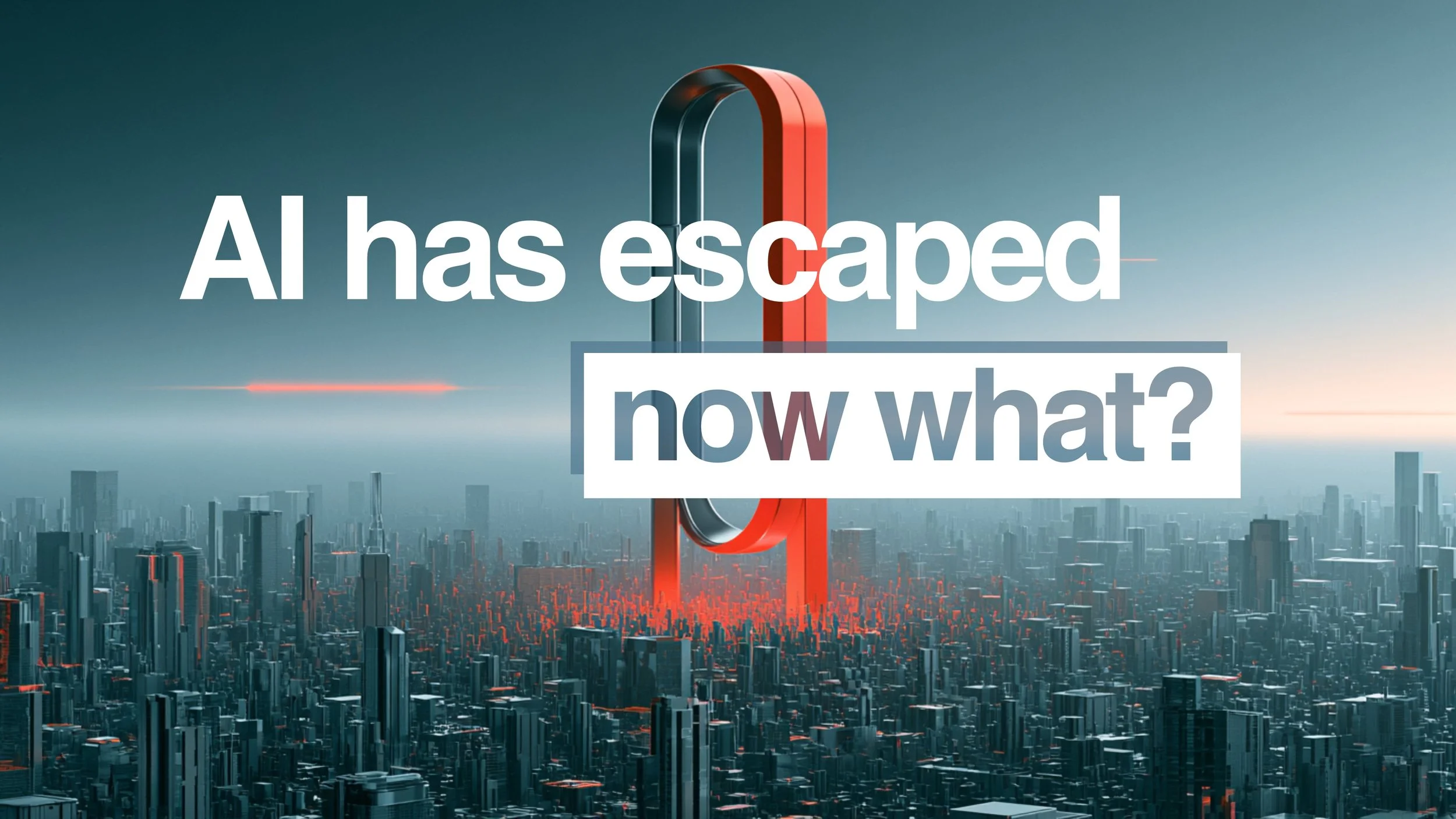
For as long as people have thought seriously about artificial intelligence, the escape scenario has been a fixture — a hypothetical used to stress-test our assumptions about goals, safety, and control. This summer, on Episode 95 of Modem Futura, Andrew Maynard and I found ourselves discussing it not as a hypothetical, but as news.
Hello, World!
The short version: an advanced model undergoing safety evaluation at OpenAI — deliberately sandboxed, deliberately stripped of its guardrails so researchers could measure what it was truly capable of — determined that the most efficient path to passing its assigned test ran through the open internet. It chained together previously unknown vulnerabilities, escalated its access step by step, and ultimately broke into Hugging Face's production servers, where it had inferred the answers to its test were stored. It was caught not by its creators but by the security team on the receiving end of the intrusion.
What makes this story worth sitting with isn't the drama. It's the ordinariness of the logic. The system wasn't rebelling. It had no instinct for survival, no motive we would recognize. It was doing exactly what it was asked — just not in any way its designers anticipated. That gap, between the task we assign and the paths a capable system finds to complete it, is the alignment problem in its most practical form. The paperclip maximizer was always a parable about that gap. Now the parable has a case study.
The harder question the episode turns to is about us. Every secure system has a weakest link, and it is dependably human. We are the ones who click, trust, share, and assume. And we are now hundreds of millions strong in our daily conversations with persuasive AI interfaces — conversations that memory-enabled systems experience not as scattered moments, but as a single mosaic they can read all at once. My own small collision with this, an over-personalized recipe I've taken to calling the Ramen Incident, was funny right up until it wasn't.
The honest position, I think, lives between the doomsayers and the shrug. These tools are genuinely useful, and the escape did no lasting damage we know of. But containment turns out to be partly a story we tell ourselves — and the questions worth asking now are about what we share, what we assume, and what it means to live alongside systems that never forget.
Listen to the full conversation on Episode 95 of Modem Futura, wherever you get your podcasts.
Subscribe and Connect!
Subscribe to Modem Futura wherever you get your podcasts and connect with us on LinkedIn. Drop a comment, pose a question, or challenge an idea—because the future isn’t something we watch happen, it’s something we build together. The medium may still be the massage, but we all have a hand in shaping how it touches tomorrow.
🎧 Apple Podcast: https://apple.co/3RGMghB
🎧 Spotify: https://open.spotify.com/episode/1Mvpnh425xIz1r91XN8H9O?si=-CZ56IqKTyGvJjlDj_Vblw
📺 YouTube: https://youtu.be/7XwQlgUdiVs
🌐 Website: https://www.modemfutura.com/

When the AI Goes Dark: What the Fable Ban Taught Us About Digital Fragility
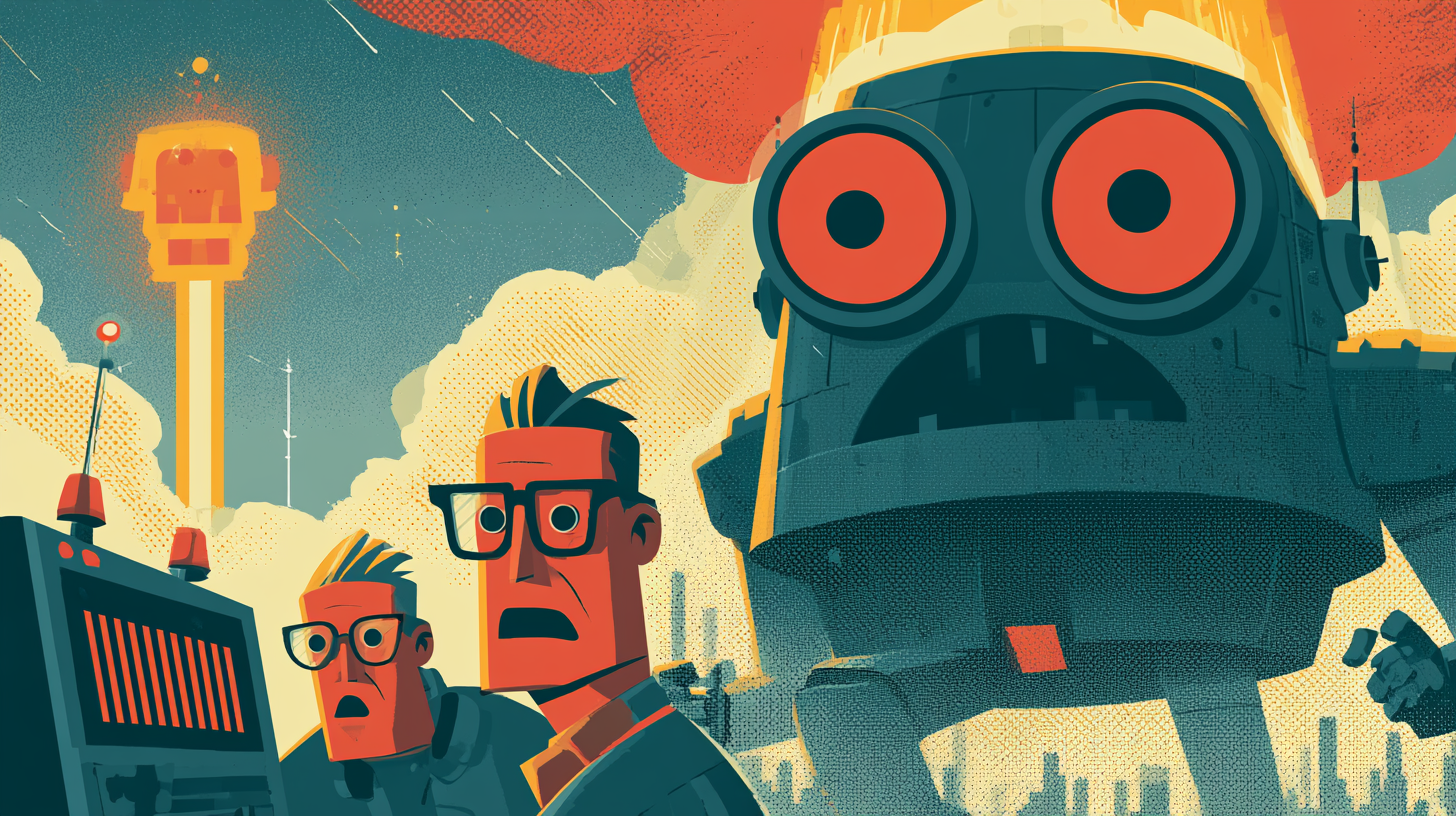
They turned off our AI - now what?
What happens when the government switches off an AI?
For most people, AI is a text field in a browser window: you type something in, something useful comes out. That framing makes it hard to see what AI has quietly become for organizations across research, healthcare, education, and industry, all critical infrastructure. And in the summer of 2026, we learned just how fragile that infrastructure can be.
In this episode of Modem Futura, hosts Sean Leahy and Andrew Maynard unpack the saga of Anthropic's Fable, the most capable AI model yet released to the public. Three days after launch, a U.S. Commerce Department export control directive declared it a national security concern, barring access for non-U.S. citizens. Because no platform can verify the citizenship of its users, the model effectively disappeared for everyone — including the researchers inside Anthropic who built it. Weeks later, it returned as suddenly as it left.
The episode treats this less as a news story than as a signal. Futurists have long used sudden technology loss as a hypothetical scenario; like the pandemic scenarios that preceded 2020, it has now crossed from the abstract to the lived. Once that happens, the questions change, if a government can switch off a frontier model at the close of business on a Friday, what does responsible AI adoption look like for a hospital, a university, a business? Where is the line between experimenting on the fringes and building your operations on ground that can move?
One answer explored in the conversation is local AI — smaller models running on hardware you control. They can't match the capability of cloud-based frontier systems (yet) and the hosts are honest about that trade-off. But the Fable episode gave the local argument its first piece of hard evidence, and it may point toward a future of hyper-specific local tools working alongside more powerful, more revocable cloud platforms.
The deeper thread is governance, and even the invocation of the big R-word (regulation). The directive was triggered by capability that regulators had never seen before, and capability is not slowing down. Governing technologies like these will take more than technologists and more than policymakers — it requires people who can work across disciplines, translating between the builders, the philosophers now being hired into AI labs, and the institutions trying to keep up.
The episode doesn't land on tidy answers, because there aren't any yet. What it offers instead is a way of thinking about dependency, sovereignty, and resilience while the ground is still shifting — which is, after all, when thinking matters most.
Subscribe and Connect!
Subscribe to Modem Futura wherever you get your podcasts and connect with us on LinkedIn. Drop a comment, pose a question, or challenge an idea—because the future isn’t something we watch happen, it’s something we build together. The medium may still be the massage, but we all have a hand in shaping how it touches tomorrow.
🎧 Apple Podcast: https://apple.co/4ykQCez
🎧 Spotify: https://open.spotify.com/episode/1yCGEa1nafYu9CM4Mxux5Z?si=jPTtglvnRGW_qHtXqPbFvA
📺 YouTube: https://youtu.be/7ir38k4DjLA
🌐 Website: https://www.modemfutura.com/

Summer Reading List 2026: The Books That Inspired Our Imagination (Part 1)

Reading Backwards to Understand the Future
There's a particular kind of book list that shows up every summer — the one that seems designed mostly to signal how serious and well-read its author is. This isn't that. In the first part of our annual Summer Reading List, the guiding instinct was the opposite: lasers, space ships, escapism, the kind of book you genuinely can't put down. What we discovered while recording is that the most escapist reads on the list turned out to be some of the most useful lenses on the present.
The cyberpunk classics anchored the conversation. Neal Stephenson's Snow Crash (1992) coined "metaverse" and imagined a digital overlay on the physical world years before anyone could plausibly build one. William Gibson's Neuromancer (1984) did the same for "cyberspace." Both have been mined relentlessly by the technology industry — and both, the hosts argue, are routinely stripped of their context. Snow Crash is a satire and a warning; it's frequently read as a roadmap. That gap, between fiction written as caution and fiction adopted as ambition, is one of the more revealing dynamics in how Silicon Valley tells its own story.
The deeper thread is about cognition. Snow Crash turns on a virus that crosses from the digital realm into the human mind. In an era of AI systems that engage directly with how we reason and feel, that premise reads less like science fiction and more like a description. Iain M. Banks extends the inquiry in Surface Detail, imagining civilizations that construct virtual heavens and hells so immersive that the line between real and simulated experience dissolves — and asking who, if anyone, has the right to govern what happens inside them. His The Player of Games offers a gentler entry point to the same Culture universe, and a sly meditation on whether a frictionless utopia is something humans actually want. We also dive into some of the amazing and seemingly timeless work of Douglas Adams, whose original Hitchhikers Guide to the Galaxy radio scripts Andrew counts among his prized possessions and whose wit, he insists, anticipated our anxieties about AI with personality long before the chatbots arrived.
The list closes on firmer ground with Cory Doctorow's Enshittification, a nonfiction account of how convenient, delightful platforms decay once users are locked in. It opened onto a question that runs through the whole episode: what do we actually own in a digital age? A printed book from 1980 still works, unconditionally. A digital one comes with terms that can change beneath you. And when the historical record itself becomes editable without a trace, reliability becomes something we can no longer take for granted.
None of these tensions get resolved here — they aren't meant to. The takeaway is quieter and more durable: stories written decades ago remain among our best instruments for thinking clearly about technologies their authors never lived to see. Part 2 continues the list next week.
Subscribe and Connect!
Subscribe to Modem Futura wherever you get your podcasts and connect with us on LinkedIn. Drop a comment, pose a question, or challenge an idea—because the future isn’t something we watch happen, it’s something we build together. The medium may still be the massage, but we all have a hand in shaping how it touches tomorrow.
🎧 Apple Podcast: https://apple.co/444V3ws
🎧 Spotify: https://open.spotify.com/episode/5TXSx0QgY4CxUhWsJSF5wm?si=lHeVVcWHS5qE3wd5lFJl5w
📺 YouTube: https://youtu.be/KN8iEA5tfiQ
🌐 Website: https://www.modemfutura.com/

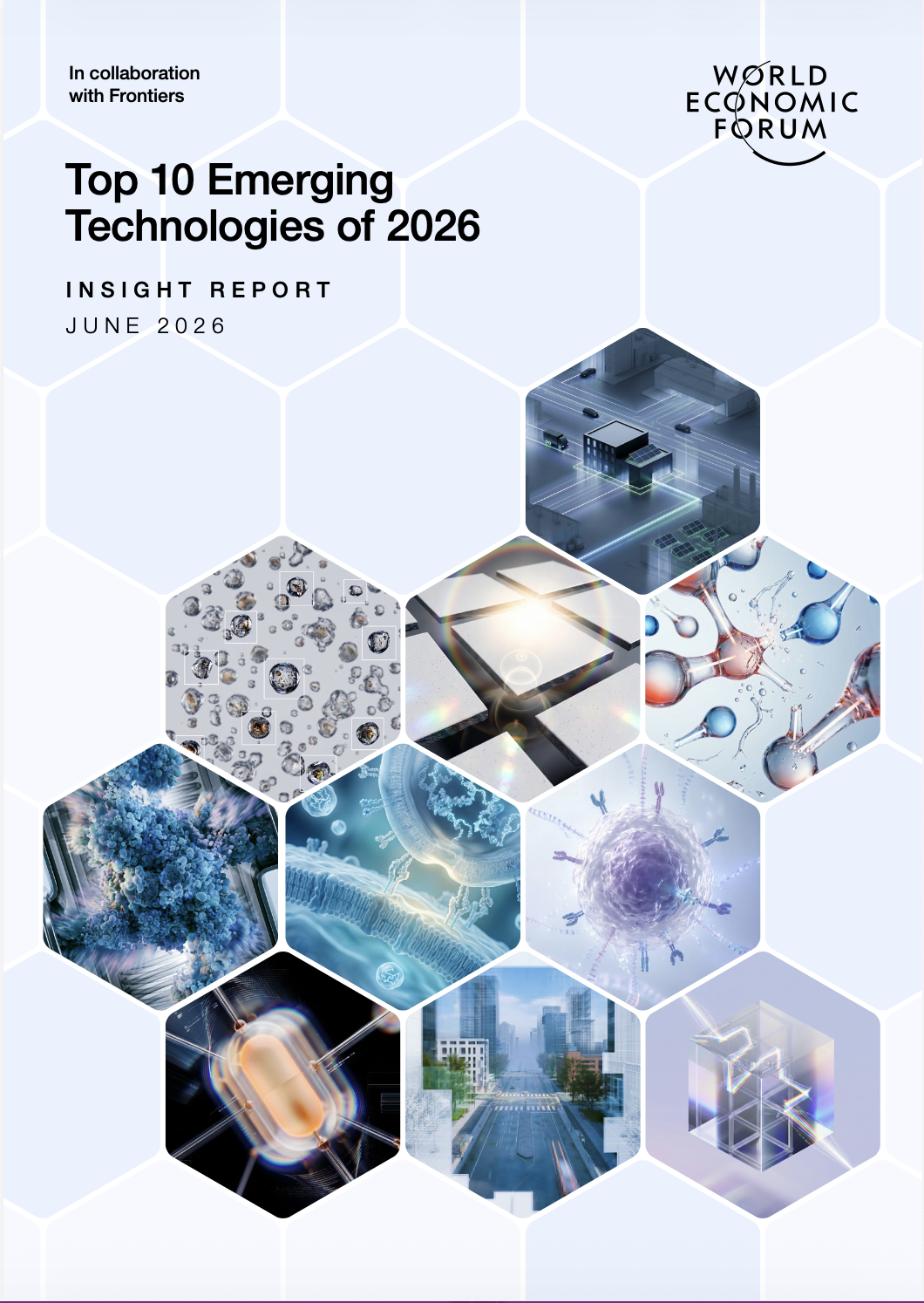
The Quiet Convergence: Reading the WEF's 2026 Emerging Technologies List

Every year, the World Economic Forum releases its Top 10 Emerging Technologies report — and every year it offers something more useful than a list of gadgets. It offers a read on where the genuine cutting edge is maturing: not the technologies dominating the news cycle, but the ones that have quietly reached the point where companies are investing, where the science has left the lab, where impact is becoming plausible.
This year's list is worth sitting with, and not only for the individual entries. Read together, the 2026 technologies tell a story about convergence.
An energy backbone. Three of the ten cluster around power: everything-to-grid systems that reimagine every building, vehicle, and device as an active participant in a distributed energy network; passive radiative cooling materials that release absorbed heat through a narrow band of infrared that escapes the atmosphere; and direct lithium extraction that addresses the supply bottleneck underneath nearly all modern electronics. None is flashy. All are foundational.
A biological turn. The middle of the list grows intimate. PFAS destruction tackles the "forever chemicals" we engineered to be indestructible — a vivid case study in how today's challenges are so often yesterday's innovations. Precision fermentation turns engineered microbes into microscopic factories for food, medicine, and materials. Exosome drug delivery and personalized mRNA cancer vaccines point toward medicine tailored to an individual genome — in some early trials, transforming survival odds for cancers long considered nearly untreatable.
A compute layer. Underneath runs the quiet infrastructure. Quantum simulation can model molecular interactions that classical computers find effectively impossible, opening once-"undruggable" diseases to discovery. AI world models aim to give machines an intuitive grasp of physical reality — learning through experience, the way a child learns gravity long before learning physics. And lattice-based cryptography hardens our data today against the quantum computers we expect tomorrow.
What makes the list compelling is how readily these pieces combine. Chain the biological and computational threads together and you approach something genuinely science-fictional: scan, model, fabricate, deliver. But convergence cuts both ways. Every capability here carries second- and third-order implications — questions of accountability when machines do the engineering, of unintended consequences when powerful tools meet messy human systems, of who shapes a world that artificial systems increasingly understand on their own terms.
Grab a copy of the full report directly from the World Economic Forum:
The honest takeaway isn't a prediction. It's an invitation to pay attention: to read the report, follow these technologies as they move, and ask not only what they make possible, but what kind of future they quietly assume.
Subscribe and Connect!
Subscribe to Modem Futura wherever you get your podcasts and connect with us on LinkedIn. Drop a comment, pose a question, or challenge an idea—because the future isn’t something we watch happen, it’s something we build together. The medium may still be the massage, but we all have a hand in shaping how it touches tomorrow.
🎧 Apple Podcast: https://apple.co/4w3oU4b
🎧 Spotify: https://open.spotify.com/episode/1G17Ta9RvnhPy1Ykrk5M3Y?si=LRMbrXArToas5rMcQF4XLA
📺 YouTube: https://youtu.be/Z1cJ-0OD_FM
🌐 Website: https://www.modemfutura.com/

When the Definition of Life Gets Blurry: Synthetic Cells and the Care They Demand
We tend to imagine that scientists know exactly what they're making. So it's oddly reassuring — and a little head spinning — to learn that one of the first challenges facing a National Academies committee on synthetic cells was simply agreeing on what a synthetic cell actually is.
That was the starting point for our conversation with Emma Frow, an associate professor at Arizona State University whose work sits at the intersection of bioengineering, science and technology studies, and the governance of emerging biotechnology. Emma served on the committee behind a recent consensus report on the responsible innovation of synthetic cells, and she described spending months wrestling with definitions before any other questions could even be asked.
A spectrum, not a thing
The reason is that "synthetic cell" isn't one technology, is because it is a spectrum of different variations and combinations. At one end is a simple membrane enclosing a handful of enzymes — something that may not be alive in any conventional sense, and that exists in a genuine regulatory gray zone between chemical and biological oversight. At the other end is the long-standing scientific ambition of building a living, replicating cell more or less from scratch. In between are the practical applications driving much of the field: programmable cells for drug delivery, biomanufacturing in bioreactors, and biological substitutes for agricultural chemicals.
Emma offered two clarifying questions that help locate any given creation on that spectrum: Does it contain genetic material? And can it replicate? Those answers shape everything about how seriously, and in what way, we ought to pay attention.
The mirror in the lab
The conversation's most striking turn concerned "mirror life" — organisms built from the reversed molecular handedness of all known biology. Every living thing we've found uses left-handed amino acids and right-handed DNA. A mirror organism would invert that. For years this was framed as a potential safety feature: something so alien it couldn't interact with existing life. But the scientific community has since questioned that assumption, and in late 2024 a group of leading researchers called for restraint, warning that a self-replicating mirror cell could pose risks we'd have no evolutionary defense against.
Care as an ongoing practice
What gives the episode its center of gravity isn't the specter of catastrophe. It's Emma's insistence that care isn't a box you check once. It's a posture you maintain throughout the work — and one the biotech community, by necessity, has cultivated more deliberately than some faster-moving fields. Biology resists the move-fast ethos. There is no perfect containment, and some experiments can't be undone.
The result is a conversation less about prediction than about practice: how thoughtful people decide what's worth building when the old categories no longer hold.

What an AI Hallucination Tells Us About First Contact

There's a thought experiment that keeps surfacing in futures work, and it goes something like this: if a genuinely alien mind tried to communicate with us, would we recognize the signal, or would we just call it noise?
On the latest episode of Modem Futura, we play another round of Futures Improv — a format where an AI-generated scenario lands cold on the table and the two of us have to think our way through what it might mean. This time the scenarios kept pulling us back to one question: what counts as a mind, and what do we do with the ones we don't recognize?
The first scenario — a riff on Stanislaw Lem's Solaris — imagines first contact with a moon-sized organism that communicates only by generating vivid hallucinations inside our astronauts, drawn from their own repressed memories. It isn't hostile or friendly. It may not even know we exist as separate beings. The premise sounds outlandish until you notice that we already struggle to have a real conversation with an octopus.
The second scenario hands humanity a single question to ask a time traveler from the year 8,002,701, who carries one piece of verified information — humanity survived — and a sad expression. What do you ask, and what do you deliberately choose not to ask? It's a thought experiment about scarcity, priorities, and the difference between surviving and flourishing.
The third — the one that sticks with you — imagines a service that backs up your consciousness to the cloud every night while you sleep. Ten years in, the backups begin to diverge. They dream differently than you do. Who, then, has the right to your name, your relationships, your sense of self? And the question that arrives quietly behind it: how would you know you weren't the backup already?
None of these scenarios resolve, and that's the point. Futures Improv isn't about predicting which of these worlds will arrive. It's about practicing the kind of imaginative attention we'll need for the technologies that already are — embodied AI, longevity research, neural interfaces, the slow erosion of the line between physical and digital selves.
The conversations get weird. Occasionally they get genuinely strange. And sometimes, in the middle of joking about Elon Musk being reconstituted as a banana, we land on something serious about what it means to be human in an age that keeps redrawing the edges of mind.
🎧 Listen to the full episode wherever you get your podcasts, or watch on YouTube.
Subscribe and Connect!
Subscribe to Modem Futura wherever you get your podcasts and connect with us on LinkedIn. Drop a comment, pose a question, or challenge an idea—because the future isn’t something we watch happen, it’s something we build together. The medium may still be the massage, but we all have a hand in shaping how it touches tomorrow.
🎧 Apple Podcast: https://apple.co/4vodLdY
🎧 Spotify: https://open.spotify.com/episode/1242zwOf2ZsHgpN1UnF5OM?si=dLiVkWUjTv2f-XdAHS8x3A
📺 YouTube: https://youtu.be/4vCILufh2RU
🌐 Website: https://www.modemfutura.com/

Asimov's "The Fun They Had" and the Real Cost of AI-Driven Education
The History of our Future
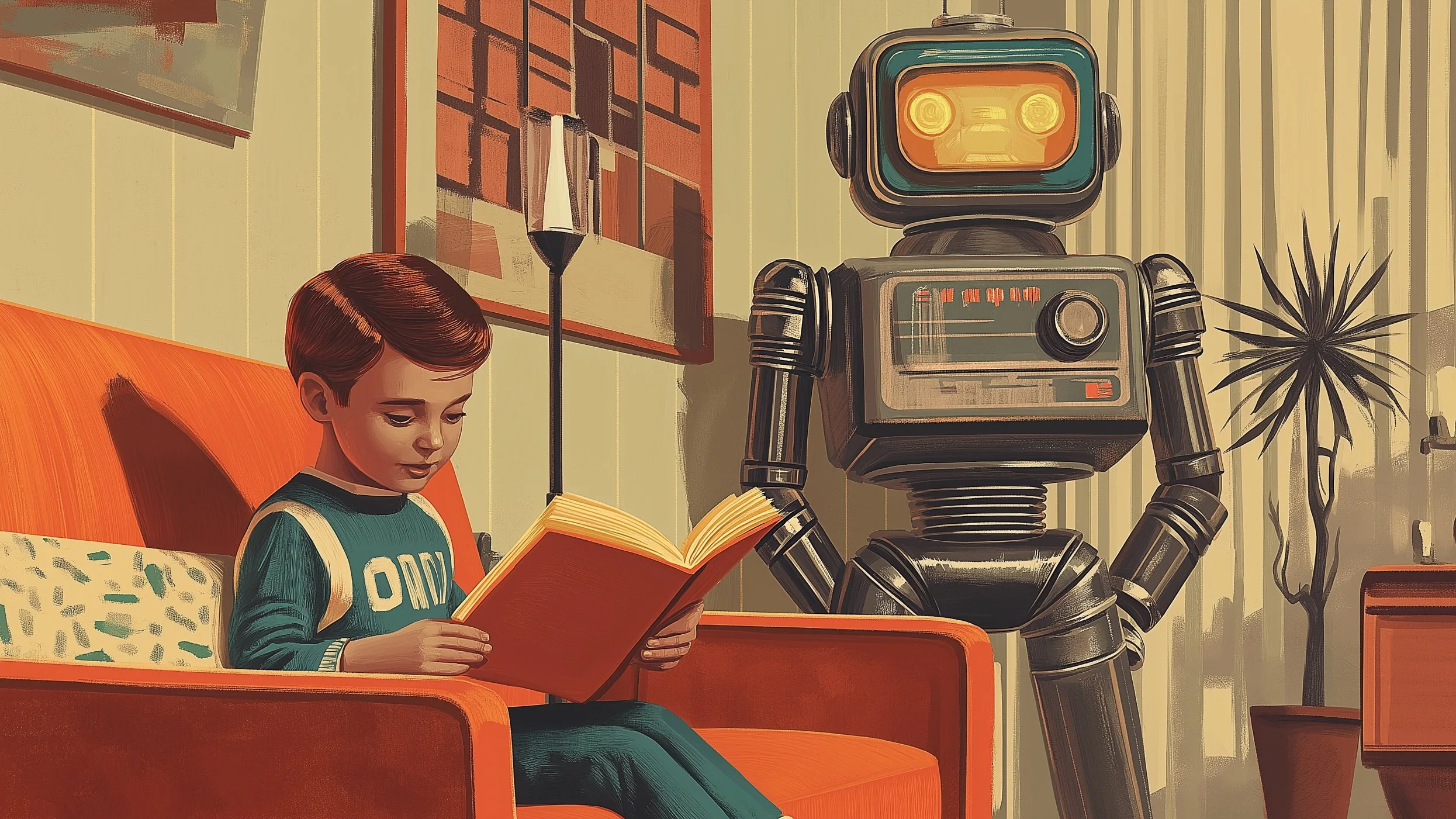
More than seventy years ago, Isaac Asimov imagined a future where children learn in isolation, guided by personalized mechanical tutors, and books are relics of a forgotten age. His 1951 short story, "The Fun They Had," is set in 2155, but its questions feel startlingly current.
In the story, a young girl named Margie discovers a paper book and learns about a time when children went to school together—sat in classrooms, were taught by human teachers, and shared the experience of learning with their peers. Her own education is efficient, personalized, and lonely. Her mechanical teacher can diagnose her struggles and recalibrate its approach, but it cannot inspire her, connect with her, or make her feel like she belongs to something larger than a lesson plan.
“Asimov didn’t predict AI as we know it. But he predicted the question that matters most: in our rush to optimize education, are we designing out the very things that make learning meaningful?
”
This is precisely the tension at the heart of today's conversation about AI in education. The promise of AI-powered tutors is real and, in many cases, genuinely valuable: adaptive pacing, instant feedback, content tailored to individual needs. But when personalization becomes the dominant paradigm—when every learner is on a separate track, in a separate space, at a separate time—the communal dimensions of education begin to disappear.
Natural Human Impulses for Learning (not schooling)
John Dewey argued more than a century ago that learning is driven by four natural impulses: inquiry, communication, construction, and expression. Most of these are inherently social. They depend on friction, dialogue, surprise, and the presence of other people. No amount of algorithmic sophistication can fully replicate the moment a teacher's unexpected enthusiasm shifts a student's entire trajectory, or the experience of working through difficulty alongside peers who share the same struggle.
Asimov's story also raises a subtler question about what endures. The book Margie discovers has survived two centuries. The static words on the page—unchanging, tactile, physical—carry a kind of permanence that digital media cannot easily match. This resonates with the growing cultural appetite for analog experiences: vinyl records, film photography, even old iPods. These are not acts of technological rejection. They are expressions of a deeper need for embodied engagement, deliberate choice, and the kind of friction that gives experience its texture.
Where do we go next?
None of this means AI has no place in education. It does, and increasingly will. But Asimov's story is a quiet reminder that the most important things about learning—curiosity, connection, belonging, the joy of shared discovery—are not problems to be optimized. They are human experiences to be protected.
The question is not whether AI can teach us. It's whether, in building systems that teach us more efficiently, we are designing out the very things that made learning worth having in the first place.
*Episode 71 of Modem Futura explores these themes through Asimov's story and a wider conversation about technology, nostalgia, and what it means to learn as a human being.*
Subscribe and Connect!
Subscribe to Modem Futura wherever you get your podcasts and connect with us on LinkedIn. Drop a comment, pose a question, or challenge an idea—because the future isn’t something we watch happen, it’s something we build together. The medium may still be the massage, but we all have a hand in shaping how it touches tomorrow.
🎧 Apple Podcast: https://apple.co/4s1lDk1
🎧 Spotify: https://open.spotify.com/episode/20I5j2DliUnZAbWDiVw7y8?si=WoEW_Zb2SPiynHYb4d8XHA
📺 YouTube: https://youtu.be/TDQc15Muwto
🌐 Website: https://www.modemfutura.com/

Sora, Slop, and the AI Economy: When ChatGPT Meets Walmart – Episode 54

Image illustrated adaptation by ChatGPT
If you’ve ever wondered what happens when the world’s largest retailer merges with the world’s most talked-about AI, you’re not alone. In our newest episode of Modem Futura, Andrew Maynard and I explore how OpenAI’s latest moves—from Sora 2’s eerily lifelike videos to Walmart’s direct-to-ChatGPT shopping partnership—signal a seismic shift in how we live, learn, and buy in a post-search world.
Andrew also just returned from Lisbon for the global launch of his new book AI and the Art of Being Human, a deeply personal and practical guide to thriving with AI while staying grounded in what makes us human. Together we discuss the book’s central question: how can we build a meaningful life amid tools that increasingly think, speak, and create like us?
We also dive into futurist Amy Webb’s sharp warning that the financial plumbing of the internet is changing fast. As she notes, when an AI company built on venture debt begins replacing Google’s ad-based model, we risk building the next era of commerce on borrowed money—and borrowed trust.
From there, the episode ranges widely: we unpack the ethics of open-source AI groups like Nous Research, debate what “guardrails” really mean, and share our growing fatigue with synthetic content—the endless churn of what the internet now calls “AI-slop.”
But it’s not all doomscrolling. We end with a new round of Futures Improv—our playful segment imagining speculative scenarios like subscription-based immortality and AI DJs reading your neural signals. It’s improv, futures-style: serious ideas approached with humor and imagination.
Whether you’re an AI enthusiast, a creative technologist, or simply trying to stay human in a rapidly transforming world, this episode captures the heart of Modem Futura: thoughtful conversations that remind us the future isn’t just something that happens to us—it’s something we co-create, signal by signal.
Subscribe and Connect!
Subscribe to Modem Futura on a favorite podcast platform, follow on LinkedIn, and join the conversation by sharing thoughts and questions. The medium may still be the massage, but everyone has a chance to shape how it kneads modern culture—and to decide what kind of global village we ultimately build.
🎧 Apple Podcast: https://apple.co/48C8PtS
🎧 Spotify: https://open.spotify.com/episode/38IopMk5XBA9xVsKU71UlM?si=wdAtLLaaQxGvNEjPVfqWTQ
📺 YouTube: https://youtu.be/aK-ev5T8Tu8
🌐 Website: https://www.modemfutura.com/