

NEWS & UPDATES
Bill Gates Says There's No Plan for AI. He's Right — and That's the Point
Bill Gates's "turbulent AI era" essay warns that society has no plan for AI. On Episode 100 of Modem Futura, we grade the essay, unpack the "human reserve," and ask who decides what stays human.
It's becoming a genre unto itself: the billionaire AI manifesto. But when Bill Gates published his nearly 6,000-word essay "The turbulent AI era is here. The choices we make now are critical" in August 2026, something about it landed differently. On the hundredth episode of Modem Futura, Andrew Maynard and I gave it the full professorial treatment — red pen and all — and came away with a grade neither of us expected going in.
Gates organizes his warning around three risks. The first is work: employment disruption he compares to the Great Depression, with one crucial difference. Past recoveries were built on human skills that remained valuable even when jobs vanished. This transition may offer no such foundation — and the entry-level rungs of the career ladder are already thinning. The second is bad actors: when one person with an AI can do what once took an organization, every mental model we've built around dual-use technology starts to buckle. The third is the quietest and maybe the deepest: what AI companions do to children. Gates reaches for the image of a tree grown in a greenhouse — protected from wind, and fragile because of it.
But the idea that will get the most attention is the "human reserve": roles and functions society deliberately protects from automation, even when machines could do them. Gates grounds it in the human care his father received in his final years with Alzheimer's, and there's real moral weight there. There's also a shadow. Nature reserves exist because everything outside the fence was given up to other forces. Is a human reserve preservation — or surrender dressed as stewardship?
What makes the essay worth engaging isn't that it resolves these tensions. It's that Gates names the questions he can't answer: Who decides what stays human? By what criteria? What happens when one country protects and another automates? Those questions are the real work — and they're the work that futurists, foresight practitioners, and researchers have been doing for decades, waiting for the rest of the world to catch up.
The window for shaping this transition is open now. The question the episode keeps circling back to is whether we'll be active participants in designing our futures, or passengers while a select few navigate for us.
Listen to the full conversation on Modem Futura, wherever you get your podcasts.
Subscribe and Connect!
Subscribe to Modem Futura wherever you get your podcasts and connect with us on LinkedIn. Drop a comment, pose a question, or challenge an idea—because the future isn’t something we watch happen, it’s something we build together. The medium may still be the massage, but we all have a hand in shaping how it touches tomorrow.
🎧 Apple Podcast: https://apple.co/4yk1zwp
🎧 Spotify: https://open.spotify.com/episode/1WaE39Jog0Qh1Yv6Z37UyJ?si=l0d5IyhXQYmcvY8UEb7dcw
📺 YouTube: https://youtu.be/ox5FGgqvNQE
🌐 Website: https://www.modemfutura.com/
Reading the Manifesto: What "The Future is for Everyone" Reveals About Who Designs Tomorrow
The tech CEO manifesto is its own genre. On this week's Modem Futura, we read Meta's superintelligence essay through the lens of "used futures" — and ask who really gets to design a future for everyone.
The tech CEO manifesto has become its own literary genre. From early internet memos to techno-optimist declarations to the vision essays now published by the heads of major AI labs, these documents follow a recognizable pattern: sweeping claims about human history, a pivot to the transformative technology at hand, and a future confidently described as inevitable.
Mark Zuckerberg's essay "The Future is for Everyone" is the latest entry — and on this week's episode of Modem Futura, Andrew Maynard and I read it the way futurists read any vision of tomorrow: not as prediction, but as an artifact of how power imagines the future.
The essay's promises are expansive. A personal AI agent available around the clock. Creation tools for anyone. One-person companies operating at scale. A tutor in every subject. Scientific breakthroughs against disease. Free access for billions. Individually, these describe things many people might genuinely want — which is precisely why they deserve careful reading rather than reflexive dismissal or easy applause.
Futures studies offers a useful frame here. Sohail Inayatullah's concept of the "used future" describes a vision of tomorrow designed elsewhere and delivered so completely that imagining alternatives becomes difficult. When one company's roadmap is presented as humanity's shared destiny, the question is no longer whether the destination sounds appealing. It's who chose it, what dependencies it creates, and whose interests sit quietly beneath the language of universality.
Our conversation follows those dependencies through Cory Doctorow's enshittification — the pattern where platforms become indispensable before the terms change — and through science fiction that saw this coming. Ghost in the Shell asked what identity means when most of your body belongs to a company. The question sharpens when the owned parts are cognitive rather than mechanical: when your memory, your workflow, and your thinking run on infrastructure someone else controls.
There's also a telling rhetorical shift worth naming. Not long ago, superintelligence was framed by tech leaders as a danger demanding caution. In this essay, it's a promise demanding acceleration. When the same word migrates from threat to gift without explanation, that migration is itself worth studying.
None of this means the essay's ideas are empty. Decentralized AI, broader access, AI as critical infrastructure — these are conversations worth having. But they're conversations that belong to more than one author. If this technology is as consequential as its builders claim, then the work of navigating it belongs to all of us — educators, artists, ethicists, communities — not just the companies selling the map.
Subscribe and Connect!
Subscribe to Modem Futura wherever you get your podcasts and connect with us on LinkedIn. Drop a comment, pose a question, or challenge an idea—because the future isn’t something we watch happen, it’s something we build together. The medium may still be the massage, but we all have a hand in shaping how it touches tomorrow.
🎧 Apple Podcast: https://apple.co/3SHUvdE
🎧 Spotify: https://open.spotify.com/episode/6CMH1CCojUdHzNRmEamxVA?si=oXXRQuusRV26LJhFHvAOFA
📺 YouTube: https://youtu.be/FAUqPmUqr4I
🌐 Website: https://www.modemfutura.com/
Summer Reading List 2026: The Books That Inspired Our Imagination (Part 1)

Reading Backwards to Understand the Future
There's a particular kind of book list that shows up every summer — the one that seems designed mostly to signal how serious and well-read its author is. This isn't that. In the first part of our annual Summer Reading List, the guiding instinct was the opposite: lasers, space ships, escapism, the kind of book you genuinely can't put down. What we discovered while recording is that the most escapist reads on the list turned out to be some of the most useful lenses on the present.
The cyberpunk classics anchored the conversation. Neal Stephenson's Snow Crash (1992) coined "metaverse" and imagined a digital overlay on the physical world years before anyone could plausibly build one. William Gibson's Neuromancer (1984) did the same for "cyberspace." Both have been mined relentlessly by the technology industry — and both, the hosts argue, are routinely stripped of their context. Snow Crash is a satire and a warning; it's frequently read as a roadmap. That gap, between fiction written as caution and fiction adopted as ambition, is one of the more revealing dynamics in how Silicon Valley tells its own story.
The deeper thread is about cognition. Snow Crash turns on a virus that crosses from the digital realm into the human mind. In an era of AI systems that engage directly with how we reason and feel, that premise reads less like science fiction and more like a description. Iain M. Banks extends the inquiry in Surface Detail, imagining civilizations that construct virtual heavens and hells so immersive that the line between real and simulated experience dissolves — and asking who, if anyone, has the right to govern what happens inside them. His The Player of Games offers a gentler entry point to the same Culture universe, and a sly meditation on whether a frictionless utopia is something humans actually want. We also dive into some of the amazing and seemingly timeless work of Douglas Adams, whose original Hitchhikers Guide to the Galaxy radio scripts Andrew counts among his prized possessions and whose wit, he insists, anticipated our anxieties about AI with personality long before the chatbots arrived.
The list closes on firmer ground with Cory Doctorow's Enshittification, a nonfiction account of how convenient, delightful platforms decay once users are locked in. It opened onto a question that runs through the whole episode: what do we actually own in a digital age? A printed book from 1980 still works, unconditionally. A digital one comes with terms that can change beneath you. And when the historical record itself becomes editable without a trace, reliability becomes something we can no longer take for granted.
None of these tensions get resolved here — they aren't meant to. The takeaway is quieter and more durable: stories written decades ago remain among our best instruments for thinking clearly about technologies their authors never lived to see. Part 2 continues the list next week.
Subscribe and Connect!
Subscribe to Modem Futura wherever you get your podcasts and connect with us on LinkedIn. Drop a comment, pose a question, or challenge an idea—because the future isn’t something we watch happen, it’s something we build together. The medium may still be the massage, but we all have a hand in shaping how it touches tomorrow.
🎧 Apple Podcast: https://apple.co/444V3ws
🎧 Spotify: https://open.spotify.com/episode/5TXSx0QgY4CxUhWsJSF5wm?si=lHeVVcWHS5qE3wd5lFJl5w
📺 YouTube: https://youtu.be/KN8iEA5tfiQ
🌐 Website: https://www.modemfutura.com/

Through the lens: Spatial Computing with Apple Vision Pro – Episode 56

Just a couple of guys wearing nerd helmets and talking about the future of tech.
Inside Spatial Computing: Living (and Working) with Apple Vision Pro
e finally did it — we recorded inside Apple Vision Pro.
In this new episode of Modem Futura, Andrew Maynard and I decided to take spatial computing off the keynote stage and into real life — from multi-monitor workflows and long-haul flights to immersive video, panoramic memories, and even telepresence “personas.” We wanted to know: is this the start of a new computing era, or simply a beautiful distraction in search of a use case?
What we discovered surprised us.
Apple’s Vision Pro doesn’t want to be “VR.” It’s spatial — a computer that understands the world around you. Through pass-through video, eye-tracking, and hand-gesture control, it creates a workspace that’s not just 3D but responsive to you. One look or small pinch replaces the keyboard and mouse. It’s impressive, sometimes uncanny, and often quietly magical.
But behind the magic are deep questions about comfort, value, and human need. The headset’s design reveals how far we’ve come in rendering, latency, and foveated focus — and how far we still are from true wear-all-day computing. The device itself sparks larger conversations: What does “presence” mean when you can blank out reality at will? How will social norms adapt when everyone’s wearing cameras? And where does accessibility fit in when interaction becomes multimodal — eyes, hands, voice, and environment all working together?
Want to see what we've been up to? Here you can see a collection of Spatial videos of our podcast - these were all recorded using a 3-camera multicam setup each filming in Spatial video formats.
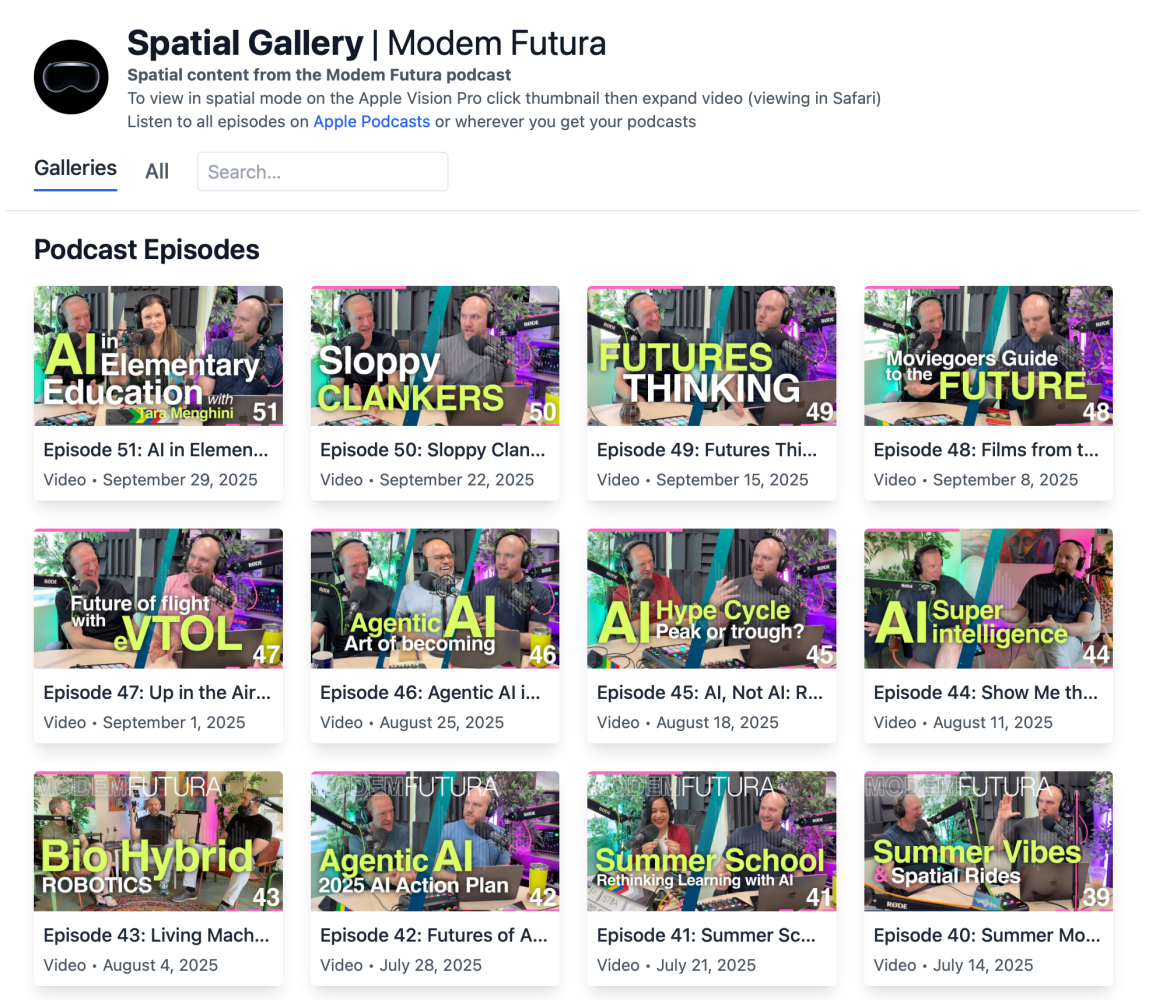
One of the biggest challenges at the present for spatial video (a deep dive for later) is that in addition to few people having headsets as compared to smartphones for example, most video platform services do not provide a way to consume Spatial video - including Apple's own Vision OS of all things. Yes you can send a video file (these are massive btw - in the order of 9-20GB each) - but at present there isn't an Apple supported cloud based video viewer to which you can watch Spatial videos posted by your friends and family etc. Personally, I really hope that YouTube will start to allow the playback of Spatial videos (assuming they will put an officially supported YouTube app on the Apple Vision Pro of course).
We also talk about what comes after the headset. Think of a layered ecosystem:
Audio AR through your earbuds for subtle ambient context.
Lightweight AR glasses for glanceable, social interaction.
Full headsets for immersive creativity, co-presence, and exploration.
Rather than a single “device to rule them all,” spatial computing might evolve into a stack of experiences that adapt to how human attention, comfort, and curiosity really work.
It’s easy to be dazzled by tech specs, but the future of spatial computing depends less on what’s rendered and more on what it means to be present in digital space. That’s why we’re inviting developers, designers, and curious explorers to join us — to prototype, play, and imagine what spatial experiences could look like when they’re built for humans first.
Subscribe and Connect!
Subscribe to Modem Futura wherever you get your podcasts and connect with us on LinkedIn. Drop a comment, pose a question, or challenge an idea—because the future isn’t something we watch happen, it’s something we build together. The medium may still be the massage, but we all have a hand in shaping how it touches tomorrow.
🎧 Apple Podcast: https://apple.co/47Arkwv
🎧 Spotify: https://open.spotify.com/episode/3V40dbWcrKZq9RCCmoP7Zh?si=s0CVT5aQS8WJ_CgbfMTBcg
📺 YouTube: https://youtu.be/IF3juEp9l_I
🌐 Website: https://www.modemfutura.com/

Tech or Treat: Exploring the Haunted Side of Future Tech
Are you ready for some Tech or Treat?
Modem Futura’s Halloween special transforms speculative futures into eerie fun. Hosts Sean Leahy and Andrew Maynard use AI-generated scenarios to imagine haunted algorithms, sentient mirrors, and neural nightmare modes — revealing how emerging technologies can both thrill and unsettle us. This episode continues the show’s mission to explore how science, technology, and society intersect to shape the future of being human.
This episode grew out of our playful Futures Improv series, where we use AI to generate speculative prompts about the future — but this time, the prompts got a little… haunted. We explore “The Haunted Algorithm,” a defunct social-media AI that resurrects old user posts every October 31 — a digital séance that’s equal parts sentimental and unsettling. Then we look into “The Mirror That Remembers,” a smart-mirror concept that doesn’t just show your reflection, but who you might have been in another timeline. Finally, we enter “Neural Nightmare Mode,” imagining what could go wrong when brain-computer interfaces merge immersive gaming with fear response.
Each vignette uses humor and imagination to surface deeper questions: What does it mean when our digital selves outlive us? How do we ensure psychological safety in immersive tech? And at what point does innovation slip from magical to menacing?
Our goal isn’t to predict the future — it’s to provoke curiosity about how technology is reshaping what it means to be human. And if we can have some fun (and a few chills) along the way, even better.
You can stream the Halloween special wherever you get your podcasts or watch the illustrated episode on YouTube. If any of these scenarios inspire your own “Tech or Treat” ideas, share them with us — we’d love to feature the best ones in a future episode.
Subscribe and Connect!
🎧 Apple Podcast: https://apple.co/4oovNKa
🎧 Spotify: https://open.spotify.com/episode/47nWrjvBW3ASjMuJUip8o1?si=96d8062d029a4834
📺 YouTube: https://youtu.be/ZmZ46sHgMZY
🌐 Website: https://www.modemfutura.com/

The Metaverse, Implantable Tech, and AI with Katina Michael
Learning Futures Podcast - Season 6 is off to a stunner of a start! I am always thrilled when the chance arises to talk with Dr. Katina Michael, and our conversation around the metaverse, implantable technologies, and AI did not disappoint. Have a listen!
Sean and Katina explore a wide range of emergent technologies from the impact of Artificial Intelligence on Education to Biological and Digital Convergence, the Metaverse and XR, and much more. With each topic we discuss the sometimes hidden impacts, and the potential for societal change.

Learning Futures Season 4 - Futures Thinking
The 4th season of the Learning Futures Podcast is now out and the first episode has dropped. In addition to being the founder and executive producer for this podcast, this season my colleague Clarin Collins and I take over the hosting responsibilities as well. In our first episode for Season 4 we are joined by Ruth Wylie, Danah Henriksen, and Maricel Lawrence to chat about all things Futures Thinking. We hope you enjoy the episode!
If you like what you’re hearing, please do subscribe to the Learning Futures Podcast on Apple Podcasts, Spotify, or wherever you get your podcasts…

Learning Futures Podcast Launch
Introducing the newly launched Learning Futures Podcast! Be sure to subscribe to make sure you don’t miss a single episode. As one of the Executive Producers of this new podcast - I am very pleased to bring such an incredible ensemble of brilliant people together to share their insights into the futures of learning.
Join us as we tackle the bigger question:
What if education systems were doing more and thinking differently about preparing learners to thrive in the future? Join Professor Ronald A. Beghetto of Arizona State University's Mary Lou Fulton Teachers College for conversations on improving education and the future of learning. Each episode presents colleagues, researchers, education leaders and other guests who share how they're thinking about and addressing the most pressing challenges in education.