

NEWS & UPDATES
Artemis II and the Long Way Home: What Deep Space Exploration Demands of Us
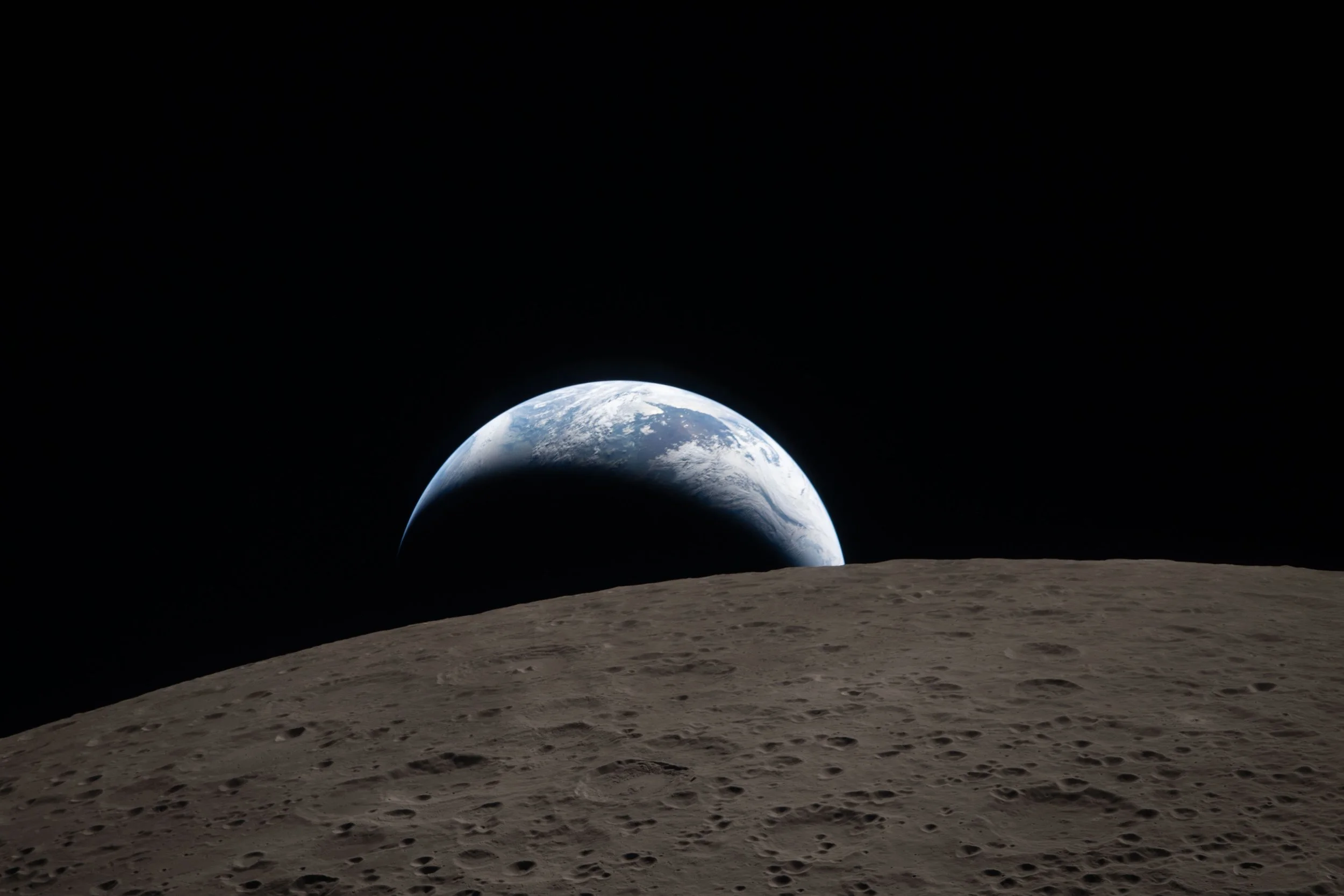
In April 2026, four human beings traveled farther from Earth than any person in history. They didn't land on the moon. They flew past it, studied it, and came home. And in doing so, they reset a clock that had been stopped since 1972.
The Artemis II mission was, on its surface, a test flight — a crewed rehearsal for the more ambitious lunar landings planned in the years ahead. But the questions it raises reach far beyond mission objectives and orbital insertion burns.
On Episode 79 of Modem Futura, hosts Sean Leahy and Andrew Maynard recorded while the Artemis II crew was still in transit — a strange, exhilarating thing to do. The conversation begins with wonder and keeps returning to it, even as it wanders through orbital mechanics, space medicine, ethics, and the philosophical puzzle of what happens to human beings when they spend extended time somewhere they were never designed to go.
The distance alone is disorienting. The International Space Station orbits roughly 254 miles above Earth. The Artemis II crew traveled 250,000 miles — a thousand times farther — to the vicinity of the moon and back. That gap isn't just logistical. It's physiological, psychological, and deeply uncertain. We know what months on the ISS do to the human body. We know almost nothing about what deep space does over time.
That's where the science aboard the Orion capsule becomes meaningful. Research into sleep disruption, immune response, radiation exposure, and tissue behavior at the cellular level isn't background noise on this mission — it's the whole point. If the goal is eventually boots on Mars, every data point from Artemis II is a foundation stone.
The episode also sits with the ethical weight of deep space ambition. What separates a calculated risk from an acceptable one? How do we think about consent when the full scope of a mission's hazards isn't yet understood? And what does it mean that commercial spaceflight operators and government agencies don't necessarily answer those questions the same way?
There's no resolution here — and that's intentional. Modem Futura isn't in the business of predictions or tidy conclusions. It's in the business of sitting with hard questions long enough that they stop feeling abstract.
By the time this episode aired, the crew had splashed down safely. The images are still coming in from cameras that make those 1972 film photographs look like another century entirely — which, of course, they are. What remains is the same question a 10-year-old at the launch site answered better than anyone: we're going to the moon. What does that actually mean for the rest of us?
🎧 Listen to the full episode wherever you get your podcasts, or watch on YouTube.
Subscribe and Connect!
Subscribe to Modem Futura wherever you get your podcasts and connect with us on LinkedIn. Drop a comment, pose a question, or challenge an idea—because the future isn’t something we watch happen, it’s something we build together. The medium may still be the massage, but we all have a hand in shaping how it touches tomorrow.
🎧 Apple Podcast: https://apple.co/3QnGDUl
🎧 Spotify: https://open.spotify.com/episode/41PaANt8205BkvkpQkV61v?si=UAEW9i-GQQWk2XwP6lw2kA
📺 YouTube: https://youtu.be/4Fv8hq_u-DY
🌐 Website: https://www.modemfutura.com/