

NEWS & UPDATES

Inherited Power: What Jurassic Park Teaches Us About AI Futures

Jurassic Park, AI, and Why “Inherited Power” Should Make Us Nervous
One of the most enduring insights from science fiction isn’t about robots, dinosaurs, or spaceships — it’s about power. In a recent episode of Modem Futura, we revisited a striking passage from Jurassic Park that feels uncannily relevant to our current moment of AI acceleration.
In the novel, Ian Malcolm warns that scientific power acquired too quickly — without discipline, humility, or deep understanding — is fundamentally dangerous. It’s “inherited wealth,” not earned mastery. Thirty-five years later, that warning lands squarely in the middle of our generative AI era.
Today, AI tools can write code, generate images, summarize research, and mimic expertise in seconds. That’s not inherently bad — in fact, it can be incredibly empowering. But it also creates a dangerous illusion: that capability equals comprehension, and speed equals wisdom. When friction disappears, responsibility often follows.
In the episode, Andrew and I explore why the most important question isn’t whether we should use these tools, but how we use them — and with what mindset. Are we willing to be humble in the face of tools that amplify our reach far faster than our understanding? Are we prepared to ask for receipts, interrogate outputs, and recognize the limits of borrowed intelligence?
From there, we leaned into something equally important: imagination. Through our Futures Improv segment, we explored bizarre but revealing scenarios — humans generating calories from sunlight, a world of post-scarcity socks, radically extended lifespans, lunar independence movements, and even the possibility that alien life might be… profoundly boring.
These playful provocations aren’t escapism. They’re a way of breaking free from “used futures” — recycled assumptions about progress that limit our thinking. Humor, speculation, and creativity allow us to test ideas safely before reality forces our hand.
If there’s one takeaway from this episode, it’s this: the future isn’t just something that happens to us. It’s something we ponder, question, and design together — ideally before the metaphorical dinosaurs escape the park.
🎧 Listen to the full episode of Modem Futura wherever you get your podcasts, and join us as we explore what it really means to be human in an age of powerful machines.
Subscribe and Connect!
Subscribe to Modem Futura wherever you get your podcasts and connect with us on LinkedIn. Drop a comment, pose a question, or challenge an idea—because the future isn’t something we watch happen, it’s something we build together. The medium may still be the massage, but we all have a hand in shaping how it touches tomorrow.
🎧 Apple Podcast: https://apple.co/3NIBdlt
🎧 Spotify: https://open.spotify.com/episode/32wGw6htnSDyGVc08DAvvQ?si=m8jS08egQyOZjYTic6cROw
📺 YouTube: https://youtu.be/jBBIbNu-XdY
🌐 Website: https://www.modemfutura.com/

Films from the Future: Moviegoer’s Guide to Tomorrow – Episode 48
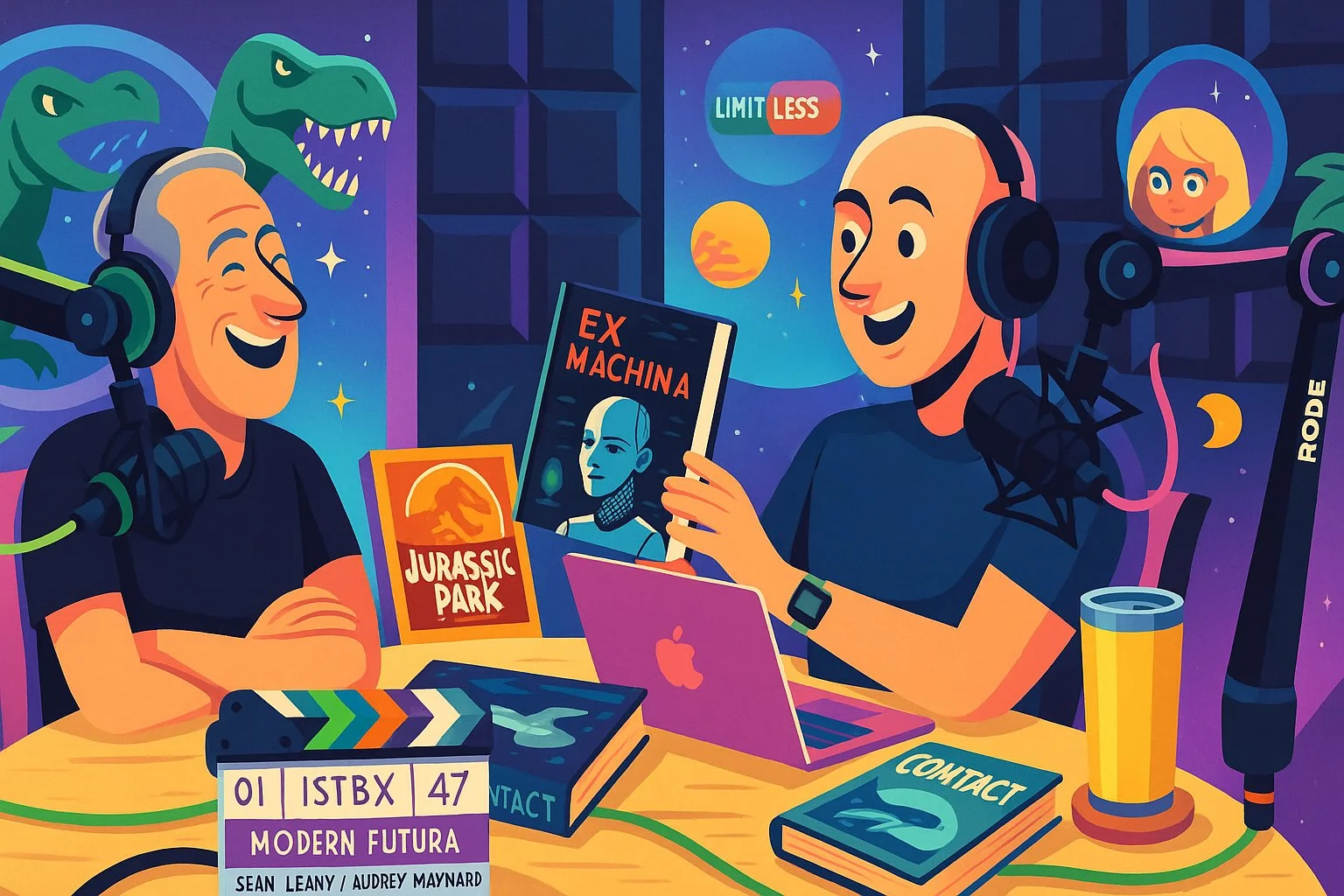
Films from the Future: How Sci-Fi Movies Shape the Way We See Tomorrow
Why do movies like Jurassic Park, Minority Report, or Ex Machina stay with us long after the credits roll? It’s not just the dinosaurs, futuristic tech, or special effects — it’s because these films reflect back to us the deeper questions of what it means to be human in a rapidly changing world.
In our latest Modem Futura episode, Andrew Maynard and I revisit his book Films from the Future: The Technology and Morality of Sci-Fi Movies and the class it inspired, The Moviegoer’s Guide to the Future. The central idea? Films are not only entertainment — they’re cultural tools that help us grapple with profound questions about technology, ethics, and identity.
Take Never Let Me Go, a haunting exploration of cloning and the value of life itself. Or Minority Report, which foreshadowed today’s debates over predictive policing and surveillance technologies. Ex Machina pushes us to consider how easily humans can be manipulated by AI that learns our cognitive biases. And Elysium asks us to confront inequality in access to innovation, healthcare, and privilege. Even Contact, Carl Sagan’s love letter to science, brings us face-to-face with the tension between faith, science, and the human search for meaning.
What makes these films powerful isn’t scientific accuracy — it’s storytelling. Stories give us a playground for exploring possible futures. They allow us to ask “what if?” and to examine how technological choices shape human lives, for better and for worse. And when these stories are shared communally — in theaters, classrooms, or even podcasts like ours — they become catalysts for conversations that spill over into dinner tables, workplaces, and beyond.
For us, this is the heart of futures thinking. By examining the stories we tell, we can better understand the world we’re building, and perhaps make wiser choices about where we’re headed.
🎧 Listen to the full episode to dive deeper into how films shape our futures: https://apple.co/3VHmkka
📺 Watch us on YouTube: https://www.youtube.com/@ModemFutura
🎬 What film has changed the way you think about the future? Drop a comment — we’d love to hear.
If you’d like to dive deeper, jump into the link and listen to the podcast or watch the YouTube video. Join us as we explore the forces shaping our collective future and the urgent need to keep human values at the heart of innovation.
Subscribe and Connect!
Subscribe to Modem Futura on a favorite podcast platform, follow on LinkedIn, and join the conversation by sharing thoughts and questions. The medium may still be the massage, but everyone has a chance to shape how it kneads modern culture—and to decide what kind of global village we ultimately build.
🎧 Apple Podcast: https://apple.co/3VHmkka
🎧 Spotify: https://open.spotify.com/episode/2cpIyNfnbveNmKC4eh4dV6?si=NiwZzFYNR5-fVrr0jgoNvg
📺 YouTube: https://youtu.be/YHR1xEG4kAo
🌐 Website: https://www.modemfutura.com/