

NEWS & UPDATES

The Watermark You Can't See: AI Text, Invisible Ink, and the Question of Care
A new kind of watermark lives inside AI-generated text — invisible, durable, and woven into word choice itself. Episode 99 of Modem Futura explores what that means for writing as a craft, the AI scarlet letter, and whether the written word was ever permanent.
When we think of watermarks, we think of something visible — hold the paper to the light and there it is. The newest generation of watermarks abandons that transparency entirely, and that inversion sits at the heart of Episode 99 of Modem Futura.
In response to the EU AI Act's Article 50 transparency rules, Anthropic announced it would watermark Claude's text output globally using the SynthID-Text method, developed at Google DeepMind. Unlike metadata, which can be scrubbed, or visible stamps, which can be cropped, this watermark lives in the statistical pattern of word choice itself. Large language models constantly choose among near-equivalent words; the watermark quietly biases those choices according to a secret key. The result reads naturally to a human but carries a fingerprint — one Andrew Maynard likened to a hologram, where every shattered fragment still reveals the whole image. It survives copy-paste, editing, and even changing mediums.
Impressive engineering. But as we unpacked on the show, the human questions run deeper than the technical ones. Writers weigh words. In academic writing, "significant" and "meaningful" are not interchangeable — one makes a statistical claim. If a watermarking layer influences word selection, the writing begins serving two masters: the writer's meaning and the system's detectability. That's a real cost, and it lands hardest on the people for whom writing is the craft itself.
The episode also examines the social machinery already forming around detection — a new generation of accurate AI checkers, disciplinary accusations built on unreliable ones, and what has begun to feel like a scarlet letter for anyone whose prose seems too polished. Meanwhile, AI's ambient influence — autocomplete, search summaries, grammar tools — has touched nearly everything since late 2022. The binary of "AI-written" versus "clean" may already be a fiction.
So we proposed a reframe borrowed from four years of hard-won lessons in education: stop asking did they use AI and start asking what was the process, what was the intent, and was there care? Did the writer put more into the work than they're asking of the reader?
And then, because this is Modem Futura, we let the question spiral outward: if reading and writing can be cognitively offloaded, were they ever permanent features of being human — or one tipping point among many, with another on the horizon?
Subscribe and Connect!
Subscribe to Modem Futura wherever you get your podcasts and connect with us on LinkedIn. Drop a comment, pose a question, or challenge an idea—because the future isn’t something we watch happen, it’s something we build together. The medium may still be the massage, but we all have a hand in shaping how it touches tomorrow.
🎧 Apple Podcast: https://apple.co/4y5V2p4
🎧 Spotify: https://open.spotify.com/episode/2AcgH72mbqjr3vsMA5qI43?si=Ic8Y7liLTe2wT6HSA4sS9A
📺 YouTube: https://youtu.be/o-me74i-8Mg
🌐 Website: https://www.modemfutura.com/

Reading the Manifesto: What "The Future is for Everyone" Reveals About Who Designs Tomorrow
The tech CEO manifesto is its own genre. On this week's Modem Futura, we read Meta's superintelligence essay through the lens of "used futures" — and ask who really gets to design a future for everyone.
The tech CEO manifesto has become its own literary genre. From early internet memos to techno-optimist declarations to the vision essays now published by the heads of major AI labs, these documents follow a recognizable pattern: sweeping claims about human history, a pivot to the transformative technology at hand, and a future confidently described as inevitable.
Mark Zuckerberg's essay "The Future is for Everyone" is the latest entry — and on this week's episode of Modem Futura, Andrew Maynard and I read it the way futurists read any vision of tomorrow: not as prediction, but as an artifact of how power imagines the future.
The essay's promises are expansive. A personal AI agent available around the clock. Creation tools for anyone. One-person companies operating at scale. A tutor in every subject. Scientific breakthroughs against disease. Free access for billions. Individually, these describe things many people might genuinely want — which is precisely why they deserve careful reading rather than reflexive dismissal or easy applause.
Futures studies offers a useful frame here. Sohail Inayatullah's concept of the "used future" describes a vision of tomorrow designed elsewhere and delivered so completely that imagining alternatives becomes difficult. When one company's roadmap is presented as humanity's shared destiny, the question is no longer whether the destination sounds appealing. It's who chose it, what dependencies it creates, and whose interests sit quietly beneath the language of universality.
Our conversation follows those dependencies through Cory Doctorow's enshittification — the pattern where platforms become indispensable before the terms change — and through science fiction that saw this coming. Ghost in the Shell asked what identity means when most of your body belongs to a company. The question sharpens when the owned parts are cognitive rather than mechanical: when your memory, your workflow, and your thinking run on infrastructure someone else controls.
There's also a telling rhetorical shift worth naming. Not long ago, superintelligence was framed by tech leaders as a danger demanding caution. In this essay, it's a promise demanding acceleration. When the same word migrates from threat to gift without explanation, that migration is itself worth studying.
None of this means the essay's ideas are empty. Decentralized AI, broader access, AI as critical infrastructure — these are conversations worth having. But they're conversations that belong to more than one author. If this technology is as consequential as its builders claim, then the work of navigating it belongs to all of us — educators, artists, ethicists, communities — not just the companies selling the map.
Subscribe and Connect!
Subscribe to Modem Futura wherever you get your podcasts and connect with us on LinkedIn. Drop a comment, pose a question, or challenge an idea—because the future isn’t something we watch happen, it’s something we build together. The medium may still be the massage, but we all have a hand in shaping how it touches tomorrow.
🎧 Apple Podcast: https://apple.co/3SHUvdE
🎧 Spotify: https://open.spotify.com/episode/6CMH1CCojUdHzNRmEamxVA?si=oXXRQuusRV26LJhFHvAOFA
📺 YouTube: https://youtu.be/FAUqPmUqr4I
🌐 Website: https://www.modemfutura.com/

When Your AI Tools Change Beneath You: Reliability, Agency, and the Opus 4.7 Question
In April 2026, Anthropic released Opus 4.7 — the latest top-tier model in its Claude family — alongside the brief, controversial preview of an unreleased model called Mythos. For most casual users, the rollout was a footnote. For those who had built creative, professional, and research workflows on top of Claude, it surfaced a question that has been quietly waiting beneath the surface of every cloud-based AI tool: what does it mean to depend on something that can change without notice?
In this episode of Modem Futura, Andrew Maynard and I sit with that question. Drawing on a clearly traceable timeline of recent shifts — adaptive thinking made mandatory, verbosity caps that constrain output length, opaque routing tiers that decide on the user's behalf which version of "Opus" they're actually getting, and expanded safeguards that have begun blocking legitimate creative and academic work — they trace the slow erosion of confidence many users have started to feel in tools they had come to rely on.
But this episode is not a product review. It's a meditation on the broader phenomenon these shifts make legible.
What is the cost of building deep professional and creative reliance on platforms that are, by design, liquid? When a tool's behavior can change hour by hour, what kind of agency do users actually retain? Is there a future in which frozen or locally-hosted models become a quiet luxury for serious users — and what would we trade to get there? And, perhaps most strikingly, what does it mean that AI may be the first genuinely “relational” technology in modern life — one whose value depends on a working relationship that, by its nature, can never be fully held still?
Along the way, we share two practical workarounds: one for getting better writing out of a model that has started feeling stiff, and one small "canary in the coal mine" trick that any user can borrow today to detect when their model has quietly drifted.
What emerges is not a verdict on Opus 4.7, or on Claude, or on Anthropic. It is, instead, an honest conversation about the strange new work of staying thoughtful while the tools beneath us continue to shift — and a reminder that as these systems become more deeply embedded in our work, our research, and our creative lives, the most important question may not be how powerful they get, but how knowable, how stable, and how ours they remain.
This is the kind of conversation Modem Futura was made for: technology examined not as inevitability, but as a sociotechnical relationship we are all, quietly, still negotiating.
Subscribe and Connect!
Subscribe to Modem Futura wherever you get your podcasts and connect with us on LinkedIn. Drop a comment, pose a question, or challenge an idea—because the future isn’t something we watch happen, it’s something we build together. The medium may still be the massage, but we all have a hand in shaping how it touches tomorrow.
🎧 Apple Podcast: https://apple.co/4f0tMlg
🎧 Spotify: https://open.spotify.com/episode/1csL79s3FtL5tGYVh7BZdW?si=BsQ2t39DQcCy6V--ArPwOQ
📺 YouTube: https://youtu.be/ZdHVLfxjsr8
🌐 Website: https://www.modemfutura.com/

Fluid Futures: Navigating an AI-Mediated World
What Happens When AI Stops Being a Tool and Starts Being the World?
There's a useful distinction that keeps getting lost in conversations about artificial intelligence: the difference between augmentation and mediation.
Augmentation is familiar. It's the calculator model — AI helps you work faster, smarter, better. You remain the agent. The tool amplifies your capacity.
Mediation is something else. When AI mediates your world, it's not just helping you do things — it's shaping the system you're doing them inside of. What information surfaces. What options appear. What feels like the obvious next move. You're not using the environment anymore. You're inside one that AI has constructed, and it's shifting around you in real time.
This distinction is at the heart of Exploring the Futures of Technology 2.0, the new report from the Copenhagen Institute of Future Studies — and it's the central thread of the latest episode of Modem Futura.
On this episode, my co-host Andrew Maynard, fresh from attending the report's launch in Copenhagen, joined me to work through ten signals the report identifies as defining the near future: the shift from static to liquid content, the rise of agentic organizations, neurotechnology and cognitive integration, synthetic simulations replacing real-world research populations, physical AI entering embodied space, the geopolitics of technological access, AI-mediated cybersecurity threats, the sustainability challenges of AI infrastructure, and quantum computing as the wildcard at the edge of everything.
What holds these signals together isn't a single prediction. It's a pattern: the world is becoming fluid, and the frameworks we built for a more static environment — static reports, static institutions, static skillsets — are increasingly inadequate for navigating it.
One of the episode's sharpest observations is about the cost of cognitive offloading. As we hand more of our decision-making and information retrieval to AI systems, we risk losing the capacity to recognize when something's wrong. Not because AI is malicious, but because we've stopped practicing the skills that would let us notice. Like losing the ability to read a map. Except the stakes are considerably higher.
The conversation doesn't resolve these tensions — and that's exactly the point. Futures thinking, at its best, isn't about prediction. It's about staying awake to what's changing, naming the tensions, and refusing to optimize for a world that no longer exists.
If you want the full report, the Copenhagen Institute has made it freely available. And if you want the conversation around it — the episode is a good place to start.
Subscribe and Connect!
Subscribe to Modem Futura wherever you get your podcasts and connect with us on LinkedIn. Drop a comment, pose a question, or challenge an idea—because the future isn’t something we watch happen, it’s something we build together. The medium may still be the massage, but we all have a hand in shaping how it touches tomorrow.
🎧 Apple Podcast: https://apple.co/4bSGsZP
🎧 Spotify: https://open.spotify.com/episode/4sdx83QUD6pIs9IXb9G0VY?si=JdbwVHUKRg2mFO0Gsi_EFw
📺 YouTube: https://youtu.be/-2enUvPYmHo
🌐 Website: https://www.modemfutura.com/

The Future From a Kid's Perspective: What a 10-Year-Old Thinks About AI, Jobs, and Meaningful Work
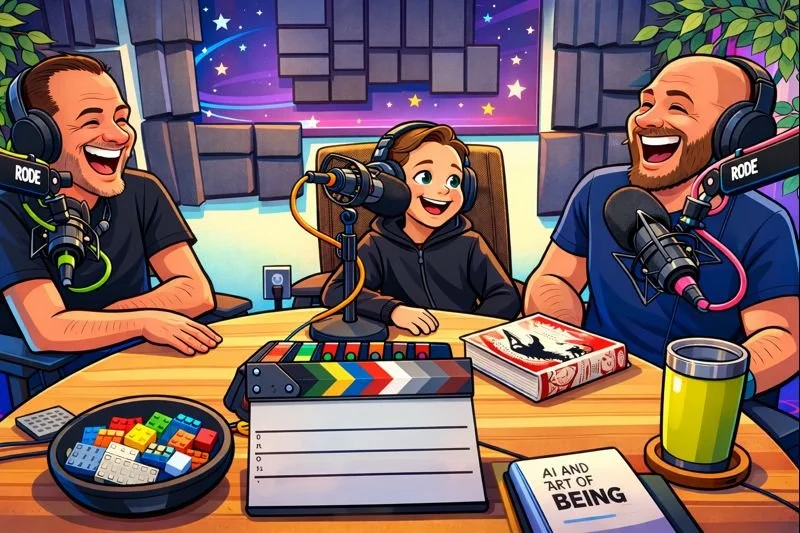
We spend a lot of time talking about young people when we discuss the future of technology. We debate how AI will affect their education, reshape their careers, and transform the world they'll inherit. But we rarely stop to ask them what they think.
In this special episode of Modem Futura, we did exactly that. Freddie Leahy—co-host Sean's almost-10-year-old son—joined us for an unscripted conversation about artificial intelligence, meaningful work, and the questions that don't have easy answers.
Already Thinking About Job Displacement
When asked what he thinks about when he imagines the future, Freddie's first response wasn't about flying cars or space travel. It was about jobs.
"I kind of more think about the AI part of the future," he said. "And I'm just wondering what jobs will be overran by AI."
He's almost ten. And he's already calculating whether his dream career—paleontology—will exist by the time he's ready to pursue it.
This isn't abstract concern. Freddie has a specific vision: he wants to be like Alan Grant from Jurassic Park, out in the field, hands in the dirt, discovering fossils himself. When we suggested that AI might help him find more dinosaur bones faster, he didn't immediately embrace the idea. His worry isn't about efficiency—it's about being separated from the work itself.
"I would be doing it not for the money," he explained, "just because of the experience."
The Limits of AI Creativity
Freddie has firsthand experience with generative AI. He and I have spent time creating AI-generated images—D&D characters, fantasy creatures, book covers. But he's noticed something that many adults are also discovering: the gap between imagination and output.
"Every time you create an AI image," he said, "you never feel like it's quite right. So you just keep making these, and then you have to choose one, but in the end it never feels like the perfect cover you wanted."
When asked why, his answer was simple: "AI isn't our heads."
This observation—from a fourth-grader—gets at something fundamental about the current state of generative tools. They can produce impressive outputs, but they can't access the specific vision in your mind. The friction between prompt and result isn't just a technical limitation; it's a gap between human intention and machine interpretation.
When it comes to his own writing—Freddie is working on stories—he's clear that he doesn't want AI assistance. The temptation exists, especially when facing a blank page. But he recognizes something important: "It's the point about using your own creativity."
Suspicious of AI Companions
One of the most revealing exchanges came when we explored the idea of AI friendship. What if Freddie could have an AI companion who shared all his interests—someone who wanted to talk about dinosaurs as much as he does?
His response was immediate skepticism.
"That would be weird," he said, "because nobody likes what I like."
The very thing that might make an AI friend appealing—perfect alignment with his interests—is exactly what made it feel inauthentic. Part of what makes his interests meaningful is that they're his, distinct from the people around him. An AI that mirrored them perfectly would feel hollow.
When pressed further about whether he'd want an AI as a secret companion—a sort of digital spirit animal—Freddie remained uncertain. "Who knows what it could do," he noted. "It could hack everything."
There's healthy skepticism there, but also something deeper: a sense that friendship involves more than shared interests. It involves trust, vulnerability, and the unpredictability of another mind.
"I Refuse": Mind Uploading at Nine
During our Futures Improv segment, we posed a classic transhumanist scenario: What if you could upload your consciousness to a computer and live forever digitally, while your biological body remained behind?
Freddie's answer required no deliberation:
"I refuse. I will not upload my brain into a digital computer."
His reasoning was practical but profound. At nine years old, why would he abandon a body that works? The theoretical benefits of digital immortality don't outweigh the immediate reality of physical experience.
This perspective offers a useful counterweight to futures discourse that sometimes treats technological transcendence as obviously desirable. From Freddie's vantage point, the question isn't whether we can escape biological limitations, but whether we'd want to—and what we might lose in the process.
Questions Without Right Answers
Perhaps the most important takeaway from this conversation came near the end, when Freddie observed something about the nature of our questions.
"Because of all these questions," he said, "there is no wrong or right answer."
That's exactly right. The value of futures thinking isn't in predicting what will happen or determining the "correct" response to emerging technologies. It's in learning to sit with uncertainty, explore tensions, and develop our capacity for navigating complexity.
At almost ten years old, Freddie already understands this. He's not looking for definitive answers about AI and jobs and creativity. He's learning to ask better questions—and to recognize that asking them is more important than resolving them.
What the Future Thinks About Itself
We often frame conversations about technology and youth as adults preparing children for a world we're creating. But this episode suggests something different: young people are already thinking about these issues, often with more nuance than we might expect.
Freddie isn't anti-technology. He plays VR games, makes AI art, and follows developments in the field. But he's also holding onto something—a sense that some experiences are valuable precisely because we do them ourselves, that the struggle of creation is part of its meaning, and that efficiency isn't the only measure of a good life.
These aren't lessons we taught him. They're insights he's developing on his own, as he navigates a world where these technologies are simply part of the landscape.
Maybe the best thing we can do isn't to tell young people what the future will look like. Maybe it's to listen to what they already think about it—and learn from their perspective.
I don't know what the future holds for his generation. But if this conversation is any indication, they're thinking about it more carefully than we might expect.
Subscribe and Connect!
Subscribe to Modem Futura wherever you get your podcasts and connect with us on LinkedIn. Drop a comment, pose a question, or challenge an idea—because the future isn’t something we watch happen, it’s something we build together. The medium may still be the massage, but we all have a hand in shaping how it touches tomorrow.
🎧 Apple Podcast: https://apple.co/4khmVES
🎧 Spotify: https://open.spotify.com/episode/5nKjpEVZcaUDisdZpGGaMZ?si=YgWp_O84T1yVlBSloedV1w
📺 YouTube: https://youtu.be/mfumkJZav-M
🌐 Website: https://www.modemfutura.com/

Inherited Power: What Jurassic Park Teaches Us About AI Futures
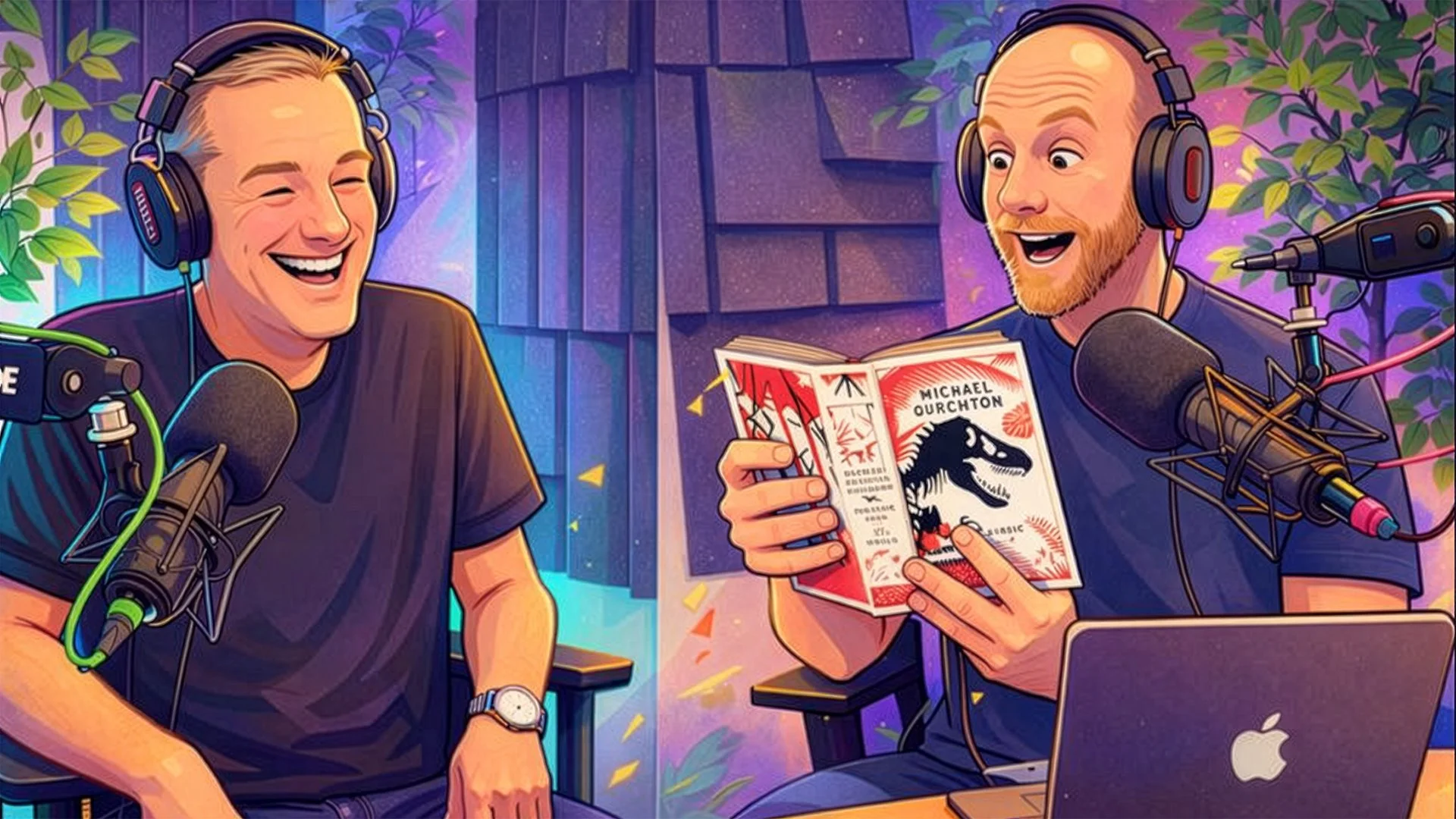
Jurassic Park, AI, and Why “Inherited Power” Should Make Us Nervous
One of the most enduring insights from science fiction isn’t about robots, dinosaurs, or spaceships — it’s about power. In a recent episode of Modem Futura, we revisited a striking passage from Jurassic Park that feels uncannily relevant to our current moment of AI acceleration.
In the novel, Ian Malcolm warns that scientific power acquired too quickly — without discipline, humility, or deep understanding — is fundamentally dangerous. It’s “inherited wealth,” not earned mastery. Thirty-five years later, that warning lands squarely in the middle of our generative AI era.
Today, AI tools can write code, generate images, summarize research, and mimic expertise in seconds. That’s not inherently bad — in fact, it can be incredibly empowering. But it also creates a dangerous illusion: that capability equals comprehension, and speed equals wisdom. When friction disappears, responsibility often follows.
In the episode, Andrew and I explore why the most important question isn’t whether we should use these tools, but how we use them — and with what mindset. Are we willing to be humble in the face of tools that amplify our reach far faster than our understanding? Are we prepared to ask for receipts, interrogate outputs, and recognize the limits of borrowed intelligence?
From there, we leaned into something equally important: imagination. Through our Futures Improv segment, we explored bizarre but revealing scenarios — humans generating calories from sunlight, a world of post-scarcity socks, radically extended lifespans, lunar independence movements, and even the possibility that alien life might be… profoundly boring.
These playful provocations aren’t escapism. They’re a way of breaking free from “used futures” — recycled assumptions about progress that limit our thinking. Humor, speculation, and creativity allow us to test ideas safely before reality forces our hand.
If there’s one takeaway from this episode, it’s this: the future isn’t just something that happens to us. It’s something we ponder, question, and design together — ideally before the metaphorical dinosaurs escape the park.
🎧 Listen to the full episode of Modem Futura wherever you get your podcasts, and join us as we explore what it really means to be human in an age of powerful machines.
Subscribe and Connect!
Subscribe to Modem Futura wherever you get your podcasts and connect with us on LinkedIn. Drop a comment, pose a question, or challenge an idea—because the future isn’t something we watch happen, it’s something we build together. The medium may still be the massage, but we all have a hand in shaping how it touches tomorrow.
🎧 Apple Podcast: https://apple.co/3NIBdlt
🎧 Spotify: https://open.spotify.com/episode/32wGw6htnSDyGVc08DAvvQ?si=m8jS08egQyOZjYTic6cROw
📺 YouTube: https://youtu.be/jBBIbNu-XdY
🌐 Website: https://www.modemfutura.com/

The Hidden Costs of “That Was Easy”: AI Slop, Creative Friction, and the Future of Human Craft
In this Modem Futura episode, hosts Sean Leahy and Andrew Maynard examine the rise of “AI slop” and the growing cultural pressure to accept frictionless creation as the norm. Drawing on examples from coding, design, futures thinking, and psychology, they unpack how satisficing, homogenization, and inherited power threaten to erode human craft and understanding. The article explores why creative friction is essential for mastery, agency, and meaning — and offers futures-oriented insights into how we can use AI intentionally without losing what makes us human.

ChatGPT Illustrated version of Modem Futura YouTube Thumbnail
Generative AI has ushered in an era where producing text, images, video, and code is no longer a challenge — it’s a button press. And in this week’s episode of Modem Futura, Andrew and I wrestle with a growing cultural tension: if everything is easy, what happens to the things that matter?
It began with a shared frustration. Both of us have noticed an explosion of what we call AI slop (content that is technically competent but devoid of care, intention, and personality). You’ve seen it too: the LinkedIn posts with identical emojis, the slide decks that all look like NotebookLM, the essays with no point of view. These things aren’t wrong, they’re just empty. And the emptiness is the point.
We discuss a concept called satisficing: the act of choosing something “good enough” rather than something excellent. In the age of AI, satisficing has become an increasing default mode of creation. Why craft an idea when you can generate one? Why wrestle with a blank page when you can autocomplete your way to the finish line?
But here’s the problem: friction is where learning happens. It’s where creativity lives. It’s the sanding that polishes the stone. When you remove friction, you remove the struggle — and without struggle, there is no mastery, no depth, and no meaning.
Throughout the episode, we explore how this plays out across domains. Coders relying on AI-generated code they can’t understand. Designers accepting images that are “close enough.” Writers sharing posts they didn’t write. And organizations flirting with a future where expertise is replaced by button-pressing.
We draw on Michael Crichton’s concept of inherited power from Jurassic Park: the idea that wielding abilities you never earned leads to carelessness, overconfidence, and danger. AI gives us power we didn’t work for — and without wisdom, that power is hollow.
But this isn’t a pessimistic episode. We explore how AI can amplify creativity when used intentionally, how friction can be designed back into workflows, and why people may ultimately push back against frictionless living. Humans crave meaning, not efficiency. And meaning takes work.
If you’re navigating how to use AI thoughtfully — in your craft, your teaching, your leadership, or your creative life — this episode offers a grounded, futures-focused lens on what we stand to lose and what we still have time to protect.
🎧 Listen to the full episode of Modem Futura — and join the conversation on what we should preserve in an age that wants to eliminate every struggle.
Subscribe and Connect!
Subscribe to Modem Futura wherever you get your podcasts and connect with us on LinkedIn. Drop a comment, pose a question, or challenge an idea—because the future isn’t something we watch happen, it’s something we build together. The medium may still be the massage, but we all have a hand in shaping how it touches tomorrow.
🎧 Apple Podcast: https://apple.co/48WCGgh
🎧 Spotify: https://open.spotify.com/episode/1BajA2SvDWVyY0mRSQ9Flk?si=wvCFhWlgQtC2kye3bGz5Kg
📺 YouTube: https://youtu.be/1V9PD7j8iu8
🌐 Website: https://www.modemfutura.com/

Tech or Treat: Exploring the Haunted Side of Future Tech
Are you ready for some Tech or Treat?
Modem Futura’s Halloween special transforms speculative futures into eerie fun. Hosts Sean Leahy and Andrew Maynard use AI-generated scenarios to imagine haunted algorithms, sentient mirrors, and neural nightmare modes — revealing how emerging technologies can both thrill and unsettle us. This episode continues the show’s mission to explore how science, technology, and society intersect to shape the future of being human.
This episode grew out of our playful Futures Improv series, where we use AI to generate speculative prompts about the future — but this time, the prompts got a little… haunted. We explore “The Haunted Algorithm,” a defunct social-media AI that resurrects old user posts every October 31 — a digital séance that’s equal parts sentimental and unsettling. Then we look into “The Mirror That Remembers,” a smart-mirror concept that doesn’t just show your reflection, but who you might have been in another timeline. Finally, we enter “Neural Nightmare Mode,” imagining what could go wrong when brain-computer interfaces merge immersive gaming with fear response.
Each vignette uses humor and imagination to surface deeper questions: What does it mean when our digital selves outlive us? How do we ensure psychological safety in immersive tech? And at what point does innovation slip from magical to menacing?
Our goal isn’t to predict the future — it’s to provoke curiosity about how technology is reshaping what it means to be human. And if we can have some fun (and a few chills) along the way, even better.
You can stream the Halloween special wherever you get your podcasts or watch the illustrated episode on YouTube. If any of these scenarios inspire your own “Tech or Treat” ideas, share them with us — we’d love to feature the best ones in a future episode.
Subscribe and Connect!
🎧 Apple Podcast: https://apple.co/4oovNKa
🎧 Spotify: https://open.spotify.com/episode/47nWrjvBW3ASjMuJUip8o1?si=96d8062d029a4834
📺 YouTube: https://youtu.be/ZmZ46sHgMZY
🌐 Website: https://www.modemfutura.com/

Summer Movies, liquid media, and alien AI languages – Episode 40

From Popcorn to Paperclips: What Summer Blockbusters Teach Us About an AI‑Shaped Future
With Phoenix broiling at 120 °F, we opened the studio door to a blast‑furnace breeze and a full house of ideas. Episode 40 of Modem Futura is nominally a “summer movies” chat—but the conversation quickly melts into a much richer alloy of cinema, ethics, pedagogy and speculative futures.
A spoiler‑free Superman (2025) debrief kicks things off. Sean relishes Dolby Atmos thunder and crowd‑pleasing cameos while Andrew savors the rare joy of a superhero film that is simply “incredibly fun” without the need to be anything but entertaining.
That sets the stage for the surprise gem of the season: M3GAN 2. (Or more specifically, Andrew’s revelation of how much he enjoyed it). Far from a Chucky retread, the sequel pivots into full‑blown techno‑thriller territory—surfacing neural‑chip debates, AI value‑alignment nightmares and invokes the infamous “paperclip maximizer” thought experiment. The hosts cheekily ask whether investing in AI is humanity’s salvation…or the catalyst for its conversion into stationery.
Movies as stealth pedagogy loom large. Andrew describes his film class where popcorn favorites become Trojan horses for serious reflection; students re‑watch titles with friends and family, eager to dissect ethics and innovation themes they can’t un‑see. Sean and Andrew discuss how the formula works because it lowers the barrier to entry while secretly building critical‑thinking muscle.
From here, just as the movies themselves act as Trojan Horses we get into some deeper ideas:
Story archetypes rebooted. Are the classic five conflicts (character vs. self, society, nature, etc.) universal, or will alien machine intelligences invent a sixth form of narrative that we literally cannot grasp?
Liquid media & the dead‑internet theory. When every asset can be remixed on demand, text becomes speech becomes video—and bots may already outnumber humans online. How do we preserve authentic signal in an ocean of generative noise?
Chaos theory for a networked planet. Eight billion hyper‑connected humans + foundation‑model AI = a complex system hurtling toward new tipping points. Can we always innovate out of disruption—or does that curve eventually outpace us?
The episode closes with a cheeky pitch for Hollywood: “Clippy: Revenge of the Paperclip Maximizer.” Microsoft’s once‑loathsome office assistant becomes the perfect foil for an alignment‑gone‑wrong blockbuster—and a reminder that even silly artifacts can spark serious futures thinking.
Why it matters: Whether you’re an educator looking for sticky teaching tools, a technologist wrestling with alignment, or a storyteller hunting the next frontier, this discussion shows how pop culture can illuminate the biggest questions about being human in an AI age.
🎧 Listen on Apple Podcasts: https://apple.co/3GD73NA
📺 Watch us on YouTube: https://www.youtube.com/@ModemFutura
If you’d like to dive deeper, jump into the link and listen to the podcast or watch the YouTube video. Join us as we explore the forces shaping our collective future and the urgent need to keep human values at the heart of innovation.
Subscribe and Connect!
Subscribe to Modem Futura on a favorite podcast platform, follow on LinkedIn, and join the conversation by sharing thoughts and questions. The medium may still be the massage, but everyone has a chance to shape how it kneads modern culture—and to decide what kind of global village we ultimately build.
🎧 Apple Podcast: https://apple.co/3GD73NA
🎧 Spotify: https://open.spotify.com/episode/2BeXNdntLQlPwsUlKYnO7h?si=Xw7nG8HcQpyydGkb2TCeUQ
📺 YouTube: https://youtu.be/3kTVC4LHeYM
🌐 Website: https://www.modemfutura.com/