

NEWS & UPDATES
Power, Probes, and the Post-Human Horizon: What the Kardashev Scale Reveals About Us
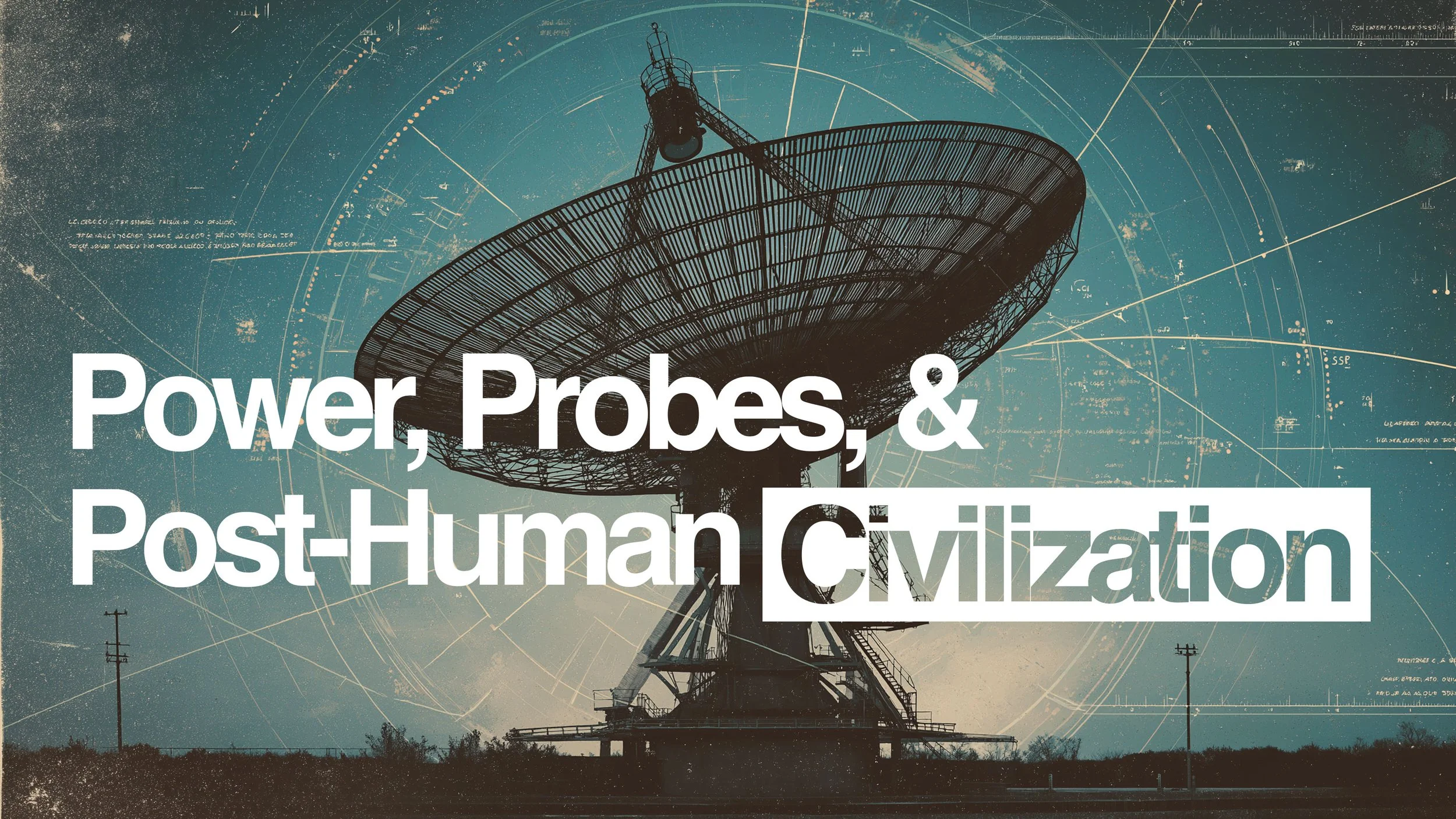
On the surface, this episode of Modem Futura is an excuse to have fun. It's a spring break Futures Improv — Sean and Andrew throwing speculative scenarios at each other and seeing where things land. And it is fun. But somewhere between Dyson Spheres and the Fermi Paradox, it becomes something else: a quiet meditation on what humanity actually wants when we talk about mastering energy, exploration, and the cosmos.
The conversation begins with the Kardashev Scale, proposed by Soviet astronomer Nikolai Kardashev in 1964 as a way to rank civilizations by their energy use. A Type 1 civilization controls its planet's full energy output. Type 2 controls its star. Type 3 commands a galaxy. Humans, for context, are not yet a Type 1 civilization. We harness a fraction of what's available to us on Earth alone.
The question the hosts bring to this framework isn't just can we get there — it's what would we do once we did? Would abundance resolve our deepest conflicts, or would we simply carry our scarcity mindset into a new era? Andrew draws on Maslow's hierarchy of needs to make the point: remove the bottom layers of the pyramid — hunger, shelter, survival — and what remains is a different kind of human problem. The need for meaning, status, belonging, and always — always — a little more.
From there, the conversation ranges widely across some of the most provocative concepts in speculative science:
Dyson Spheres — hypothetical megastructures built around a star to harvest its complete energy output. Theoretical, yes, but not quite as theoretical as they once seemed. In 2024, seven anomalous objects within 1,000 light-years of Earth caught researchers' attention for occlusion patterns that didn't fit known planetary behavior.
Matrioshka Brains — named after Russian nesting dolls, these are hypothetical star-powered supercomputers of almost incomprehensible scale. The hosts draw an obvious connection: if AI data centers already strain Earth's energy grid, what does that compute-energy loop look like at stellar scales?
Von Neumann Probes — self-replicating spacecraft capable of exploring the galaxy by mining local resources to reproduce themselves. Biology can't survive interstellar space. Self-replicating machines, perhaps, can.
The Fermi Paradox — the haunting question of why, in a universe this old and this large, we can't find anyone else. The hosts explore the possibility that civilizations rise and fall within cosmic time windows too narrow to ever overlap. That the universe may be full of life that simply never gets to meet itself.
What makes this episode work is not the concepts themselves — though they're genuinely fascinating — but the humility behind the exploration. No predictions. No resolution. Just two people genuinely wondering, out loud, whether the same drive that would take us to the stars might also be the thing that holds us back.
🎧 Listen to the full episode wherever you get your podcasts, or watch on YouTube.
Subscribe and Connect!
Subscribe to Modem Futura wherever you get your podcasts and connect with us on LinkedIn. Drop a comment, pose a question, or challenge an idea—because the future isn’t something we watch happen, it’s something we build together. The medium may still be the massage, but we all have a hand in shaping how it touches tomorrow.
🎧 Apple Podcast: https://apple.co/4bOu2kk
🎧 Spotify: https://open.spotify.com/episode/2sbRQEuoabpKCUTrOQPCGT?si=159db4727a8841cb
📺 YouTube: https://youtu.be/z53hk7AlXZ4
🌐 Website: https://www.modemfutura.com/
Inherited Power: What Jurassic Park Teaches Us About AI Futures

Jurassic Park, AI, and Why “Inherited Power” Should Make Us Nervous
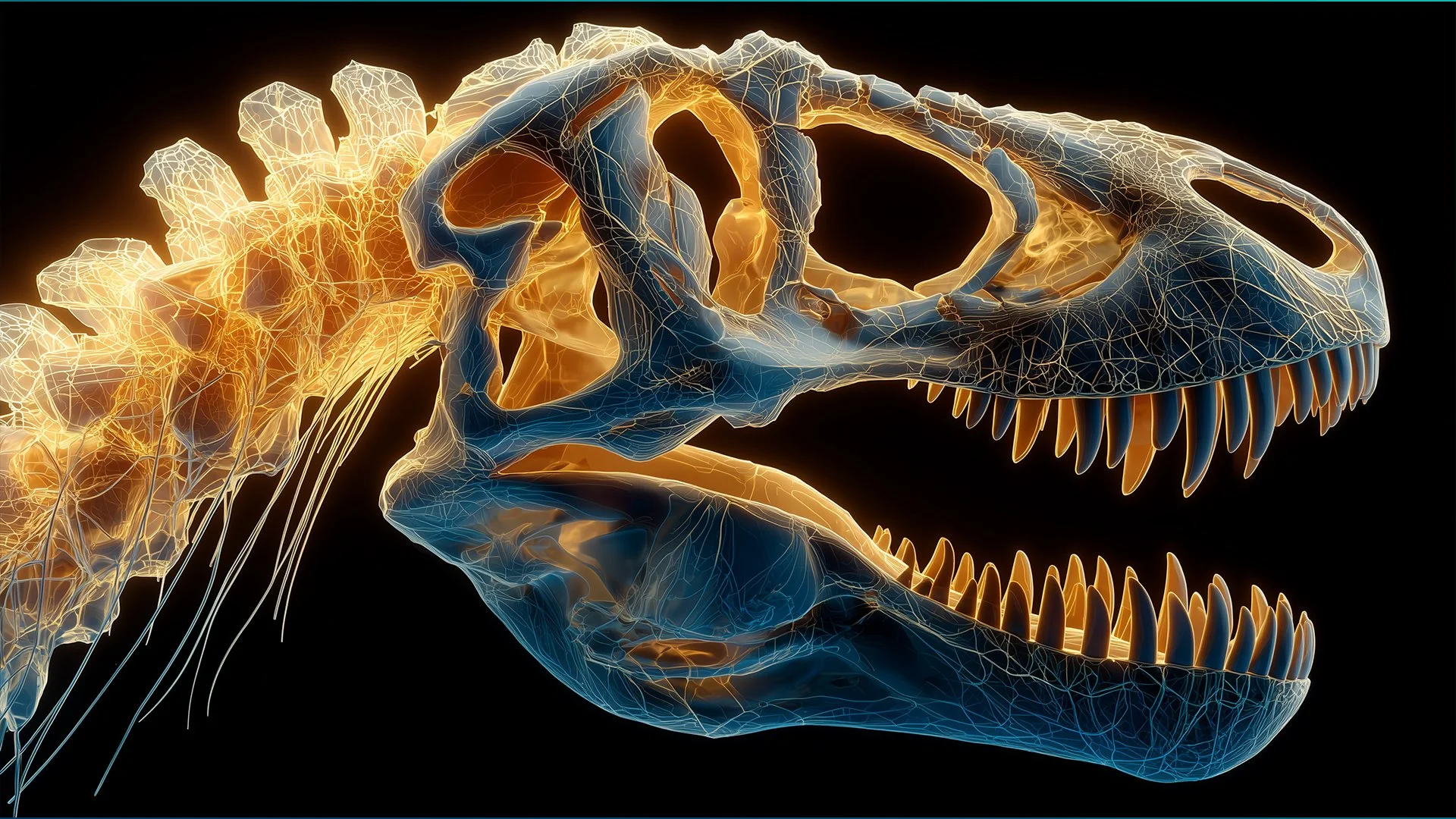
One of the most enduring insights from science fiction isn’t about robots, dinosaurs, or spaceships — it’s about power. In a recent episode of Modem Futura, we revisited a striking passage from Jurassic Park that feels uncannily relevant to our current moment of AI acceleration.
In the novel, Ian Malcolm warns that scientific power acquired too quickly — without discipline, humility, or deep understanding — is fundamentally dangerous. It’s “inherited wealth,” not earned mastery. Thirty-five years later, that warning lands squarely in the middle of our generative AI era.
Today, AI tools can write code, generate images, summarize research, and mimic expertise in seconds. That’s not inherently bad — in fact, it can be incredibly empowering. But it also creates a dangerous illusion: that capability equals comprehension, and speed equals wisdom. When friction disappears, responsibility often follows.
In the episode, Andrew and I explore why the most important question isn’t whether we should use these tools, but how we use them — and with what mindset. Are we willing to be humble in the face of tools that amplify our reach far faster than our understanding? Are we prepared to ask for receipts, interrogate outputs, and recognize the limits of borrowed intelligence?
From there, we leaned into something equally important: imagination. Through our Futures Improv segment, we explored bizarre but revealing scenarios — humans generating calories from sunlight, a world of post-scarcity socks, radically extended lifespans, lunar independence movements, and even the possibility that alien life might be… profoundly boring.
These playful provocations aren’t escapism. They’re a way of breaking free from “used futures” — recycled assumptions about progress that limit our thinking. Humor, speculation, and creativity allow us to test ideas safely before reality forces our hand.
If there’s one takeaway from this episode, it’s this: the future isn’t just something that happens to us. It’s something we ponder, question, and design together — ideally before the metaphorical dinosaurs escape the park.
🎧 Listen to the full episode of Modem Futura wherever you get your podcasts, and join us as we explore what it really means to be human in an age of powerful machines.
Subscribe and Connect!
Subscribe to Modem Futura wherever you get your podcasts and connect with us on LinkedIn. Drop a comment, pose a question, or challenge an idea—because the future isn’t something we watch happen, it’s something we build together. The medium may still be the massage, but we all have a hand in shaping how it touches tomorrow.
🎧 Apple Podcast: https://apple.co/3NIBdlt
🎧 Spotify: https://open.spotify.com/episode/32wGw6htnSDyGVc08DAvvQ?si=m8jS08egQyOZjYTic6cROw
📺 YouTube: https://youtu.be/jBBIbNu-XdY
🌐 Website: https://www.modemfutura.com/

Tech or Treat: Exploring the Haunted Side of Future Tech
Are you ready for some Tech or Treat?
Modem Futura’s Halloween special transforms speculative futures into eerie fun. Hosts Sean Leahy and Andrew Maynard use AI-generated scenarios to imagine haunted algorithms, sentient mirrors, and neural nightmare modes — revealing how emerging technologies can both thrill and unsettle us. This episode continues the show’s mission to explore how science, technology, and society intersect to shape the future of being human.
This episode grew out of our playful Futures Improv series, where we use AI to generate speculative prompts about the future — but this time, the prompts got a little… haunted. We explore “The Haunted Algorithm,” a defunct social-media AI that resurrects old user posts every October 31 — a digital séance that’s equal parts sentimental and unsettling. Then we look into “The Mirror That Remembers,” a smart-mirror concept that doesn’t just show your reflection, but who you might have been in another timeline. Finally, we enter “Neural Nightmare Mode,” imagining what could go wrong when brain-computer interfaces merge immersive gaming with fear response.
Each vignette uses humor and imagination to surface deeper questions: What does it mean when our digital selves outlive us? How do we ensure psychological safety in immersive tech? And at what point does innovation slip from magical to menacing?
Our goal isn’t to predict the future — it’s to provoke curiosity about how technology is reshaping what it means to be human. And if we can have some fun (and a few chills) along the way, even better.
You can stream the Halloween special wherever you get your podcasts or watch the illustrated episode on YouTube. If any of these scenarios inspire your own “Tech or Treat” ideas, share them with us — we’d love to feature the best ones in a future episode.
Subscribe and Connect!
🎧 Apple Podcast: https://apple.co/4oovNKa
🎧 Spotify: https://open.spotify.com/episode/47nWrjvBW3ASjMuJUip8o1?si=96d8062d029a4834
📺 YouTube: https://youtu.be/ZmZ46sHgMZY
🌐 Website: https://www.modemfutura.com/