

NEWS & UPDATES

The AI Gold Rush Is Real. So Is the Backlash. What Sits Between Them Is Human.
A curious thing is happening at graduation ceremonies: students have begun booing speakers who mention AI. Meanwhile, builders are using the same technology to do things that seemed impossible three years ago. In Episode 88 of Modem Futura, hosts Sean Leahy and Andrew Maynard sit down with venture capitalist Jeff Abbott — founding partner at Blitzscaling Ventures, founder of the global AI Salon community, and Andrew's co-author on *AI and the Art of Being Human* — to explore the widening gap between those two experiences of artificial intelligence.
Abbott offers a rare insider's view of what he calls the new gold rush, and it's stranger than the headlines suggest. Technical moats have largely evaporated; everyone builds on the same foundation models, and those models change without warning. Software itself is becoming liquid — apps described in natural language, generated in seconds, used once, and discarded. A teleprompter for a single video shoot. A custom CRM coded in two weeks. The conversation traces what this means for the future of work, for startups, and for a generation being told AI will transform careers they haven't yet been able to start.
But the episode's most striking turn is inward. Abbott built an AI tool that performs much of his own job — analyzing startups, scoring them, generating reports instantly. What it lacks, he argues, is judgment: the lived experience and relational trust that make venture capital, and arguably every business, a human business. The data crunching is the tip of the iceberg; the weight beneath is intuition and relationship.
The trio also explores one-person unicorns and the "minimum viable human team," why the entrepreneurial mindset matters more than entrepreneurship itself, and a question Abbott poses to his academic hosts: what would an investment framework for human flourishing actually look like? True to form, the episode doesn't resolve that question — it opens it. Because if AI really can do more and more of what we thought defined our work, the things that remain — judgment, trust, knowing where you want to go — start to look less like soft skills and more like the whole point.
Listen to the full conversation wherever you get your podcasts, or watch on YouTube.
Subscribe and Connect!
Subscribe to Modem Futura wherever you get your podcasts and connect with us on LinkedIn. Drop a comment, pose a question, or challenge an idea—because the future isn’t something we watch happen, it’s something we build together. The medium may still be the massage, but we all have a hand in shaping how it touches tomorrow.
🎧 Apple Podcast: https://apple.co/4goqIjF
🎧 Spotify: https://open.spotify.com/episode/2JosPwJazSUxYL3iQmf2rj?si=UxJN_WTVTzqif09lqnJN3A
📺 YouTube: https://youtu.be/YA8vS02lhss
🌐 Website: https://www.modemfutura.com/

Vibe Coding and the Return of Personal Software
The Echo of Early Personal Computing
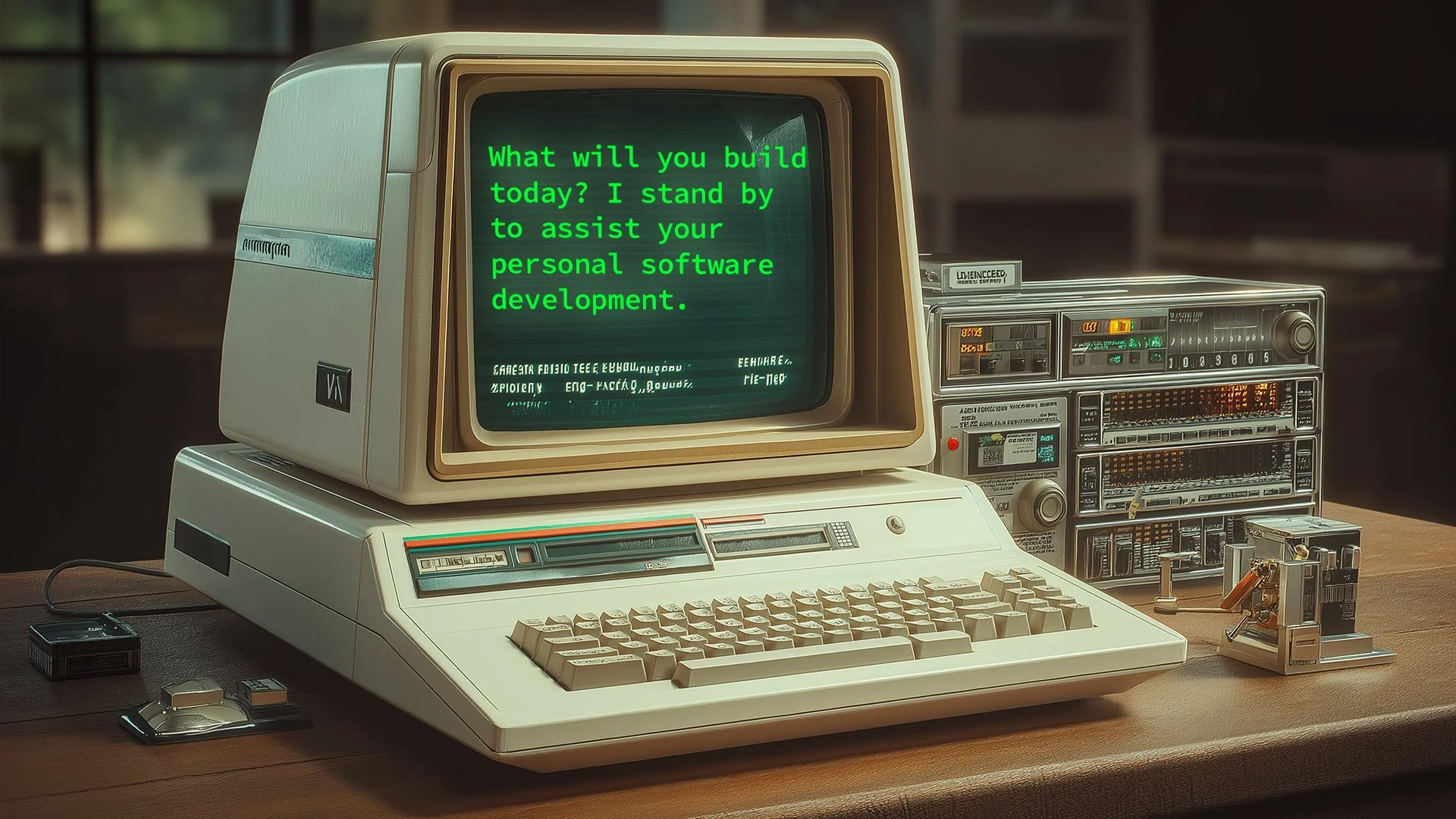
There was a brief, electric moment in the history of computing—roughly the late 1970s through the mid-1980s—when ordinary people could sit down at a keyboard and make a machine do something it hadn't done before. The Commodore 64, the BBC Micro, the Apple II: these were limited, clunky, and profoundly empowering. For a generation, they opened the door to a kind of creative agency that felt almost magical.
That door closed, gradually, as software became professionalized. The gap between what you could imagine and what you could build widened into a canyon. If you wanted a tool that didn't exist, you needed a developer—or you went without.
Vibe coding is reopening that door.
The term refers to the practice of describing what you want in natural language and letting a generative AI—tools like Claude, ChatGPT, or Copilot—write the code for you. No syntax to memorize. No debugging by hand. You describe your intent, and working software comes back in seconds.
In this episode of Modem Futura, we explore what this shift means—not just technically, but humanly. I demonstrates tools he built from single prompts (also referred to as a a ‘one-shot’): a horizon-scanning app for futures research and a two-by-two uncertainty matrix used in strategic foresight. Both were functional on the first attempt. Both took less time to create than it takes to describe them.
The Inherited Power Problem
But the episode resists the temptation to treat this as a simple good-news story. The hosts dig into the real tensions: AI-generated code that no one fully understands, security vulnerabilities baked into apps that reach market before anyone reviews them, the new threat landscape of prompt injection, and the philosophical question of wielding power you haven't earned the literacy to evaluate—what the hosts call "inherited power."
There are also rich implications for education. Rather than relying on off-the-shelf apps that never quite fit, instructors and students alike can now build purpose-specific tools—and in doing so, develop a more grounded understanding of what these AI systems can and cannot do.
The deeper question the episode surfaces is less about code and more about agency. For decades, software was something done to us—platforms we adapted to, interfaces we learned, ecosystems we bought into. Vibe coding hints at a possible reversal: software shaped by the individual, for the individual, in the moment they need it.
Whether that future is liberating or reckless—or both—depends on the kind of literacy, caution, and imagination we bring to it.
Listen to the full conversation on Modem Futura.
Subscribe and Connect!
Subscribe to Modem Futura wherever you get your podcasts and connect with us on LinkedIn. Drop a comment, pose a question, or challenge an idea—because the future isn’t something we watch happen, it’s something we build together. The medium may still be the massage, but we all have a hand in shaping how it touches tomorrow.
🎧 Apple Podcast: https://apple.co/4rbOr9r
🎧 Spotify: https://open.spotify.com/episode/28DMXJsM2kEBA2QDxuDmtJ?si=AJpR7zCpRgS2KCCfWwjjWg
📺 YouTube: https://youtu.be/lQGYaiThuBk?si=nRbHVEQk9dwL3gXr
🌐 Website: https://www.modemfutura.com/

Modem Futura Year in Review: What 2025 Taught Us About Being Human
As we step toward 2026, we recorded a “Year in Review” episode of Modem Futura to pause the treadmill, look back, and ask a bigger question: what did this year reveal about the future of being human?
This wasn’t a victory lap. It was a reflection on what resonated, what surprised us, and what it means to build a future-focused show while the future keeps moving.
metrics matter… and they don’t
Yes, growth matters — it helps ideas travel. But podcast analytics are often incomplete and inconsistent, and they rarely capture what impact actually looks like. The most meaningful signals are still human: messages, emails, thoughtful disagreement, and reviews that help someone new discover the show.
“If you want to support the show: subscribing, sharing, and leaving a rating/review are still the most helpful actions.”
The themes that defined our year:
AI, beyond the hype: We kept returning to the same tension — generative tools are everywhere, but “AI” isn’t just a feature set. It’s a cultural force that shapes identity, agency, creativity, and values. We try hard to avoid both the hype machine and the doom loop, and instead stay in the messy middle where the most useful questions live.
Education and learning: We lean into what learning actually is (not just schooling), including John Dewey’s idea that humans are wired for inquiry, communication, construction, and expression. When AI arrives in every document and device, what does it do to those impulses — especially for kids?
Technology in the physical world: From autonomous‑vehicle safety systems that quietly drift out of calibration, to EVs and the persistent “flying car” dream, we explore what happens when shiny promises meet real‑world constraints.
Big questions, no apologies: Yes, we go there — simulation hypotheses, black holes, de‑extinction, space travel, and the edges of what science can (and can’t) explain. These episodes aren’t about “being right.” They’re about expanding the space of possible futures we can imagine.
If there’s one takeaway, it’s this: the future isn’t something that happens to us — it’s something we build together.That’s why we keep showing up each week: to create a shared space for curiosity, skepticism, wonder, and responsible imagination.
If you’ve been listening, thank you. If you’re new here, welcome. And if an episode sparked a thought you can’t shake — share it with a colleague, a student, a friend, or your community. As we step into 2026, we’re excited to keep exploring the possible, probable, and preferable futures — with you.