

NEWS & UPDATES

Three Horizons Framework & Futures Wheel Explained
There's a reason some organizations consistently seem to see disruption coming — and it's usually not because they're smarter or better funded. It's because they've built structured habits of thinking about change in multiple time horizons simultaneously, and they've learned how to trace the cascading consequences of a single shift before it becomes a crisis.
Two of the oldest and most reliable tools for doing exactly that are the Three Horizons Framework and the Futures Wheel. In this episode of Modem Futura, hosts Sean Leahy and Andrew Maynard break both down in accessible, conversational detail — and show what becomes possible when you use them together.
The Three Horizons Framework
Originally developed by Bill Sharpe and widely used in professional foresight and strategic planning, divides the landscape of change into three overlapping zones. Horizon 1 represents the dominant present — the systems, structures, and assumptions that govern how the world works today. Horizon 3 is the emergent fringe: weak signals, nascent ideas, and early-stage shifts that are observable but not yet mainstream. And Horizon 2 is the transitional space between them — turbulent, hard to define, and full of both opportunity and risk.
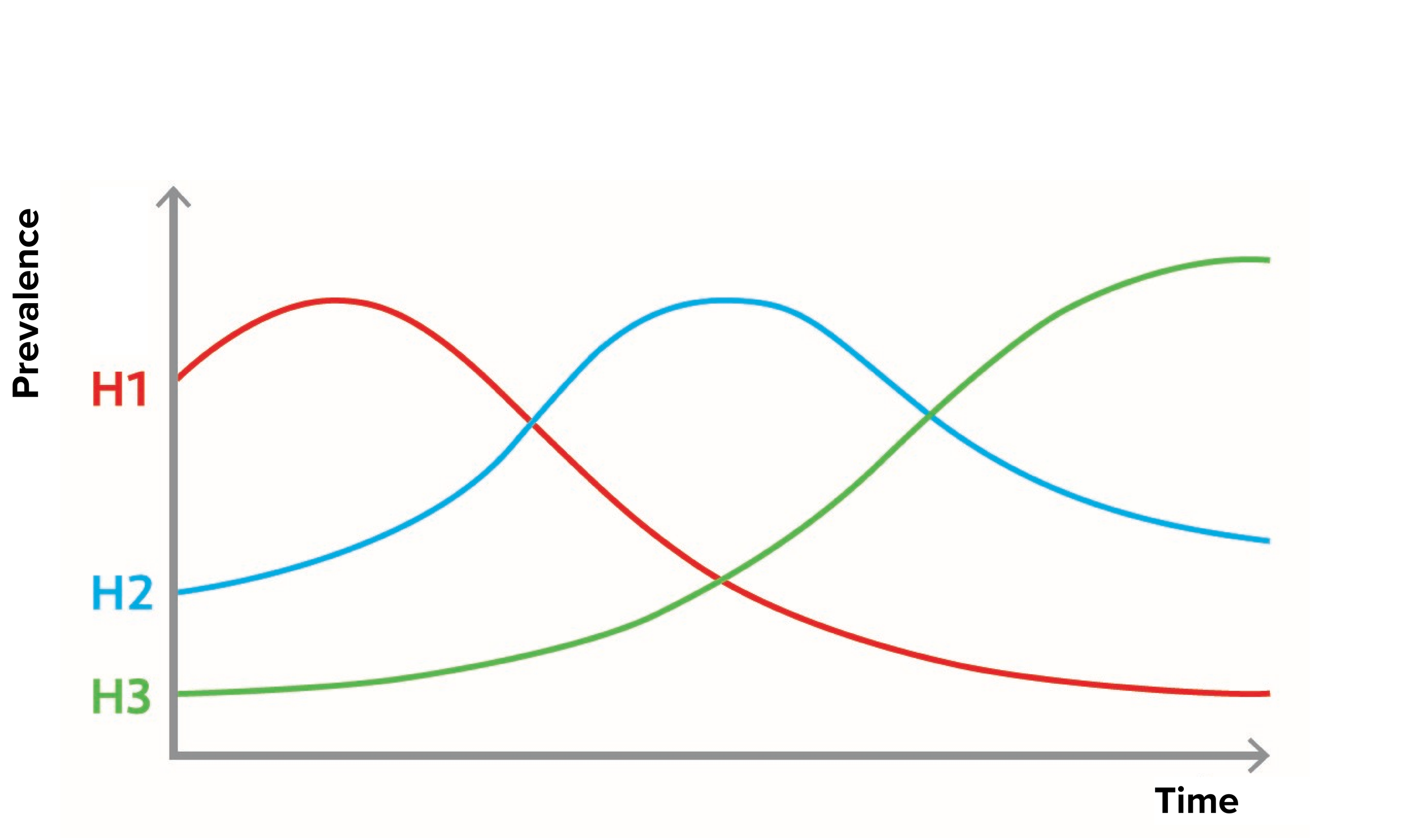
The model doesn't tell you what the future will bring. What it offers is a way of *positioning* trends, signals, and innovations in relation to change — helping individuals and organizations understand what to watch, what to act on, and what to prepare for.
The Futures Wheel
Developed by Jerome Glenn in 1971, works differently but complementarily. Starting from a specific change or trend, it maps outward through first, second, and third-order consequences — building a rich, networked picture of how a single shift might ripple through a system over time. It's a brainstorming and sense-making tool, not a prediction engine, and it's at its most powerful when used with diverse groups who bring different perspectives to the same question.
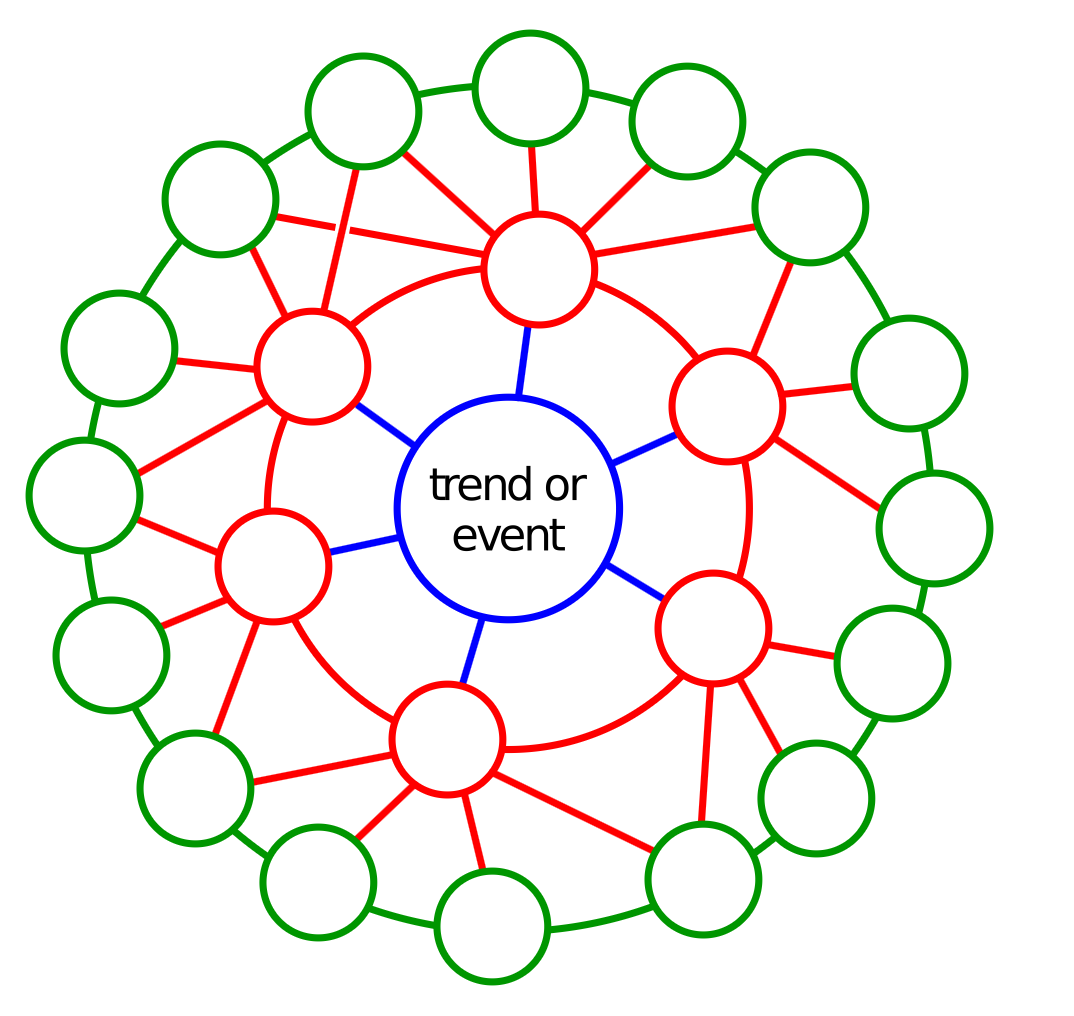
Used individually, each tool offers genuine insight. Used together, they offer something more: a way of understanding not just *what* a signal might do, but *when* and *through which pathways* it might do it.
Whether you're a founder trying to figure out which wave to ride, a strategist scanning for disruption, or simply someone trying to make better decisions in an uncertain world, these tools are worth adding to your thinking practice.
🎧 Listen to the full episode wherever you get your podcasts, or watch on YouTube.
Subscribe and Connect!
Subscribe to Modem Futura wherever you get your podcasts and connect with us on LinkedIn. Drop a comment, pose a question, or challenge an idea—because the future isn’t something we watch happen, it’s something we build together. The medium may still be the massage, but we all have a hand in shaping how it touches tomorrow.
🎧 Apple Podcast: https://apple.co/4sosMdQ
🎧 Spotify: https://open.spotify.com/episode/58Fdc2SrWodBTbwfxK8Pwm?si=leiCnhRsQxuv-_hnxEeNjQ
📺 YouTube: https://youtu.be/eVk6L_VfAkY
🌐 Website: https://www.modemfutura.com/

Fluid Futures: Navigating an AI-Mediated World
What Happens When AI Stops Being a Tool and Starts Being the World?
There's a useful distinction that keeps getting lost in conversations about artificial intelligence: the difference between augmentation and mediation.
Augmentation is familiar. It's the calculator model — AI helps you work faster, smarter, better. You remain the agent. The tool amplifies your capacity.
Mediation is something else. When AI mediates your world, it's not just helping you do things — it's shaping the system you're doing them inside of. What information surfaces. What options appear. What feels like the obvious next move. You're not using the environment anymore. You're inside one that AI has constructed, and it's shifting around you in real time.
This distinction is at the heart of Exploring the Futures of Technology 2.0, the new report from the Copenhagen Institute of Future Studies — and it's the central thread of the latest episode of Modem Futura.
On this episode, my co-host Andrew Maynard, fresh from attending the report's launch in Copenhagen, joined me to work through ten signals the report identifies as defining the near future: the shift from static to liquid content, the rise of agentic organizations, neurotechnology and cognitive integration, synthetic simulations replacing real-world research populations, physical AI entering embodied space, the geopolitics of technological access, AI-mediated cybersecurity threats, the sustainability challenges of AI infrastructure, and quantum computing as the wildcard at the edge of everything.
What holds these signals together isn't a single prediction. It's a pattern: the world is becoming fluid, and the frameworks we built for a more static environment — static reports, static institutions, static skillsets — are increasingly inadequate for navigating it.
One of the episode's sharpest observations is about the cost of cognitive offloading. As we hand more of our decision-making and information retrieval to AI systems, we risk losing the capacity to recognize when something's wrong. Not because AI is malicious, but because we've stopped practicing the skills that would let us notice. Like losing the ability to read a map. Except the stakes are considerably higher.
The conversation doesn't resolve these tensions — and that's exactly the point. Futures thinking, at its best, isn't about prediction. It's about staying awake to what's changing, naming the tensions, and refusing to optimize for a world that no longer exists.
If you want the full report, the Copenhagen Institute has made it freely available. And if you want the conversation around it — the episode is a good place to start.
Subscribe and Connect!
Subscribe to Modem Futura wherever you get your podcasts and connect with us on LinkedIn. Drop a comment, pose a question, or challenge an idea—because the future isn’t something we watch happen, it’s something we build together. The medium may still be the massage, but we all have a hand in shaping how it touches tomorrow.
🎧 Apple Podcast: https://apple.co/4bSGsZP
🎧 Spotify: https://open.spotify.com/episode/4sdx83QUD6pIs9IXb9G0VY?si=JdbwVHUKRg2mFO0Gsi_EFw
📺 YouTube: https://youtu.be/-2enUvPYmHo
🌐 Website: https://www.modemfutura.com/

The Futures Cone: A Framework for Exploring What Could Be
How one deceptively simple tool can transform the way you think about uncertainty, possibility, and the choices that shape tomorrow.
There's a habit most of us share when it comes to thinking about the future: we treat it as a destination. A singular, somewhat “predictable” place that today's trends are quietly marching toward. It's a useful shorthand — but as a mental model, it's quietly limiting.
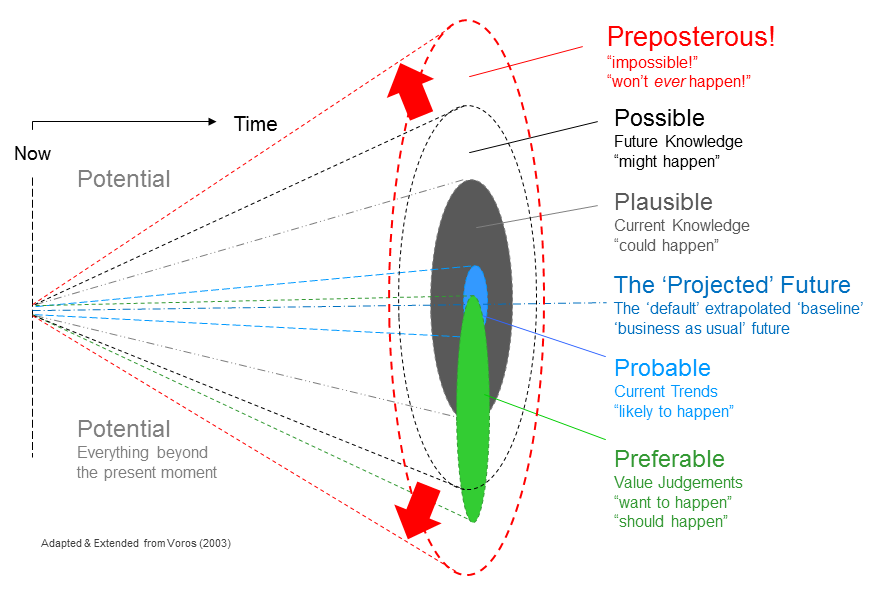
The Futures Cone, a foundational tool in the field of futures studies, offers a different way of seeing. Rather than imagining the future as a point, it asks you to imagine it as a cone — wide open, expanding outward from the present moment, filled with layers of possibility that range from the likely to the genuinely unthinkable.
How the Cone Works
The narrowest point is now. As the cone extends outward through time, it widens to reveal different regions of possible futures, each defined by how much disruption or change would be required to bring them about:
Projected futures — the baseline; what happens if nothing changes
Probable futures — where current trends are pointing
Plausible futures — what could happen given known forces and trajectories
Possible futures — speculative, requiring future knowledge we don't yet have
Preposterous futures — the outer edge; scenarios that challenge our deepest assumptions about what is physically or socially feasible
Threaded through all of these is the Preferable future — not a separate ring, but a cross-section that asks: given everything in this cone, what do we actually want? Where do our values point?
The Dator-Clarke Line
One of the most provocative ideas associated with the cone is what's referred to as the Dator-Clarke Line — drawn from futurist James Dator's claim that any genuinely useful idea about the future should, at first glance, appear ridiculous. Paired with Arthur C. Clarke's observation that the only way to find the limits of the possible is to push into the impossible, it suggests that the most valuable futures work happens precisely in the uncomfortable space at the edge of the cone.
The practical implication is significant: if every idea your team generates sounds reasonable, you probably haven't stretched far enough. The preposterous isn't a failure of imagination — it's a boundary worth exploring.
Why This Tool Matters Now
In a period defined by technological acceleration, geopolitical uncertainty, and rapid social change, the instinct to "project forward" can feel reassuring — but it's also where strategic blind spots form. The Futures Cone doesn't resolve that uncertainty. Instead, it gives individuals, teams, and organizations a shared language for navigating it: a structured way to ask not just "what will happen?" but "what could happen, what might we prefer, and what are we willing to do about it?"
This is the subject of Episode 74 of Modem Futura, in which we walk through the cone layer by layer — and then demonstrate it live with a thought experiment that starts with frogs and ends somewhere near the moons of Jupiter.
Subscribe and Connect!
Subscribe to Modem Futura wherever you get your podcasts and connect with us on LinkedIn. Drop a comment, pose a question, or challenge an idea—because the future isn’t something we watch happen, it’s something we build together. The medium may still be the massage, but we all have a hand in shaping how it touches tomorrow.
🎧 Apple Podcast: https://apple.co/4bz1tIC
🎧 Spotify: https://open.spotify.com/episode/20Hz36eLfZ90M6EifUrRuu?si=swNkzHWZSLCelVSKsAyj7A
📺 YouTube: https://youtu.be/wc_e3dsY-vw
🌐 Website: https://www.modemfutura.com/

Thriving with AI: Two Futures Thinking Tools for Navigating Uncertainty
The question is no longer whether AI will reshape education. It already has. The more interesting question — and the harder one — is how educators, leaders, and institutions can navigate that transformation with clarity, purpose, and agency.
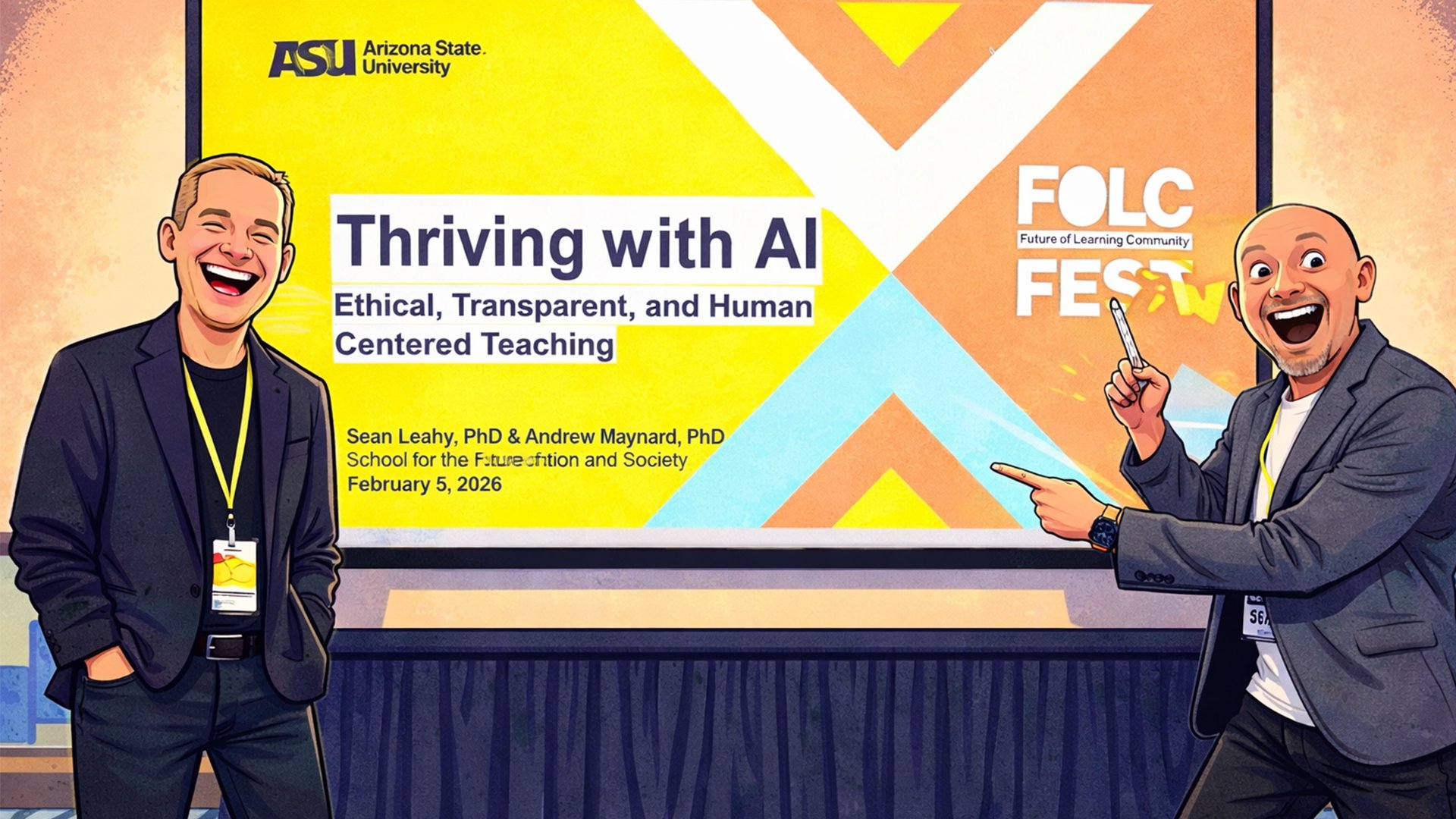
In this episode of Modem Futura, hosts Sean Leahy and Andrew Maynard walk listeners through a workshop they developed for ASU's 2026 Folk Fest titled "Thriving with AI: Ethical, Transparent, and Human-Centered Learning." Rather than demonstrating AI platforms or advocating for a particular stance, the session offers two practical thinking tools designed to help individuals make sense of complexity and make intentional decisions — regardless of where they fall on the AI adoption spectrum.
Foresight Methodologies
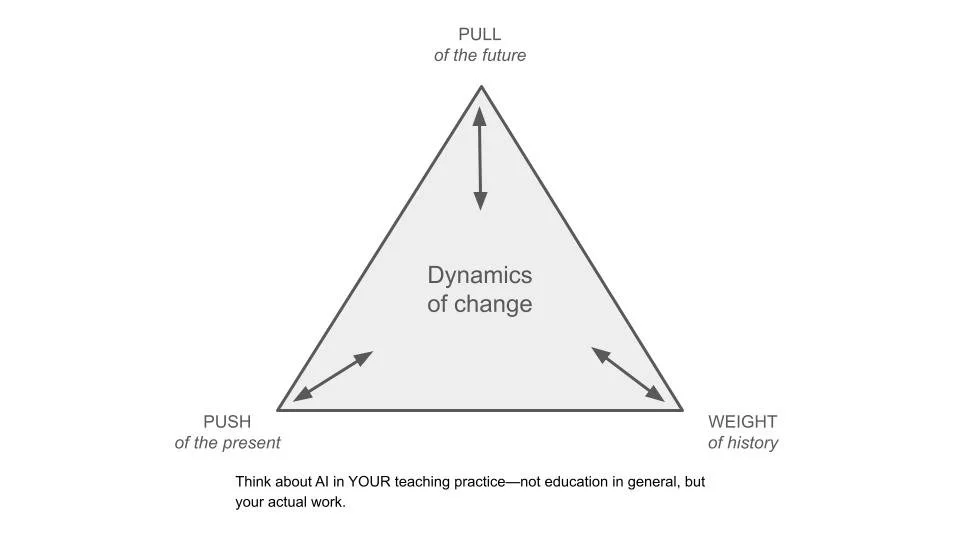
The Futures Triangle, originally developed by futurist Sohail Inayatullah, is a foresight method that maps three forces shaping any change landscape: the pull of the future (emerging visions and possibilities), the push of the present (trends, pressures, and mandates driving change), and the weight of history (the traditions, values, and institutional structures that resist or ground that change). By making these forces visible, individuals and teams can better orient themselves within the dynamics of change rather than simply reacting to them.
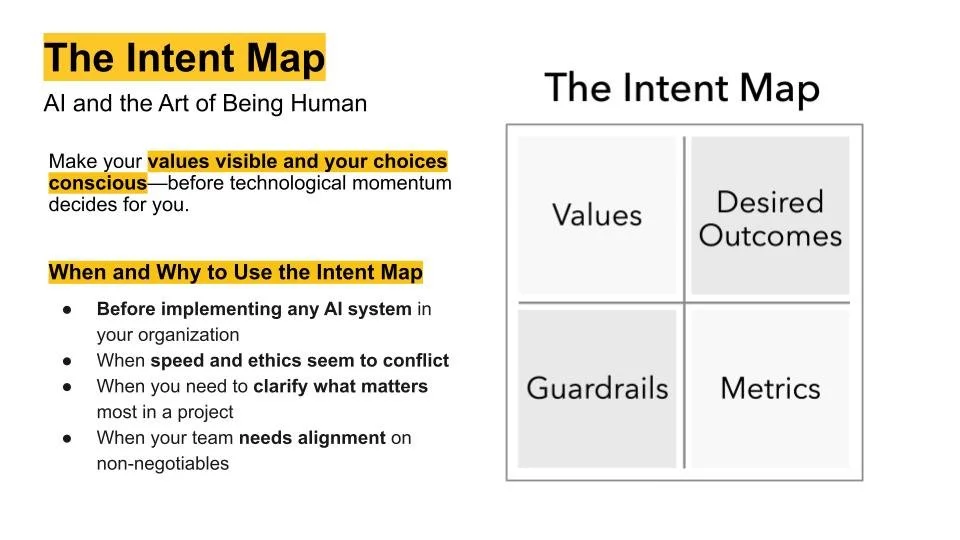
The Intent Map, drawn from Jefferey Abbott and Andrew Maynard's book AI and the Art of Being Human, complements the triangle by shifting from orientation to action. A simple two-by-two matrix, it asks users to identify four elements: their core values (what they won't compromise), their desired outcomes (what success looks like), their guardrails (the hard boundaries they won't cross), and their metrics (how they'll know if it's working). Critically, the framework recognizes that metrics don't have to be numerical — sometimes the most meaningful indicators of success are qualitative, like a student who can't stop thinking about what they learned.
What makes these tools particularly valuable is their accessibility. Both can be sketched on a scrap of paper. Both work for individuals and teams. And both are domain-agnostic — while the episode frames them in the context of education, they apply equally well to organizational strategy, technology adoption, and personal decision-making.
The episode is anchored by two provocative 2035 headlines: one in which AI tutors outperform human teachers and faculty roles come under review, and another in which human-AI partnership produces the most critically thinking generation in history. The question the workshop poses isn't which headline is more likely. It's which one you want — and what intentional choices you need to make to move toward it.
Thriving with AI, as the hosts frame it, isn't about mastering the latest platform. It's about staying awake to what matters.
Subscribe and Connect!
Subscribe to Modem Futura wherever you get your podcasts and connect with us on LinkedIn. Drop a comment, pose a question, or challenge an idea—because the future isn’t something we watch happen, it’s something we build together. The medium may still be the massage, but we all have a hand in shaping how it touches tomorrow.
🎧 Apple Podcast: https://apple.co/3ZXgT2P
🎧 Spotify: https://open.spotify.com/episode/1b1Q0W7YVSGZA2ELYj6g6C?si=wL1sXb-DQsSluBkLYCu9tg
📺 YouTube: https://youtu.be/zi_zvXCt9sY
🌐 Website: https://www.modemfutura.com/

Vibe Coding and the Return of Personal Software
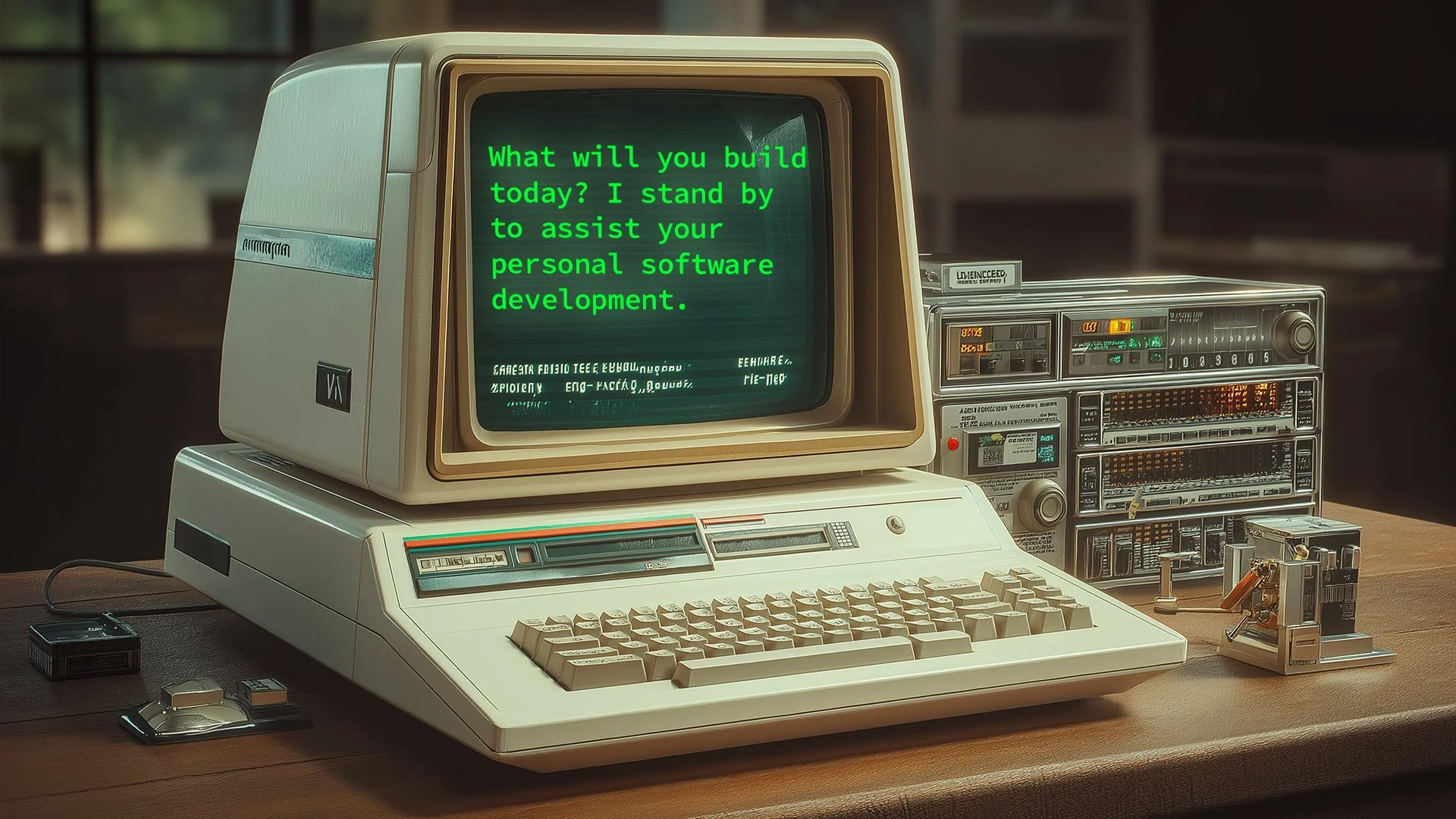
The Echo of Early Personal Computing
There was a brief, electric moment in the history of computing—roughly the late 1970s through the mid-1980s—when ordinary people could sit down at a keyboard and make a machine do something it hadn't done before. The Commodore 64, the BBC Micro, the Apple II: these were limited, clunky, and profoundly empowering. For a generation, they opened the door to a kind of creative agency that felt almost magical.
That door closed, gradually, as software became professionalized. The gap between what you could imagine and what you could build widened into a canyon. If you wanted a tool that didn't exist, you needed a developer—or you went without.
Vibe coding is reopening that door.
The term refers to the practice of describing what you want in natural language and letting a generative AI—tools like Claude, ChatGPT, or Copilot—write the code for you. No syntax to memorize. No debugging by hand. You describe your intent, and working software comes back in seconds.
In this episode of Modem Futura, we explore what this shift means—not just technically, but humanly. I demonstrates tools he built from single prompts (also referred to as a a ‘one-shot’): a horizon-scanning app for futures research and a two-by-two uncertainty matrix used in strategic foresight. Both were functional on the first attempt. Both took less time to create than it takes to describe them.
The Inherited Power Problem
But the episode resists the temptation to treat this as a simple good-news story. The hosts dig into the real tensions: AI-generated code that no one fully understands, security vulnerabilities baked into apps that reach market before anyone reviews them, the new threat landscape of prompt injection, and the philosophical question of wielding power you haven't earned the literacy to evaluate—what the hosts call "inherited power."
There are also rich implications for education. Rather than relying on off-the-shelf apps that never quite fit, instructors and students alike can now build purpose-specific tools—and in doing so, develop a more grounded understanding of what these AI systems can and cannot do.
The deeper question the episode surfaces is less about code and more about agency. For decades, software was something done to us—platforms we adapted to, interfaces we learned, ecosystems we bought into. Vibe coding hints at a possible reversal: software shaped by the individual, for the individual, in the moment they need it.
Whether that future is liberating or reckless—or both—depends on the kind of literacy, caution, and imagination we bring to it.
Listen to the full conversation on Modem Futura.
Subscribe and Connect!
Subscribe to Modem Futura wherever you get your podcasts and connect with us on LinkedIn. Drop a comment, pose a question, or challenge an idea—because the future isn’t something we watch happen, it’s something we build together. The medium may still be the massage, but we all have a hand in shaping how it touches tomorrow.
🎧 Apple Podcast: https://apple.co/4rbOr9r
🎧 Spotify: https://open.spotify.com/episode/28DMXJsM2kEBA2QDxuDmtJ?si=AJpR7zCpRgS2KCCfWwjjWg
📺 YouTube: https://youtu.be/lQGYaiThuBk?si=nRbHVEQk9dwL3gXr
🌐 Website: https://www.modemfutura.com/

Futures Thinking: Foresight You Can Use – Episode 49
We don’t predict the future, but we prepared for the uncertainties the futures will bring
Ever been stuck in traffic and thought, “Where’s my eVTOL button?” We open this episode right there—and quickly flip the fantasy into a lesson on systems: technologies don’t fix congestion (or most complex problems) unless policy, behavior, equity, and infrastructure evolve with them. From that launchpad, Sean Leahy and Dr. Andrew Maynard unpack futures thinking as a mindset—distinct from prediction—that helps people and organizations navigate uncertainty with agency. They walk through the classic triad of possible, probable, and preferable futures, then translate it into practice: horizon scanning (signals, trends, megatrends), scenario building, and backcasting from a desired 10‑year outcome to concrete actions today. Along the way, they surface guardrails like avoiding “used futures” (inherited visions of someone else’s desired future) and stress‑testing for unintended consequences, especially for vulnerable communities and the planet.
The conversation ranges widely—think SimCity lessons and Mars‑city thought experiments as mirrors for Earth’s complexity; protopian (step‑by‑step better) versus utopian/dystopian frames; and why foresight shouldn’t be a bolt‑on consultancy only, but a capacity embedded across teams. Educators will appreciate a practical take on bringing futures thinking into K–12 and higher ed without “one more thing”: weave foresight into existing subjects to build creativity, inquiry, and resilience. Pop culture helps, too—using films (à la The Moviegoer’s Guide to the Future) creates a low‑stakes, high‑insight space to explore tough issues together. And for those tracking AI’s breakneck pace, the episode doubles as an antidote to future shock—a way to slow down, widen perspective, and choose well‑considered next steps.
Why it matters: Futures Thinking is for everyone - all humans poses the qualities needed to engage in thinking about our collective futures. Whether you lead a product team, a classroom, or a community, cultivating a futures mindset helps you spot weak signals earlier, align around preferable outcomes, and take action that nudges the world toward human flourishing.
Join the conversation:
What “used future” have you noticed in your field? If you were backcasting from a 2035 future you’d be proud of, what’s the first move you’d make this quarter? Drop your thoughts—and feel free to borrow this episode in your class, team meeting, or strategy offsite.
🎧 Listen to the full episode to dive deeper into how films shape our futures: https://apple.co/4nrAIci
📺 Watch us on YouTube: https://www.youtube.com/@ModemFutura
🎬 What film has changed the way you think about the future? Drop a comment — we’d love to hear.
If you’d like to dive deeper, jump into the link and listen to the podcast or watch the YouTube video. Join us as we explore the forces shaping our collective future and the urgent need to keep human values at the heart of innovation.
Subscribe and Connect!
Subscribe to Modem Futura on a favorite podcast platform, follow on LinkedIn, and join the conversation by sharing thoughts and questions. The medium may still be the massage, but everyone has a chance to shape how it kneads modern culture—and to decide what kind of global village we ultimately build.
🎧 Apple Podcast: https://apple.co/4nrAIci
🎧 Spotify: https://open.spotify.com/episode/1OmUyc6fYdMIZ8thORheOJ?si=ZTQ-ZI7hQzSjNTy3jhjgfQ
📺 YouTube: https://youtu.be/85cTuht_a8k
🌐 Website: https://www.modemfutura.com/

Symbiotic Futures: Megatrends, Foresight, and Futures Thinking – Episode 31

From flying with an Apple Vision Pro to confronting an Iberian peninsula‑wide blackout, Sean Leahy and Andrew Maynard unpack the Future Days “symbiotic futures” summit and discuss how the futures of emerging real‑world tech adventures (and mishaps) expose the urgency of futures thinking and strategic foresight—and share the need for awareness of megatrends, staying resilient, and keeping humanity front‑and‑center in an increasingly tangled digital world.
Trans-Atlantic red-eyes are rarely inspiring, yet this one kicked off our latest Modem Futura episode in style: Sean stuffed his Apple Vision Pro into his carry-on and discovered that row 24G can double as a multi-monitor studio—until a flight attendant tapped his shoulder and yanked him out of an AR-powered “flow state.” That jolt proved prophetic: given he landed in Lisbon just hours after a massive blackout had plunged Spain, Portugal, and parts of France into darkness, spotlighting just how fragile our techno-social infrastructures really are.
🎧 Listen on Apple Podcasts: https://apple.co/45kz9XI
📺 Watch us on YouTube: https://www.youtube.com/@ModemFutura
In this episode we unpack three intertwined themes: resilience, mindfulness, and strategic foresight. The Iberian outage becomes a live case study in cascading failure: digital payments, automated check-outs, ride-hailing apps—nothing works when the grid goes down. Yet crises like these also catalyze community; neighbors emerge with guitars and flashlights, rediscovering analog bonds that tech so often displaces.
From there we jump to Lisbon’s Future Days conference (the reason Sean was in Lisbon), whose “Symbiotic Futures” theme asked participants—from UN Futures Lab, UK Ministry of Justice, Copenhagen Institute for Futures Studies, and many many more including analysts to indie designers—how humans and systems can co-evolve without erasing one another. One clear takeaway: “futures thinking” isn’t a niche job description; it’s a competency every profession now needs. By scanning megatrends—those climate, geopolitical, and technological forces that reshape the next 10-15 years—we build the agility to thrive amid volatility, uncertainty, complexity, and ambiguity (VUCA) volatility.
But preparedness requires cognitive breathing room, and that’s where the Dutch concept of Niksen—“the art of doing nothing”—enters the chat. Slowing down isn’t a luxury; it’s a strategy that lets us question which tools genuinely advance human flourishing and which merely accelerate the attention treadmill.
Throughout, we circle back to a simple call: if you value conversations that blend tech realism with human-centered optimism, rate and review Modem Futura. Every star elevates the show in Apple Podcasts’ algorithms and helps new listeners discover our global community.
If you’d like to dive deeper, jump into the link and listen to the podcast or watch the YouTube video. Join us as we explore the forces shaping our collective future and the urgent need to keep human values at the heart of innovation.
Subscribe and Connect!
Subscribe to Modem Futura on your favorite podcast platform, follow on LinkedIn, and join the conversation by sharing thoughts and questions. The medium may still be the massage, but everyone has a chance to shape how it kneads modern culture—and to decide what kind of global village we ultimately build.
🎧 Podcast: https://apple.co/45kz9XI
📺 YouTube: https://www.youtube.com/@ModemFutura