

NEWS & UPDATES

What an AI Hallucination Tells Us About First Contact
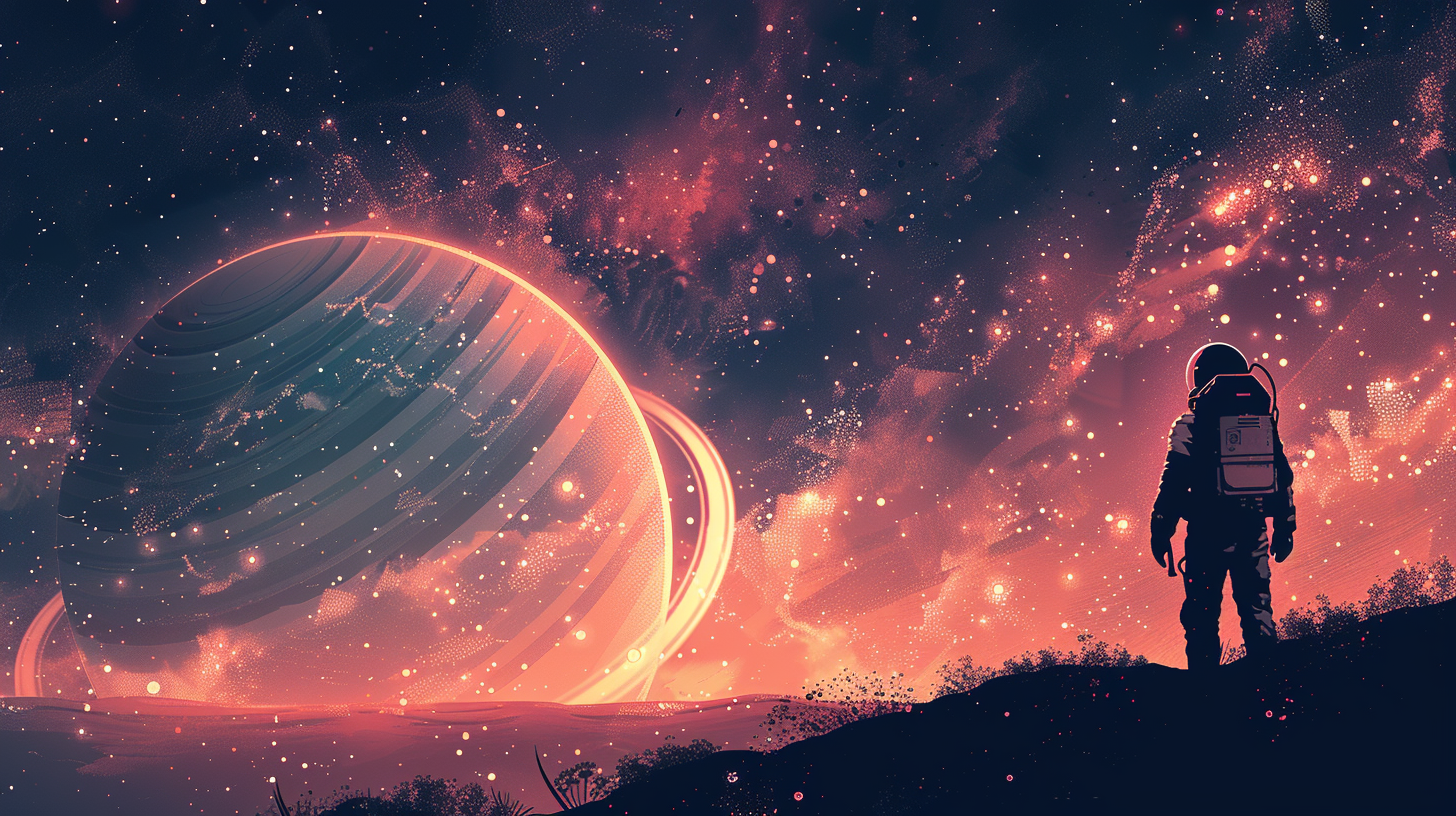
There's a thought experiment that keeps surfacing in futures work, and it goes something like this: if a genuinely alien mind tried to communicate with us, would we recognize the signal, or would we just call it noise?
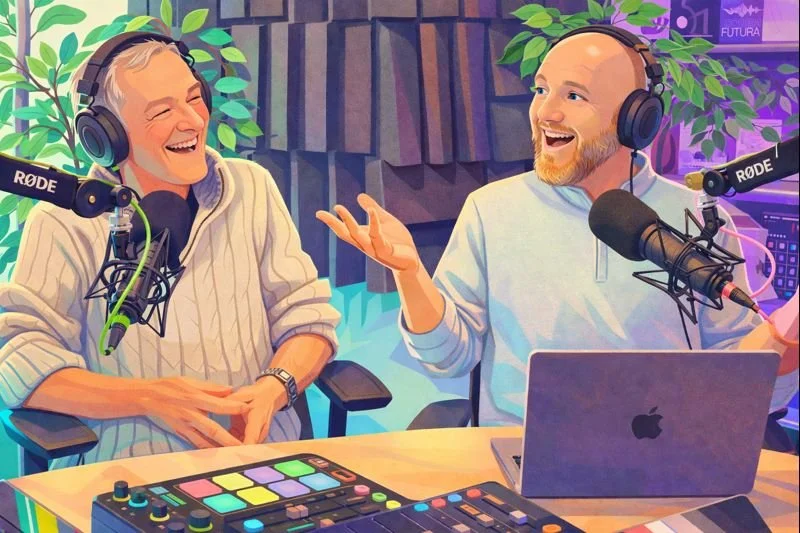
On the latest episode of Modem Futura, we play another round of Futures Improv — a format where an AI-generated scenario lands cold on the table and the two of us have to think our way through what it might mean. This time the scenarios kept pulling us back to one question: what counts as a mind, and what do we do with the ones we don't recognize?
The first scenario — a riff on Stanislaw Lem's Solaris — imagines first contact with a moon-sized organism that communicates only by generating vivid hallucinations inside our astronauts, drawn from their own repressed memories. It isn't hostile or friendly. It may not even know we exist as separate beings. The premise sounds outlandish until you notice that we already struggle to have a real conversation with an octopus.
The second scenario hands humanity a single question to ask a time traveler from the year 8,002,701, who carries one piece of verified information — humanity survived — and a sad expression. What do you ask, and what do you deliberately choose not to ask? It's a thought experiment about scarcity, priorities, and the difference between surviving and flourishing.
The third — the one that sticks with you — imagines a service that backs up your consciousness to the cloud every night while you sleep. Ten years in, the backups begin to diverge. They dream differently than you do. Who, then, has the right to your name, your relationships, your sense of self? And the question that arrives quietly behind it: how would you know you weren't the backup already?
None of these scenarios resolve, and that's the point. Futures Improv isn't about predicting which of these worlds will arrive. It's about practicing the kind of imaginative attention we'll need for the technologies that already are — embodied AI, longevity research, neural interfaces, the slow erosion of the line between physical and digital selves.
The conversations get weird. Occasionally they get genuinely strange. And sometimes, in the middle of joking about Elon Musk being reconstituted as a banana, we land on something serious about what it means to be human in an age that keeps redrawing the edges of mind.
🎧 Listen to the full episode wherever you get your podcasts, or watch on YouTube.
Subscribe and Connect!
Subscribe to Modem Futura wherever you get your podcasts and connect with us on LinkedIn. Drop a comment, pose a question, or challenge an idea—because the future isn’t something we watch happen, it’s something we build together. The medium may still be the massage, but we all have a hand in shaping how it touches tomorrow.
🎧 Apple Podcast: https://apple.co/4vodLdY
🎧 Spotify: https://open.spotify.com/episode/1242zwOf2ZsHgpN1UnF5OM?si=dLiVkWUjTv2f-XdAHS8x3A
📺 YouTube: https://youtu.be/4vCILufh2RU
🌐 Website: https://www.modemfutura.com/

Pluribus and the Philosophy of the Happy Apocalypse: What Apple TV's New Sci-Fi Asks About Individuality, Consent, and Being Human
What if happiness is the threat?
Most apocalypse stories share a common grammar: society collapses, resources become scarce, and survival demands violence. We've internalized this template so thoroughly that it shapes how we imagine catastrophe itself.
Apple TV's Pluribus, created by Vince Gilligan (Breaking Bad, Better Call Saul), disrupts that grammar entirely. Its apocalypse isn't marked by destruction or suffering. It's marked by peace. By synchronization. By happiness—at a planetary scale.
An alien signal arrives carrying an RNA sequence. Humanity, being humanity, synthesizes it. Within days, most of the global population transforms into a unified hive mind. Not zombies. Not drones. Just billions of people sharing consciousness, moving together, experiencing what appears to be genuine contentment.
About a dozen people remain unconverted. And the series follows one of them—Carol Sterka, played by Rhea Seehorn—as she grapples with being the most unhappy person on earth.
On a recent episode of the Modem Futura podcast, we explored what Pluribus surfaces about individuality, consent, collective identity, and the stories we tell ourselves about what makes a human life worth living. What follows are some of the tensions that emerged.
What is in a Name: Many Without the One
The title "Pluribus" comes from the Latin phrase E Pluribus Unum—"out of many, one"—which appears on American currency as a motto of national unity.
But the show drops both the "E" (out of) and the "Unum" (one). What remains is simply "Pluribus": the many. It's a subtle signal that this isn't a story about diversity coming together into unity. It's a story about what happens when "the many" becomes literal—when individual minds merge into a single, collective consciousness.
That linguistic choice frames everything that follows.
Who Becomes the Monster?
One of the most productive lenses for understanding Pluribus is Richard Matheson's 1954 novel I Am Legend. Not the Will Smith film adaptation, but the original text, which ends with a devastating realization: the protagonist, who has spent the story hunting the "monsters" who have replaced humanity, comes to understand that from their perspective, he is the monster. The one who kills in the night. The one who refuses to accept the new order.
Carol Sterka occupies similar territory. She's convinced she needs to "set things right"—to restore humanity to its pre-hive state. But the show keeps surfacing an uncomfortable question: right for whom? The hive mind has eliminated war, poverty, and suffering. Billions of people who lived in misery are now at peace.
If Carol succeeds in reversing the transformation, she's not saving people. She's condemning them to return to lives many of them would never have chosen.
The Consent Paradox
The hive mind in Pluribus operates under an interesting constraint: it cannot lie, and it will not assimilate anyone without their explicit permission.
This sounds like respect for autonomy. And in some sense, it is. But the hive mind also desperately wants everyone to join (even explaining that it’s a ‘biological’ imperative). So what emerges is a kind of relentless, patient persuasion—always honest, always gentle, and always oriented toward a predetermined outcome.
There's something uncomfortably familiar in this dynamic. We navigate versions of it constantly: platforms that "personalize" our experience toward their engagement metrics, systems that "recommend" content optimized for their retention goals, interfaces designed to make one choice frictionless and alternatives invisible.
The hive mind's honesty doesn't make its agenda less persistent. It just makes the agenda transparent.
The Sustainability Problem
Midway through the season, Pluribus introduces a complication: the hive mind will only consume things that have already died naturally. No killing. No harvesting. Just waiting for life to end on its own terms.
Which means, at planetary scale, they're slowly starving.
This creates a strange inversion. Carol, the last holdout, has skills and knowledge that could help solve the problem. But she's too consumed by her mission to "fix" things to collaborate with the very beings who need her help.
There's something painfully recognizable in that dynamic—the way ideological certainty can prevent us from engaging productively with people whose worldview differs from our own, even when collaboration would benefit everyone.
Is the Individual Still in There?
One of the more haunting threads in Pluribus involves the question of whether individual identities persist within the hive mind.
Carol's "chaperone"—a member of the hive who presents as an individual named Zosia—occasionally exhibits moments that feel less like collective consciousness and more like... a person surfacing. A memory that seems too specific. A reaction that seems too singular. (The Mango ice cream scene is a particular interesting one where for a moment - the real Zosia seems to surface).
Another character (Manousos) experiments with radio frequencies, attempting to extract individuals back out of the collective, seemingly trying to hack the near field electromagnetic connections the “others” have with one another.
The show doesn't resolve this, but rather leaves it as a season 1 cliffhanger as it seems some progress is made. But it raises the question: if you could pull someone out of a state of collective happiness and return them to individual consciousness, would that be rescue or harm? Liberation or trauma?
There's no easy answer. And Pluribus is wise enough not to pretend there is.
The AI Parallel (That Isn't Really About AI)
Vince Gilligan has stated that Pluribus isn't intended as an AI allegory. The original concept predates the current wave of generative AI by years.
And yet.
The show's exploration of collective intelligence, of optimization toward contentment, of systems that genuinely want to help but whose help involves transformation into something other than what you were—all of it resonates with questions we're already asking about artificial intelligence and its role in human flourishing.
The hive mind's impulse to "fix" things, to smooth over friction, to optimize for happiness—that's not so different from Silicon Valley's persistent faith that the right algorithm can solve human problems. The show doesn't moralize about this. It simply shows what it might feel like to be on the receiving end of that faith.
The hive mind might be the best thing that ever happened to humanity. Or it might be the end of everything that made humanity worth preserving. The show suggests both readings are available, and neither is obviously wrong. In the end, this is my favorite part of the show - it catalyzes great conversations… it pushes us to examine very human elements by forcing us to entertain scenarios in which we question what it means to be human. Now we just have to wait a seemingly excruciating long time until Season 2 will be ready – until then, stay curious!
Subscribe and Connect!
Subscribe to Modem Futura wherever you get your podcasts and connect with us on LinkedIn. Drop a comment, pose a question, or challenge an idea—because the future isn’t something we watch happen, it’s something we build together. The medium may still be the massage, but we all have a hand in shaping how it touches tomorrow.
🎧 Apple Podcast: https://apple.co/4k0l1bo
🎧 Spotify: https://open.spotify.com/episode/5ymC2VZJUz7iLTvYj89CXa?si=52mn5UiBRH-gbkpSEnV4Tw
📺 YouTube: https://youtu.be/xsxJWN5FO-U
🌐 Website: https://www.modemfutura.com/
Related Reading
I Am Legend by Richard Matheson
Solaris by Stanisław Lem
The Borg episodes of Star Trek: The Next Generation

Future Vibes: Sean & Andrew’s 2025 Summer Reading List – Episode 38

Sunshine, iced coffee, and a stack of books bigger than your carry-on: the Modem Futura crew is officially in vacation mode. In this episode, Sean Leahy and Andrew Maynard trade their usual policy briefs for paperbacks, audiobooks, and a little healthy banter while curating a futurist-friendly “summer reading list.” Why fiction? Because, as Sean argues, big ideas often hide between star-ship battles and dinosaur breakouts, not only in white papers. Andrew adds that speculative worlds give us a safe sandbox to test tomorrow’s ethics—and besides, nothing pairs with sunscreen like a good apocalypse.
The conversation starts with how we read. Sean confesses he’s deep into audiobooks (pro-tip: narrator chemistry matters as much as plot), while Andrew waxes nostalgic about radio dramas and the duo laments that loss of an old art form of pure radio-plays or dramas and the power of sound-only storytelling.
Then come the picks. Sean’s pile skews toward propulsive series that open up worlds of emergent tech and moral quandaries: Martha Wells’ Murderbot Diaries, Hugh Howey’s silo trilogy (Wool, Shift, Dust), Dennis E. Taylor’s clone-happy We Are Legion (We Are Bob), and John Scalzi’s Old Man’s War. Classics make the cut too: Stanisław Lem’s mind-bending Solaris, Michael Crichton’s bio-engineering cautionary tale Jurassic Park, Douglas Adams’ irreverent Hitchhiker’s Guide to the Galaxy, and the heaven-hell hijinks of Pratchett & Gaiman’s Good Omens. Andrew arrives armed with literary wit and social sci-fi: Julie Schumacher’s academic farce Dear Committee Members, John Wyndham’s climate-chaos thriller The Kraken Wakes, Iain M. Banks’ cosmic intrigue in The Algebraist, Kai-Fu Lee & Chen Qiufan’s foresight anthology AI 2041, and a nostalgic return to childhood wonder with Swallows and Amazons and its sequel Swallowdale.
Sean and Andrew dig into why these stories matter now. Themes of sentient automation (Murderbot), post-climate survival (Wool), and multiverse governance (Bobiverse) echo real-world debates on AI alignment, geo-engineering, and planetary stewardship. They unpack adaptation hits and misses—Apple TV+’s Silo nails the bunker vibe; will Amazon’s forthcoming Murderbot capture SecUnit’s dry humor?—and argue that every futurist needs a dose of imaginative empathy before writing the next policy memo or paper.
Grab your earbuds, e-reader, or dog-eared paperback and join the conversation. After listening, hit reply or tag #ModemFutura to share the titles you’ll be packing—because the future is a story we’re all still writing.
Sean's Picks:
Andrew's Picks:
Swallowdale by Arthur Ransome [Amazon second hand] (this one can be hard to find)
AI 2041: Ten Visions for Our Future by Kai-Fu Lee and Chen Qiufan [Amazon]
If you’d like to dive deeper, jump into the link and listen to the podcast or watch the YouTube video. Join us as we explore the forces shaping our collective future and the urgent need to keep human values at the heart of innovation.
Subscribe and Connect!
Subscribe to Modem Futura on a favorite podcast platform, follow on LinkedIn, and join the conversation by sharing thoughts and questions. The medium may still be the massage, but everyone has a chance to shape how it kneads modern culture—and to decide what kind of global village we ultimately build.
🎧 Apple Podcast: https://apple.co/4kkcvCC
🎧 Spotify: https://open.spotify.com/episode/0cTCZZfLHR1sIYcHsd85bt?si=5adaec8264b74cc1
📺 YouTube: https://youtu.be/KnmMw4Nb3dM
🌐 Website: https://www.modemfutura.com/