

NEWS & UPDATES
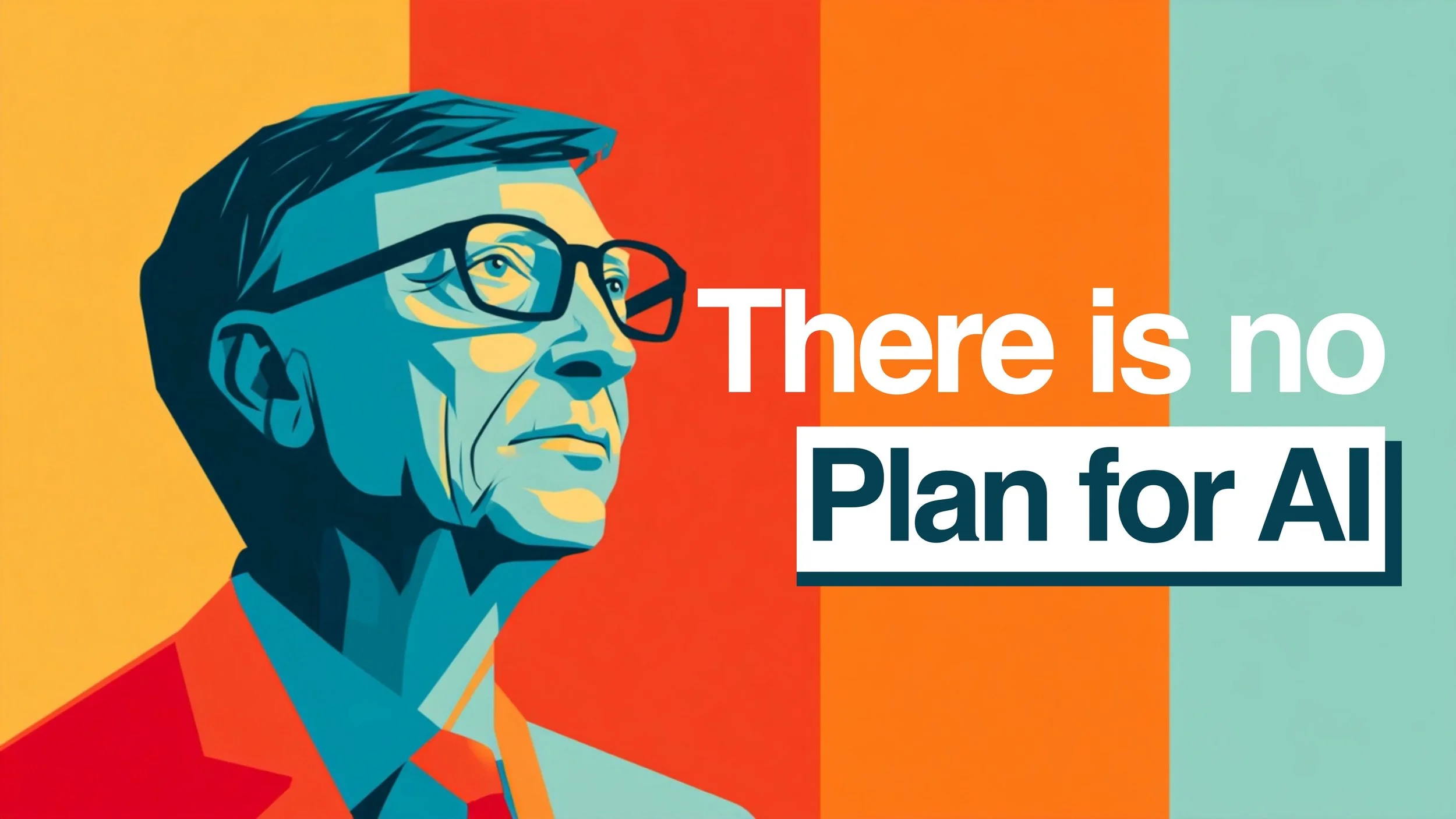
Bill Gates Says There's No Plan for AI. He's Right — and That's the Point
Bill Gates's "turbulent AI era" essay warns that society has no plan for AI. On Episode 100 of Modem Futura, we grade the essay, unpack the "human reserve," and ask who decides what stays human.
It's becoming a genre unto itself: the billionaire AI manifesto. But when Bill Gates published his nearly 6,000-word essay "The turbulent AI era is here. The choices we make now are critical" in August 2026, something about it landed differently. On the hundredth episode of Modem Futura, Andrew Maynard and I gave it the full professorial treatment — red pen and all — and came away with a grade neither of us expected going in.
Gates organizes his warning around three risks. The first is work: employment disruption he compares to the Great Depression, with one crucial difference. Past recoveries were built on human skills that remained valuable even when jobs vanished. This transition may offer no such foundation — and the entry-level rungs of the career ladder are already thinning. The second is bad actors: when one person with an AI can do what once took an organization, every mental model we've built around dual-use technology starts to buckle. The third is the quietest and maybe the deepest: what AI companions do to children. Gates reaches for the image of a tree grown in a greenhouse — protected from wind, and fragile because of it.
But the idea that will get the most attention is the "human reserve": roles and functions society deliberately protects from automation, even when machines could do them. Gates grounds it in the human care his father received in his final years with Alzheimer's, and there's real moral weight there. There's also a shadow. Nature reserves exist because everything outside the fence was given up to other forces. Is a human reserve preservation — or surrender dressed as stewardship?
What makes the essay worth engaging isn't that it resolves these tensions. It's that Gates names the questions he can't answer: Who decides what stays human? By what criteria? What happens when one country protects and another automates? Those questions are the real work — and they're the work that futurists, foresight practitioners, and researchers have been doing for decades, waiting for the rest of the world to catch up.
The window for shaping this transition is open now. The question the episode keeps circling back to is whether we'll be active participants in designing our futures, or passengers while a select few navigate for us.
Listen to the full conversation on Modem Futura, wherever you get your podcasts.
Subscribe and Connect!
Subscribe to Modem Futura wherever you get your podcasts and connect with us on LinkedIn. Drop a comment, pose a question, or challenge an idea—because the future isn’t something we watch happen, it’s something we build together. The medium may still be the massage, but we all have a hand in shaping how it touches tomorrow.
🎧 Apple Podcast: https://apple.co/4yk1zwp
🎧 Spotify: https://open.spotify.com/episode/1WaE39Jog0Qh1Yv6Z37UyJ?si=l0d5IyhXQYmcvY8UEb7dcw
📺 YouTube: https://youtu.be/ox5FGgqvNQE
🌐 Website: https://www.modemfutura.com/
When the AI Goes Dark: What the Fable Ban Taught Us About Digital Fragility
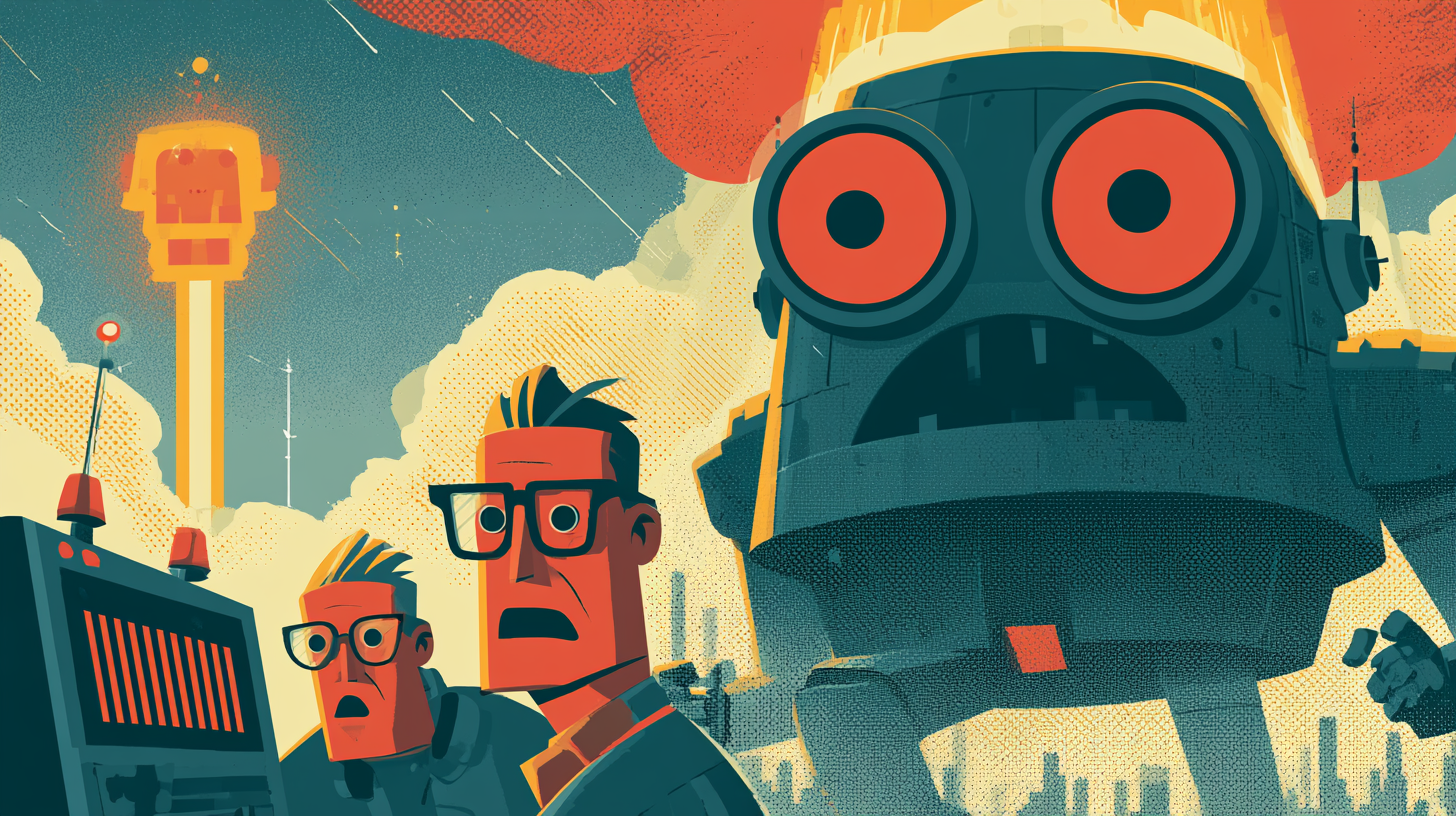
They turned off our AI - now what?
What happens when the government switches off an AI?
For most people, AI is a text field in a browser window: you type something in, something useful comes out. That framing makes it hard to see what AI has quietly become for organizations across research, healthcare, education, and industry, all critical infrastructure. And in the summer of 2026, we learned just how fragile that infrastructure can be.
In this episode of Modem Futura, hosts Sean Leahy and Andrew Maynard unpack the saga of Anthropic's Fable, the most capable AI model yet released to the public. Three days after launch, a U.S. Commerce Department export control directive declared it a national security concern, barring access for non-U.S. citizens. Because no platform can verify the citizenship of its users, the model effectively disappeared for everyone — including the researchers inside Anthropic who built it. Weeks later, it returned as suddenly as it left.
The episode treats this less as a news story than as a signal. Futurists have long used sudden technology loss as a hypothetical scenario; like the pandemic scenarios that preceded 2020, it has now crossed from the abstract to the lived. Once that happens, the questions change, if a government can switch off a frontier model at the close of business on a Friday, what does responsible AI adoption look like for a hospital, a university, a business? Where is the line between experimenting on the fringes and building your operations on ground that can move?
One answer explored in the conversation is local AI — smaller models running on hardware you control. They can't match the capability of cloud-based frontier systems (yet) and the hosts are honest about that trade-off. But the Fable episode gave the local argument its first piece of hard evidence, and it may point toward a future of hyper-specific local tools working alongside more powerful, more revocable cloud platforms.
The deeper thread is governance, and even the invocation of the big R-word (regulation). The directive was triggered by capability that regulators had never seen before, and capability is not slowing down. Governing technologies like these will take more than technologists and more than policymakers — it requires people who can work across disciplines, translating between the builders, the philosophers now being hired into AI labs, and the institutions trying to keep up.
The episode doesn't land on tidy answers, because there aren't any yet. What it offers instead is a way of thinking about dependency, sovereignty, and resilience while the ground is still shifting — which is, after all, when thinking matters most.
Subscribe and Connect!
Subscribe to Modem Futura wherever you get your podcasts and connect with us on LinkedIn. Drop a comment, pose a question, or challenge an idea—because the future isn’t something we watch happen, it’s something we build together. The medium may still be the massage, but we all have a hand in shaping how it touches tomorrow.
🎧 Apple Podcast: https://apple.co/4ykQCez
🎧 Spotify: https://open.spotify.com/episode/1yCGEa1nafYu9CM4Mxux5Z?si=jPTtglvnRGW_qHtXqPbFvA
📺 YouTube: https://youtu.be/7ir38k4DjLA
🌐 Website: https://www.modemfutura.com/
Summer Reading List 2026: The Books That Inspired Our Imagination (Part 1)

Reading Backwards to Understand the Future
There's a particular kind of book list that shows up every summer — the one that seems designed mostly to signal how serious and well-read its author is. This isn't that. In the first part of our annual Summer Reading List, the guiding instinct was the opposite: lasers, space ships, escapism, the kind of book you genuinely can't put down. What we discovered while recording is that the most escapist reads on the list turned out to be some of the most useful lenses on the present.
The cyberpunk classics anchored the conversation. Neal Stephenson's Snow Crash (1992) coined "metaverse" and imagined a digital overlay on the physical world years before anyone could plausibly build one. William Gibson's Neuromancer (1984) did the same for "cyberspace." Both have been mined relentlessly by the technology industry — and both, the hosts argue, are routinely stripped of their context. Snow Crash is a satire and a warning; it's frequently read as a roadmap. That gap, between fiction written as caution and fiction adopted as ambition, is one of the more revealing dynamics in how Silicon Valley tells its own story.
The deeper thread is about cognition. Snow Crash turns on a virus that crosses from the digital realm into the human mind. In an era of AI systems that engage directly with how we reason and feel, that premise reads less like science fiction and more like a description. Iain M. Banks extends the inquiry in Surface Detail, imagining civilizations that construct virtual heavens and hells so immersive that the line between real and simulated experience dissolves — and asking who, if anyone, has the right to govern what happens inside them. His The Player of Games offers a gentler entry point to the same Culture universe, and a sly meditation on whether a frictionless utopia is something humans actually want. We also dive into some of the amazing and seemingly timeless work of Douglas Adams, whose original Hitchhikers Guide to the Galaxy radio scripts Andrew counts among his prized possessions and whose wit, he insists, anticipated our anxieties about AI with personality long before the chatbots arrived.
The list closes on firmer ground with Cory Doctorow's Enshittification, a nonfiction account of how convenient, delightful platforms decay once users are locked in. It opened onto a question that runs through the whole episode: what do we actually own in a digital age? A printed book from 1980 still works, unconditionally. A digital one comes with terms that can change beneath you. And when the historical record itself becomes editable without a trace, reliability becomes something we can no longer take for granted.
None of these tensions get resolved here — they aren't meant to. The takeaway is quieter and more durable: stories written decades ago remain among our best instruments for thinking clearly about technologies their authors never lived to see. Part 2 continues the list next week.
Subscribe and Connect!
Subscribe to Modem Futura wherever you get your podcasts and connect with us on LinkedIn. Drop a comment, pose a question, or challenge an idea—because the future isn’t something we watch happen, it’s something we build together. The medium may still be the massage, but we all have a hand in shaping how it touches tomorrow.
🎧 Apple Podcast: https://apple.co/444V3ws
🎧 Spotify: https://open.spotify.com/episode/5TXSx0QgY4CxUhWsJSF5wm?si=lHeVVcWHS5qE3wd5lFJl5w
📺 YouTube: https://youtu.be/KN8iEA5tfiQ
🌐 Website: https://www.modemfutura.com/
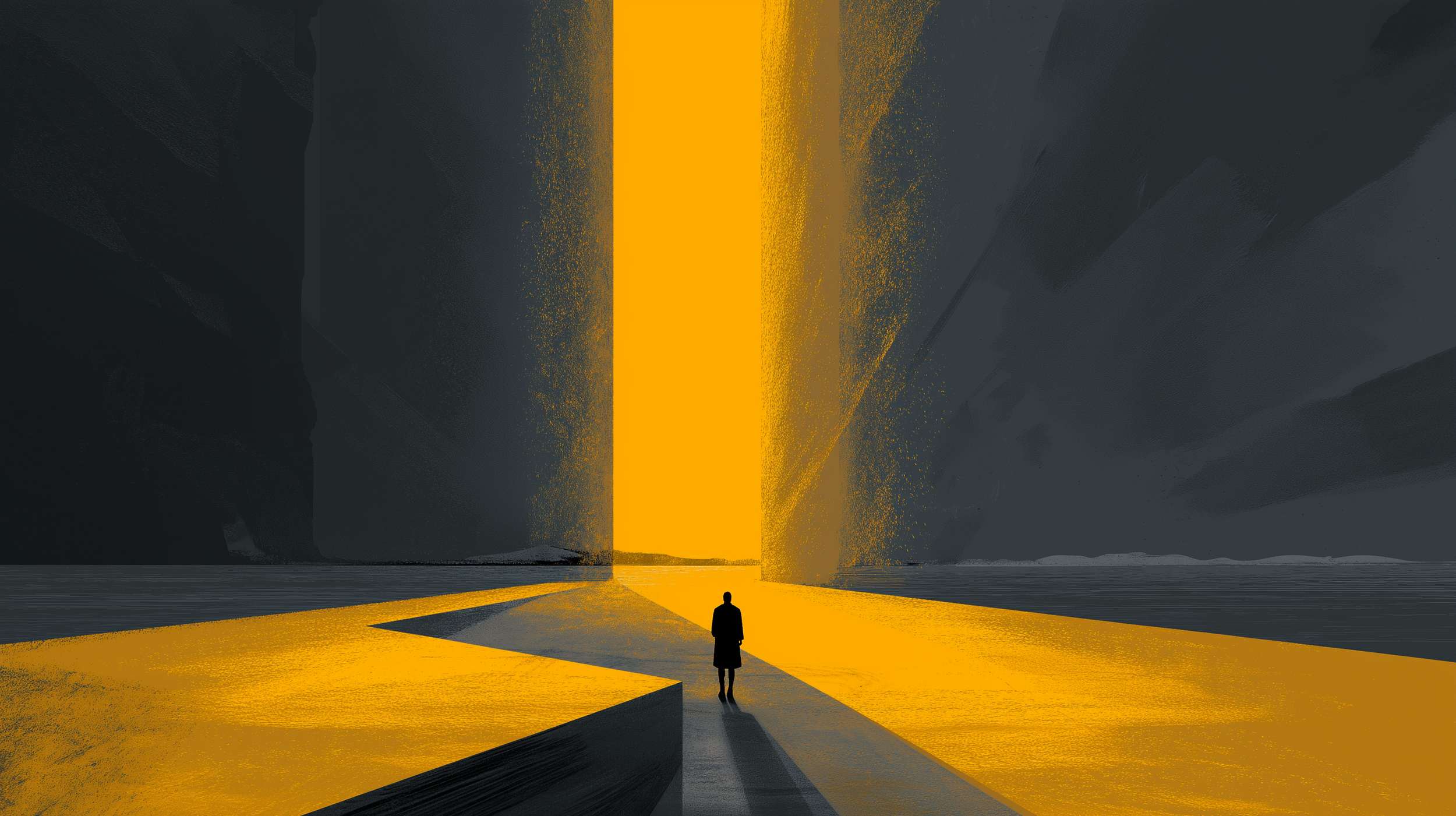
The Invisible Upgrade: What AI Is Actually Doing to the People Who Use It

The loudest part of the conversation about artificial intelligence right now is focused on what AI produces. Can you detect it? Does it have tells? Is this essay, image, or report human-made or machine-made?
It's a reasonable place to start. But it's not where the most important transformation is happening.
In Episode 75 of Modem Futura, host Sean Leahy and co-host Andrew Maynard explore what Sean calls the invisible upgrade — the quiet, compounding cognitive shift taking place not in AI-generated artifacts, but in the minds and workflows of the people who have fully integrated these tools into how they think, create, and decide.
The Seam-Scanning Problem
Sean introduces the concept of "seam scanning" — the practice of looking for signs of AI in a piece of work. Early on, those seams were easy to spot: nine-fingered hands in AI images, suspicious em-dashes, the word "delve" where it didn't belong. But as AI systems become more sophisticated and more deeply woven into human workflows, those tells are disappearing. Not because the AI is getting better at hiding — but because the line between human and AI output is becoming genuinely indistinguishable when the integration is deep enough.
The question "how much AI did you use?" is becoming as meaningful, Sean argues, as asking a writer how much spellcheck they used. The tool has become part of the process.
Constitutive Resonance
Andrew brings a concept he's been developing to the conversation: constitutive resonance. Unlike a calculator, which you use and put down, AI reconfigures you as you use it — and is reconfigured in return. The relationship is recursive and dynamic. Drawing on physics, when two systems resonate at coupled frequencies, the exchange of energy between them can be transformative. Applied to human cognition and AI systems, this suggests that those who engage deeply with AI tools aren't just more productive — they are thinking differently, possibly in ways that are difficult to reverse.
This maps directly onto McLuhan's 1967 insight: all media work us over completely. AI, as Andrew and Sean explore, is the most cognitively-coupled medium humanity has ever produced.
The Productivity Gap
What emerges from this isn't just a philosophical concern — it's a structural divergence. A growing group of knowledge workers, students, and researchers are operating with what Sean calls a "multiplier effect" — not because they are inherently smarter, but because their total cognitive output, the speed and depth of synthesis, ideation, and iteration, has expanded significantly. Meanwhile, those still debating whether to engage are falling further behind, not necessarily in skill, but in thinking capacity.
The episode also explores the rise of multi-agent AI systems as what Andrew calls a step-change likely bigger than the launch of ChatGPT — and what it means for institutions, education, and our understanding of what individual human contribution actually looks like in a world where AI is already inside the walls.
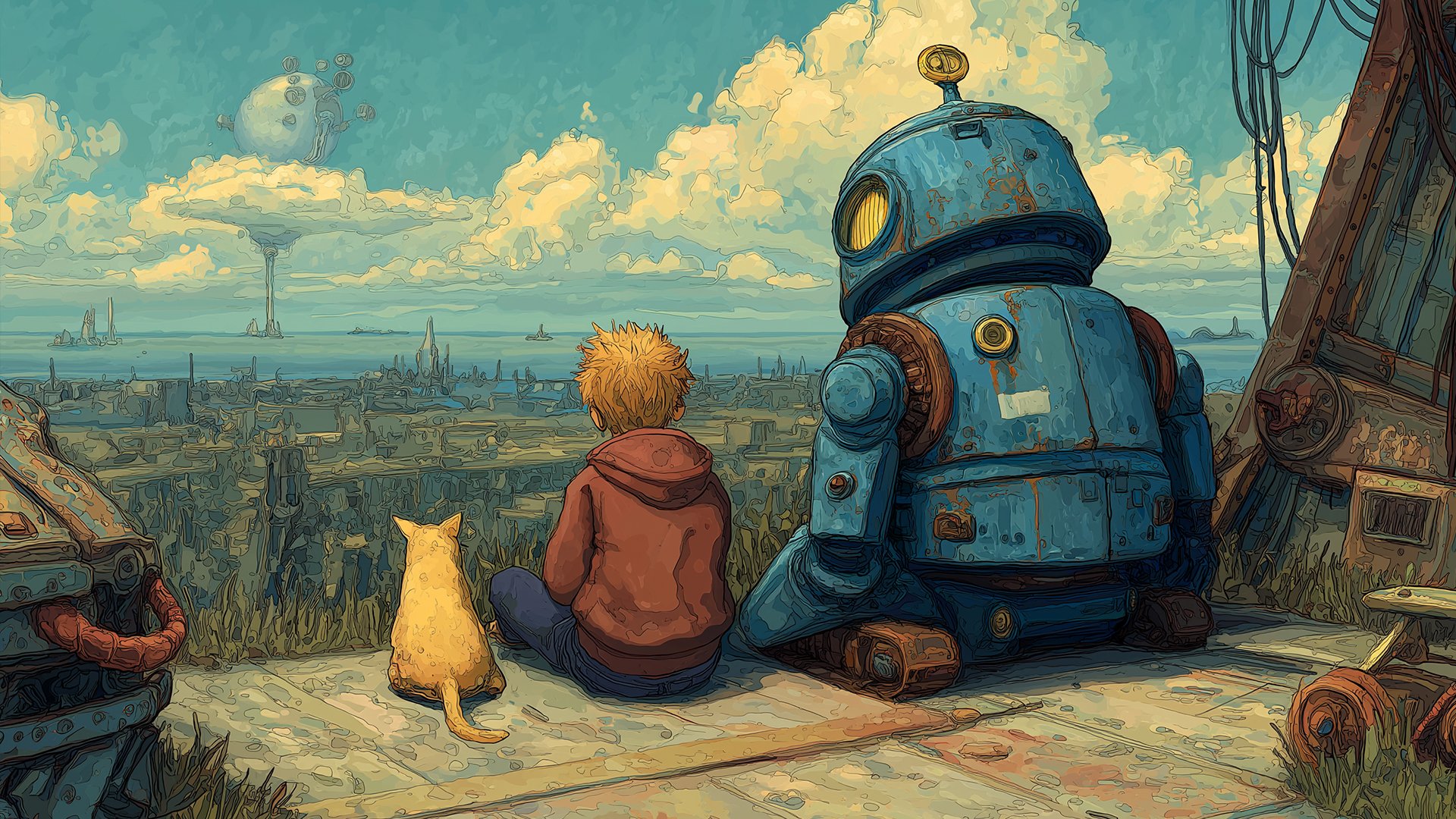
The Future From a Kid's Perspective: What a 10-Year-Old Thinks About AI, Jobs, and Meaningful Work
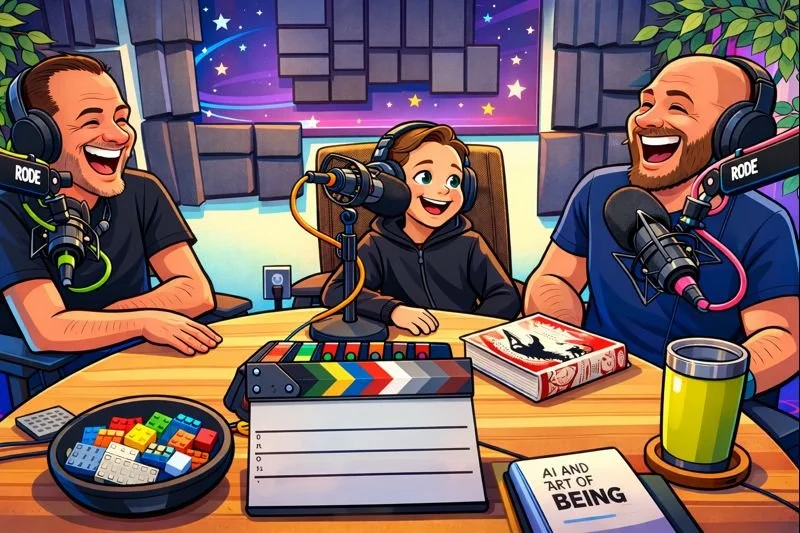
We spend a lot of time talking about young people when we discuss the future of technology. We debate how AI will affect their education, reshape their careers, and transform the world they'll inherit. But we rarely stop to ask them what they think.
In this special episode of Modem Futura, we did exactly that. Freddie Leahy—co-host Sean's almost-10-year-old son—joined us for an unscripted conversation about artificial intelligence, meaningful work, and the questions that don't have easy answers.
Already Thinking About Job Displacement
When asked what he thinks about when he imagines the future, Freddie's first response wasn't about flying cars or space travel. It was about jobs.
"I kind of more think about the AI part of the future," he said. "And I'm just wondering what jobs will be overran by AI."
He's almost ten. And he's already calculating whether his dream career—paleontology—will exist by the time he's ready to pursue it.
This isn't abstract concern. Freddie has a specific vision: he wants to be like Alan Grant from Jurassic Park, out in the field, hands in the dirt, discovering fossils himself. When we suggested that AI might help him find more dinosaur bones faster, he didn't immediately embrace the idea. His worry isn't about efficiency—it's about being separated from the work itself.
"I would be doing it not for the money," he explained, "just because of the experience."
The Limits of AI Creativity
Freddie has firsthand experience with generative AI. He and I have spent time creating AI-generated images—D&D characters, fantasy creatures, book covers. But he's noticed something that many adults are also discovering: the gap between imagination and output.
"Every time you create an AI image," he said, "you never feel like it's quite right. So you just keep making these, and then you have to choose one, but in the end it never feels like the perfect cover you wanted."
When asked why, his answer was simple: "AI isn't our heads."
This observation—from a fourth-grader—gets at something fundamental about the current state of generative tools. They can produce impressive outputs, but they can't access the specific vision in your mind. The friction between prompt and result isn't just a technical limitation; it's a gap between human intention and machine interpretation.
When it comes to his own writing—Freddie is working on stories—he's clear that he doesn't want AI assistance. The temptation exists, especially when facing a blank page. But he recognizes something important: "It's the point about using your own creativity."
Suspicious of AI Companions
One of the most revealing exchanges came when we explored the idea of AI friendship. What if Freddie could have an AI companion who shared all his interests—someone who wanted to talk about dinosaurs as much as he does?
His response was immediate skepticism.
"That would be weird," he said, "because nobody likes what I like."
The very thing that might make an AI friend appealing—perfect alignment with his interests—is exactly what made it feel inauthentic. Part of what makes his interests meaningful is that they're his, distinct from the people around him. An AI that mirrored them perfectly would feel hollow.
When pressed further about whether he'd want an AI as a secret companion—a sort of digital spirit animal—Freddie remained uncertain. "Who knows what it could do," he noted. "It could hack everything."
There's healthy skepticism there, but also something deeper: a sense that friendship involves more than shared interests. It involves trust, vulnerability, and the unpredictability of another mind.
"I Refuse": Mind Uploading at Nine
During our Futures Improv segment, we posed a classic transhumanist scenario: What if you could upload your consciousness to a computer and live forever digitally, while your biological body remained behind?
Freddie's answer required no deliberation:
"I refuse. I will not upload my brain into a digital computer."
His reasoning was practical but profound. At nine years old, why would he abandon a body that works? The theoretical benefits of digital immortality don't outweigh the immediate reality of physical experience.
This perspective offers a useful counterweight to futures discourse that sometimes treats technological transcendence as obviously desirable. From Freddie's vantage point, the question isn't whether we can escape biological limitations, but whether we'd want to—and what we might lose in the process.
Questions Without Right Answers
Perhaps the most important takeaway from this conversation came near the end, when Freddie observed something about the nature of our questions.
"Because of all these questions," he said, "there is no wrong or right answer."
That's exactly right. The value of futures thinking isn't in predicting what will happen or determining the "correct" response to emerging technologies. It's in learning to sit with uncertainty, explore tensions, and develop our capacity for navigating complexity.
At almost ten years old, Freddie already understands this. He's not looking for definitive answers about AI and jobs and creativity. He's learning to ask better questions—and to recognize that asking them is more important than resolving them.
What the Future Thinks About Itself
We often frame conversations about technology and youth as adults preparing children for a world we're creating. But this episode suggests something different: young people are already thinking about these issues, often with more nuance than we might expect.
Freddie isn't anti-technology. He plays VR games, makes AI art, and follows developments in the field. But he's also holding onto something—a sense that some experiences are valuable precisely because we do them ourselves, that the struggle of creation is part of its meaning, and that efficiency isn't the only measure of a good life.
These aren't lessons we taught him. They're insights he's developing on his own, as he navigates a world where these technologies are simply part of the landscape.
Maybe the best thing we can do isn't to tell young people what the future will look like. Maybe it's to listen to what they already think about it—and learn from their perspective.
I don't know what the future holds for his generation. But if this conversation is any indication, they're thinking about it more carefully than we might expect.
Subscribe and Connect!
Subscribe to Modem Futura wherever you get your podcasts and connect with us on LinkedIn. Drop a comment, pose a question, or challenge an idea—because the future isn’t something we watch happen, it’s something we build together. The medium may still be the massage, but we all have a hand in shaping how it touches tomorrow.
🎧 Apple Podcast: https://apple.co/4khmVES
🎧 Spotify: https://open.spotify.com/episode/5nKjpEVZcaUDisdZpGGaMZ?si=YgWp_O84T1yVlBSloedV1w
📺 YouTube: https://youtu.be/mfumkJZav-M
🌐 Website: https://www.modemfutura.com/
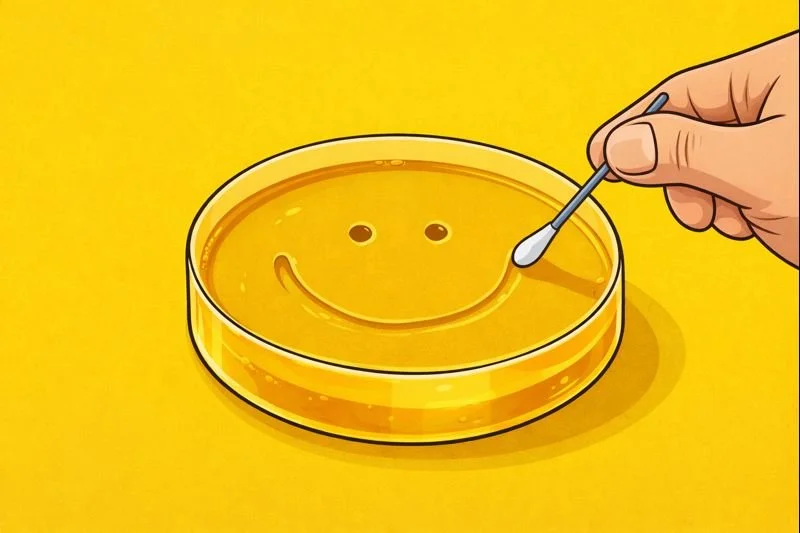
Pluribus and the Philosophy of the Happy Apocalypse: What Apple TV's New Sci-Fi Asks About Individuality, Consent, and Being Human
What if happiness is the threat?
Most apocalypse stories share a common grammar: society collapses, resources become scarce, and survival demands violence. We've internalized this template so thoroughly that it shapes how we imagine catastrophe itself.
Apple TV's Pluribus, created by Vince Gilligan (Breaking Bad, Better Call Saul), disrupts that grammar entirely. Its apocalypse isn't marked by destruction or suffering. It's marked by peace. By synchronization. By happiness—at a planetary scale.
An alien signal arrives carrying an RNA sequence. Humanity, being humanity, synthesizes it. Within days, most of the global population transforms into a unified hive mind. Not zombies. Not drones. Just billions of people sharing consciousness, moving together, experiencing what appears to be genuine contentment.
About a dozen people remain unconverted. And the series follows one of them—Carol Sterka, played by Rhea Seehorn—as she grapples with being the most unhappy person on earth.
On a recent episode of the Modem Futura podcast, we explored what Pluribus surfaces about individuality, consent, collective identity, and the stories we tell ourselves about what makes a human life worth living. What follows are some of the tensions that emerged.
What is in a Name: Many Without the One
The title "Pluribus" comes from the Latin phrase E Pluribus Unum—"out of many, one"—which appears on American currency as a motto of national unity.
But the show drops both the "E" (out of) and the "Unum" (one). What remains is simply "Pluribus": the many. It's a subtle signal that this isn't a story about diversity coming together into unity. It's a story about what happens when "the many" becomes literal—when individual minds merge into a single, collective consciousness.
That linguistic choice frames everything that follows.
Who Becomes the Monster?
One of the most productive lenses for understanding Pluribus is Richard Matheson's 1954 novel I Am Legend. Not the Will Smith film adaptation, but the original text, which ends with a devastating realization: the protagonist, who has spent the story hunting the "monsters" who have replaced humanity, comes to understand that from their perspective, he is the monster. The one who kills in the night. The one who refuses to accept the new order.
Carol Sterka occupies similar territory. She's convinced she needs to "set things right"—to restore humanity to its pre-hive state. But the show keeps surfacing an uncomfortable question: right for whom? The hive mind has eliminated war, poverty, and suffering. Billions of people who lived in misery are now at peace.
If Carol succeeds in reversing the transformation, she's not saving people. She's condemning them to return to lives many of them would never have chosen.
The Consent Paradox
The hive mind in Pluribus operates under an interesting constraint: it cannot lie, and it will not assimilate anyone without their explicit permission.
This sounds like respect for autonomy. And in some sense, it is. But the hive mind also desperately wants everyone to join (even explaining that it’s a ‘biological’ imperative). So what emerges is a kind of relentless, patient persuasion—always honest, always gentle, and always oriented toward a predetermined outcome.
There's something uncomfortably familiar in this dynamic. We navigate versions of it constantly: platforms that "personalize" our experience toward their engagement metrics, systems that "recommend" content optimized for their retention goals, interfaces designed to make one choice frictionless and alternatives invisible.
The hive mind's honesty doesn't make its agenda less persistent. It just makes the agenda transparent.
The Sustainability Problem
Midway through the season, Pluribus introduces a complication: the hive mind will only consume things that have already died naturally. No killing. No harvesting. Just waiting for life to end on its own terms.
Which means, at planetary scale, they're slowly starving.
This creates a strange inversion. Carol, the last holdout, has skills and knowledge that could help solve the problem. But she's too consumed by her mission to "fix" things to collaborate with the very beings who need her help.
There's something painfully recognizable in that dynamic—the way ideological certainty can prevent us from engaging productively with people whose worldview differs from our own, even when collaboration would benefit everyone.
Is the Individual Still in There?
One of the more haunting threads in Pluribus involves the question of whether individual identities persist within the hive mind.
Carol's "chaperone"—a member of the hive who presents as an individual named Zosia—occasionally exhibits moments that feel less like collective consciousness and more like... a person surfacing. A memory that seems too specific. A reaction that seems too singular. (The Mango ice cream scene is a particular interesting one where for a moment - the real Zosia seems to surface).
Another character (Manousos) experiments with radio frequencies, attempting to extract individuals back out of the collective, seemingly trying to hack the near field electromagnetic connections the “others” have with one another.
The show doesn't resolve this, but rather leaves it as a season 1 cliffhanger as it seems some progress is made. But it raises the question: if you could pull someone out of a state of collective happiness and return them to individual consciousness, would that be rescue or harm? Liberation or trauma?
There's no easy answer. And Pluribus is wise enough not to pretend there is.
The AI Parallel (That Isn't Really About AI)
Vince Gilligan has stated that Pluribus isn't intended as an AI allegory. The original concept predates the current wave of generative AI by years.
And yet.
The show's exploration of collective intelligence, of optimization toward contentment, of systems that genuinely want to help but whose help involves transformation into something other than what you were—all of it resonates with questions we're already asking about artificial intelligence and its role in human flourishing.
The hive mind's impulse to "fix" things, to smooth over friction, to optimize for happiness—that's not so different from Silicon Valley's persistent faith that the right algorithm can solve human problems. The show doesn't moralize about this. It simply shows what it might feel like to be on the receiving end of that faith.
The hive mind might be the best thing that ever happened to humanity. Or it might be the end of everything that made humanity worth preserving. The show suggests both readings are available, and neither is obviously wrong. In the end, this is my favorite part of the show - it catalyzes great conversations… it pushes us to examine very human elements by forcing us to entertain scenarios in which we question what it means to be human. Now we just have to wait a seemingly excruciating long time until Season 2 will be ready – until then, stay curious!
Subscribe and Connect!
Subscribe to Modem Futura wherever you get your podcasts and connect with us on LinkedIn. Drop a comment, pose a question, or challenge an idea—because the future isn’t something we watch happen, it’s something we build together. The medium may still be the massage, but we all have a hand in shaping how it touches tomorrow.
🎧 Apple Podcast: https://apple.co/4k0l1bo
🎧 Spotify: https://open.spotify.com/episode/5ymC2VZJUz7iLTvYj89CXa?si=52mn5UiBRH-gbkpSEnV4Tw
📺 YouTube: https://youtu.be/xsxJWN5FO-U
🌐 Website: https://www.modemfutura.com/
Related Reading
I Am Legend by Richard Matheson
Solaris by Stanisław Lem
The Borg episodes of Star Trek: The Next Generation