
NEWS & UPDATES
Summer Reading for Futures Thinkers: Part Two of the Modem Futura List
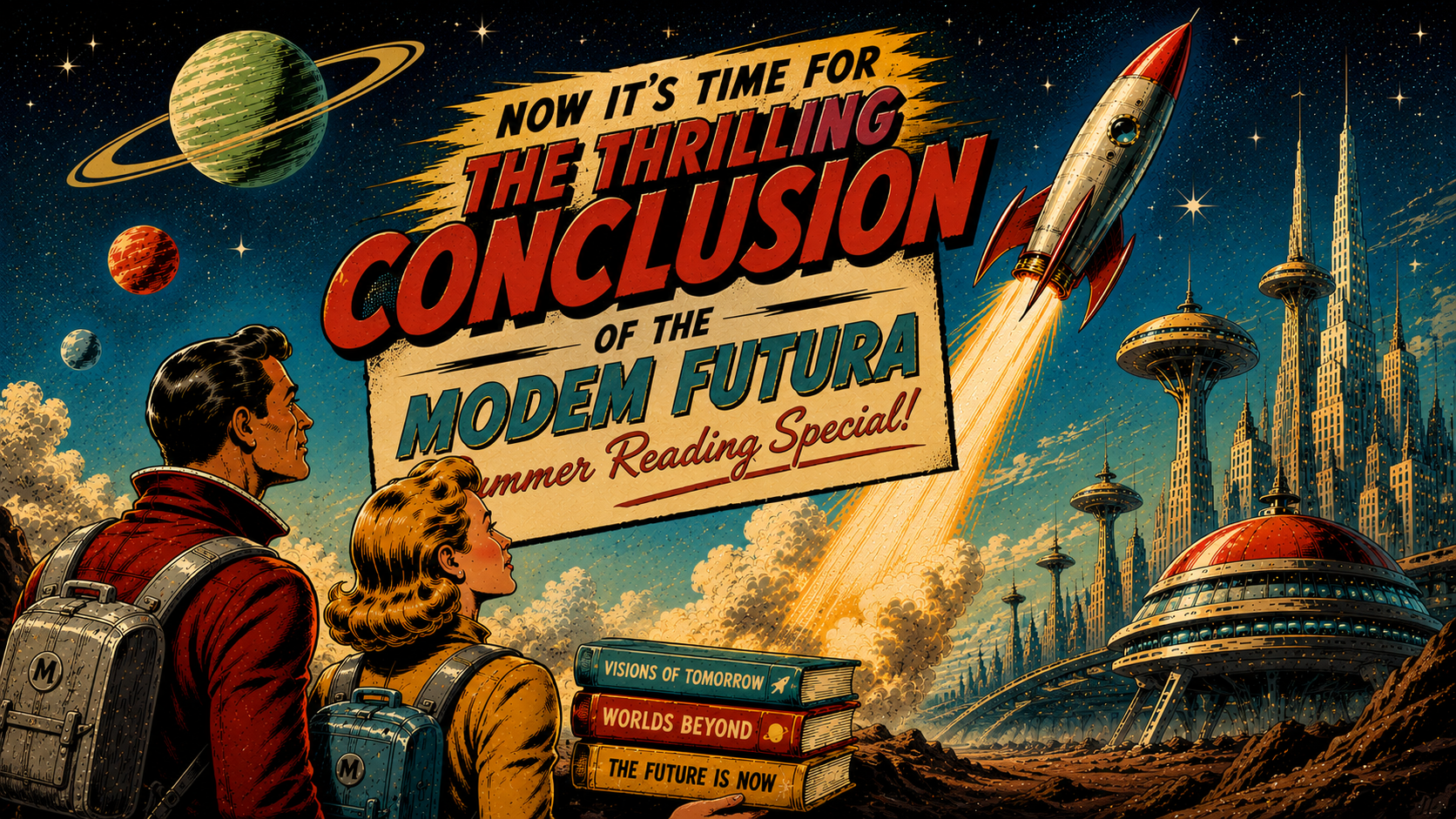
What makes a book worth your summer? On the concluding half of our annual summer reading list, an answer kept surfacing: the best stories are the ones that don't end when you finish them — the ones that plant an idea you can't shake, and that keeps growing into something uniquely yours.
Part two of the list ranges well beyond the cyberpunk canon we explored in part one. Andrew Maynard opens with Terry Pratchett's Unseen Academicals, a satire of university life so accurate that anyone who has worked in academia will cringe in recognition — and one that connects, unexpectedly, to our recent conversation about enshittification: where does the true value proposition of our institutions actually live? His bonus pick, Pratchett's often-overlooked Bromeliad trilogy, is a reminder that the best children's books are age-agnostic.
Sean breaks the pattern entirely with Henri Cartier-Bresson's The Decisive Moment — the landmark photography collection, still available through the Fondation Henri Cartier-Bresson in Paris. It sparks a meditation on analog intentionality: how portable cameras created street photography, why a single frame can hold an entire technological era, and the idea that every photograph has two subjects — the one in the frame, and the one behind the camera.
Time travel threads through the middle of the list. Connie Willis's Blackout and All Clear are historical novels wearing the lightest science fiction overlay, following future academics who live through the London Blitz. And La Jetée, Chris Marker's 1962 short film told almost entirely in still photographs, proves that sixteen minutes and a compelling idea can seed decades of storytelling — you can trace its time-loop DNA through much of what we watch today.
The lighter fare earns its place too: Mick Herron's Slow Horses novels (arguably better than the acclaimed series they inspired), the full-cast Harry Potter audio dramatizations, and a return to Silo ahead of its new season. Two friends-and-family picks round things out: Riz Virk's The Simulation Hypothesis and AI and the Art of Being Human by Jeffrey Abbott and Andrew Maynard — a deliberately agnostic, tools-based guide to navigating AI with intentionality and care, whether you approach the technology with enthusiasm or deep unease.
Subscribe and Connect!
Subscribe to Modem Futura wherever you get your podcasts and connect with us on LinkedIn. Drop a comment, pose a question, or challenge an idea—because the future isn’t something we watch happen, it’s something we build together. The medium may still be the massage, but we all have a hand in shaping how it touches tomorrow.
🎧 Apple Podcast: https://apple.co/4vdP3wf
🎧 Spotify: https://open.spotify.com/episode/1X4nEJUORnt4Txs73mGNeY?si=dB8iH1scSq6rQcwsZgoCnw
📺 YouTube: https://youtu.be/JHSHtAkTKvk
🌐 Website: https://www.modemfutura.com/
Summer Reading List 2026: The Books That Inspired Our Imagination (Part 1)

Reading Backwards to Understand the Future
There's a particular kind of book list that shows up every summer — the one that seems designed mostly to signal how serious and well-read its author is. This isn't that. In the first part of our annual Summer Reading List, the guiding instinct was the opposite: lasers, space ships, escapism, the kind of book you genuinely can't put down. What we discovered while recording is that the most escapist reads on the list turned out to be some of the most useful lenses on the present.
The cyberpunk classics anchored the conversation. Neal Stephenson's Snow Crash (1992) coined "metaverse" and imagined a digital overlay on the physical world years before anyone could plausibly build one. William Gibson's Neuromancer (1984) did the same for "cyberspace." Both have been mined relentlessly by the technology industry — and both, the hosts argue, are routinely stripped of their context. Snow Crash is a satire and a warning; it's frequently read as a roadmap. That gap, between fiction written as caution and fiction adopted as ambition, is one of the more revealing dynamics in how Silicon Valley tells its own story.
The deeper thread is about cognition. Snow Crash turns on a virus that crosses from the digital realm into the human mind. In an era of AI systems that engage directly with how we reason and feel, that premise reads less like science fiction and more like a description. Iain M. Banks extends the inquiry in Surface Detail, imagining civilizations that construct virtual heavens and hells so immersive that the line between real and simulated experience dissolves — and asking who, if anyone, has the right to govern what happens inside them. His The Player of Games offers a gentler entry point to the same Culture universe, and a sly meditation on whether a frictionless utopia is something humans actually want. We also dive into some of the amazing and seemingly timeless work of Douglas Adams, whose original Hitchhikers Guide to the Galaxy radio scripts Andrew counts among his prized possessions and whose wit, he insists, anticipated our anxieties about AI with personality long before the chatbots arrived.
The list closes on firmer ground with Cory Doctorow's Enshittification, a nonfiction account of how convenient, delightful platforms decay once users are locked in. It opened onto a question that runs through the whole episode: what do we actually own in a digital age? A printed book from 1980 still works, unconditionally. A digital one comes with terms that can change beneath you. And when the historical record itself becomes editable without a trace, reliability becomes something we can no longer take for granted.
None of these tensions get resolved here — they aren't meant to. The takeaway is quieter and more durable: stories written decades ago remain among our best instruments for thinking clearly about technologies their authors never lived to see. Part 2 continues the list next week.
Subscribe and Connect!
Subscribe to Modem Futura wherever you get your podcasts and connect with us on LinkedIn. Drop a comment, pose a question, or challenge an idea—because the future isn’t something we watch happen, it’s something we build together. The medium may still be the massage, but we all have a hand in shaping how it touches tomorrow.
🎧 Apple Podcast: https://apple.co/444V3ws
🎧 Spotify: https://open.spotify.com/episode/5TXSx0QgY4CxUhWsJSF5wm?si=lHeVVcWHS5qE3wd5lFJl5w
📺 YouTube: https://youtu.be/KN8iEA5tfiQ
🌐 Website: https://www.modemfutura.com/

Future Vibes: Sean & Andrew’s 2025 Summer Reading List – Episode 38

Sunshine, iced coffee, and a stack of books bigger than your carry-on: the Modem Futura crew is officially in vacation mode. In this episode, Sean Leahy and Andrew Maynard trade their usual policy briefs for paperbacks, audiobooks, and a little healthy banter while curating a futurist-friendly “summer reading list.” Why fiction? Because, as Sean argues, big ideas often hide between star-ship battles and dinosaur breakouts, not only in white papers. Andrew adds that speculative worlds give us a safe sandbox to test tomorrow’s ethics—and besides, nothing pairs with sunscreen like a good apocalypse.
The conversation starts with how we read. Sean confesses he’s deep into audiobooks (pro-tip: narrator chemistry matters as much as plot), while Andrew waxes nostalgic about radio dramas and the duo laments that loss of an old art form of pure radio-plays or dramas and the power of sound-only storytelling.
Then come the picks. Sean’s pile skews toward propulsive series that open up worlds of emergent tech and moral quandaries: Martha Wells’ Murderbot Diaries, Hugh Howey’s silo trilogy (Wool, Shift, Dust), Dennis E. Taylor’s clone-happy We Are Legion (We Are Bob), and John Scalzi’s Old Man’s War. Classics make the cut too: Stanisław Lem’s mind-bending Solaris, Michael Crichton’s bio-engineering cautionary tale Jurassic Park, Douglas Adams’ irreverent Hitchhiker’s Guide to the Galaxy, and the heaven-hell hijinks of Pratchett & Gaiman’s Good Omens. Andrew arrives armed with literary wit and social sci-fi: Julie Schumacher’s academic farce Dear Committee Members, John Wyndham’s climate-chaos thriller The Kraken Wakes, Iain M. Banks’ cosmic intrigue in The Algebraist, Kai-Fu Lee & Chen Qiufan’s foresight anthology AI 2041, and a nostalgic return to childhood wonder with Swallows and Amazons and its sequel Swallowdale.
Sean and Andrew dig into why these stories matter now. Themes of sentient automation (Murderbot), post-climate survival (Wool), and multiverse governance (Bobiverse) echo real-world debates on AI alignment, geo-engineering, and planetary stewardship. They unpack adaptation hits and misses—Apple TV+’s Silo nails the bunker vibe; will Amazon’s forthcoming Murderbot capture SecUnit’s dry humor?—and argue that every futurist needs a dose of imaginative empathy before writing the next policy memo or paper.
Grab your earbuds, e-reader, or dog-eared paperback and join the conversation. After listening, hit reply or tag #ModemFutura to share the titles you’ll be packing—because the future is a story we’re all still writing.
Sean's Picks:
Andrew's Picks:
Swallowdale by Arthur Ransome [Amazon second hand] (this one can be hard to find)
AI 2041: Ten Visions for Our Future by Kai-Fu Lee and Chen Qiufan [Amazon]
If you’d like to dive deeper, jump into the link and listen to the podcast or watch the YouTube video. Join us as we explore the forces shaping our collective future and the urgent need to keep human values at the heart of innovation.
Subscribe and Connect!
Subscribe to Modem Futura on a favorite podcast platform, follow on LinkedIn, and join the conversation by sharing thoughts and questions. The medium may still be the massage, but everyone has a chance to shape how it kneads modern culture—and to decide what kind of global village we ultimately build.
🎧 Apple Podcast: https://apple.co/4kkcvCC
🎧 Spotify: https://open.spotify.com/episode/0cTCZZfLHR1sIYcHsd85bt?si=5adaec8264b74cc1
📺 YouTube: https://youtu.be/KnmMw4Nb3dM
🌐 Website: https://www.modemfutura.com/