

NEWS & UPDATES
Summer Reading List 2026: The Books That Inspired Our Imagination (Part 1)

Reading Backwards to Understand the Future
There's a particular kind of book list that shows up every summer — the one that seems designed mostly to signal how serious and well-read its author is. This isn't that. In the first part of our annual Summer Reading List, the guiding instinct was the opposite: lasers, space ships, escapism, the kind of book you genuinely can't put down. What we discovered while recording is that the most escapist reads on the list turned out to be some of the most useful lenses on the present.
The cyberpunk classics anchored the conversation. Neal Stephenson's Snow Crash (1992) coined "metaverse" and imagined a digital overlay on the physical world years before anyone could plausibly build one. William Gibson's Neuromancer (1984) did the same for "cyberspace." Both have been mined relentlessly by the technology industry — and both, the hosts argue, are routinely stripped of their context. Snow Crash is a satire and a warning; it's frequently read as a roadmap. That gap, between fiction written as caution and fiction adopted as ambition, is one of the more revealing dynamics in how Silicon Valley tells its own story.
The deeper thread is about cognition. Snow Crash turns on a virus that crosses from the digital realm into the human mind. In an era of AI systems that engage directly with how we reason and feel, that premise reads less like science fiction and more like a description. Iain M. Banks extends the inquiry in Surface Detail, imagining civilizations that construct virtual heavens and hells so immersive that the line between real and simulated experience dissolves — and asking who, if anyone, has the right to govern what happens inside them. His The Player of Games offers a gentler entry point to the same Culture universe, and a sly meditation on whether a frictionless utopia is something humans actually want. We also dive into some of the amazing and seemingly timeless work of Douglas Adams, whose original Hitchhikers Guide to the Galaxy radio scripts Andrew counts among his prized possessions and whose wit, he insists, anticipated our anxieties about AI with personality long before the chatbots arrived.
The list closes on firmer ground with Cory Doctorow's Enshittification, a nonfiction account of how convenient, delightful platforms decay once users are locked in. It opened onto a question that runs through the whole episode: what do we actually own in a digital age? A printed book from 1980 still works, unconditionally. A digital one comes with terms that can change beneath you. And when the historical record itself becomes editable without a trace, reliability becomes something we can no longer take for granted.
None of these tensions get resolved here — they aren't meant to. The takeaway is quieter and more durable: stories written decades ago remain among our best instruments for thinking clearly about technologies their authors never lived to see. Part 2 continues the list next week.
Subscribe and Connect!
Subscribe to Modem Futura wherever you get your podcasts and connect with us on LinkedIn. Drop a comment, pose a question, or challenge an idea—because the future isn’t something we watch happen, it’s something we build together. The medium may still be the massage, but we all have a hand in shaping how it touches tomorrow.
🎧 Apple Podcast: https://apple.co/444V3ws
🎧 Spotify: https://open.spotify.com/episode/5TXSx0QgY4CxUhWsJSF5wm?si=lHeVVcWHS5qE3wd5lFJl5w
📺 YouTube: https://youtu.be/KN8iEA5tfiQ
🌐 Website: https://www.modemfutura.com/
When the Definition of Life Gets Blurry: Synthetic Cells and the Care They Demand
We tend to imagine that scientists know exactly what they're making. So it's oddly reassuring — and a little head spinning — to learn that one of the first challenges facing a National Academies committee on synthetic cells was simply agreeing on what a synthetic cell actually is.
That was the starting point for our conversation with Emma Frow, an associate professor at Arizona State University whose work sits at the intersection of bioengineering, science and technology studies, and the governance of emerging biotechnology. Emma served on the committee behind a recent consensus report on the responsible innovation of synthetic cells, and she described spending months wrestling with definitions before any other questions could even be asked.
A spectrum, not a thing
The reason is that "synthetic cell" isn't one technology, is because it is a spectrum of different variations and combinations. At one end is a simple membrane enclosing a handful of enzymes — something that may not be alive in any conventional sense, and that exists in a genuine regulatory gray zone between chemical and biological oversight. At the other end is the long-standing scientific ambition of building a living, replicating cell more or less from scratch. In between are the practical applications driving much of the field: programmable cells for drug delivery, biomanufacturing in bioreactors, and biological substitutes for agricultural chemicals.
Emma offered two clarifying questions that help locate any given creation on that spectrum: Does it contain genetic material? And can it replicate? Those answers shape everything about how seriously, and in what way, we ought to pay attention.
The mirror in the lab
The conversation's most striking turn concerned "mirror life" — organisms built from the reversed molecular handedness of all known biology. Every living thing we've found uses left-handed amino acids and right-handed DNA. A mirror organism would invert that. For years this was framed as a potential safety feature: something so alien it couldn't interact with existing life. But the scientific community has since questioned that assumption, and in late 2024 a group of leading researchers called for restraint, warning that a self-replicating mirror cell could pose risks we'd have no evolutionary defense against.
Care as an ongoing practice
What gives the episode its center of gravity isn't the specter of catastrophe. It's Emma's insistence that care isn't a box you check once. It's a posture you maintain throughout the work — and one the biotech community, by necessity, has cultivated more deliberately than some faster-moving fields. Biology resists the move-fast ethos. There is no perfect containment, and some experiments can't be undone.
The result is a conversation less about prediction than about practice: how thoughtful people decide what's worth building when the old categories no longer hold.

What an AI Hallucination Tells Us About First Contact

There's a thought experiment that keeps surfacing in futures work, and it goes something like this: if a genuinely alien mind tried to communicate with us, would we recognize the signal, or would we just call it noise?
On the latest episode of Modem Futura, we play another round of Futures Improv — a format where an AI-generated scenario lands cold on the table and the two of us have to think our way through what it might mean. This time the scenarios kept pulling us back to one question: what counts as a mind, and what do we do with the ones we don't recognize?
The first scenario — a riff on Stanislaw Lem's Solaris — imagines first contact with a moon-sized organism that communicates only by generating vivid hallucinations inside our astronauts, drawn from their own repressed memories. It isn't hostile or friendly. It may not even know we exist as separate beings. The premise sounds outlandish until you notice that we already struggle to have a real conversation with an octopus.
The second scenario hands humanity a single question to ask a time traveler from the year 8,002,701, who carries one piece of verified information — humanity survived — and a sad expression. What do you ask, and what do you deliberately choose not to ask? It's a thought experiment about scarcity, priorities, and the difference between surviving and flourishing.
The third — the one that sticks with you — imagines a service that backs up your consciousness to the cloud every night while you sleep. Ten years in, the backups begin to diverge. They dream differently than you do. Who, then, has the right to your name, your relationships, your sense of self? And the question that arrives quietly behind it: how would you know you weren't the backup already?
None of these scenarios resolve, and that's the point. Futures Improv isn't about predicting which of these worlds will arrive. It's about practicing the kind of imaginative attention we'll need for the technologies that already are — embodied AI, longevity research, neural interfaces, the slow erosion of the line between physical and digital selves.
The conversations get weird. Occasionally they get genuinely strange. And sometimes, in the middle of joking about Elon Musk being reconstituted as a banana, we land on something serious about what it means to be human in an age that keeps redrawing the edges of mind.
🎧 Listen to the full episode wherever you get your podcasts, or watch on YouTube.
Subscribe and Connect!
Subscribe to Modem Futura wherever you get your podcasts and connect with us on LinkedIn. Drop a comment, pose a question, or challenge an idea—because the future isn’t something we watch happen, it’s something we build together. The medium may still be the massage, but we all have a hand in shaping how it touches tomorrow.
🎧 Apple Podcast: https://apple.co/4vodLdY
🎧 Spotify: https://open.spotify.com/episode/1242zwOf2ZsHgpN1UnF5OM?si=dLiVkWUjTv2f-XdAHS8x3A
📺 YouTube: https://youtu.be/4vCILufh2RU
🌐 Website: https://www.modemfutura.com/

The Futures Cone: A Framework for Exploring What Could Be
How one deceptively simple tool can transform the way you think about uncertainty, possibility, and the choices that shape tomorrow.
There's a habit most of us share when it comes to thinking about the future: we treat it as a destination. A singular, somewhat “predictable” place that today's trends are quietly marching toward. It's a useful shorthand — but as a mental model, it's quietly limiting.
The Futures Cone, a foundational tool in the field of futures studies, offers a different way of seeing. Rather than imagining the future as a point, it asks you to imagine it as a cone — wide open, expanding outward from the present moment, filled with layers of possibility that range from the likely to the genuinely unthinkable.
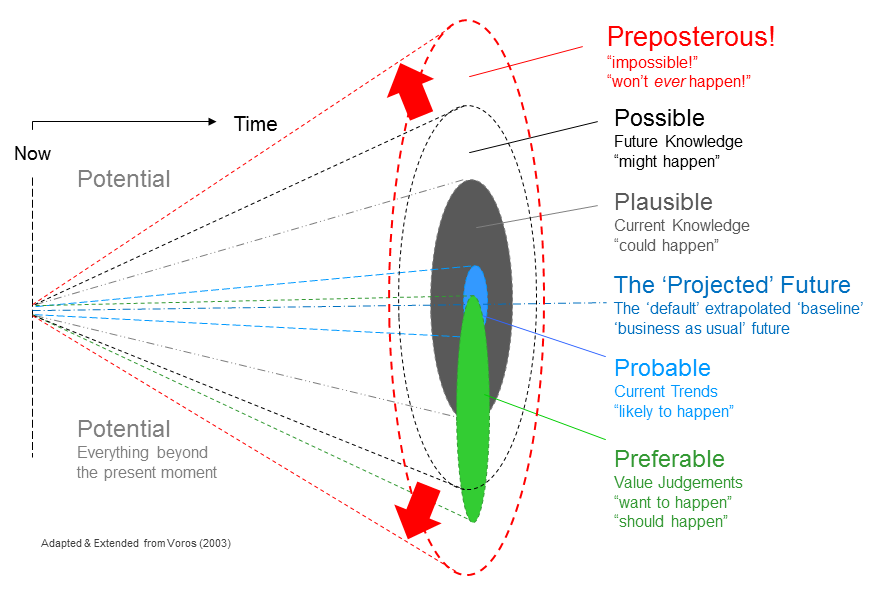
How the Cone Works
The narrowest point is now. As the cone extends outward through time, it widens to reveal different regions of possible futures, each defined by how much disruption or change would be required to bring them about:
Projected futures — the baseline; what happens if nothing changes
Probable futures — where current trends are pointing
Plausible futures — what could happen given known forces and trajectories
Possible futures — speculative, requiring future knowledge we don't yet have
Preposterous futures — the outer edge; scenarios that challenge our deepest assumptions about what is physically or socially feasible
Threaded through all of these is the Preferable future — not a separate ring, but a cross-section that asks: given everything in this cone, what do we actually want? Where do our values point?
The Dator-Clarke Line
One of the most provocative ideas associated with the cone is what's referred to as the Dator-Clarke Line — drawn from futurist James Dator's claim that any genuinely useful idea about the future should, at first glance, appear ridiculous. Paired with Arthur C. Clarke's observation that the only way to find the limits of the possible is to push into the impossible, it suggests that the most valuable futures work happens precisely in the uncomfortable space at the edge of the cone.
The practical implication is significant: if every idea your team generates sounds reasonable, you probably haven't stretched far enough. The preposterous isn't a failure of imagination — it's a boundary worth exploring.
Why This Tool Matters Now
In a period defined by technological acceleration, geopolitical uncertainty, and rapid social change, the instinct to "project forward" can feel reassuring — but it's also where strategic blind spots form. The Futures Cone doesn't resolve that uncertainty. Instead, it gives individuals, teams, and organizations a shared language for navigating it: a structured way to ask not just "what will happen?" but "what could happen, what might we prefer, and what are we willing to do about it?"
This is the subject of Episode 74 of Modem Futura, in which we walk through the cone layer by layer — and then demonstrate it live with a thought experiment that starts with frogs and ends somewhere near the moons of Jupiter.
Subscribe and Connect!
Subscribe to Modem Futura wherever you get your podcasts and connect with us on LinkedIn. Drop a comment, pose a question, or challenge an idea—because the future isn’t something we watch happen, it’s something we build together. The medium may still be the massage, but we all have a hand in shaping how it touches tomorrow.
🎧 Apple Podcast: https://apple.co/4bz1tIC
🎧 Spotify: https://open.spotify.com/episode/20Hz36eLfZ90M6EifUrRuu?si=swNkzHWZSLCelVSKsAyj7A
📺 YouTube: https://youtu.be/wc_e3dsY-vw
🌐 Website: https://www.modemfutura.com/
Thriving with AI: Two Futures Thinking Tools for Navigating Uncertainty
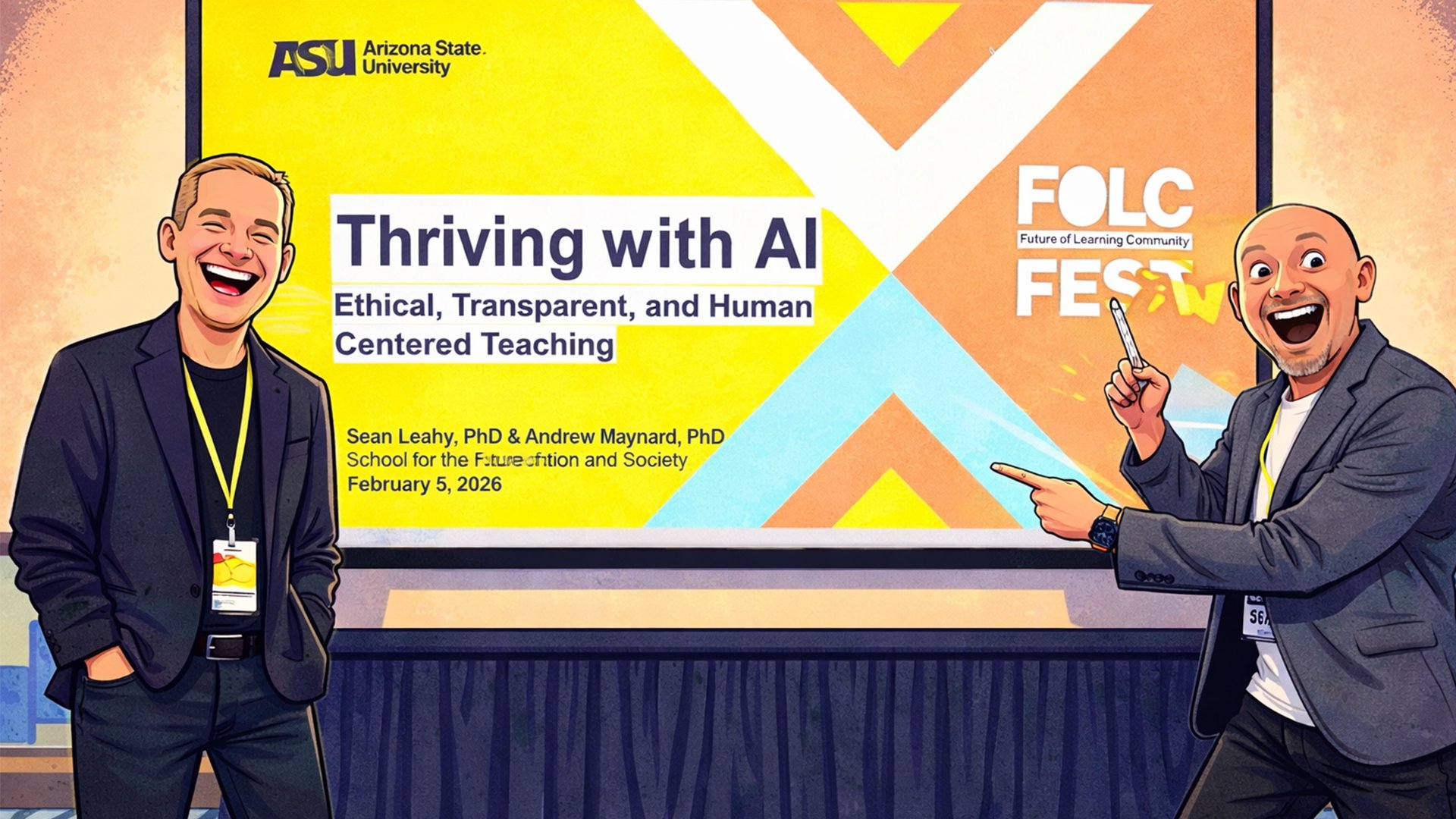
The question is no longer whether AI will reshape education. It already has. The more interesting question — and the harder one — is how educators, leaders, and institutions can navigate that transformation with clarity, purpose, and agency.
In this episode of Modem Futura, hosts Sean Leahy and Andrew Maynard walk listeners through a workshop they developed for ASU's 2026 Folk Fest titled "Thriving with AI: Ethical, Transparent, and Human-Centered Learning." Rather than demonstrating AI platforms or advocating for a particular stance, the session offers two practical thinking tools designed to help individuals make sense of complexity and make intentional decisions — regardless of where they fall on the AI adoption spectrum.
Foresight Methodologies
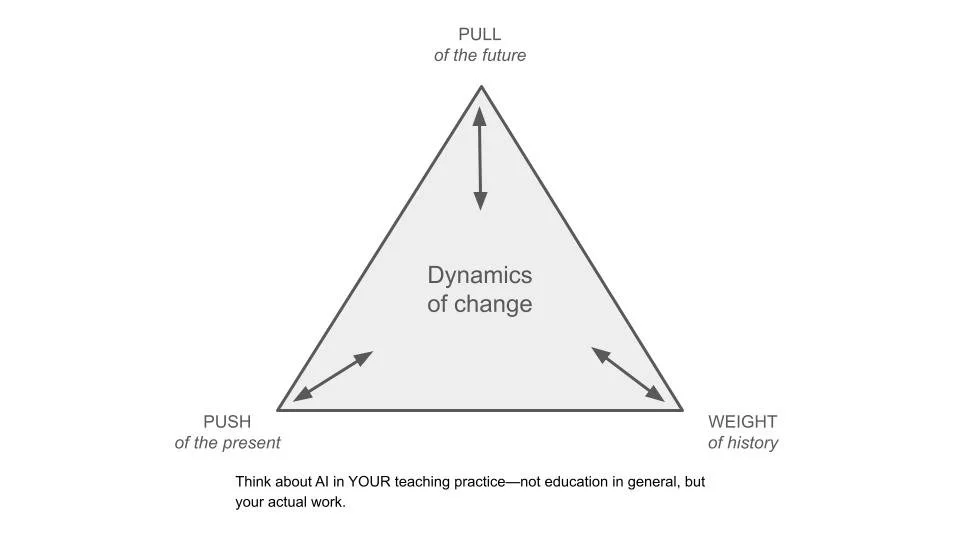
The Futures Triangle, originally developed by futurist Sohail Inayatullah, is a foresight method that maps three forces shaping any change landscape: the pull of the future (emerging visions and possibilities), the push of the present (trends, pressures, and mandates driving change), and the weight of history (the traditions, values, and institutional structures that resist or ground that change). By making these forces visible, individuals and teams can better orient themselves within the dynamics of change rather than simply reacting to them.
The Intent Map, drawn from Jefferey Abbott and Andrew Maynard's book AI and the Art of Being Human, complements the triangle by shifting from orientation to action. A simple two-by-two matrix, it asks users to identify four elements: their core values (what they won't compromise), their desired outcomes (what success looks like), their guardrails (the hard boundaries they won't cross), and their metrics (how they'll know if it's working). Critically, the framework recognizes that metrics don't have to be numerical — sometimes the most meaningful indicators of success are qualitative, like a student who can't stop thinking about what they learned.
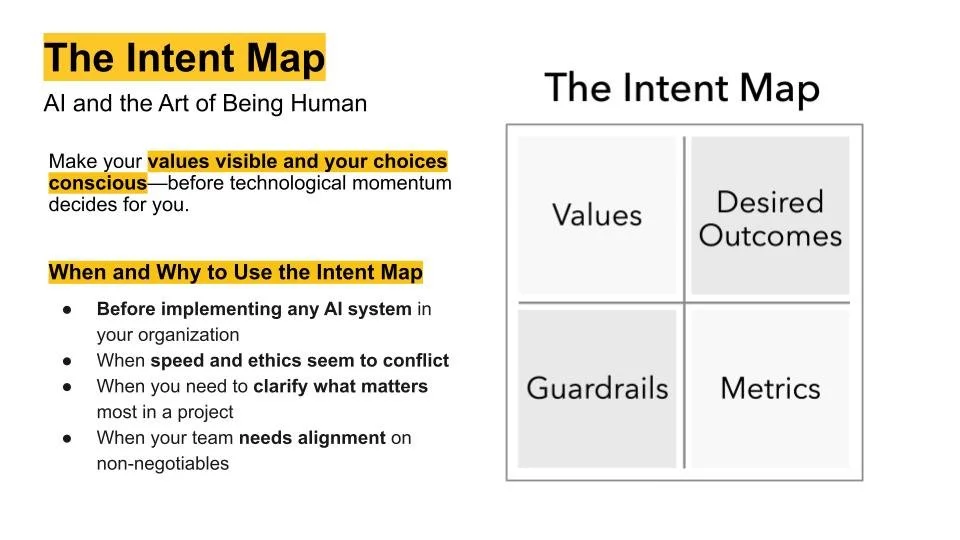
What makes these tools particularly valuable is their accessibility. Both can be sketched on a scrap of paper. Both work for individuals and teams. And both are domain-agnostic — while the episode frames them in the context of education, they apply equally well to organizational strategy, technology adoption, and personal decision-making.
The episode is anchored by two provocative 2035 headlines: one in which AI tutors outperform human teachers and faculty roles come under review, and another in which human-AI partnership produces the most critically thinking generation in history. The question the workshop poses isn't which headline is more likely. It's which one you want — and what intentional choices you need to make to move toward it.
Thriving with AI, as the hosts frame it, isn't about mastering the latest platform. It's about staying awake to what matters.
Subscribe and Connect!
Subscribe to Modem Futura wherever you get your podcasts and connect with us on LinkedIn. Drop a comment, pose a question, or challenge an idea—because the future isn’t something we watch happen, it’s something we build together. The medium may still be the massage, but we all have a hand in shaping how it touches tomorrow.
🎧 Apple Podcast: https://apple.co/3ZXgT2P
🎧 Spotify: https://open.spotify.com/episode/1b1Q0W7YVSGZA2ELYj6g6C?si=wL1sXb-DQsSluBkLYCu9tg
📺 YouTube: https://youtu.be/zi_zvXCt9sY
🌐 Website: https://www.modemfutura.com/

We Turned One - plus Liquid Media, Work Slop, and the Road Ahead – Episode 53
Year One, Human First: How We’re Building a Relational Future Podcast
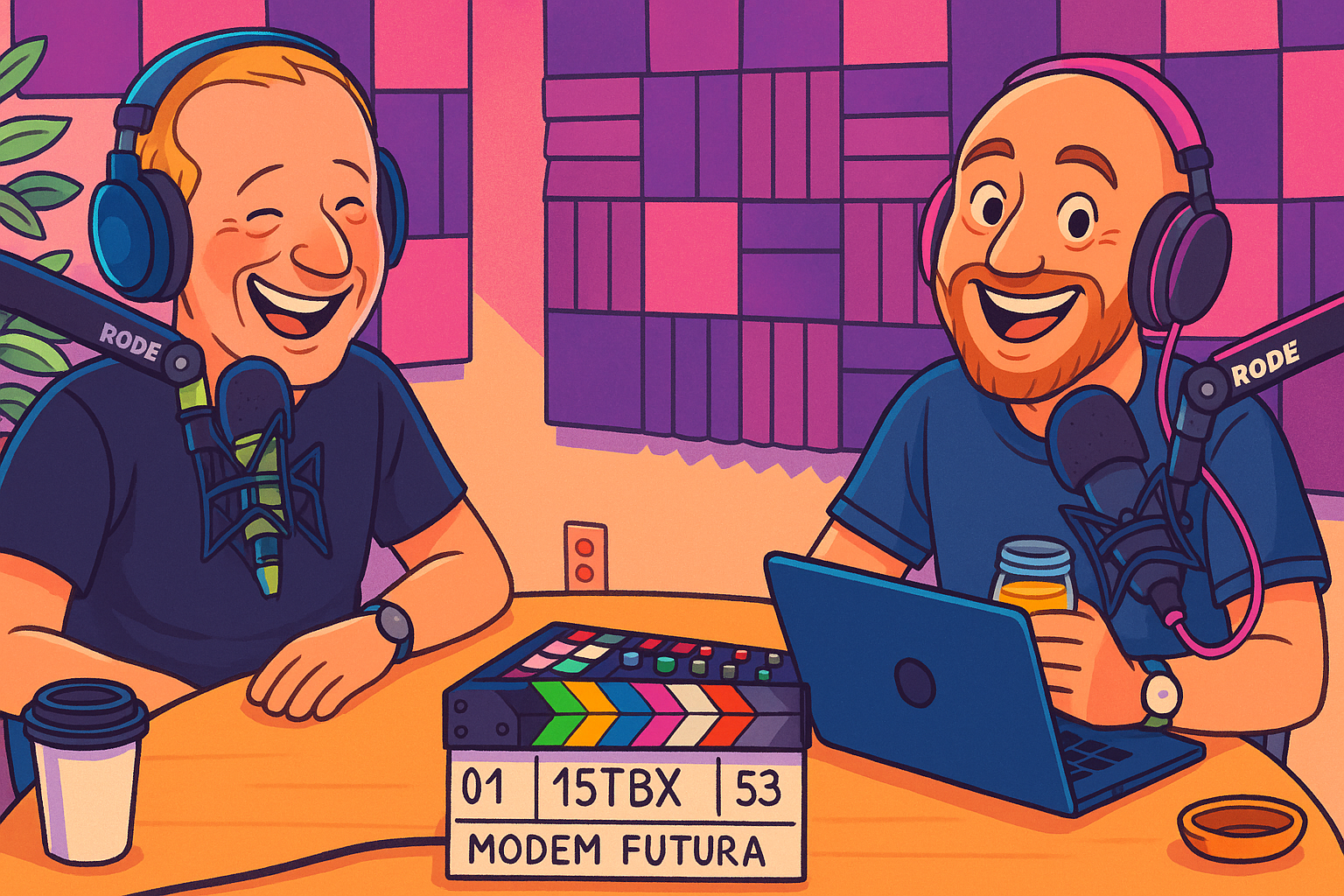
When ChatGPT thinks you run a podcast gameshow - this is how it draws you ;)
Fifty‑two straight weeks, many guests, and countless “aha” moments later, Modem Futura just turned one. Instead of a victory lap, we used this episode to do what we always do: invite you into the studio while we make sense of the future—together.
From day one we set out to be relational rather than transactional. That means no polished lectures and no sugar‑coated takes. It means showing our work, making space for genuine curiosity, and trusting that a community grows when people feel like they’ve pulled up a chair at the table. Over the past year, that approach has taken us everywhere—from AI and AGI to bio‑hybrid robots, simulation hypotheses, autonomous mobility (including a Waymo ride‑along), space futures, and media theory, just to scratch the top of the list. Listeners have told us they’re using episodes to kick off team discussions, and yes, we’re even astronaut approved! (Thanks Cady). That’s rocket fuel!
This anniversary episode isn’t just about reflections we also look ahead. We probe “liquid media”—from tools like NotebookLM to Huxe’s 24/7 AI‑generated radio—and ask where convenience ends and exhaustion begins. We talk about “work slop,” the plausible‑sounding but soulless output AI can slip into workflows, and the hidden cognitive tax leaders pay to verify it. And to keep futures thinking playful, we run a “Futures Improv” lightning round: AI pets smarter than real ones? Brain‑to‑brain headbands at work? Meditation‑mandated robotaxis? Jurassic Park on the Moon? The point isn’t to predict perfectly—it’s to stretch how we think so we can exercise our radical creativity. (Maybe this should become a reoccurring segment? - I’ll need to craft up a quick theme song I think… )
What’s on the calendar for next year? Expect deeper dives into human‑centered AI, experiments with spatial and wearable interfaces (Vision Pro, Meta’s glasses), and conversations that foreground care—for people, institutions, and futures worth having. And as Andrew’s new book AI and the Art of Being Human lands, we’ll keep exploring how technology can amplify, not erode, what makes us…us.
Join us:
Listen to the anniversary episode and subscribe on your favorite app
Comment with one idea we should explore next—or what we should put in the “empty chair” on non‑guest weeks
If the show sparked a conversation where you work, tell us how. We’ll highlight examples in a future episode.
If you believe better futures are built through candid, caring conversation, you’re in the right place.
Subscribe and Connect!
Subscribe to Modem Futura on a favorite podcast platform, follow on LinkedIn, and join the conversation by sharing thoughts and questions. The medium may still be the massage, but everyone has a chance to shape how it kneads modern culture—and to decide what kind of global village we ultimately build.
🎧 Apple Podcast: https://apple.co/48oB1QS
🎧 Spotify: https://open.spotify.com/episode/1H29Q1LnP8oL7LER1gS6wa?si=5j97IKzGSjGJFlZSQMS-hg
📺 YouTube: https://youtu.be/FX0DmYgIe0w
🌐 Website: https://www.modemfutura.com/

Ice to Water - Exploring Biotechnology through Virtual Reality

It was an honor to present this paper, Ice to water: Exploring biotechnology through virtual reality at the 35th EdMedia + Innovate Learning Conference (by AACE) in Vienna Austria this week. A special thank you to my co-authors for their hard work and contributions to the paper (Ahbi and Mustafa!).
Ice to water: Exploring biotechnology through virtual reality
(Sean Leahy, Mustafa Demir, & Abhishek Singharoy)
Paper Abstract
The BioSense Network has developed a new generation of a virtual computational microscope using virtual reality (VR) to bring the wonders of the microscopic world of biotechnology to a mainstream audience. Funded by the U.S. Department of Defense National Defense Education Program (DOD NDEP), the BioSense Network aims to build sustainable biotechnology programs for middle and high schools by redefining the approach to biotechnology learning in the K-12 environment enabling learners to experience the behavior and interactions of molecules in a simulated first-hand experience in virtual reality.
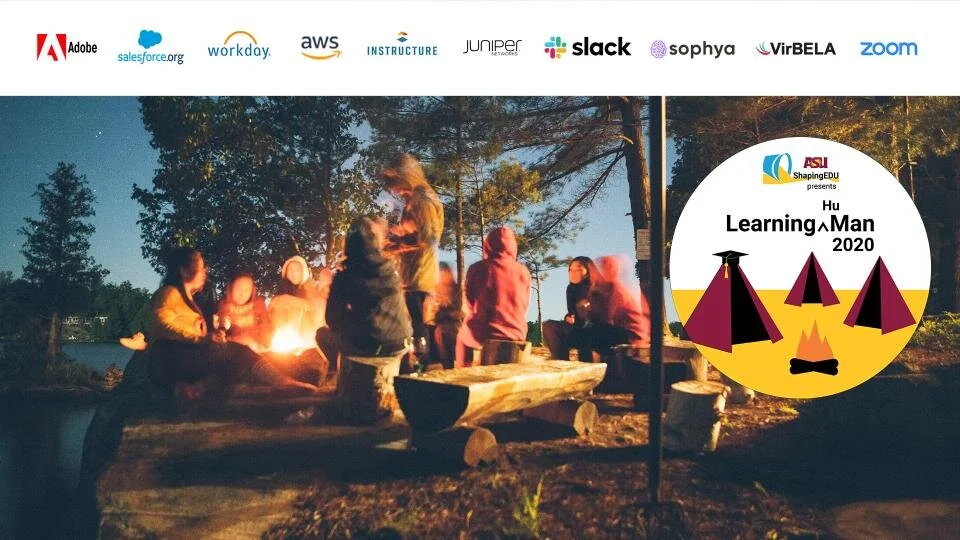
Learning (Hu)Man
Around the Flagpole: The What, Why, and How of Learner-Centered Everything
Well campers… thats a wrap!
With the end of Learning(Hu)Man today, I’m reminded of how fun this event was. It was a real pleasure to not only present, but to moderate this amazing panel. It was interesting to see how various organizations have been building experiences with students at the center. Specifically, it was interesting to hear the approach of Instructure, the owners of CMS platform Canvas, and how their approach to creating spaces for students aligns with the work from ASU and Michigan State University.
Perhaps most impressive, was the inclusion of our students Sabrina in this panel. She brought the much needed student perspective to this panel all about center-role of students in the development of learning experiences.
A major thanks to Laura for organizing this session and the invitation to moderate.
“If it’s not in service of learners, then who is it serving?”

Multiple ways to connect - a virtual experience
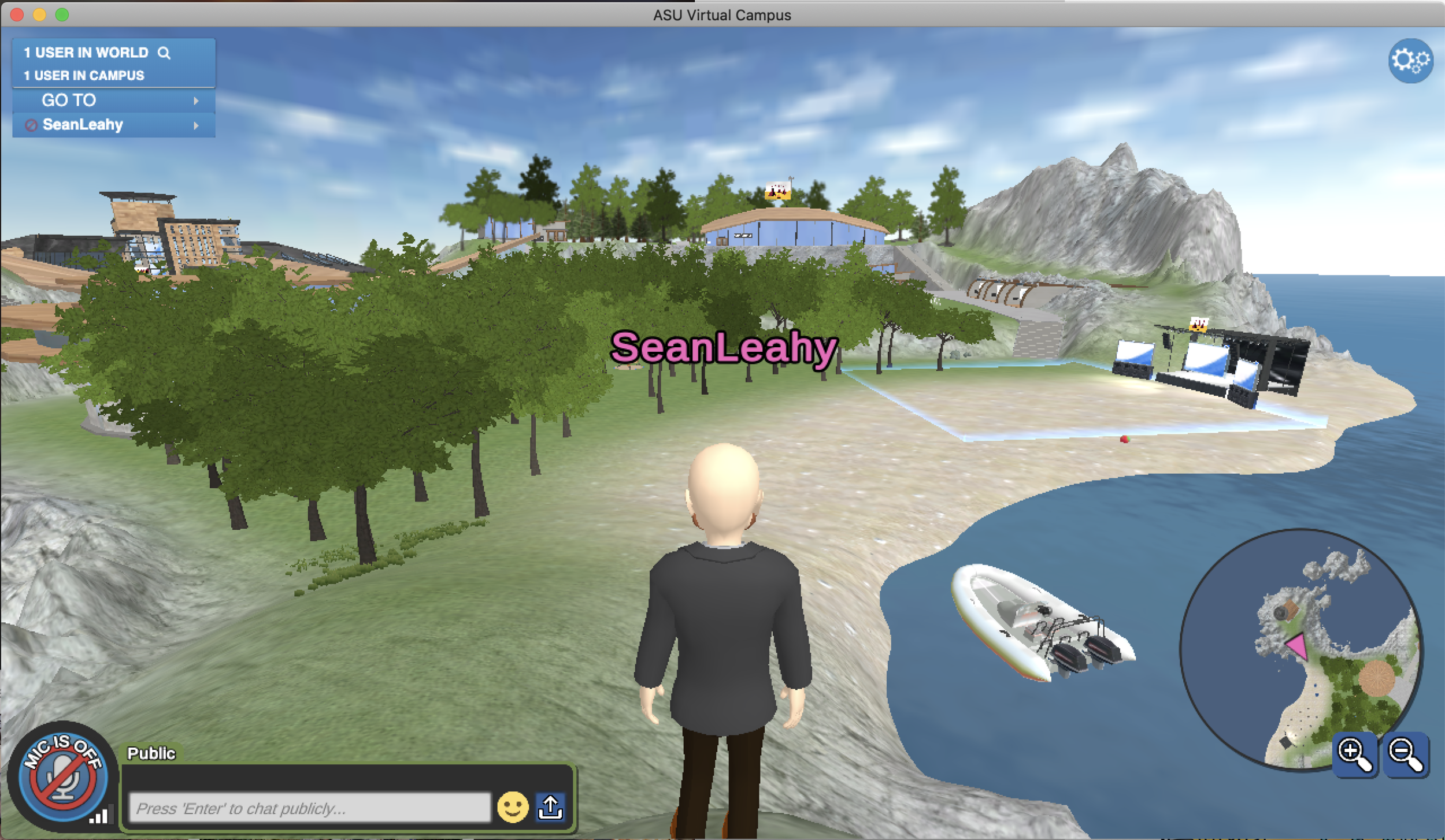
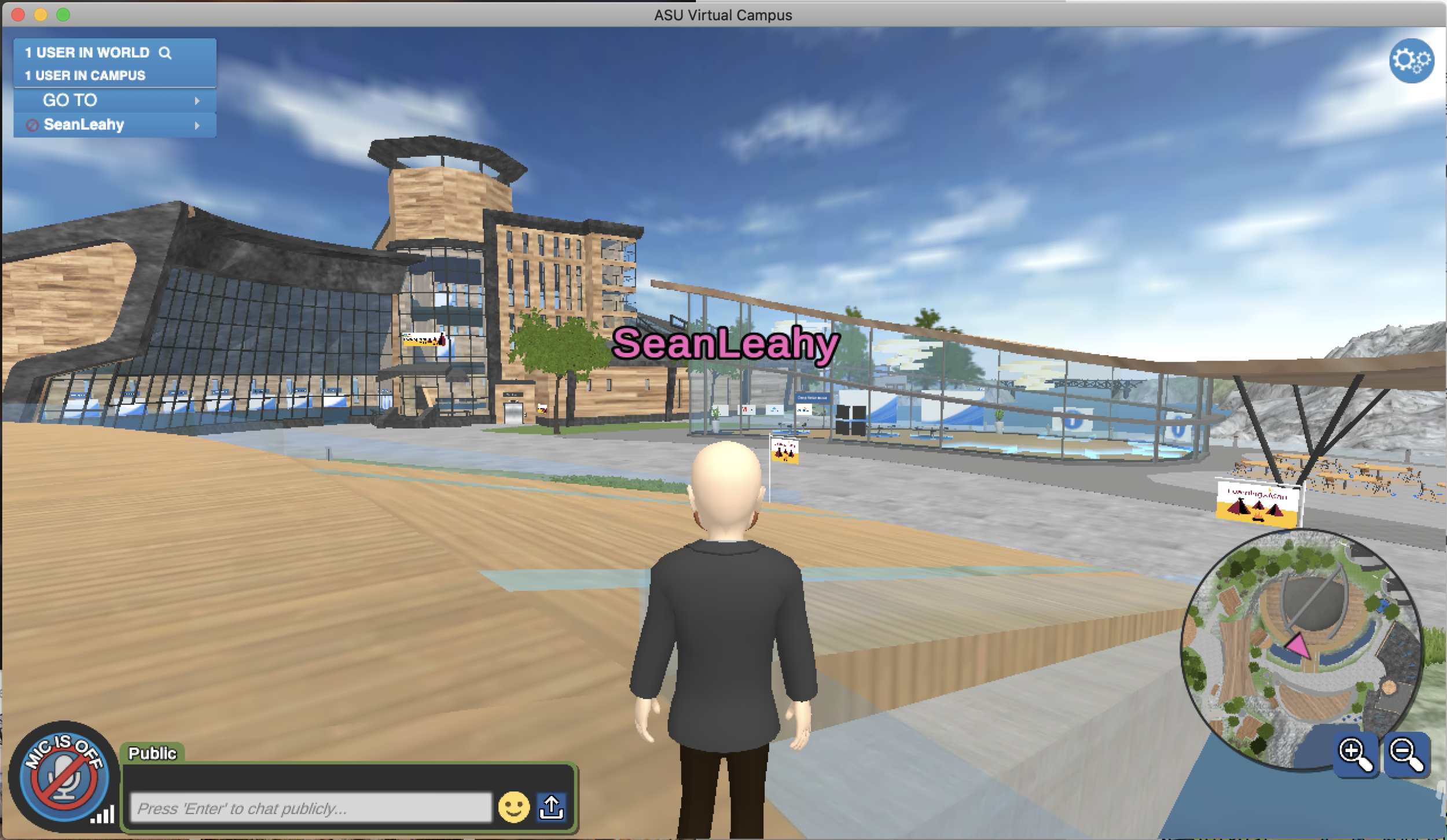
While the online camp experience had several ways to connect, web streaming, Zoom, the organizers also provided a unique way to get more immersed in the ‘virtual’ environment through a virtual Second Life-esque experience called VirBELA. I thought this was a really compelling way to try and reach a deeper level of immersion while participating in the event remotely.

Reflections - Powered by Illustration

One of the fun elements of participating in events hosted and run out of the ShapingEDU community and ASU UTO - is the always present graphic illustrators who capture the conversations (big and small) and create these rich assets that capture the spirit and energy of the events.
Looking forward to returning to camp next summer!

A Slice of PI Podcast Appearance: IgnitED Labs Part 1
The IgnitED Labs are creative spaces where users can explore and play with new and emerging technologies that can serve a role in teaching and learning. We sat down with Dr. Sean Leahy, Director of Technology Initiatives, and Jodie Donner, Lead Technology Strategist and Head of IgnitED Labs, to talk about the design and creation of the labs here at MLFTC. This is part one of our conversation.
Recently, Jodie and myself were asked to do an interview with the newly launched Slice of PI Podcast that is produced out of our college. It was a great conversation, and to be honest, I think we talked so much that Claire and Hannah (hosts) had to split this into two parts.
It was a lot of fun to share and discuss all of the hard work and collaboration that has gone into creating the innovative IgnitED Labs.
Have a listen, if you like what you hear, subscribe to Slice of PI wherever you get your podcasts…

Unconference: Dreamers Doers & Drivers of the Future of Learning

On April 25-27, 2018 I joined a small group of higher education change-makers for an unconference around the "Future of Learning in a Digital Age" in Scottsdale Arizona. The Conference was structured loosely around three main tracks: 1) Research to Action, 2) Mixed Reality Environments and Student Centered Learning Frontiers, and 3) Organizational Network Models.
“An unconference, also called an Open Space conference, is a participant-driven meeting. The term “unconference” has been applied, or self-applied, to a wide range of gatherings that try to avoid one or more aspects of a conventional conference, such as fees, sponsored presentations, and top-down organization.”
The unconference structure of this convening allowed for a free (open) conversational flow with loads of great ideas (big and small) and a variety of perspectives on the emerging themes. While there were many high energy "neighborhoods" of discussion, I was particularly drawn to the discussions around Mixed Reality and discussion around use, deployment, contextual relevance, and scalability within the context of one-three-five years. Additionally, on the last day of the unconference I was engaged in conversations around the growing desire and challenges of Micro Credentialing.
Throughout the event participants used the Twitter hashtag #shapingEDU to share the ideas and connections from the unconference with the intention of continuing the conversation long after the two day event was completed.

The event (including presentations and discussions and share-outs) was captured via graphic facilitator. The full unconference is available at: https://uto.asu.edu/shapingedu where you can access all of the images and files shared.
I am very much looking forward to continuing the discussions around the future of learning in the digital age.