

NEWS & UPDATES

The Jagged Frontier: Reading the 2026 Stanford AI Index

Every year, Stanford's Human-Centered AI Institute releases its AI Index — a careful, voluminous attempt to map where artificial intelligence actually stands. The 2026 edition, just released, runs over 400 pages. On the newest episode of Modem Futura, Sean Leahy and Andrew Maynard work their way through its top takeaways and sit with what the data is — and isn't — telling us.
The report opens on a striking juxtaposition. Today's frontier AI models can win gold medals at the International Mathematical Olympiad, yet still stumble on tasks as ordinary as reading an analog clock. Stanford's researchers call this the jagged frontier of AI — and it's more than a quirk. It's a reminder that these systems are not human intelligences being perfected. They are something structurally different, with capabilities and failure modes that don't map neatly onto ours. The interesting question isn't how close AI gets to human thinking. It's what becomes possible when we stop asking it to.
A second thread running through the 2026 Index is the lag in responsible AI. Safety benchmarks are falling behind capability. Incidents are rising. And, as Maynard points out in the episode, the conversation keeps collapsing “responsible” AI into “ethical” AI — two related but meaningfully different things. Ethics gives us the framing. Responsibility asks us to make real, pragmatic, often messy decisions about value, trade-offs, and whose futures we're building toward.
The education findings are equally hard to look away from. Over 80% of students are now using AI for school-related tasks, yet only half of middle and high schools have AI policies in place — and just 6% of teachers describe those policies as clear. Learning is happening. Institutional support is not yet meeting it.
Other findings threaded through the conversation: the closing US–China model performance gap, the fragile TSMC chokepoint at the center of global AI supply chains, and the fifty-point perception gap between AI experts and the public. Each opens a different kind of question about how this technology is being built, distributed, and absorbed.
None of these tensions resolve cleanly — and that's part of what makes the Index valuable. It gives us a shared map for a landscape that keeps shifting under our feet.
📘 Read the 2026 AI Index: https://hai.stanford.edu
Subscribe and Connect!
Subscribe to Modem Futura wherever you get your podcasts and connect with us on LinkedIn. Drop a comment, pose a question, or challenge an idea—because the future isn’t something we watch happen, it’s something we build together. The medium may still be the massage, but we all have a hand in shaping how it touches tomorrow.
🎧 Apple Podcast: https://apple.co/3QxxQiZ
🎧 Spotify: https://open.spotify.com/episode/0bTUTHRsLWedLuYbLOiz3j?si=I8j0ahK8RBeXPIhVqqM9tw
📺 YouTube: https://youtu.be/xnCWMLJ_hsA
🌐 Website: https://www.modemfutura.com/

Thriving with AI: Two Futures Thinking Tools for Navigating Uncertainty
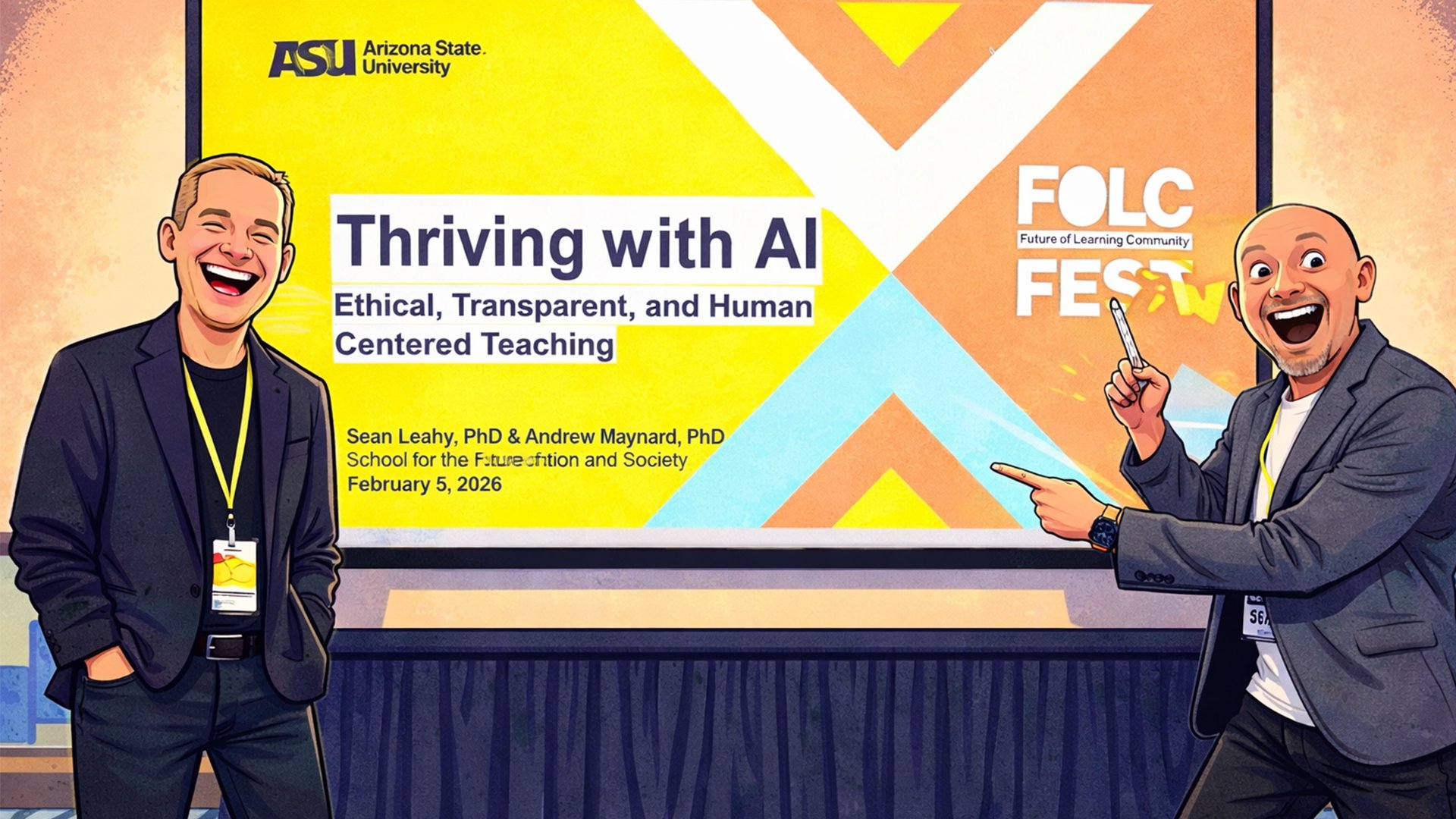
The question is no longer whether AI will reshape education. It already has. The more interesting question — and the harder one — is how educators, leaders, and institutions can navigate that transformation with clarity, purpose, and agency.
In this episode of Modem Futura, hosts Sean Leahy and Andrew Maynard walk listeners through a workshop they developed for ASU's 2026 Folk Fest titled "Thriving with AI: Ethical, Transparent, and Human-Centered Learning." Rather than demonstrating AI platforms or advocating for a particular stance, the session offers two practical thinking tools designed to help individuals make sense of complexity and make intentional decisions — regardless of where they fall on the AI adoption spectrum.
Foresight Methodologies
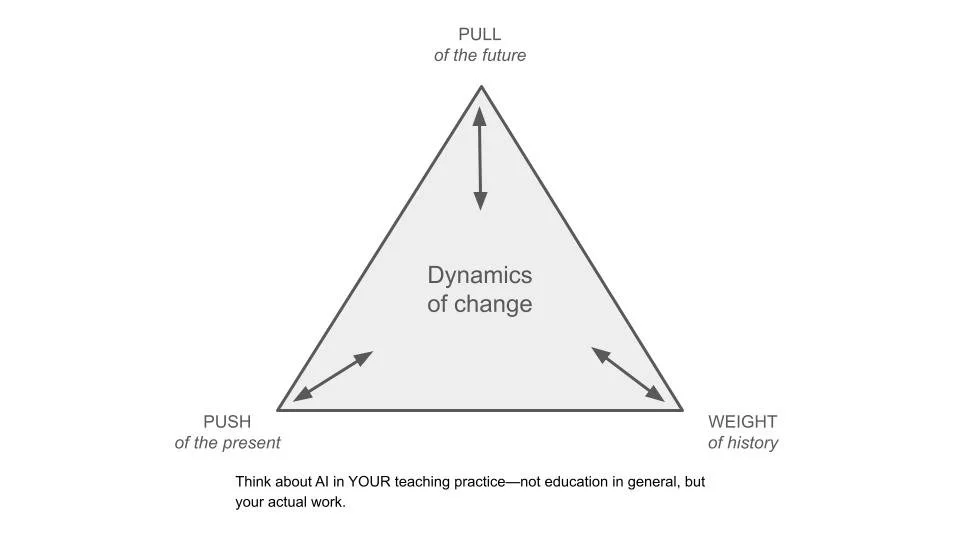
The Futures Triangle, originally developed by futurist Sohail Inayatullah, is a foresight method that maps three forces shaping any change landscape: the pull of the future (emerging visions and possibilities), the push of the present (trends, pressures, and mandates driving change), and the weight of history (the traditions, values, and institutional structures that resist or ground that change). By making these forces visible, individuals and teams can better orient themselves within the dynamics of change rather than simply reacting to them.
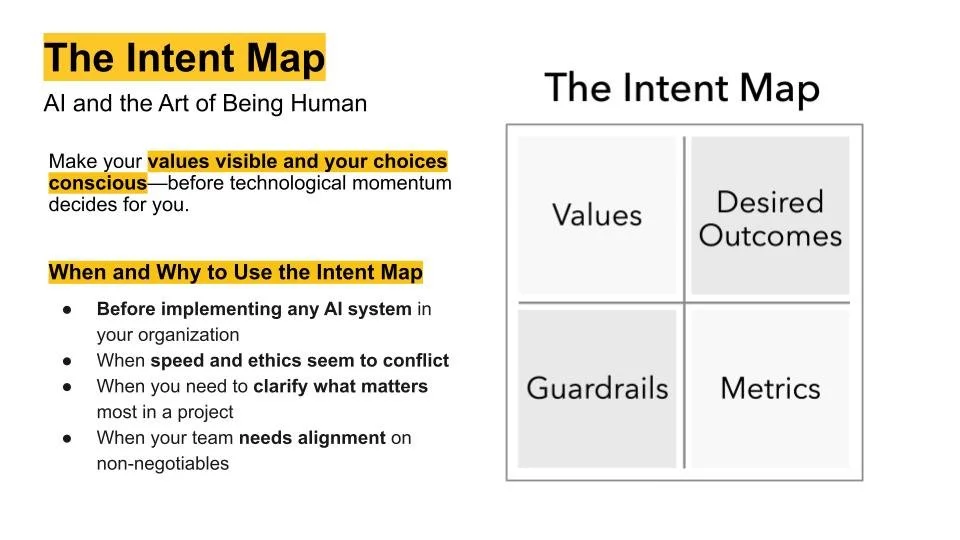
The Intent Map, drawn from Jefferey Abbott and Andrew Maynard's book AI and the Art of Being Human, complements the triangle by shifting from orientation to action. A simple two-by-two matrix, it asks users to identify four elements: their core values (what they won't compromise), their desired outcomes (what success looks like), their guardrails (the hard boundaries they won't cross), and their metrics (how they'll know if it's working). Critically, the framework recognizes that metrics don't have to be numerical — sometimes the most meaningful indicators of success are qualitative, like a student who can't stop thinking about what they learned.
What makes these tools particularly valuable is their accessibility. Both can be sketched on a scrap of paper. Both work for individuals and teams. And both are domain-agnostic — while the episode frames them in the context of education, they apply equally well to organizational strategy, technology adoption, and personal decision-making.
The episode is anchored by two provocative 2035 headlines: one in which AI tutors outperform human teachers and faculty roles come under review, and another in which human-AI partnership produces the most critically thinking generation in history. The question the workshop poses isn't which headline is more likely. It's which one you want — and what intentional choices you need to make to move toward it.
Thriving with AI, as the hosts frame it, isn't about mastering the latest platform. It's about staying awake to what matters.
Subscribe and Connect!
Subscribe to Modem Futura wherever you get your podcasts and connect with us on LinkedIn. Drop a comment, pose a question, or challenge an idea—because the future isn’t something we watch happen, it’s something we build together. The medium may still be the massage, but we all have a hand in shaping how it touches tomorrow.
🎧 Apple Podcast: https://apple.co/3ZXgT2P
🎧 Spotify: https://open.spotify.com/episode/1b1Q0W7YVSGZA2ELYj6g6C?si=wL1sXb-DQsSluBkLYCu9tg
📺 YouTube: https://youtu.be/zi_zvXCt9sY
🌐 Website: https://www.modemfutura.com/