

NEWS & UPDATES

Thriving with AI: Two Futures Thinking Tools for Navigating Uncertainty
The question is no longer whether AI will reshape education. It already has. The more interesting question — and the harder one — is how educators, leaders, and institutions can navigate that transformation with clarity, purpose, and agency.
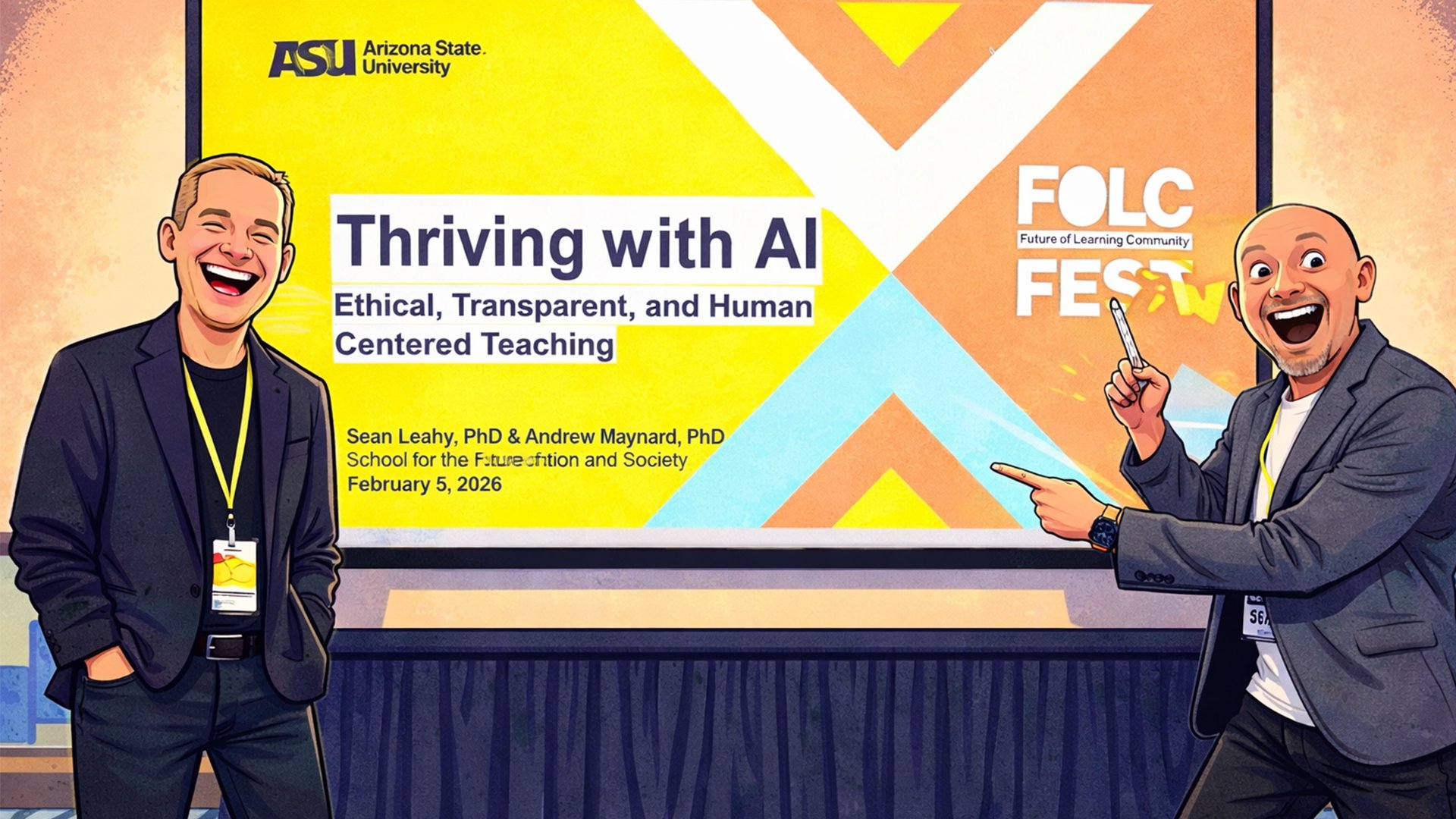
In this episode of Modem Futura, hosts Sean Leahy and Andrew Maynard walk listeners through a workshop they developed for ASU's 2026 Folk Fest titled "Thriving with AI: Ethical, Transparent, and Human-Centered Learning." Rather than demonstrating AI platforms or advocating for a particular stance, the session offers two practical thinking tools designed to help individuals make sense of complexity and make intentional decisions — regardless of where they fall on the AI adoption spectrum.
Foresight Methodologies
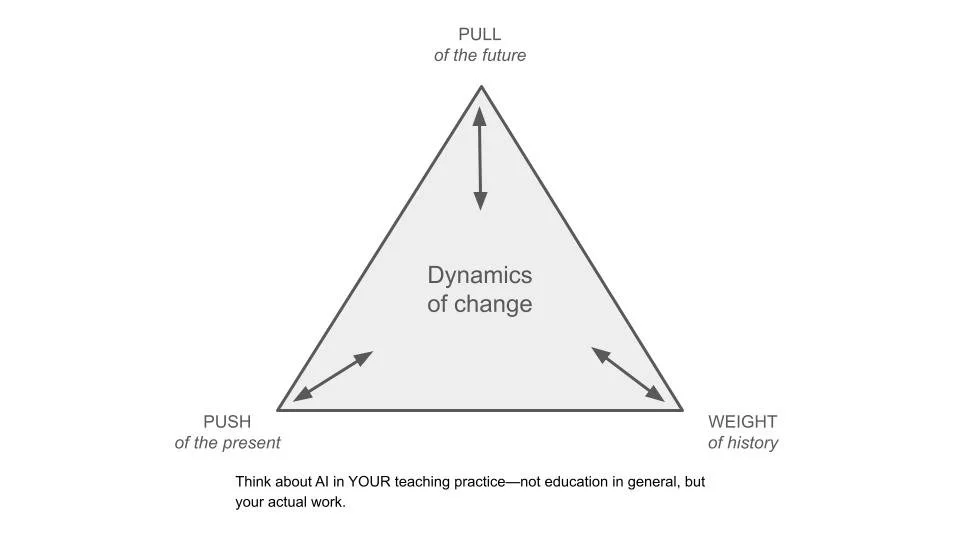
The Futures Triangle, originally developed by futurist Sohail Inayatullah, is a foresight method that maps three forces shaping any change landscape: the pull of the future (emerging visions and possibilities), the push of the present (trends, pressures, and mandates driving change), and the weight of history (the traditions, values, and institutional structures that resist or ground that change). By making these forces visible, individuals and teams can better orient themselves within the dynamics of change rather than simply reacting to them.
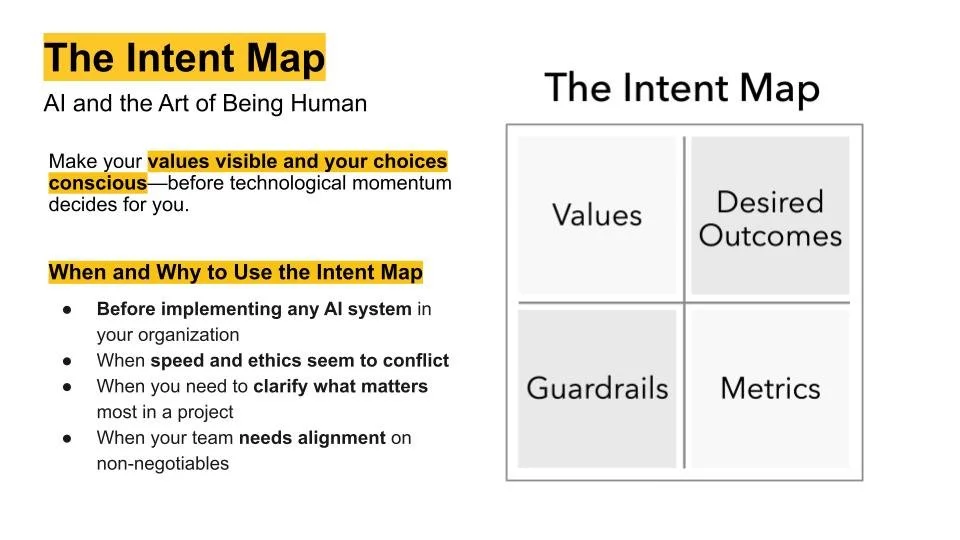
The Intent Map, drawn from Jefferey Abbott and Andrew Maynard's book AI and the Art of Being Human, complements the triangle by shifting from orientation to action. A simple two-by-two matrix, it asks users to identify four elements: their core values (what they won't compromise), their desired outcomes (what success looks like), their guardrails (the hard boundaries they won't cross), and their metrics (how they'll know if it's working). Critically, the framework recognizes that metrics don't have to be numerical — sometimes the most meaningful indicators of success are qualitative, like a student who can't stop thinking about what they learned.
What makes these tools particularly valuable is their accessibility. Both can be sketched on a scrap of paper. Both work for individuals and teams. And both are domain-agnostic — while the episode frames them in the context of education, they apply equally well to organizational strategy, technology adoption, and personal decision-making.
The episode is anchored by two provocative 2035 headlines: one in which AI tutors outperform human teachers and faculty roles come under review, and another in which human-AI partnership produces the most critically thinking generation in history. The question the workshop poses isn't which headline is more likely. It's which one you want — and what intentional choices you need to make to move toward it.
Thriving with AI, as the hosts frame it, isn't about mastering the latest platform. It's about staying awake to what matters.
Subscribe and Connect!
Subscribe to Modem Futura wherever you get your podcasts and connect with us on LinkedIn. Drop a comment, pose a question, or challenge an idea—because the future isn’t something we watch happen, it’s something we build together. The medium may still be the massage, but we all have a hand in shaping how it touches tomorrow.
🎧 Apple Podcast: https://apple.co/3ZXgT2P
🎧 Spotify: https://open.spotify.com/episode/1b1Q0W7YVSGZA2ELYj6g6C?si=wL1sXb-DQsSluBkLYCu9tg
📺 YouTube: https://youtu.be/zi_zvXCt9sY
🌐 Website: https://www.modemfutura.com/

Futures of Learning: AI in Education with Punya Mishra – Episode 33

Friction Required: How will a world transformed by emerging technologies like AI reshape the world? Sean Leahy,Andrew Maynard and special guest Punya Mishra cut through the hype to reveal the creative tension, hidden risks, and big-picture futures for AI-powered, human-centered education. How can the power of AI be harnessed without losing the soul of learning?
Friction Required: Re-imagining Learning in an AI World
Generative AI burst onto campuses promising personalized tutoring, instant lesson plans, and anytime feedback. Yet beneath the buzz lies a more provocative question: What, exactly, makes education worth the effort once answers are a prompt away? In this week’s Modem Futura, hosts Sean Leahy and Andrew Maynard sit down with educator-innovatorDr. Punya Mishra to look past the shiny tools and into the messy, human heart of learning.
🎧 Listen on Apple Podcasts: https://apple.co/3ZDH8vg
📺 Watch us on YouTube: https://www.youtube.com/@ModemFutura
Over an energetic hour they explore why purposeful “friction”—the struggle, inquiry, and face-to-face negotiation of meaning—is still essential. Punya and Sean draw on John Dewey’s four impulses—Inquiry, Communication, Construction, Expression—as a compass for designing AI-infused classrooms that amplify (rather than automate) these deep-learning moments. The trio swap stories of chatbots that spark creativity, debate whether banning tools curbs cheating or curiosity, and ask whether transparency beats top-down rules when it comes to academic integrity.
But the conversation zooms further out. What happens when large language models become persuasive co-teachers? Could Universal Basic Income turn learning into a lifelong pursuit instead of a credentialing race? And might universities act as society’s “flywheel”—a deliberate drag that buys time to think before technology rewrites the rules? The answers aren’t neat, yet they underscore a shared conviction: the future of education must be AI-powered and human-centered.
Key Takeaways
Friction is a feature, not a bug. Struggle fosters agency, resilience, and creativity—qualities that instant answers risk eroding.
Design for Dewey’s impulses. Use AI to scaffold inquiry, amplify student expression, and make thinking visible, not to short-circuit it.
Radical transparency > blanket bans. Open dialog about capabilities, limitations, and ethics beats whack-a-mole policies.
Cheating vs. caring. Focus on cultivating authentic motivation; surveillance tech alone can’t fix a trust gap.
Universities as sandboxes and speed-bumps. Higher ed can prototype responsible uses and slow premature adoption that harms society.
Whether you’re an instructor drafting next semester’s syllabus, a student exploring new creative tools, or a policymaker worried about the automation of learning, this episode offers frameworks—and questions—to keep humans at the center of the AI revolution.
🎧 Ready for the full conversation? Click below to listen or watch, then let us know how you’re embracing (or resisting) AI in your own learning spaces. And if the discussion sparks ideas, consider sharing this newsletter with a colleague—friction loves company!
If you’d like to dive deeper, jump into the link and listen to the podcast or watch the YouTube video. Join us as we explore the forces shaping our collective future and the urgent need to keep human values at the heart of innovation.

Subscribe and Connect!
Subscribe to Modem Futura on a favorite podcast platform, follow on LinkedIn, and join the conversation by sharing thoughts and questions. The medium may still be the massage, but everyone has a chance to shape how it kneads modern culture—and to decide what kind of global village we ultimately build.
🎧 Podcast: https://apple.co/3ZDH8vg
📺 YouTube: https://www.youtube.com/@ModemFutura