

NEWS & UPDATES

Asimov's "The Fun They Had" and the Real Cost of AI-Driven Education
The History of our Future
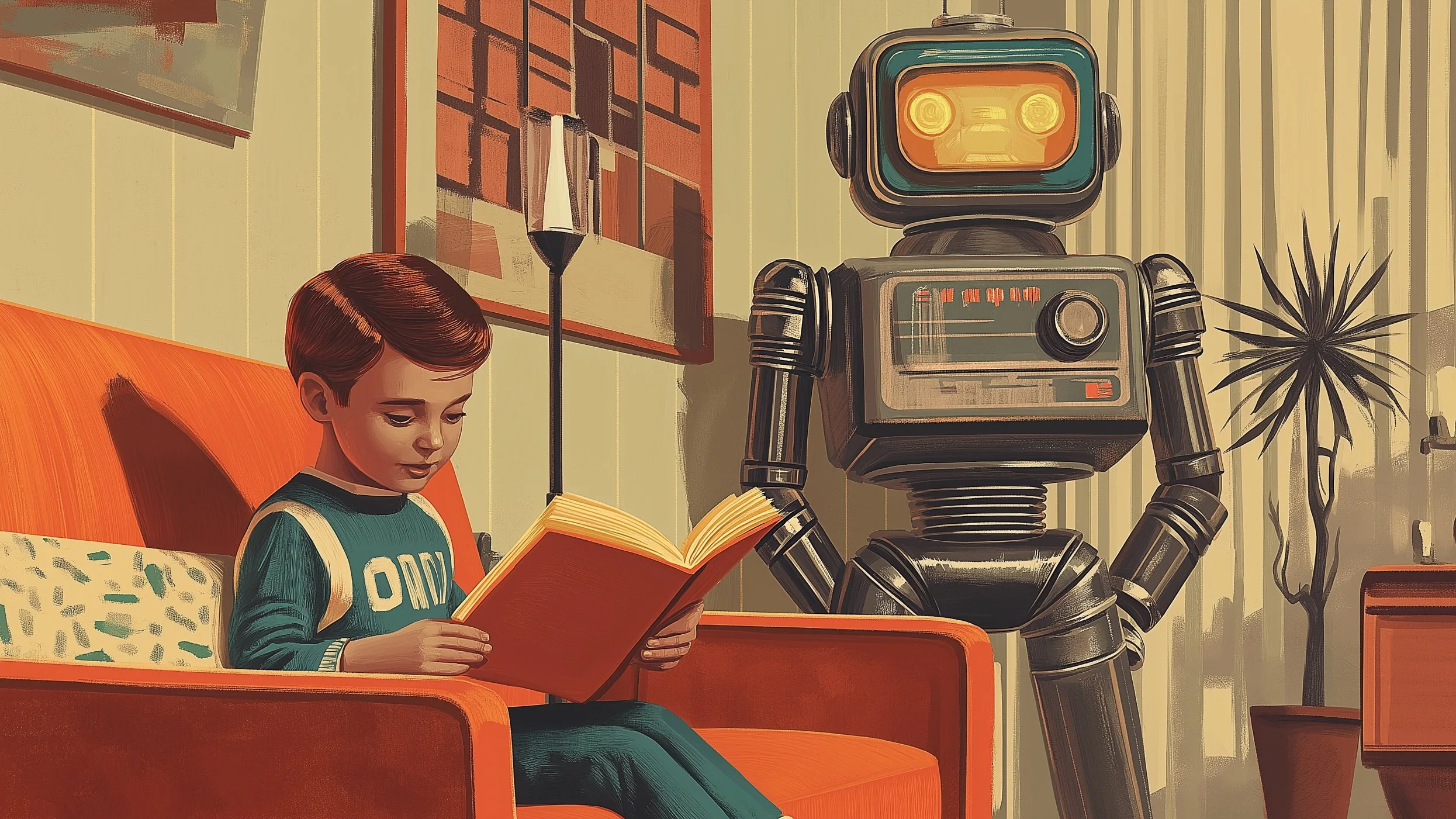
More than seventy years ago, Isaac Asimov imagined a future where children learn in isolation, guided by personalized mechanical tutors, and books are relics of a forgotten age. His 1951 short story, "The Fun They Had," is set in 2155, but its questions feel startlingly current.
In the story, a young girl named Margie discovers a paper book and learns about a time when children went to school together—sat in classrooms, were taught by human teachers, and shared the experience of learning with their peers. Her own education is efficient, personalized, and lonely. Her mechanical teacher can diagnose her struggles and recalibrate its approach, but it cannot inspire her, connect with her, or make her feel like she belongs to something larger than a lesson plan.
“Asimov didn’t predict AI as we know it. But he predicted the question that matters most: in our rush to optimize education, are we designing out the very things that make learning meaningful?
”
This is precisely the tension at the heart of today's conversation about AI in education. The promise of AI-powered tutors is real and, in many cases, genuinely valuable: adaptive pacing, instant feedback, content tailored to individual needs. But when personalization becomes the dominant paradigm—when every learner is on a separate track, in a separate space, at a separate time—the communal dimensions of education begin to disappear.
Natural Human Impulses for Learning (not schooling)
John Dewey argued more than a century ago that learning is driven by four natural impulses: inquiry, communication, construction, and expression. Most of these are inherently social. They depend on friction, dialogue, surprise, and the presence of other people. No amount of algorithmic sophistication can fully replicate the moment a teacher's unexpected enthusiasm shifts a student's entire trajectory, or the experience of working through difficulty alongside peers who share the same struggle.
Asimov's story also raises a subtler question about what endures. The book Margie discovers has survived two centuries. The static words on the page—unchanging, tactile, physical—carry a kind of permanence that digital media cannot easily match. This resonates with the growing cultural appetite for analog experiences: vinyl records, film photography, even old iPods. These are not acts of technological rejection. They are expressions of a deeper need for embodied engagement, deliberate choice, and the kind of friction that gives experience its texture.
Where do we go next?
None of this means AI has no place in education. It does, and increasingly will. But Asimov's story is a quiet reminder that the most important things about learning—curiosity, connection, belonging, the joy of shared discovery—are not problems to be optimized. They are human experiences to be protected.
The question is not whether AI can teach us. It's whether, in building systems that teach us more efficiently, we are designing out the very things that made learning worth having in the first place.
*Episode 71 of Modem Futura explores these themes through Asimov's story and a wider conversation about technology, nostalgia, and what it means to learn as a human being.*
Subscribe and Connect!
Subscribe to Modem Futura wherever you get your podcasts and connect with us on LinkedIn. Drop a comment, pose a question, or challenge an idea—because the future isn’t something we watch happen, it’s something we build together. The medium may still be the massage, but we all have a hand in shaping how it touches tomorrow.
🎧 Apple Podcast: https://apple.co/4s1lDk1
🎧 Spotify: https://open.spotify.com/episode/20I5j2DliUnZAbWDiVw7y8?si=WoEW_Zb2SPiynHYb4d8XHA
📺 YouTube: https://youtu.be/TDQc15Muwto
🌐 Website: https://www.modemfutura.com/

Summer School with AI: Rethinking Learning in the Age of GPT – Episode 41

Summer School with AI: Why “Back to Basics” Isn’t Enough
Why this episode matters? If you’re charting strategy for schools, workforce development or lifelong learning, this discussion offers a candid roadmap—and a few provocative questions—for navigating the next decade of educational transformation.
This month on Modem Futura I welcomed Rachna Mathur, Ed.D. —engineer, artist, lifelong-learner and Senior STEM Strategist at ASU Preparatory Academy—to a scorching‑hot Arizona studio for a free‑flowing “summer session” on the future of learning in the age of generative AI.
Our conversation touches on many aspects of learning and AI, but laser in on the implications of living the “digital world” for learning, partially inspired from the headline that shocked many educators: Sweden’s decision to pull back from screens and re‑embrace handwriting and printed books after seeing declines in comprehension and critical‑thinking benchmarks. We explore the move as an important—but incomplete—signal. We arguee that the real challenge is finding a sustainable balance between analog depth and digital acceleration, not retreating wholesale from technology, and not leaning into a pure technological solution just for technologies sake.
The theme of moderation threads the entire episode. We swap Montessori childhood stories—self‑directed, community‑anchored, and surprisingly common among tech leaders—before examining how that philosophy might translate to AI‑rich classrooms where personalization risks isolation if community norms aren’t protected.
We then fast‑forward 50 years to imagine two stark futures: a post‑scarcity Star‑Trek‑style society of flourishing creativity, or the WALL‑E “hover‑chair” dystopia where humans outsource thinking, writing and even curiosity to autonomous agents. In both scenarios, today’s policy and design choices in K‑12 systems carve the path. Should we double‑down on foundational literacies—or teach students how to audit machine output for bias, hallucination and relevance?
We highlight the rising cognitive load on teachers, who are expected to master every “shiny new doodad” while still wearing a dozen other hats. We discuss realistic guardrails: cell‑phone moderation policies; AI readers that empower dyslexic learners; and iterative, living guidelines that evolve alongside the tech itself rather than one‑and‑done declarations.
Finally, we confront the looming content‑collapse problem (the recursive nightmare that may be building right in front of us): models now train on data increasingly generated by other models, a self‑referential “snake eating its own tail” that threatens originality and human perspective. Our shared conclusion? Educators, parents and technologists must collaborate on a middle path that preserves human agency, cultivates critical judgment, and leverages AI as an amplifier—not a crutch.
🎧 Listen on Apple Podcasts: https://apple.co/4o6LwOc
📺 Watch us on YouTube: https://www.youtube.com/@ModemFutura
If you’d like to dive deeper, jump into the link and listen to the podcast or watch the YouTube video. Join us as we explore the forces shaping our collective future and the urgent need to keep human values at the heart of innovation.
Subscribe and Connect!
Subscribe to Modem Futura on a favorite podcast platform, follow on LinkedIn, and join the conversation by sharing thoughts and questions. The medium may still be the massage, but everyone has a chance to shape how it kneads modern culture—and to decide what kind of global village we ultimately build.
🎧 Apple Podcast: https://apple.co/4o6LwOc
🎧 Spotify: https://open.spotify.com/episode/1E9LMkkOTYvTJVwlb6Ey0F?si=ADMbNGEWSUW-Jdx-h0oBsA
📺 YouTube: https://youtu.be/cvxHCJxahlg
🌐 Website: https://www.modemfutura.com/

Futures of Learning: AI in Education with Punya Mishra – Episode 33

Friction Required: How will a world transformed by emerging technologies like AI reshape the world? Sean Leahy,Andrew Maynard and special guest Punya Mishra cut through the hype to reveal the creative tension, hidden risks, and big-picture futures for AI-powered, human-centered education. How can the power of AI be harnessed without losing the soul of learning?
Friction Required: Re-imagining Learning in an AI World
Generative AI burst onto campuses promising personalized tutoring, instant lesson plans, and anytime feedback. Yet beneath the buzz lies a more provocative question: What, exactly, makes education worth the effort once answers are a prompt away? In this week’s Modem Futura, hosts Sean Leahy and Andrew Maynard sit down with educator-innovatorDr. Punya Mishra to look past the shiny tools and into the messy, human heart of learning.
🎧 Listen on Apple Podcasts: https://apple.co/3ZDH8vg
📺 Watch us on YouTube: https://www.youtube.com/@ModemFutura
Over an energetic hour they explore why purposeful “friction”—the struggle, inquiry, and face-to-face negotiation of meaning—is still essential. Punya and Sean draw on John Dewey’s four impulses—Inquiry, Communication, Construction, Expression—as a compass for designing AI-infused classrooms that amplify (rather than automate) these deep-learning moments. The trio swap stories of chatbots that spark creativity, debate whether banning tools curbs cheating or curiosity, and ask whether transparency beats top-down rules when it comes to academic integrity.
But the conversation zooms further out. What happens when large language models become persuasive co-teachers? Could Universal Basic Income turn learning into a lifelong pursuit instead of a credentialing race? And might universities act as society’s “flywheel”—a deliberate drag that buys time to think before technology rewrites the rules? The answers aren’t neat, yet they underscore a shared conviction: the future of education must be AI-powered and human-centered.
Key Takeaways
Friction is a feature, not a bug. Struggle fosters agency, resilience, and creativity—qualities that instant answers risk eroding.
Design for Dewey’s impulses. Use AI to scaffold inquiry, amplify student expression, and make thinking visible, not to short-circuit it.
Radical transparency > blanket bans. Open dialog about capabilities, limitations, and ethics beats whack-a-mole policies.
Cheating vs. caring. Focus on cultivating authentic motivation; surveillance tech alone can’t fix a trust gap.
Universities as sandboxes and speed-bumps. Higher ed can prototype responsible uses and slow premature adoption that harms society.
Whether you’re an instructor drafting next semester’s syllabus, a student exploring new creative tools, or a policymaker worried about the automation of learning, this episode offers frameworks—and questions—to keep humans at the center of the AI revolution.
🎧 Ready for the full conversation? Click below to listen or watch, then let us know how you’re embracing (or resisting) AI in your own learning spaces. And if the discussion sparks ideas, consider sharing this newsletter with a colleague—friction loves company!
If you’d like to dive deeper, jump into the link and listen to the podcast or watch the YouTube video. Join us as we explore the forces shaping our collective future and the urgent need to keep human values at the heart of innovation.

Subscribe and Connect!
Subscribe to Modem Futura on a favorite podcast platform, follow on LinkedIn, and join the conversation by sharing thoughts and questions. The medium may still be the massage, but everyone has a chance to shape how it kneads modern culture—and to decide what kind of global village we ultimately build.
🎧 Podcast: https://apple.co/3ZDH8vg
📺 YouTube: https://www.youtube.com/@ModemFutura