

NEWS & UPDATES

The Futures Cone: A Framework for Exploring What Could Be
How one deceptively simple tool can transform the way you think about uncertainty, possibility, and the choices that shape tomorrow.
There's a habit most of us share when it comes to thinking about the future: we treat it as a destination. A singular, somewhat “predictable” place that today's trends are quietly marching toward. It's a useful shorthand — but as a mental model, it's quietly limiting.
The Futures Cone, a foundational tool in the field of futures studies, offers a different way of seeing. Rather than imagining the future as a point, it asks you to imagine it as a cone — wide open, expanding outward from the present moment, filled with layers of possibility that range from the likely to the genuinely unthinkable.
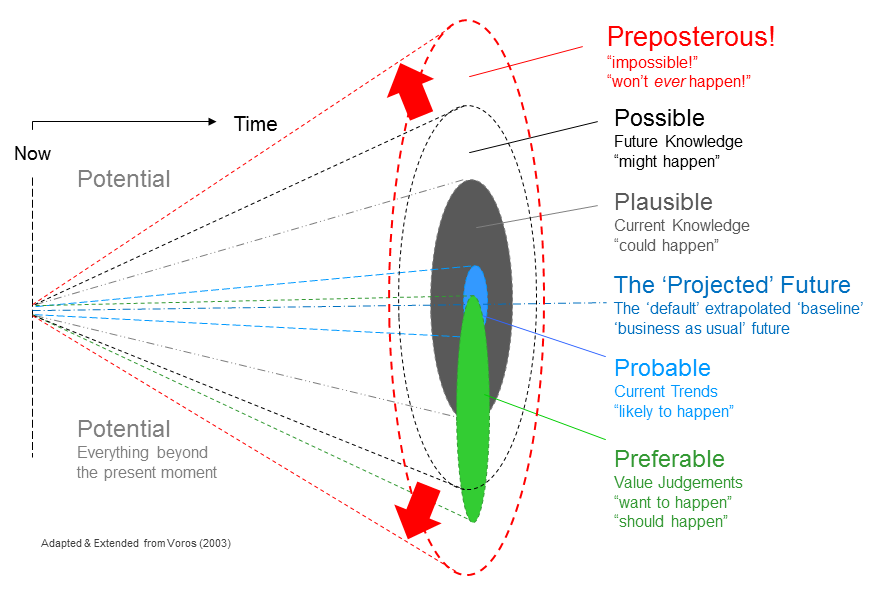
How the Cone Works
The narrowest point is now. As the cone extends outward through time, it widens to reveal different regions of possible futures, each defined by how much disruption or change would be required to bring them about:
Projected futures — the baseline; what happens if nothing changes
Probable futures — where current trends are pointing
Plausible futures — what could happen given known forces and trajectories
Possible futures — speculative, requiring future knowledge we don't yet have
Preposterous futures — the outer edge; scenarios that challenge our deepest assumptions about what is physically or socially feasible
Threaded through all of these is the Preferable future — not a separate ring, but a cross-section that asks: given everything in this cone, what do we actually want? Where do our values point?
The Dator-Clarke Line
One of the most provocative ideas associated with the cone is what's referred to as the Dator-Clarke Line — drawn from futurist James Dator's claim that any genuinely useful idea about the future should, at first glance, appear ridiculous. Paired with Arthur C. Clarke's observation that the only way to find the limits of the possible is to push into the impossible, it suggests that the most valuable futures work happens precisely in the uncomfortable space at the edge of the cone.
The practical implication is significant: if every idea your team generates sounds reasonable, you probably haven't stretched far enough. The preposterous isn't a failure of imagination — it's a boundary worth exploring.
Why This Tool Matters Now
In a period defined by technological acceleration, geopolitical uncertainty, and rapid social change, the instinct to "project forward" can feel reassuring — but it's also where strategic blind spots form. The Futures Cone doesn't resolve that uncertainty. Instead, it gives individuals, teams, and organizations a shared language for navigating it: a structured way to ask not just "what will happen?" but "what could happen, what might we prefer, and what are we willing to do about it?"
This is the subject of Episode 74 of Modem Futura, in which we walk through the cone layer by layer — and then demonstrate it live with a thought experiment that starts with frogs and ends somewhere near the moons of Jupiter.
Subscribe and Connect!
Subscribe to Modem Futura wherever you get your podcasts and connect with us on LinkedIn. Drop a comment, pose a question, or challenge an idea—because the future isn’t something we watch happen, it’s something we build together. The medium may still be the massage, but we all have a hand in shaping how it touches tomorrow.
🎧 Apple Podcast: https://apple.co/4bz1tIC
🎧 Spotify: https://open.spotify.com/episode/20Hz36eLfZ90M6EifUrRuu?si=swNkzHWZSLCelVSKsAyj7A
📺 YouTube: https://youtu.be/wc_e3dsY-vw
🌐 Website: https://www.modemfutura.com/

Futures Thinking: Foresight You Can Use – Episode 49
We don’t predict the future, but we prepared for the uncertainties the futures will bring
Ever been stuck in traffic and thought, “Where’s my eVTOL button?” We open this episode right there—and quickly flip the fantasy into a lesson on systems: technologies don’t fix congestion (or most complex problems) unless policy, behavior, equity, and infrastructure evolve with them. From that launchpad, Sean Leahy and Dr. Andrew Maynard unpack futures thinking as a mindset—distinct from prediction—that helps people and organizations navigate uncertainty with agency. They walk through the classic triad of possible, probable, and preferable futures, then translate it into practice: horizon scanning (signals, trends, megatrends), scenario building, and backcasting from a desired 10‑year outcome to concrete actions today. Along the way, they surface guardrails like avoiding “used futures” (inherited visions of someone else’s desired future) and stress‑testing for unintended consequences, especially for vulnerable communities and the planet.
The conversation ranges widely—think SimCity lessons and Mars‑city thought experiments as mirrors for Earth’s complexity; protopian (step‑by‑step better) versus utopian/dystopian frames; and why foresight shouldn’t be a bolt‑on consultancy only, but a capacity embedded across teams. Educators will appreciate a practical take on bringing futures thinking into K–12 and higher ed without “one more thing”: weave foresight into existing subjects to build creativity, inquiry, and resilience. Pop culture helps, too—using films (à la The Moviegoer’s Guide to the Future) creates a low‑stakes, high‑insight space to explore tough issues together. And for those tracking AI’s breakneck pace, the episode doubles as an antidote to future shock—a way to slow down, widen perspective, and choose well‑considered next steps.
Why it matters: Futures Thinking is for everyone - all humans poses the qualities needed to engage in thinking about our collective futures. Whether you lead a product team, a classroom, or a community, cultivating a futures mindset helps you spot weak signals earlier, align around preferable outcomes, and take action that nudges the world toward human flourishing.
Join the conversation:
What “used future” have you noticed in your field? If you were backcasting from a 2035 future you’d be proud of, what’s the first move you’d make this quarter? Drop your thoughts—and feel free to borrow this episode in your class, team meeting, or strategy offsite.
🎧 Listen to the full episode to dive deeper into how films shape our futures: https://apple.co/4nrAIci
📺 Watch us on YouTube: https://www.youtube.com/@ModemFutura
🎬 What film has changed the way you think about the future? Drop a comment — we’d love to hear.
If you’d like to dive deeper, jump into the link and listen to the podcast or watch the YouTube video. Join us as we explore the forces shaping our collective future and the urgent need to keep human values at the heart of innovation.
Subscribe and Connect!
Subscribe to Modem Futura on a favorite podcast platform, follow on LinkedIn, and join the conversation by sharing thoughts and questions. The medium may still be the massage, but everyone has a chance to shape how it kneads modern culture—and to decide what kind of global village we ultimately build.
🎧 Apple Podcast: https://apple.co/4nrAIci
🎧 Spotify: https://open.spotify.com/episode/1OmUyc6fYdMIZ8thORheOJ?si=ZTQ-ZI7hQzSjNTy3jhjgfQ
📺 YouTube: https://youtu.be/85cTuht_a8k
🌐 Website: https://www.modemfutura.com/