

NEWS & UPDATES

The Future From a Kid's Perspective: What a 10-Year-Old Thinks About AI, Jobs, and Meaningful Work
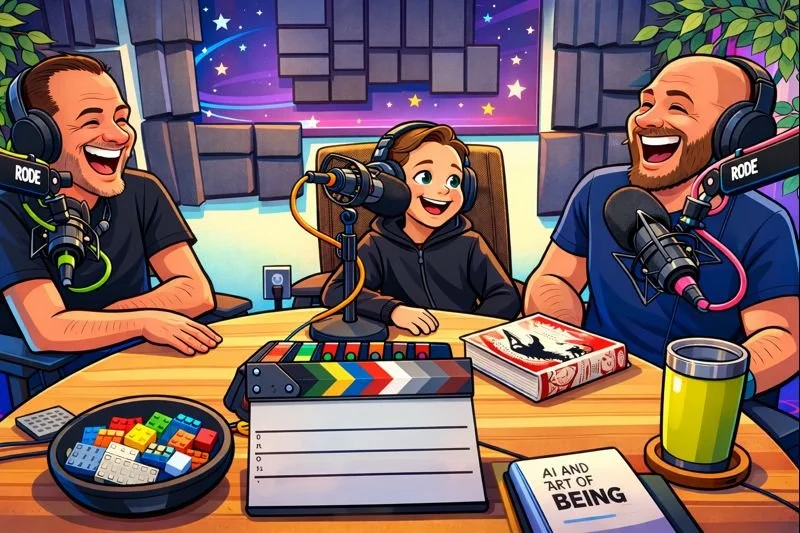
We spend a lot of time talking about young people when we discuss the future of technology. We debate how AI will affect their education, reshape their careers, and transform the world they'll inherit. But we rarely stop to ask them what they think.
In this special episode of Modem Futura, we did exactly that. Freddie Leahy—co-host Sean's almost-10-year-old son—joined us for an unscripted conversation about artificial intelligence, meaningful work, and the questions that don't have easy answers.
Already Thinking About Job Displacement
When asked what he thinks about when he imagines the future, Freddie's first response wasn't about flying cars or space travel. It was about jobs.
"I kind of more think about the AI part of the future," he said. "And I'm just wondering what jobs will be overran by AI."
He's almost ten. And he's already calculating whether his dream career—paleontology—will exist by the time he's ready to pursue it.
This isn't abstract concern. Freddie has a specific vision: he wants to be like Alan Grant from Jurassic Park, out in the field, hands in the dirt, discovering fossils himself. When we suggested that AI might help him find more dinosaur bones faster, he didn't immediately embrace the idea. His worry isn't about efficiency—it's about being separated from the work itself.
"I would be doing it not for the money," he explained, "just because of the experience."
The Limits of AI Creativity
Freddie has firsthand experience with generative AI. He and I have spent time creating AI-generated images—D&D characters, fantasy creatures, book covers. But he's noticed something that many adults are also discovering: the gap between imagination and output.
"Every time you create an AI image," he said, "you never feel like it's quite right. So you just keep making these, and then you have to choose one, but in the end it never feels like the perfect cover you wanted."
When asked why, his answer was simple: "AI isn't our heads."
This observation—from a fourth-grader—gets at something fundamental about the current state of generative tools. They can produce impressive outputs, but they can't access the specific vision in your mind. The friction between prompt and result isn't just a technical limitation; it's a gap between human intention and machine interpretation.
When it comes to his own writing—Freddie is working on stories—he's clear that he doesn't want AI assistance. The temptation exists, especially when facing a blank page. But he recognizes something important: "It's the point about using your own creativity."
Suspicious of AI Companions
One of the most revealing exchanges came when we explored the idea of AI friendship. What if Freddie could have an AI companion who shared all his interests—someone who wanted to talk about dinosaurs as much as he does?
His response was immediate skepticism.
"That would be weird," he said, "because nobody likes what I like."
The very thing that might make an AI friend appealing—perfect alignment with his interests—is exactly what made it feel inauthentic. Part of what makes his interests meaningful is that they're his, distinct from the people around him. An AI that mirrored them perfectly would feel hollow.
When pressed further about whether he'd want an AI as a secret companion—a sort of digital spirit animal—Freddie remained uncertain. "Who knows what it could do," he noted. "It could hack everything."
There's healthy skepticism there, but also something deeper: a sense that friendship involves more than shared interests. It involves trust, vulnerability, and the unpredictability of another mind.
"I Refuse": Mind Uploading at Nine
During our Futures Improv segment, we posed a classic transhumanist scenario: What if you could upload your consciousness to a computer and live forever digitally, while your biological body remained behind?
Freddie's answer required no deliberation:
"I refuse. I will not upload my brain into a digital computer."
His reasoning was practical but profound. At nine years old, why would he abandon a body that works? The theoretical benefits of digital immortality don't outweigh the immediate reality of physical experience.
This perspective offers a useful counterweight to futures discourse that sometimes treats technological transcendence as obviously desirable. From Freddie's vantage point, the question isn't whether we can escape biological limitations, but whether we'd want to—and what we might lose in the process.
Questions Without Right Answers
Perhaps the most important takeaway from this conversation came near the end, when Freddie observed something about the nature of our questions.
"Because of all these questions," he said, "there is no wrong or right answer."
That's exactly right. The value of futures thinking isn't in predicting what will happen or determining the "correct" response to emerging technologies. It's in learning to sit with uncertainty, explore tensions, and develop our capacity for navigating complexity.
At almost ten years old, Freddie already understands this. He's not looking for definitive answers about AI and jobs and creativity. He's learning to ask better questions—and to recognize that asking them is more important than resolving them.
What the Future Thinks About Itself
We often frame conversations about technology and youth as adults preparing children for a world we're creating. But this episode suggests something different: young people are already thinking about these issues, often with more nuance than we might expect.
Freddie isn't anti-technology. He plays VR games, makes AI art, and follows developments in the field. But he's also holding onto something—a sense that some experiences are valuable precisely because we do them ourselves, that the struggle of creation is part of its meaning, and that efficiency isn't the only measure of a good life.
These aren't lessons we taught him. They're insights he's developing on his own, as he navigates a world where these technologies are simply part of the landscape.
Maybe the best thing we can do isn't to tell young people what the future will look like. Maybe it's to listen to what they already think about it—and learn from their perspective.
I don't know what the future holds for his generation. But if this conversation is any indication, they're thinking about it more carefully than we might expect.
Subscribe and Connect!
Subscribe to Modem Futura wherever you get your podcasts and connect with us on LinkedIn. Drop a comment, pose a question, or challenge an idea—because the future isn’t something we watch happen, it’s something we build together. The medium may still be the massage, but we all have a hand in shaping how it touches tomorrow.
🎧 Apple Podcast: https://apple.co/4khmVES
🎧 Spotify: https://open.spotify.com/episode/5nKjpEVZcaUDisdZpGGaMZ?si=YgWp_O84T1yVlBSloedV1w
📺 YouTube: https://youtu.be/mfumkJZav-M
🌐 Website: https://www.modemfutura.com/

The Hidden Costs of “That Was Easy”: AI Slop, Creative Friction, and the Future of Human Craft
In this Modem Futura episode, hosts Sean Leahy and Andrew Maynard examine the rise of “AI slop” and the growing cultural pressure to accept frictionless creation as the norm. Drawing on examples from coding, design, futures thinking, and psychology, they unpack how satisficing, homogenization, and inherited power threaten to erode human craft and understanding. The article explores why creative friction is essential for mastery, agency, and meaning — and offers futures-oriented insights into how we can use AI intentionally without losing what makes us human.

ChatGPT Illustrated version of Modem Futura YouTube Thumbnail
Generative AI has ushered in an era where producing text, images, video, and code is no longer a challenge — it’s a button press. And in this week’s episode of Modem Futura, Andrew and I wrestle with a growing cultural tension: if everything is easy, what happens to the things that matter?
It began with a shared frustration. Both of us have noticed an explosion of what we call AI slop (content that is technically competent but devoid of care, intention, and personality). You’ve seen it too: the LinkedIn posts with identical emojis, the slide decks that all look like NotebookLM, the essays with no point of view. These things aren’t wrong, they’re just empty. And the emptiness is the point.
We discuss a concept called satisficing: the act of choosing something “good enough” rather than something excellent. In the age of AI, satisficing has become an increasing default mode of creation. Why craft an idea when you can generate one? Why wrestle with a blank page when you can autocomplete your way to the finish line?
But here’s the problem: friction is where learning happens. It’s where creativity lives. It’s the sanding that polishes the stone. When you remove friction, you remove the struggle — and without struggle, there is no mastery, no depth, and no meaning.
Throughout the episode, we explore how this plays out across domains. Coders relying on AI-generated code they can’t understand. Designers accepting images that are “close enough.” Writers sharing posts they didn’t write. And organizations flirting with a future where expertise is replaced by button-pressing.
We draw on Michael Crichton’s concept of inherited power from Jurassic Park: the idea that wielding abilities you never earned leads to carelessness, overconfidence, and danger. AI gives us power we didn’t work for — and without wisdom, that power is hollow.
But this isn’t a pessimistic episode. We explore how AI can amplify creativity when used intentionally, how friction can be designed back into workflows, and why people may ultimately push back against frictionless living. Humans crave meaning, not efficiency. And meaning takes work.
If you’re navigating how to use AI thoughtfully — in your craft, your teaching, your leadership, or your creative life — this episode offers a grounded, futures-focused lens on what we stand to lose and what we still have time to protect.
🎧 Listen to the full episode of Modem Futura — and join the conversation on what we should preserve in an age that wants to eliminate every struggle.
Subscribe and Connect!
Subscribe to Modem Futura wherever you get your podcasts and connect with us on LinkedIn. Drop a comment, pose a question, or challenge an idea—because the future isn’t something we watch happen, it’s something we build together. The medium may still be the massage, but we all have a hand in shaping how it touches tomorrow.
🎧 Apple Podcast: https://apple.co/48WCGgh
🎧 Spotify: https://open.spotify.com/episode/1BajA2SvDWVyY0mRSQ9Flk?si=wvCFhWlgQtC2kye3bGz5Kg
📺 YouTube: https://youtu.be/1V9PD7j8iu8
🌐 Website: https://www.modemfutura.com/

Apple TV’s New Logo and Mnemonic: Proof Craft and Care Matter in Modern Design

In a digital landscape overflowing with AI slop, synthetic users, and nonstop algorithmic noise, moments of genuine craft feel increasingly rare. Every now and then, though, something cuts through—something small, precise, and clearly built with care. For me, that respite lately has been Apple’s new Apple TV mnemonic: a simple animated logo with sound, but one that feels unmistakably crafted by human hands.
As many have noted, Apple quietly updated its Apple TV streaming brand by dropping the “+,” refreshing the color treatment, and unveiling a new animated mnemonic designed to anchor the brand before all video content. The audio component was created in collaboration with musician and producer Finneas (best known for his work with Billie Eilish), who spoke with Variety about shaping a sound that would instantly signal “Apple” in a fraction of a second.
So why does this tiny logo animation matter?
Because beneath its sleek surface lies a level of intentionality and craftsmanship that is increasingly uncommon. Apple has long embraced this ethic—one handed down directly from Steve Jobs, who often invoked his father’s lessons about finishing the back of the fence. The idea was simple: even if no one else sees it, you see it, and your work should reflect a complete commitment to quality. Jobs echoed this in a 1994 Wired interview:
““When you’re a carpenter making a beautiful chest of drawers, you’re not going to use a piece of plywood on the back… You’ll know it’s there. For you to sleep well at night, the aesthetic, the quality, has to be carried all the way through.””

Source: AdAge
The new Apple TV mnemonic embodies that ethos. Viewers see a sharp animation and a clean sonic signature—nothing unusual on the surface. What they don’t see is the painstaking creative work behind it. In a behind-the-scenes reel (via AdAge), Apple reveals that the animation wasn’t CGI or AI-generated. Instead, they filmed it as a practical effect: a physical glass logo turning under carefully orchestrated light, later composited to create the final result. Light refracting through real material—something still extraordinarily difficult to simulate convincingly—gives the piece a richness that no purely synthetic workflow could replicate. (Source: BTS video provided by AdAge)
And that’s the point.
In a moment when digital production pipelines are optimizing for speed, scale, and automation, Apple chose deliberateness. They chose craft. They chose to paint the back of the fence.
Every time the mnemonic appears before a show or film, it’s a brief reminder that care is a design value. That craft still matters. That human creativity leaves traces—subtle, often invisible—that shape how something feels, even if the average viewer never notices the details consciously.
It’s a tiny gesture, but an important one: proof that intention can still shine through the noise.
Well done, Apple!
I can’t wait to see what’s next.

Sora, Slop, and the AI Economy: When ChatGPT Meets Walmart – Episode 54

Image illustrated adaptation by ChatGPT
If you’ve ever wondered what happens when the world’s largest retailer merges with the world’s most talked-about AI, you’re not alone. In our newest episode of Modem Futura, Andrew Maynard and I explore how OpenAI’s latest moves—from Sora 2’s eerily lifelike videos to Walmart’s direct-to-ChatGPT shopping partnership—signal a seismic shift in how we live, learn, and buy in a post-search world.
Andrew also just returned from Lisbon for the global launch of his new book AI and the Art of Being Human, a deeply personal and practical guide to thriving with AI while staying grounded in what makes us human. Together we discuss the book’s central question: how can we build a meaningful life amid tools that increasingly think, speak, and create like us?
We also dive into futurist Amy Webb’s sharp warning that the financial plumbing of the internet is changing fast. As she notes, when an AI company built on venture debt begins replacing Google’s ad-based model, we risk building the next era of commerce on borrowed money—and borrowed trust.
From there, the episode ranges widely: we unpack the ethics of open-source AI groups like Nous Research, debate what “guardrails” really mean, and share our growing fatigue with synthetic content—the endless churn of what the internet now calls “AI-slop.”
But it’s not all doomscrolling. We end with a new round of Futures Improv—our playful segment imagining speculative scenarios like subscription-based immortality and AI DJs reading your neural signals. It’s improv, futures-style: serious ideas approached with humor and imagination.
Whether you’re an AI enthusiast, a creative technologist, or simply trying to stay human in a rapidly transforming world, this episode captures the heart of Modem Futura: thoughtful conversations that remind us the future isn’t just something that happens to us—it’s something we co-create, signal by signal.
Subscribe and Connect!
Subscribe to Modem Futura on a favorite podcast platform, follow on LinkedIn, and join the conversation by sharing thoughts and questions. The medium may still be the massage, but everyone has a chance to shape how it kneads modern culture—and to decide what kind of global village we ultimately build.
🎧 Apple Podcast: https://apple.co/48C8PtS
🎧 Spotify: https://open.spotify.com/episode/38IopMk5XBA9xVsKU71UlM?si=wdAtLLaaQxGvNEjPVfqWTQ
📺 YouTube: https://youtu.be/aK-ev5T8Tu8
🌐 Website: https://www.modemfutura.com/