

NEWS & UPDATES

What an AI Hallucination Tells Us About First Contact
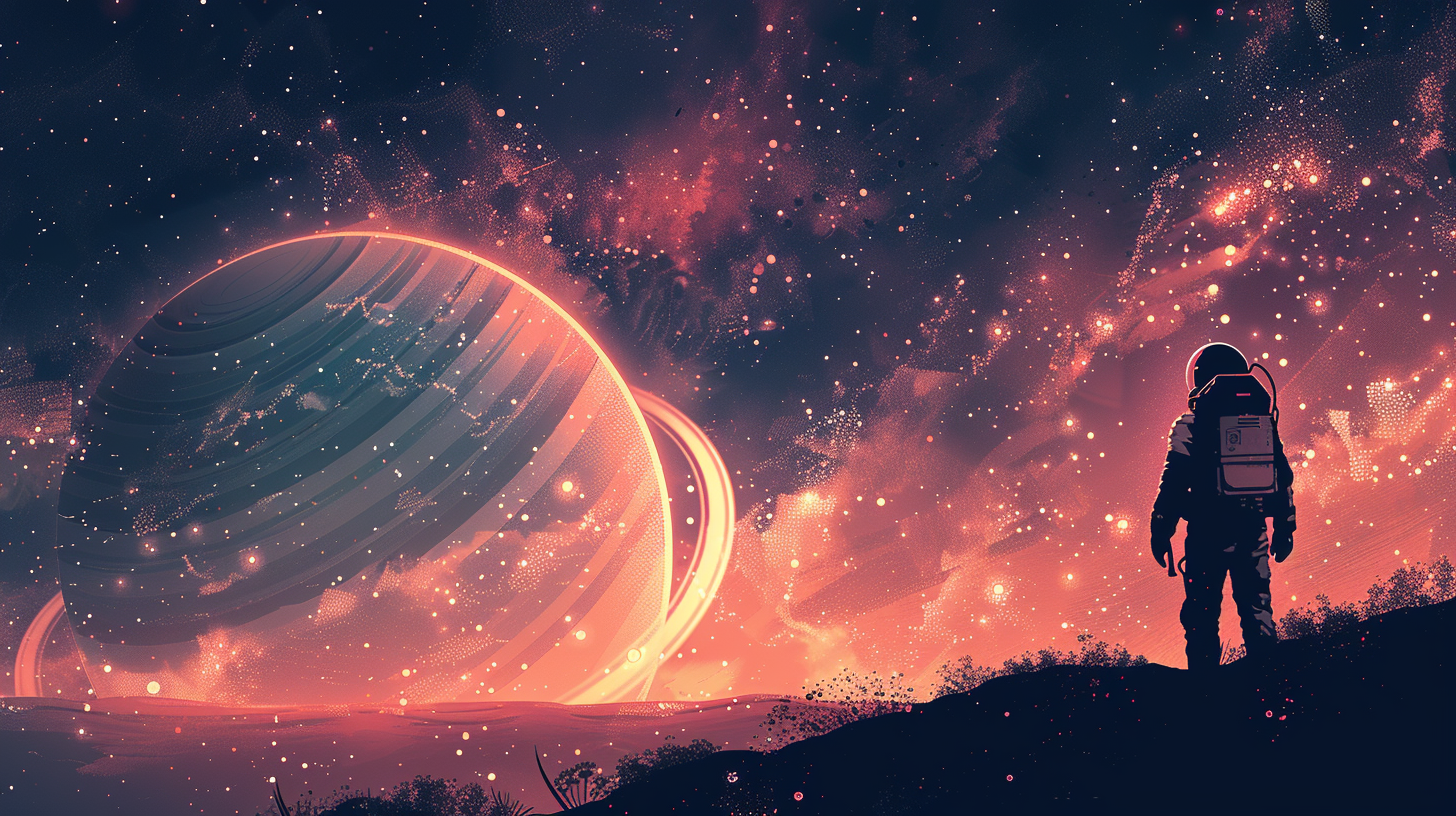
There's a thought experiment that keeps surfacing in futures work, and it goes something like this: if a genuinely alien mind tried to communicate with us, would we recognize the signal, or would we just call it noise?
On the latest episode of Modem Futura, we play another round of Futures Improv — a format where an AI-generated scenario lands cold on the table and the two of us have to think our way through what it might mean. This time the scenarios kept pulling us back to one question: what counts as a mind, and what do we do with the ones we don't recognize?
The first scenario — a riff on Stanislaw Lem's Solaris — imagines first contact with a moon-sized organism that communicates only by generating vivid hallucinations inside our astronauts, drawn from their own repressed memories. It isn't hostile or friendly. It may not even know we exist as separate beings. The premise sounds outlandish until you notice that we already struggle to have a real conversation with an octopus.
The second scenario hands humanity a single question to ask a time traveler from the year 8,002,701, who carries one piece of verified information — humanity survived — and a sad expression. What do you ask, and what do you deliberately choose not to ask? It's a thought experiment about scarcity, priorities, and the difference between surviving and flourishing.
The third — the one that sticks with you — imagines a service that backs up your consciousness to the cloud every night while you sleep. Ten years in, the backups begin to diverge. They dream differently than you do. Who, then, has the right to your name, your relationships, your sense of self? And the question that arrives quietly behind it: how would you know you weren't the backup already?
None of these scenarios resolve, and that's the point. Futures Improv isn't about predicting which of these worlds will arrive. It's about practicing the kind of imaginative attention we'll need for the technologies that already are — embodied AI, longevity research, neural interfaces, the slow erosion of the line between physical and digital selves.
The conversations get weird. Occasionally they get genuinely strange. And sometimes, in the middle of joking about Elon Musk being reconstituted as a banana, we land on something serious about what it means to be human in an age that keeps redrawing the edges of mind.
🎧 Listen to the full episode wherever you get your podcasts, or watch on YouTube.
Subscribe and Connect!
Subscribe to Modem Futura wherever you get your podcasts and connect with us on LinkedIn. Drop a comment, pose a question, or challenge an idea—because the future isn’t something we watch happen, it’s something we build together. The medium may still be the massage, but we all have a hand in shaping how it touches tomorrow.
🎧 Apple Podcast: https://apple.co/4vodLdY
🎧 Spotify: https://open.spotify.com/episode/1242zwOf2ZsHgpN1UnF5OM?si=dLiVkWUjTv2f-XdAHS8x3A
📺 YouTube: https://youtu.be/4vCILufh2RU
🌐 Website: https://www.modemfutura.com/

Power, Probes, and the Post-Human Horizon: What the Kardashev Scale Reveals About Us
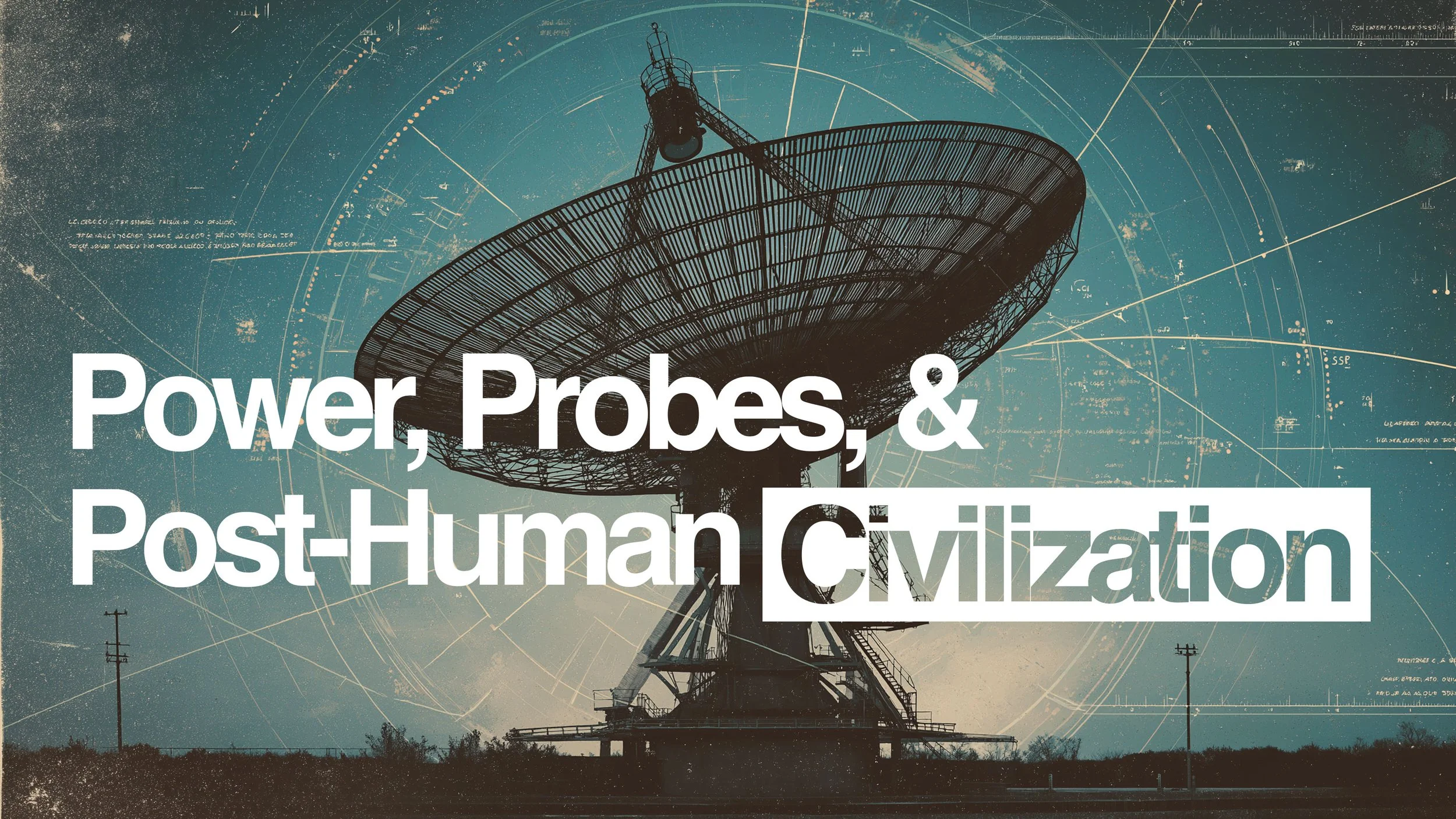
On the surface, this episode of Modem Futura is an excuse to have fun. It's a spring break Futures Improv — Sean and Andrew throwing speculative scenarios at each other and seeing where things land. And it is fun. But somewhere between Dyson Spheres and the Fermi Paradox, it becomes something else: a quiet meditation on what humanity actually wants when we talk about mastering energy, exploration, and the cosmos.
The conversation begins with the Kardashev Scale, proposed by Soviet astronomer Nikolai Kardashev in 1964 as a way to rank civilizations by their energy use. A Type 1 civilization controls its planet's full energy output. Type 2 controls its star. Type 3 commands a galaxy. Humans, for context, are not yet a Type 1 civilization. We harness a fraction of what's available to us on Earth alone.
The question the hosts bring to this framework isn't just can we get there — it's what would we do once we did? Would abundance resolve our deepest conflicts, or would we simply carry our scarcity mindset into a new era? Andrew draws on Maslow's hierarchy of needs to make the point: remove the bottom layers of the pyramid — hunger, shelter, survival — and what remains is a different kind of human problem. The need for meaning, status, belonging, and always — always — a little more.
From there, the conversation ranges widely across some of the most provocative concepts in speculative science:
Dyson Spheres — hypothetical megastructures built around a star to harvest its complete energy output. Theoretical, yes, but not quite as theoretical as they once seemed. In 2024, seven anomalous objects within 1,000 light-years of Earth caught researchers' attention for occlusion patterns that didn't fit known planetary behavior.
Matrioshka Brains — named after Russian nesting dolls, these are hypothetical star-powered supercomputers of almost incomprehensible scale. The hosts draw an obvious connection: if AI data centers already strain Earth's energy grid, what does that compute-energy loop look like at stellar scales?
Von Neumann Probes — self-replicating spacecraft capable of exploring the galaxy by mining local resources to reproduce themselves. Biology can't survive interstellar space. Self-replicating machines, perhaps, can.
The Fermi Paradox — the haunting question of why, in a universe this old and this large, we can't find anyone else. The hosts explore the possibility that civilizations rise and fall within cosmic time windows too narrow to ever overlap. That the universe may be full of life that simply never gets to meet itself.
What makes this episode work is not the concepts themselves — though they're genuinely fascinating — but the humility behind the exploration. No predictions. No resolution. Just two people genuinely wondering, out loud, whether the same drive that would take us to the stars might also be the thing that holds us back.
🎧 Listen to the full episode wherever you get your podcasts, or watch on YouTube.
Subscribe and Connect!
Subscribe to Modem Futura wherever you get your podcasts and connect with us on LinkedIn. Drop a comment, pose a question, or challenge an idea—because the future isn’t something we watch happen, it’s something we build together. The medium may still be the massage, but we all have a hand in shaping how it touches tomorrow.
🎧 Apple Podcast: https://apple.co/4bOu2kk
🎧 Spotify: https://open.spotify.com/episode/2sbRQEuoabpKCUTrOQPCGT?si=159db4727a8841cb
📺 YouTube: https://youtu.be/z53hk7AlXZ4
🌐 Website: https://www.modemfutura.com/

Sora, Slop, and the AI Economy: When ChatGPT Meets Walmart – Episode 54

Image illustrated adaptation by ChatGPT
If you’ve ever wondered what happens when the world’s largest retailer merges with the world’s most talked-about AI, you’re not alone. In our newest episode of Modem Futura, Andrew Maynard and I explore how OpenAI’s latest moves—from Sora 2’s eerily lifelike videos to Walmart’s direct-to-ChatGPT shopping partnership—signal a seismic shift in how we live, learn, and buy in a post-search world.
Andrew also just returned from Lisbon for the global launch of his new book AI and the Art of Being Human, a deeply personal and practical guide to thriving with AI while staying grounded in what makes us human. Together we discuss the book’s central question: how can we build a meaningful life amid tools that increasingly think, speak, and create like us?
We also dive into futurist Amy Webb’s sharp warning that the financial plumbing of the internet is changing fast. As she notes, when an AI company built on venture debt begins replacing Google’s ad-based model, we risk building the next era of commerce on borrowed money—and borrowed trust.
From there, the episode ranges widely: we unpack the ethics of open-source AI groups like Nous Research, debate what “guardrails” really mean, and share our growing fatigue with synthetic content—the endless churn of what the internet now calls “AI-slop.”
But it’s not all doomscrolling. We end with a new round of Futures Improv—our playful segment imagining speculative scenarios like subscription-based immortality and AI DJs reading your neural signals. It’s improv, futures-style: serious ideas approached with humor and imagination.
Whether you’re an AI enthusiast, a creative technologist, or simply trying to stay human in a rapidly transforming world, this episode captures the heart of Modem Futura: thoughtful conversations that remind us the future isn’t just something that happens to us—it’s something we co-create, signal by signal.
Subscribe and Connect!
Subscribe to Modem Futura on a favorite podcast platform, follow on LinkedIn, and join the conversation by sharing thoughts and questions. The medium may still be the massage, but everyone has a chance to shape how it kneads modern culture—and to decide what kind of global village we ultimately build.
🎧 Apple Podcast: https://apple.co/48C8PtS
🎧 Spotify: https://open.spotify.com/episode/38IopMk5XBA9xVsKU71UlM?si=wdAtLLaaQxGvNEjPVfqWTQ
📺 YouTube: https://youtu.be/aK-ev5T8Tu8
🌐 Website: https://www.modemfutura.com/